
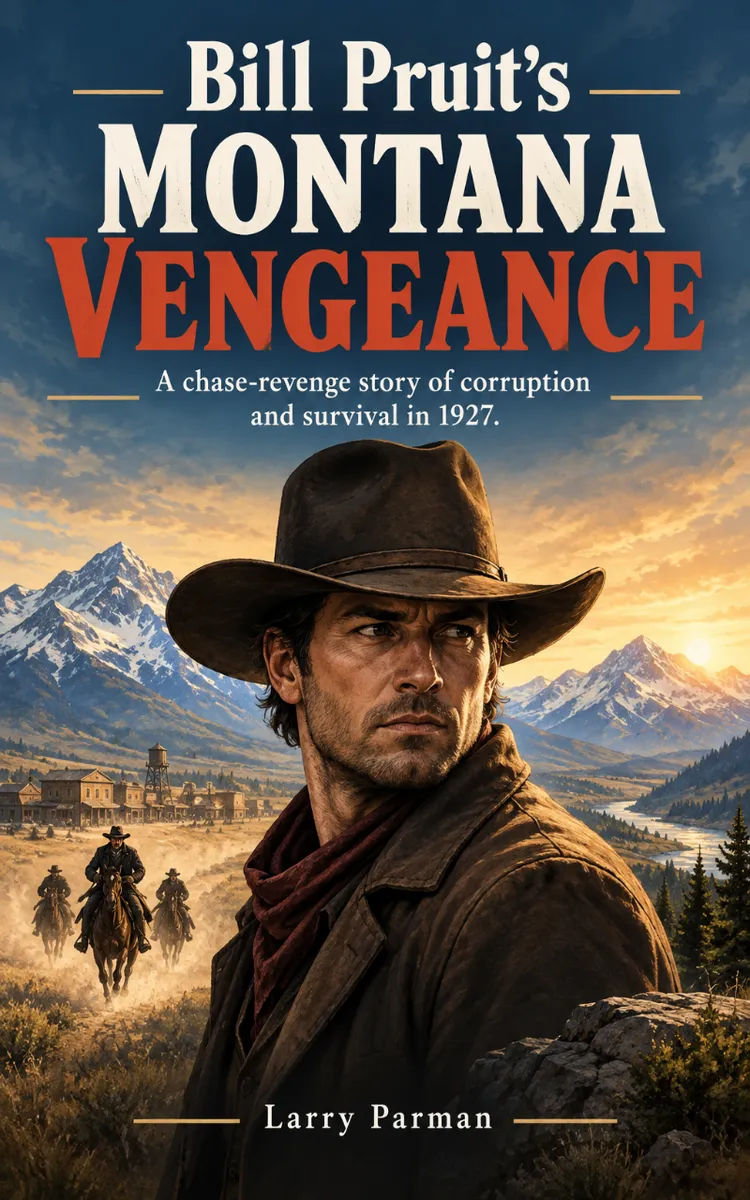
Read the first chapter
The whole of chapter one, free. About 8 min. Turn the pages with the arrows, your keyboard, or a swipe.
Chapter 1
A Rented Cabin on the Edge
The cabin’s door stuck halfway, swollen by spring snowmelt, and Bill Pruit had to shoulder it open.
Inside, the room was smaller than the listing had promised. A stove stood crooked on a stone hearth. One window looked toward the timberline, its glass filmed with dust. The floor sagged beside the bed, and a mouse had worked a narrow tunnel through the flour sack left in the corner.
Bill set down his valise.
The road behind him had taken three days from the rail line. His coat was gray with dust, his boots white at the seams. He had come into southwest Montana with forty dollars, a surveyor’s compass, and a name he did not intend to use often.
Outside, a horse stamped in the yard.
“Mr. Pruit?”
Bill turned.
A broad man stood beyond the doorway, hat pushed back from a red forehead. He held a ring of keys and watched the room before he watched Bill.
“Amos said you’d come before noon,” the man said.
“Train was late.”
“There hasn’t been a train on this road since Tuesday.”
“Then the wagon was late.”
The man studied him. “You pay by the week or month?”
“Month.”
“Cash.”
Bill reached into his coat and counted the money onto the table. The man’s eyes followed each bill. When the last one lay flat, he took it without touching Bill’s hand.
“Cabin belongs to Marchant land,” he said. “You damage it, you pay. You leave, you give notice.”
“Whose land isn’t it?”
The man’s mouth tightened. “You’ll learn.”
He gave Bill the key.
From the road came the thin rattle of a truck climbing toward town. Bill looked past the man at the hills. Pine stood dark along the upper slopes, broken by old cuts and pale scars where the earth had been opened.
“I’m here to survey timber,” he said.
“That what you’re calling it?”
Bill looked back at him.
The man shrugged. “Town asks questions of strangers.”
“Then town can ask.”
The man smiled without warmth. “It will.”
He left Bill with the door hanging open.
Bill waited until the horse and wagon had faded down the road. Then he closed the door, tested the latch, and walked the cabin once. The bed had no mattress beneath its ticking. The stove pipe leaked at the joint. A loose board near the wall lifted under his boot.
He pried it up with his knife.
A space beneath held a rusted coffee tin, two dead spiders, and a folded receipt bearing a name he did not know. Marchant was printed at the top in black letters.
Bill replaced the board.
He had slept in trenches with water running through the duckboards. He had slept in a Russian station while men argued in the dark over rifles and bread. In Central America, he had slept with one eye open beneath palms that rattled like dry bones whenever the wind came off the hills. The cabin was better than those places.
That did not make it safe.
He carried his valise to the bed and opened it. A clean shirt. Razor. Socks. A Bible with its cover removed. Beneath those, wrapped in oilcloth, lay a Colt revolver and three envelopes tied with cord.
He touched the top envelope but did not open it.
A knock sounded.
Bill’s hand remained near the gun.
The door opened before he answered. A woman in a dark dress stood there, holding a tin pail. She was perhaps fifty, with gray hair pinned tight and a face marked by weather.
“Mrs. Vale said the stove leaks,” she said.
“Who is Mrs. Vale?”
“The woman who rented you the cabin.”
“She sent you?”
“No.”
The woman looked past him at the bed, the valise, the empty shelves. “You’ll need coal. The woodpile is Marchant’s. Don’t cut from it.”
“I can buy wood.”
“Everything here is bought from somebody.”
She set the pail beside the stove.
“Where can I find the timber office?”
“Town.”
“That tells me little.”
“It tells you enough to reach it.”
Bill watched her hands. No rings. A small burn scar across the left thumb.
“Do you know a surveyor named James?” he asked.
Something moved in her expression, then vanished.
“James who?”
“James.”
“Town is full of names.”
“Not that one.”
She lifted the pail again. “If you’re working for Marchant, say so. If you aren’t, don’t say anything.”
Then she went.
Bill stood in the doorway and watched her cross the yard. She did not look back. At the road, she stopped beside the fence and spoke to a man sitting in a parked automobile. The man wore a black hat. He looked toward the cabin.
Bill stepped away from the window.
By late afternoon he had cleaned the stove, patched the pipe with wire, and walked the boundary of the property. The cabin sat beyond the last sheds of town, close enough to hear wagon wheels when the wind came east. A stand of lodgepole pine climbed the slope behind it. Beyond the trees, the ridges ran blue and hard toward the Continental Divide.
He took out the compass and field book.
The first page held a false survey, copied from a county map. Timber acreage. Creek lines. Elevation marks. Enough to give a reason for his presence and not enough to invite questions from a careful man.
He drew a rough boundary around the cabin.
A rider appeared on the road.
Bill closed the book.
The rider came slowly, giving the appearance of chance. He was young, narrow in the shoulders, and wore a deputy’s badge pinned beneath his coat. He reined in near the fence.
“Bill Pruit?”
“Yes.”
“Sheriff wants to see you.”
“For what?”
The deputy looked at the cabin. “New men are recorded.”
“By the sheriff?”
“By somebody.”
Bill came down the steps.
The deputy’s eyes went to his hands, then to his boots. Men who had served in armies learned to look at boots. They told more than faces did.
“You carry a weapon?” the deputy asked.
“Most men do.”
“That wasn’t my question.”
“No.”
The deputy smiled faintly. “You’ll come into town before dark.”
“I have work.”
“Surveying?”
“Measuring the trees.”
“Trees don’t move.”
“People do.”
The deputy’s smile left him. “Sheriff doesn’t like clever.”
“Then he’ll be disappointed.”
For a moment the road held them both. Then the deputy touched the reins.
“Tomorrow morning,” he said. “The jail is on Main.”
“I’ll remember.”
The deputy rode away.
Bill waited until he disappeared behind the rise. Then he entered the cabin and opened the Bible. The pages had been cut away cleanly. Inside the hollow cover was a strip of paper with three names written in his own hand.
Marchant.
James.
A third name he had crossed out so hard the paper had torn.
He closed the book.
At dusk, he walked into town.
The main street was a mixture of mud, boardwalk, and coal dust. A gasoline truck coughed beside the hotel. The saloon doors swung open and shut in the wind. Men glanced at Bill and returned to their cards or their talk. The town had the quiet of a place accustomed to deciding who belonged.
He found the timber office above a feed store. A painted sign leaned against the wall. Inside, a thin man sat behind a desk stacked with maps.
“Surveyor?” the man asked.
“Bill Pruit.”
“Certificate?”
Bill placed his papers on the desk.
The man read them without lifting his eyes. “You worked in Idaho.”
“Two seasons.”
“Before that?”
“Army.”
The man looked up. “Regular?”
“Overseas.”
“France?”
“And Russia.”
That ended the questions for a moment.
The man touched the papers. “There’s work along the north ridge. Marchant holdings. Lines need checking before the snow comes.”
“What sort of pay?”
“Enough for a cabin.”
“Who signs?”
The man nodded toward the window.
Across the street stood a brick building with black windows and a brass plate beside the door. The plate read MARCHANT LAND AND LIVESTOCK.
“Marchant?” Bill said.
“Marchant owns the timber.”
“Which Marchant?”
The man’s face closed. “There’s only one family that matters.”
Bill gathered his papers.
“I’ll take the work.”
“You haven’t heard the terms.”
“I heard the pay.”
The man pushed a ledger across the desk. Bill signed his name. The ink spread slightly into the rough paper.
“Start at dawn,” the man said. “Take the north trail. Mark what you find.”
“Who checks the lines?”
“Marchant’s man.”
“Name?”
The man hesitated.
“James,” he said at last.
Bill’s fingers rested on the ledger.
The name had come quietly, but it struck with the force of a rifle butt. For a moment he saw another place: a kitchen window broken inward, his mother’s shawl caught on a nail, his father facedown beside the stove. He saw James standing in the yard years later, saying nothing while the county men carried away the last of the furniture.
Then the office returned. Dust in the window. Ink on his thumb. The feed store bell ringing below.
“James what?” Bill asked.
The man shook his head. “You’ll meet him.”
Outside, the sheriff stood beneath the brick building’s awning.
He was a thick-necked man with pale eyes and a star polished bright at the center. He watched Bill descend the stairs.
“Pruit,” he said.
“Sheriff.”
“You’ve been in town less than a day.”
“Seems so.”
“And already working for Marchant.”
“Timber office hired me.”
“Same thing.”
Bill stopped at the edge of the boardwalk. Rain had begun, fine and cold.
The sheriff stepped closer. “Where were you before Montana?”
“Idaho.”
“Before Idaho?”
“Several places.”
“Army?”
“Yes.”
“What army?”
“United States.”
The sheriff’s eyes moved over him again, slower this time. “You were in France?”
“Yes.”
“Russia?”
“Yes.”
“Central America?”
Bill said nothing.
The sheriff nodded as if silence were an answer. “Men who travel that much usually have a reason.”
“Men who ask that many questions usually have one too.”
A wagon rolled past, spraying mud against the boardwalk. The sheriff did not blink.
“Come by tomorrow,” he said. “Bring your papers. I want to see the originals.”
“They’re filed with the timber office.”
“Then bring yourself.”
Bill looked toward the road leading out of town. Beyond it, the cabin waited beneath the dark trees. He had secured a roof and a job. The first part of his purpose had been made ordinary.
The sheriff remained beneath the awning.
“What are you looking for here, Pruit?”
Bill met his eyes.
“Timber.”
The sheriff glanced toward the Marchant building.
“No,” he said. “Not only timber.”
Bill walked away before the rain thickened. Behind him, the sheriff’s boots struck the boards, following for three steps before stopping.
At the edge of town, Bill turned once.
The sheriff was still watching. In the upper window of the Marchant building, another face had appeared. It vanished when Bill looked directly at it.
He continued toward the cabin with the compass in his pocket and the names turning over in his mind.
Marchant.
James.
The road was dark before he reached the trees.
End of chapter one. 32 more chapters and about 73,016 words in the full book.
Swipe or use the arrows to turn the page


What's inside: 33 chapters
- 1. A Rented Cabin on the Edge
- 2. The Survey Map That Didn’t Match
- 3. Old Trenches in a New Winter
- 4. When the River Swallowed Evidence
- 5. A Handshake With Sheriff Calder
- 6. The Timber Client With a Locked Door
- 7. The Court Clerk’s Misfiled Docket
- 8. Night Watch on the Survey Shed
- 9. A Letter Smelling of Gunpowder
- 10. The Marchant Man Who Knew His Name
- 11. A Hidden Photo Under Floorboards
- 12. Calder’s Deputy Takes the Notebook
- 13. A Russian Campaign Memory Returns
- 14. The Abandoned Mine With Fresh Tracks
- 15. The Old Acquaintance Names Marchants
- 16. Bill Pruit Loses His Cover
- 17. A Train Ticket to Nowhere
- 18. The Cabin Search That Found Nothing
- 19. Pursuit Through the Cottonwoods
- 20. The Sheriff’s Offer of Mercy
- 21. A Stranger’s Map With a Price
- 22. The Tailer’s Shot Misses Bill
- 23. Marchant Papers in the Sawmill Vault
- 24. The Bridge Burn That Didn’t Hold
- 25. Hiding the Papers Under Ash
- 26. The Cell Where Calder Smiles
- 27. A Rope Made From Survey Twine
- 28. The Ash Cache Is Gone
- 29. The Sawmill Raid at Dusk
- 30. Witnesses Finally Speak
- 31. Calder’s Roadblock Breaks
- 32. Marchant Power Starts to Fray
- 33. Vengeance Filed Away in Paper
About this book
"Bill Pruit’s Montana Vengeance" is a fiction book by Larry Parman with 33 chapters and approximately 73,016 words. Chase-revenge novel set in 1927 southwest Montana.
This book was created using Inkfluence AI, an AI-powered book generation platform that helps authors write, design, and publish complete books. It was made with the AI Novel Writer.
Frequently Asked Questions
What is "Bill Pruit’s Montana Vengeance" about?
Chase-revenge novel set in 1927 southwest Montana
How many chapters are in "Bill Pruit’s Montana Vengeance"?
The book contains 33 chapters and approximately 73,016 words. Topics covered include A Rented Cabin on the Edge, The Survey Map That Didn’t Match, Old Trenches in a New Winter, When the River Swallowed Evidence, and more.
Who wrote "Bill Pruit’s Montana Vengeance"?
This book was written by Larry Parman and created using Inkfluence AI, an AI book generation platform that helps authors write, design, and publish books.
How can I create a similar fiction book?
You can create your own fiction book using Inkfluence AI. Describe your idea, choose your style, and the AI writes the full book for you. It's free to start.
Write your own fiction book with AI
Describe your idea and Inkfluence writes the whole thing. Free to start.
Start writingCreated with Inkfluence AI


