
Read the first chapter
The whole of chapter one, free. About 8 min. Turn the pages with the arrows, your keyboard, or a swipe.
Chapter 1
The Flooded Footbridge
Rain tapped the tin lunch pail on Elsie’s knee as she hurried along the lane beside Mill Creek. The drops were small now, but they struck hard enough to make the pail sing.
“Keep up,” she called.
Her brother, Tom, splashed through the muddy ruts behind her. “You’re the one who said we had time.”
“I said we had a little time.”
The footbridge was still ahead, half-hidden by the leaning alder trees. Elsie could see its brown rails through the rain. Once they crossed, the path climbed past the old mill and curled toward the village. Their house was on the other side, with its blue door and the crooked flower box Mama had promised to fix.
Elsie tightened her fingers around the pail handle. She wanted to get home before the storm grew teeth. She wanted to be inside before the thunder came close, with Tom dry enough that Mama would not ask why his socks were muddy.
A low growl rolled across the hills.
Tom stopped. “Was that thunder?”
“No. The mill.”
“The mill doesn’t growl.”
“It does when the wind pushes the wheel.”
The sound came again, deeper this time. The ground seemed to give a tiny shiver beneath Elsie’s boots. She looked toward the creek.
Mill Creek had always been a narrow, bright ribbon beneath the footbridge. She knew the stones that showed through the water and the flat one where Tom liked to poke sticks. Today the creek had climbed over every stone. Brown water shoved past the banks, carrying twigs, leaves, and a wooden crate that spun once before vanishing under the bridge.
Elsie’s stomach tightened.
“We should hurry,” she said.
Tom came up beside her. He was seven and wore his red rubber boots, the ones Mama had bought after he stepped into a puddle so deep it swallowed both shoes. One boot had a yellow duck painted on the side. The duck was already splattered with mud.
“Are we going across?” he asked.
“Of course.”
The bridge was only a bridge. Elsie had crossed it in sunshine, fog, snow, and once while carrying a basket of eggs. Its boards creaked, but they always held. The creek could roar as loudly as it liked. It was still the same creek.
She stepped onto the first plank.
Water rushed beneath her, loud enough to cover the rain. The bridge trembled. Elsie stopped with one foot ahead and one behind.
“Elsie?” Tom said.
“I’m here.”
The rail felt cold and slick beneath her palm. She looked down. The water was not brown anymore. It was the color of tea stirred with dirt, and it rushed so fast that her eyes could not follow one piece of floating bark.
“Come on,” she said. “Stay close.”
Tom put his hand in hers.
They moved together. Elsie counted the boards because counting made the bridge feel smaller. One, two, three. A gap showed between the fourth and fifth planks, wide enough for a finger. Four, five, six.
A branch struck the side rail with a crack.
Tom jumped. His hand jerked away.
“Don’t let go!” Elsie shouted.
“I didn’t!”
The bridge tipped beneath them. Tom’s red boot slid off the next board. His heel caught for one second, then the boot flew loose.
“Tom!”
The red boot bounced once on a plank and dropped between the rails.
For a moment it stayed there, bright as a berry in the brown water.
Then the creek took it.
Tom stared over the rail. “My boot!”
Elsie grabbed the back of his coat. “Don’t lean!”
“It’s going away!”
“It’s gone!”
The boot spun below them, duck painted yellow, then struck a jutting stone and vanished beneath the bridge.
Tom’s face crumpled. “Mama’s going to be mad.”
“She won’t be mad about a boot.”
“She will. She said not to lose them.”
“You didn’t lose it. The creek stole it.”
The words sounded foolish as soon as Elsie said them, but Tom looked at her as if the creek might be punished for what it had done.
Another hard jolt ran through the bridge. A plank groaned under Elsie’s foot.
“We’re going back,” she said.
“But we’re halfway.”
“Back.”
They turned. Elsie kept one hand on the rail and the other on Tom’s shoulder. The rain had thickened, pricking her cheeks. Behind them, the lane was blurred gray. Ahead, the village seemed very far away.
At the third board, Tom’s bare-socked foot slipped between two planks.
He cried out.
Elsie dropped the pail. It struck the boards and rolled against the rail. She caught Tom under both arms and pulled. His knee banged the wood. For one terrible moment, the creek tugged at his leg through the gap.
“Hold still!” she said.
“I am holding still!”
“Not with your foot. With everything!”
Tom grabbed the rail. Elsie pulled again. His leg came free, and he fell against her. They stayed pressed together while the bridge bucked beneath them.
The sound of rushing water filled Elsie’s ears. She could feel Tom shaking through his wet coat.
“Are we going to fall?” he whispered.
“No.”
The answer came too quickly. Elsie looked at the boards beneath them. Water flashed through the cracks. One plank near the middle had lifted at one end, and another had split down the center.
She swallowed.
“We’re going to get off,” she said. “Slowly.”
They moved one step at a time. Elsie left the pail where it lay. It was only a pail. Tom was more important, and Mama would understand that. She hoped.
At last her boot touched the muddy bank.
“Jump,” she told Tom.
He hopped from the last board and landed against her. Both of them slid down the slope, but Elsie caught a willow root and held tight until they stopped.
For a moment, neither spoke.
Tom looked at his one remaining boot. His sock was gray with mud, and his knee had a red scrape across it.
“Does it hurt?” Elsie asked.
“A little.”
She wiped the mud from his cheek with her sleeve. “We’re safe.”
Behind them, something cracked.
Elsie turned.
The footbridge stood crooked over the creek. One rail leaned toward the water. The middle boards sagged like loose teeth. The pail was still on the bridge, trapped beside the rail.
“We left it,” Tom said.
“We can get it later.”
“But Mama’s pail.”
Elsie stared at the bright metal. Mama used it for flour, nails, apples, and sometimes to carry hot coals to the outdoor stove. If Elsie went home without it, Mama would ask questions. If she went back for it, the bridge might break.
“We don’t need it,” Elsie said.
Tom pointed toward the creek. “There.”
Something red flashed in the water below the bank.
Elsie leaned forward. The missing boot had caught in a tangle of willow branches. It bobbed near the edge, not far from where they stood.
“Tom,” she said.
His eyes widened. “My boot!”
The branch holding it bent under the current. The boot dipped and rose again.
“Don’t go,” Elsie said.
Tom took one step.
“I said don’t.”
“It’s right there!”
The bank between them and the water was slick with clay. Elsie could see the boot. She could see the yellow duck. She could also see the dark water twisting around the roots.
Tom’s lower lip trembled. “I need both boots.”
“You need both feet more.”
He looked at her, angry and frightened. “You always say things like Mama.”
“Then listen like you listen to Mama.”
The willow branch snapped.
The boot shot free.
Elsie moved before she had time to think. She dropped onto her stomach and reached into the rushing water. Cold seized her arm through her sleeve. Her fingers brushed the boot’s wet rubber.
“Elsie!” Tom shouted.
She caught the heel.
The creek pulled hard. Her chest slid over the bank, and mud smeared across her coat. She wrapped her other hand around a root, then hauled the boot toward herself. Water slapped her wrist. The boot twisted, trying to escape.
“Pull me!” she cried.
Tom grabbed the back of her coat. His hands were small, but he pulled with all his strength.
Elsie dug her elbow into the mud. She pulled again.
The boot came free.
Tom fell backward with it clutched to his chest. Elsie rolled away from the water, coughing. Her sleeve dripped onto the ground.
For a few seconds, the storm was only rain ticking on leaves and Tom breathing hard beside her.
“You got it,” he said.
Elsie sat up. “We got it.”
Tom hugged the boot. “It’s full of water.”
“Empty it.”
He turned it upside down. A stream poured over his knee.
Then the bridge gave a long, splintering groan.
Elsie looked up.
The center plank lifted. The rail shuddered. The pail slid across the boards, struck the broken edge, and dropped into the creek.
“Mama’s pail!” Tom cried.
It hit the water with a bright clang and disappeared.
Elsie rose to her knees. “No!”
The bridge shifted again. A crack raced from the middle toward the far bank. The central plank broke loose and fell, spinning once before the creek swallowed it.
Tom pressed the red boot against his chest.
“What do we do?” he asked.
Elsie stared at the gap. It was not huge, but it was growing. The bridge no longer reached safely from one side to the other. The path home lay beyond the creek, and the creek had become a wide, moving wall.
“We can use the mill road,” Tom said.
Elsie turned toward the hill. The old road ran behind the mill, but she could already see water pouring across it in silver sheets.
A tree cracked somewhere above them.
She grabbed Tom’s hand. “We’re going back to the village side.”
“But home is over there.”
“I know.”
They climbed the muddy bank. Tom slipped once, and Elsie pulled him upright. At the top, she looked back at the bridge. Rain streamed from the rails. The broken middle gaped above the water.
A man appeared through the gray curtain near the mill. It was Mr. Vale, the miller, waving both arms.
“Stay away from the bridge!” he shouted.
Elsie waved back. “We’re on this side!”
“Get to the high road! The lower path is flooding!”
Tom leaned close. “What does he mean?”
Elsie looked toward the village. The lane they had come along was already covered in shallow water. Beyond it, the roofs of the houses rose dark and small beneath the storm.
Mr. Vale cupped his hands around his mouth. “The crossing is gone! Tell everyone! No one gets home by the creek!”
Elsie felt the wet boot in Tom’s hand, the cold water running from her sleeve, and the empty space where Mama’s pail had been. She had wanted only to reach home before the storm closed the path.
Now the path was closed.
She squeezed Tom’s hand. “We have to warn them.”
Together they turned toward the village, with the creek roaring behind them and the red boot dripping at their feet.
End of chapter one. 39 more chapters and about 82,419 words in the full book.
Swipe or use the arrows to turn the page


What's inside: 40 chapters
- 1. The Flooded Footbridge
- 2. A Bell in the Blackout
- 3. The Map Beneath the Table
- 4. The Orchard in Deep Water
- 5. The Lie About Being Brave
- 6. The Lantern Goes Out
- 7. Who Opened the Sluice?
- 8. Across the Mill Roof
- 9. The Smallest Voice
- 10. The Mill Wheel Stops
- 11. The Name on the Key
- 12. The Schoolhouse Cellar
- 13. A Child’s Wrong Guess
- 14. The School Bell Rings
- 15. The Ledger’s Floating Page
- 16. The Rooftop Crossing
- 17. The Picture of Home
- 18. The Bridge Breaks Away
- 19. The Greenhouse Passage
- 20. The Sluice Was Never Sealed
- 21. The Brother Who Stayed
- 22. The Market Floats Away
- 23. The Chalk Arrow
- 24. The Quarry’s Narrow Ledge
- 25. The Fear of Being Wrong
- 26. The Siren Without Power
- 27. The Marks on the Stone
- 28. The Tunnel of Bats
- 29. The Wheel in the Weeds
- 30. The Empty Scarf
- 31. The Red Thread Downstream
- 32. The Ferry Rope Snaps
- 33. The Child Who Could Say No
- 34. The Answer in the Ferry Log
- 35. The Wheel Turns North
- 36. A Brother’s Wet Laugh
- 37. The Village Above Water
- 38. The Map for Tomorrow
- 39. The First Dry Morning
- 40. What the Creek Remembers
About this book
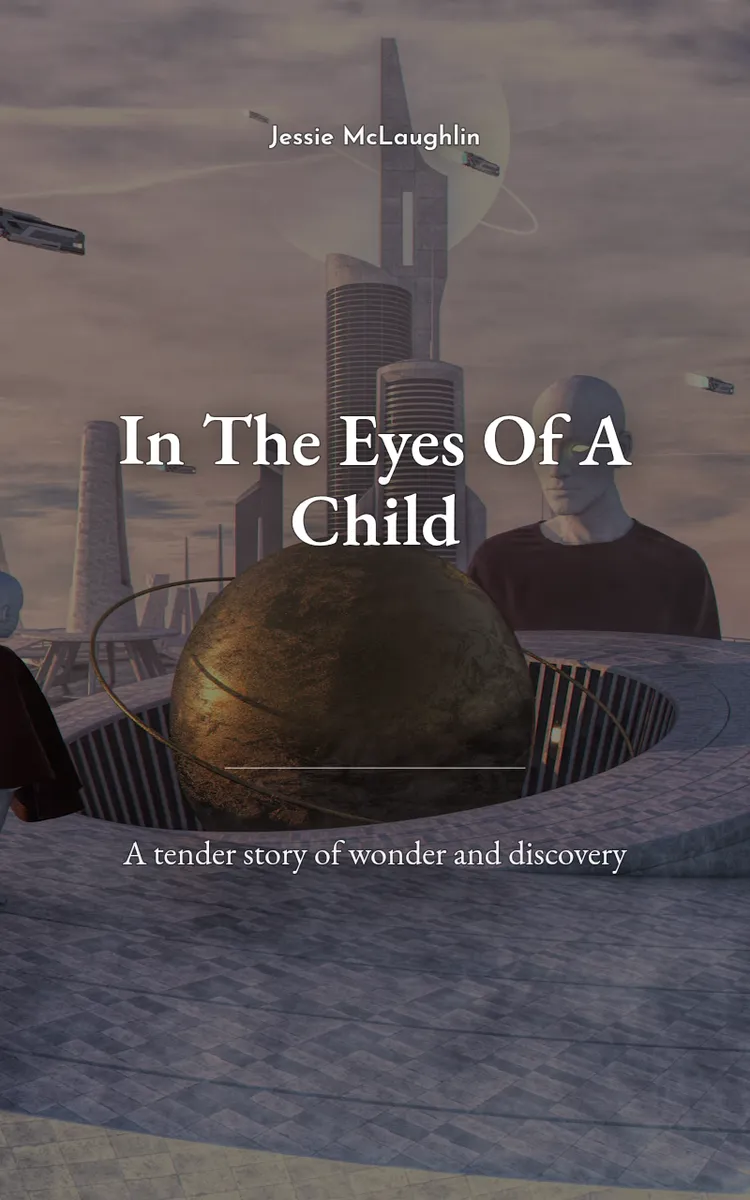
"In The Eyes Of A Child" is a fiction book by Jessie McLaughlin with 40 chapters and approximately 82,419 words. A child’s perspective on the world and everyday life.
This book was created using Inkfluence AI, an AI-powered book generation platform that helps authors write, design, and publish complete books. It was made with the AI Novel Writer.
Frequently Asked Questions
What is "In The Eyes Of A Child" about?
A child’s perspective on the world and everyday life
How many chapters are in "In The Eyes Of A Child"?
The book contains 40 chapters and approximately 82,419 words. Topics covered include The Flooded Footbridge, A Bell in the Blackout, The Map Beneath the Table, The Orchard in Deep Water, and more.
Who wrote "In The Eyes Of A Child"?
This book was written by Jessie McLaughlin and created using Inkfluence AI, an AI book generation platform that helps authors write, design, and publish books.
How can I create a similar fiction book?
You can create your own fiction book using Inkfluence AI. Describe your idea, choose your style, and the AI writes the full book for you. It's free to start.
Write your own fiction book with AI
Describe your idea and Inkfluence writes the whole thing. Free to start.
Start writingCreated with Inkfluence AI


