

Read the first chapter
The whole of chapter one, free. About 10 min. Turn the pages with the arrows, your keyboard, or a swipe.
Chapter 1
Jay Adams and Nouthetic Counseling
When a Pastor Refused to Separate Scripture from Counseling
A pastor once asked Jay Adams what he should do with a church member whose marriage, anger, and spiritual life had collapsed. The question assumed that the pastor needed a second authority - perhaps a psychological theory - to address the problem responsibly. Adams’s answer, developed through years of pastoral ministry and teaching, challenged that assumption: the church already possessed God’s sufficient Word for addressing the deepest moral and spiritual struggles of human beings.
That conviction placed Adams at the center of the modern Christian counseling debate. He did not deny suffering, bodily weakness, family history, or the value of careful observation. He rejected the idea that the church must borrow its basic understanding of people and change from secular psychology. His work gave pastors and counselors a vocabulary, method, and biblical warrant for counseling that calls people to face sin, receive grace, and practice new obedience.
The Historical Roots Map helps readers trace three matters together: Adams’s ministry, his biblical commitments, and the conflict between Scripture-centered counseling and approaches that place autonomous human wisdom above Scripture. By the end, you should be able to explain why nouthetic counseling emerged, identify its central claims, and begin applying its method without reducing it to harsh confrontation or vague religious advice.
The Historical Roots Map: Adams’s Ministry and Commitments
The word nouthetic comes from the Greek verb noutheteō, commonly translated “to admonish,” “to warn,” or “to counsel.” Paul used the word when he described his ministry: “Admonishing every man and teaching every man in all wisdom” (Colossians 1:28). In Romans 15:14, he told believers that they were “able also to admonish one another.” Nouthetic counseling therefore does not begin with a modern brand name. It begins with a biblical ministry entrusted to the people of God.
Adams served as a pastor and professor of practical theology at Westminster Theological Seminary. His pastoral experience convinced him that many ministers had received strong training in doctrine but little preparation for helping people apply biblical truth to anger, marriage conflict, fear, guilt, addiction, and discouragement. His landmark book Competent to Counsel, published in 1970, challenged the growing dependence on secular psychological models within evangelical counseling. Later, Adams helped establish the Christian Counseling and Educational Foundation, commonly known as the Christian Counseling and Educational Foundation (CCEF), though the organization’s later direction differed from Adams’s own developing model.
Adams’s central commitment rested on biblical sufficiency. He did not mean that Scripture supplies technical instructions for every medical or vocational question. He meant that Scripture gives the authoritative framework for understanding God, humanity, sin, suffering, redemption, and holy change. Second Timothy 3:16-17 says that Scripture equips the servant of God “for every good work.” Hebrews 4:12 describes God’s Word as living and discerning, exposing the thoughts and intentions of the heart. Adams treated those passages as counseling texts, not merely doctrinal statements.
His second commitment involved the authority of Christ over every counseling relationship. A counselor does not function as a neutral technician who helps a client reach self-defined goals. Jesus Christ calls His people to repent and believe (Mark 1:15), to deny themselves and follow Him (Luke 9:23), and to put off sinful practices while putting on righteous ones (Ephesians 4:22-24). Nouthetic counseling therefore asks more than, “How does this person feel?” It also asks, “What does this person believe, desire, choose, and practice before God?”
The Historical Roots Map contains three landmarks:
• Biblical authority. Begin with what Scripture says about God, the person, the problem, and the path of change. This prevents the counselor from treating secular categories as the final explanation.
• Pastoral responsibility. Counselors address real people in real relationships, not abstract cases. Adams pressed pastors to recover their responsibility to shepherd the whole life of the flock (Acts 20:27-28; 1 Peter 5:1-4).
• Practical sanctification. Counseling must lead toward specific obedience. James 1:22 warns against hearing the Word without doing it, and Ephesians 4:28 gives a concrete example: the thief must stop stealing and begin honest labor that serves others.
These landmarks explain why nouthetic counseling appeared when it did. During the twentieth century, many Christians accepted psychological theories that described people mainly through unconscious drives, damaged self-esteem, conditioning, or personal autonomy. Christian counselors often added Bible verses to those systems without examining their underlying view of humanity. Adams argued that such integration could quietly replace biblical anthropology - the Bible’s teaching about human beings - with assumptions that deny sin, minimize worship, or treat personal happiness as the highest goal.
Christian counseling stands superior to secular counseling at this foundational point: it can name both guilt and suffering without confusing them. Secular approaches may describe pain accurately while lacking a final account of evil, forgiveness, or reconciliation with God. Scripture gives counselors categories for both. Joseph’s brothers sinned against him, yet Joseph also endured genuine harm. He could say, “You meant evil against me; but God meant it for good” (Genesis 50:20). That verse neither excuses the brothers nor denies God’s providence. It shows the kind of full account biblical counseling must pursue.
Ask yourself: when you hear a counseling problem, do you first reach for a psychological label, or do you first ask what Scripture reveals about the person’s worship, responsibility, suffering, and hope? Your answer reveals the roots of your counseling practice.
Applying Adams’s Method Without Distorting It
Adams’s approach requires more than quoting verses during a conversation. It requires disciplined movement from biblical interpretation to personal application. A counselor should prepare carefully, listen accurately, speak truthfully, and assign practices that express repentance and faith.
Use these steps when you begin a nouthetic counseling relationship:
• Clarify the presenting problem. Ask what happened, when it began, how often it occurs, and whom it affects. A spouse who says, “We communicate badly,” may later identify repeated yelling after work, silent treatment during disagreements, and refusal to ask forgiveness. Specific details make biblical application possible.
• Identify the heart direction. Scripture connects behavior with the heart (Proverbs 4:23; Mark 7:20-23). Ask what the person wants, fears, believes, and demands. “I lose my temper when people disrespect me” may reveal a demand for honor rather than a simple anger-management problem.
• Distinguish sin, suffering, and weakness. Do not call every hardship rebellion, and do not call every sinful response a disorder. Paul’s thorn in the flesh involved suffering, while his response required dependence on grace (2 Corinthians 12:7-10). A counselor may need to address medical care, grief, exhaustion, or trauma while also examining sinful responses.
• Open the relevant biblical teaching. Explain the passage in context. For anger, consider James 1:19-20, Ephesians 4:26-32, Proverbs 15:1, and Matthew 5:21-26. Use Scripture to expose and direct, not to decorate an opinion you formed elsewhere.
• Call for repentance and faith. Repentance means turning from sin toward God, not merely feeling regret (Acts 26:20). Faith means relying on Christ and His promises rather than trusting self-reform. The counselor should explain what the counselee must confess, forsake, believe, and do.
• Assign observable obedience. Give one or two practices that the person can complete before the next meeting. An angry husband might record each trigger, pray through James 1:19-20, ask forgiveness without qualification, and answer his wife with a gentle response. Concrete assignments reveal whether counseling has moved from agreement to change.
• Review fruit and adjust. At the next meeting, ask what the person did, what prevented obedience, and what changed. This process reflects Jesus’ concern for fruit (Matthew 7:16-20) and Paul’s call to put off and put on (Ephesians 4:25-32).
Adams used confrontation in the biblical sense: bringing a person face to face with God’s truth for the purpose of restoration. Galatians 6:1 requires spiritual believers to restore someone gently, while Matthew 18:15 directs a believer to address sin privately. Nouthetic counseling should therefore combine clarity with patience. “You sinned” must not become a weapon; it must serve the goal, “You can turn to Christ and walk in new obedience.”
A counselor should also remember that Scripture addresses motives without pretending to read the heart infallibly. Ask questions, test conclusions, and allow the counselee to describe facts. Do not label a person rebellious because he missed one assignment. Do not excuse repeated disobedience because he speaks emotionally. Wise counseling joins careful listening with courageous biblical direction.
A Ministry Scenario: Mapping a Marriage Conflict
Consider a church counselor meeting with a couple after three months of repeated arguments. The husband reports that his wife “always criticizes him.” The wife reports that he “shuts down and punishes her with silence.” The counselor should not begin by choosing a side or assigning a diagnosis. The Historical Roots Map provides a better route.
• Gather the pattern during the first meeting. Ask each spouse to describe the last three conflicts, including the trigger, words spoken, actions taken, and outcome. Expected result: the counselor discovers that arguments usually begin when the wife asks about unfinished household tasks and the husband interprets the question as disrespect.
• Name the competing demands. The husband wants unquestioned respect; the wife wants immediate reassurance and shared responsibility. Expected result: both spouses see that the conflict involves more than communication technique. Their desires have become demands, and those demands govern their responses.
• Open Scripture together. Study James 1:19-20, Ephesians 4:29-32, Philippians 2:3-4, and Proverbs 15:1. Expected result: each spouse receives a direct biblical duty. The husband must reject silent punishment and speak truthfully; the wife must reject accusatory speech and pursue a gentle, specific request.
• Assign a seven-day practice. Require each spouse to record one conflict per day, state the concern in one sentence, answer without insult or withdrawal, and seek forgiveness before bedtime when either person sins. Expected result: the couple creates measurable opportunities to practice new obedience rather than waiting for feelings to improve.
• Review the record on day eight. Count completed conversations, apologies, withdrawals, and unresolved conflicts. If they completed five of seven practices and reduced silent withdrawals from five occasions to two, celebrate God’s grace while addressing the remaining failures. Expected result: the next meeting focuses on actual fruit and remaining heart issues.
Quick checklist
• Define the conflict with dates, words, actions, and outcomes.
• Ask what each person wants, fears, believes, and demands.
• Separate suffering or weakness from sinful responses.
• Choose passages that address the actual pattern.
• Assign practices with a deadline and observable results.
• Review obedience, failure, repentance, and growth.
• Keep Christ, not marital comfort, as the final goal.
This scenario shows Adams’s distinctive contribution. The counselor does not merely teach communication skills, though better speech matters. The counselor brings the couple under Christ’s authority, identifies sinful responses, offers biblical hope, and gives each spouse a path of obedience. Christian counseling surpasses secular counseling here because it can pursue reconciliation with God as the foundation for reconciliation with one another (2 Corinthians 5:18-20).
Mistakes That Weaken Nouthetic Counseling
Reducing nouthetic counseling to blunt confrontation
Some counselors hear “admonish” and speak before they listen. They quote a verse, announce a verdict, and overlook fear, grief, medical concerns, or the counselee’s confusion. That method misrepresents Adams and violates biblical wisdom. Proverbs 18:13 warns against answering before hearing.
Do this: gather specific facts, ask careful questions, explain the relevant passage, and connect confrontation to restoration.
Not this: “You are just rebellious,” offered after five minutes of conversation.
Treating every problem as identical
A counselor may force every case into the same explanation: every depressed person lacks faith, every anxious person refuses trust, and every conflict has one obvious offender. Scripture gives richer categories. Elijah experienced profound exhaustion and fear (1 Kings 19), and God addressed him with rest, food, questions, and renewed direction. The passage does not erase spiritual responsibility, but it warns counselors to consider the whole person.
Do this: examine bodily conditions, suffering, relationships, beliefs, choices, and spiritual practices before deciding what requires repentance.
Not this: assigning a moral label without investigating sleep, medication, grief, abuse, or danger.
Borrowing secular authority while claiming biblical sufficiency
A counselor may use biblical language while allowing a secular theory to define the person’s deepest problem. If “low self-esteem” becomes the ruling category, the counselor may encourage the counselee to build confidence without asking whether the person seeks human praise, fears man, or rests in Christ. Scripture directs believers to seek the approval of God (Galatians 1:10) and find identity in union with Christ (Galatians 2:20).
Do this: state clearly which biblical text governs your understanding, then use outside information only as limited observation - not as the final explanation or cure.
Not this: adding a verse to a counseling plan whose goals and assumptions came entirely from secular psychology.
Adams’s legacy calls Christian counselors to recover confidence in Scripture without abandoning patience, careful listening, or compassion. His ministry emerged from a particular historical conflict, but his central question remains urgent: will the church counsel people as autonomous selves, or as worshipers who must meet the living God in His Word? Nouthetic counseling answers by bringing every problem - sinful, sorrowful, relational, and bodily - under the lordship of Jesus Christ. That answer supplies the foundation for the practical work that follows.
End of chapter one. 7 more chapters and about 15,026 words in the full book.
Swipe or use the arrows to turn the page


What's inside: 8 chapters
- 1. Jay Adams and Nouthetic Counseling
- 2. Scripture’s Authority in Counseling
- 3. The Nouthetic Model of Change
- 4. Assessing People and Their Problems
- 5. Conducting a Counseling Session
- 6. Homework, Habits, and Repentance
- 7. Crisis, Abuse, and Clinical Boundaries
- 8. Comparing Christian and Secular Counseling
About this book
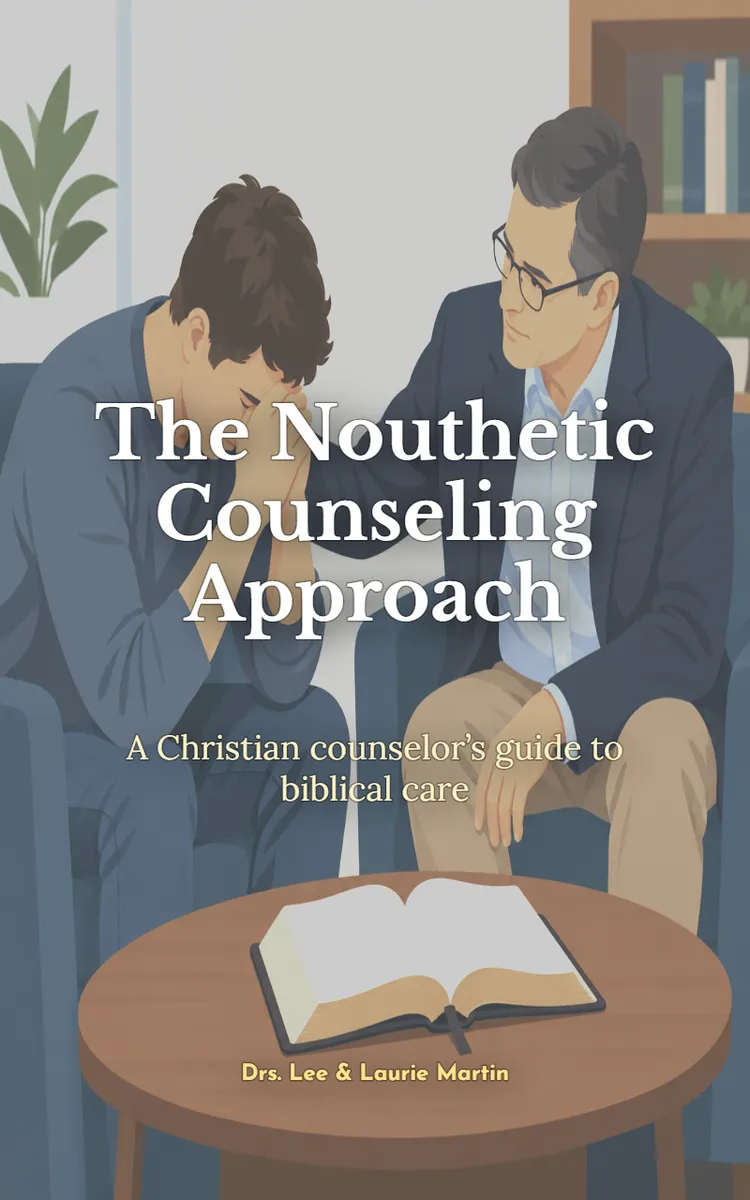
"The Nouthetic Counseling Approach" is a how-to guide book by Drs. Lee & Laurie Martin with 8 chapters and approximately 15,026 words. Nouthetic counseling, Jay Adams, biblical foundations, and counseling practice.
This book was created using Inkfluence AI, an AI-powered book generation platform that helps authors write, design, and publish complete books. It was made with the AI Ebook Generator.
Frequently Asked Questions
What is "The Nouthetic Counseling Approach" about?
Nouthetic counseling, Jay Adams, biblical foundations, and counseling practice
How many chapters are in "The Nouthetic Counseling Approach"?
The book contains 8 chapters and approximately 15,026 words. Topics covered include Jay Adams and Nouthetic Counseling, Scripture’s Authority in Counseling, The Nouthetic Model of Change, Assessing People and Their Problems, and more.
Who wrote "The Nouthetic Counseling Approach"?
This book was written by Drs. Lee & Laurie Martin and created using Inkfluence AI, an AI book generation platform that helps authors write, design, and publish books.
How can I create a similar how-to guide book?
You can create your own how-to guide book using Inkfluence AI. Describe your idea, choose your style, and the AI writes the full book for you. It's free to start.
Write your own how-to guide book with AI
Describe your idea and Inkfluence writes the whole thing. Free to start.
Start writingCreated with Inkfluence AI


