

Read the first chapter
The whole of chapter one, free. About 9 min. Turn the pages with the arrows, your keyboard, or a swipe.
Chapter 1
What manipulation actually is?
Define Manipulation and Distinguish Identity
Manipulation is a pattern of deliberate tactics that influence another person’s choices or emotions, replacing direct, honest requests with indirect pressure. It can involve guilt-tripping, pressuring, stonewalling, distorting facts, or emotional punishment. The method changes, but the aim is similar: get the outcome while avoiding a clear, respectful conversation.
This matters because actions can be changed, even when they feel tied to who someone is. A person can exhibit toxic behaviors without being an inherently toxic person. Saying, “I pressured my partner,” is different from saying, “I’m a toxic person.” The first names an action. The second turns an action into a permanent identity. That distinction isn’t a free pass: it separates behavior from permanent identity, and it makes honest accountability possible. It makes honest accountability possible by separating the act from the person and pointing to specific reparative steps.
Intentions matter, but they don’t erase impact. Someone may manipulate because they’re afraid of rejection, desperate to avoid conflict, or trying to keep control. Those intentions may explain the behavior. They don’t make it harmless. A person can mean well and still corner someone, punish them for saying no, or twist the conversation until the other person gives in.
So look at four separate things: identity (who you are), behavior (what you did), intentions (what you meant), and willingness to change (what you will do next). Identity asks, “Who am I?” Behavior asks, “What did I do?” Intentions ask, “What was I trying to achieve?” Willingness to change asks, “What am I prepared to do now that I know this caused harm?” Mixing these together creates confusion. Separating them creates a clear view.
Willingness to Change
Importantly, willingness to change is different from merely feeling bad about what happened. It’s not a tearful apology, a burst of shame, or saying, “I’ll never do that again.” Those reactions may be real, but change shows up in what happens next. Do they stop defending the behavior? Can they hear the other person’s experience without arguing every detail? Do they accept a boundary even when it costs them something?
This is where identity can become an escape route. “That’s just who I am” sounds honest, but often means, “I don’t plan to examine what I do.” The opposite escape route is just as unhelpful: “I’m a terrible person, so nothing can change.” Shame keeps attention on the self. Accountability keeps attention on the harm and the next choice.
A useful distinction is simple: a harmful act doesn’t prove a person is beyond repair, but refusing to face the act tells you something important. Repeated manipulation, followed by excuses and no meaningful effort, is not just a bad moment. It’s a pattern being protected.
You don’t need to decide someone’s entire character in one conversation. Pay attention to the gap between their words and their response when change becomes inconvenient. That gap often tells the truth.
A short scene that lands the question: you just had the conversation where you meant to be honest, and somehow it spiraled into a defensive exchange.
You meant to be honest, but the talk spiraled and you heard yourself say, “Fine, do what you want,” even though you were furious. Later, you replay the words and feel that tug: you wanted the same outcome, but quieter, cleaner, less vulnerable. You notice the other person’s face went flat, then small; they retreated. You wanted to keep the relationship intact, but you also wanted to get your way without arguing. That mix of relief and shame sits heavy in your chest.
Was that manipulation? Or just stress? The difference matters, because how you answer it changes what you do next. Bold choice time: are you willing to look honestly at what you did and ask the hard questions? Are you ready to recognize manipulation and take responsibility for it - not as a label, but as a path to real change?
Old vs. New: a clear reframing you can use. Old Belief, New Reality shows the shift from judgment to action.
Old Belief: Manipulation equals a person's character, and labeling it often feels like the end of the conversation.
New Reality: Manipulation is a set of behaviors people use to get what they want; these behaviors can be stopped when they're clearly identified, owned, and replaced with honest options.
This shift matters because it moves you from moral judgment to practical action. When you see manipulation as a behavior, you can point to specific moves - withholding, guilt-tripping, playing the victim - and name them without saying the person is irredeemable. That makes accountability doable, because it lets you point to concrete actions and measurable changes. It also helps you separate your self-worth from your worst moments.
Concrete example: after an argument you discover you texted your partner a guilt-heavy message that implied they don’t care about the relationship unless they changed. Old belief would make you spiral into “I’m horrible” and hide; new reality lets you name the behavior, apologize specifically, and state what you’ll do instead next time - like saying, “I felt unheard and pressured you; next time I’ll ask for a timeout so I don’t weaponize guilt.” That’s practical, repairable, and real.
Why this lens matters, signs it’s running your life, and a short takeaway
When you stop treating manipulation as an identity and start treating it as behavior, you gain practical benefits: you reduce shame that paralyzes change, and you sharpen the tools you need to change. People who shift to this mindset become better at spotting their own patterns and less likely to defend reflexive moves. That’s how relationships heal - not by blame, but by clearer choices.
Signs this pattern is running your life:
• You often soften requests by adding judgment or guilt, for example: “When plans change, I say, ‘If you cared, you would have come.’”
• You answer boundaries by bargaining or making the other person prove loyalty.
• You wait until you feel cornered and then drop a dramatized confession to get sympathy or avoid accountability.
• You frequently rationalize that the ends justify the means, especially when you’re stressed.
Short conclusion: Name the move, and focus on repairing it rather than turning it into your identity.
Questions to make this personal
• When did I last get what I wanted by making someone feel bad rather than asking?
• An honest answer might be: “Last week, I implied my friend didn’t care when she missed dinner so she’d plan around me.” That helps you notice the exact behavior to change.
• What excuse do I reach for when someone calls me manipulative?
• You might find you say, “I was emotional,” or “It was a misunderstanding.” Noticing the excuse helps you move from defense to ownership.
• Which response from someone else makes me most likely to use manipulation (withdrawal, loud anger, silence)?
• Example answer: “When my partner goes quiet, I panic and try to guilt them back in.” That links your tactics to triggers you can manage differently.
• What small, concrete replacement can I use instead of guilt or silence the next time I feel that urge?
• A helpful script: “I need a break; can we pause and come back at [time]?”
• If the person I manipulated told me how it felt, what would I fear most hearing - and why?
• You might fear being seen as selfish or insecure; naming that fear points toward the real need behind the manipulation.
A short, specific time-bound challenge you can start today
Challenge title: 7 Days of Naming the Move
• Instructions:
• For the next 7 days, any time you notice you used pressure, guilt, silence, or another manipulative tactic, stop and write one sentence describing the exact behavior (e.g., “I closed up and gave the silent treatment for three hours after a text”).
• If possible, say a short correction: “That was me using guilt; I’m sorry - I’ll try a different approach.” Keep it brief and factual.
• End each day by reading what you wrote and jotting one small replacement you’ll try tomorrow (example: “Ask for a pause instead of accusing.”).
• Difficulty: Medium
• You’ll know it's working when...
• You notice fewer automatic defenses and more pause between feeling and acting.
• You can name a specific tactic you used without an immediate defensive justification.
• Someone responds with curiosity rather than more conflict the next day.
Small clarity beats big guilt; focus on concrete steps rather than self-reproach.
One-line core truth, quick takeaways, and a bridge forward
Manipulation stops being destiny the moment you stop treating it like a character flaw and start treating it like a fixable set of choices.
• Learned how to separate behavior from identity so you can own actions without being crushed by shame.
• Saw concrete signs that manipulation is running your reactions.
• Got targeted questions that make your patterns visible instead of vague.
• Took a 7-day practice that trades reflex for a tiny habit of accountability.
Keep this momentum. The next chapter walks through how manipulation shows up in specific relationship types - and how that visibility makes repair realistic. You’re doing better than you think; keep paying attention and you’ll build trust back, step by step.
Why people manipulate others
Manipulation is a strategy, and strategies exist because they work. When someone learns that emotional pressure or distortion reliably changes another person’s behavior, they’ll keep using it. That’s the brutal truth: manipulation survives because it is effective often enough to reinforce itself.
Four core needs drive the behavior.
Control
People who feel powerless use subtle coercion to reclaim a sense of influence. Control here isn’t only domination; it’s a hedge against uncertainty, an attempt to steer outcomes without exposing personal fear.
Conflict avoidance and shame-avoidance
Direct requests can force people to be seen as needy, wrong, or vulnerable. So they choose tactics that sidestep exposure: minimizing their need, shifting blame, or weaponizing guilt. Those moves protect short-term face at the expense of long-term honesty.
Attention and validation
When someone’s emotional needs aren’t met, they may escalate to tactics that guarantee response: repeated texts, dramatized complaints, or presenting themselves as wounded. These are attempts to force care rather than ask for it.
Immediate emotional relief
Manipulation often provides instant relief from discomfort. If a manipulative line or silence ends an argument, it works as a quick fix. Repeated use of that fix becomes a habit because the brain rewards relief.
How the pattern locks in
Successful moves get remembered. Caregivers, partners, or managers who responded to pressure rewarded it. Under stress, the brain defaults to those learned shortcuts. That’s why smart, decent people sometimes behave manipulatively in high-stakes moments.
Common self-justifications
People soften the admission of manipulation with excuses: “I was too upset,” “They forced my hand,” “I only wanted what’s best,” or “I didn’t see another option.” Each justification shifts blame away from the specific action and keeps the habit intact.
Why it keeps working, and why that’s dangerous
Short-term success rewires expectations. The person being manipulated learns to protect themselves: they may give more to avoid conflict or withdraw to avoid getting hurt. Either response trains the manipulator to refine or intensify tactics. Trust decays. Patterns calcify.
Practical check to interrupt the habit
When you catch yourself using pressure or distortion, answer these fast, functional questions in a sentence each:
• What outcome did I want?
• What tactic did I use to get it?
• What exact request would have asked for it instead?
Replacement lines that work
Use these concrete alternatives, word-for-word:
• Swap guilt for clarity: “I felt hurt when you canceled; can we plan so this doesn’t keep happening?”
• Swap silence for a timed pause: “I’m shutting down so I don’t say something I’ll regret. I’ll come back in 20 minutes.”
• Swap theatre for a check-in: “I’m anxious and need a five-minute conversation. Can you sit with me now?”
Mini-discipline: three-day reset
For three days, keep a one-line log: moment, tactic you used, script you’ll try next time. Use the replacement lines above. Small repetition breaks the reflex.
Closing note
Understanding the why strips the glamour off manipulation. It stops being cleverness and looks like what it is: a short-term trick with long-term costs. Next chapter maps the specific forms so you can name them and stop giving them power.
End of chapter one. 11 more chapters and about 38,671 words in the full book.
Swipe or use the arrows to turn the page


What's inside: 12 chapters
- 1. What manipulation actually is?
- 2. Why people manipulate others.
- 3. The different forms of manipulation.
- 4. How manipulation develops.
- 5. How manipulators justify their behavior.
- 6. How manipulation affects the person receiving it.
- 7. Signs you may be manipulating someone without realizing it.
- 8. How to recognize manipulation in relationships.
- 9. How to stop manipulating others.
- 10. How to rebuild trust after manipulative behavior.
- 11. How to take accountability.
- 12. Closing synthesis (implied by 12 chapters request).
About this book
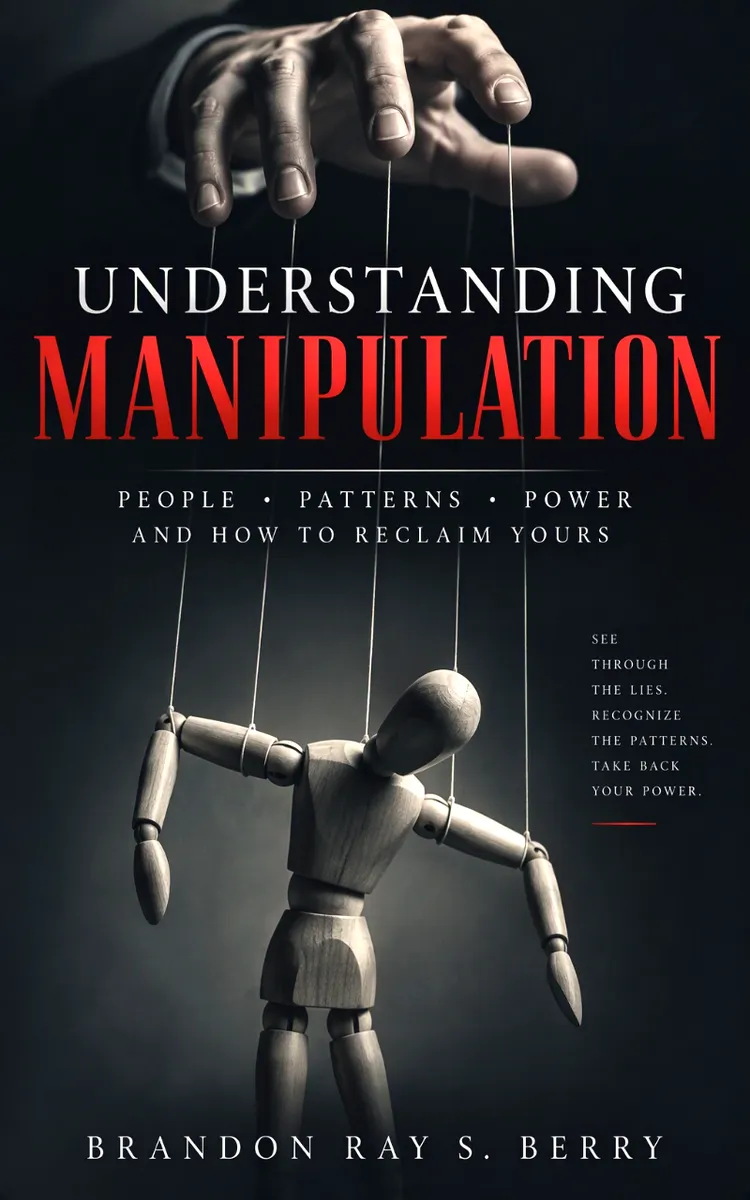
"Understanding Manipulation" is a self-help book by Brandon Ray S. Berry with 12 chapters and approximately 38,671 words. Learn to name manipulative behavior without reducing yourself or someone else to a label. Understanding Manipulation gives you a clear way to separate identity, behavior, intentions, and willingness to change.
This book was created using Inkfluence AI, an AI-powered book generation platform that helps authors write, design, and publish complete books. It was made with the AI Self-Help Book Writer.
Frequently Asked Questions
What is "Understanding Manipulation" about?
Learn to name manipulative behavior without reducing yourself or someone else to a label. Understanding Manipulation gives you a clear way to separate identity, behavior, intentions, and willingness to change. You’ll recognize pressure in guilt-tripping, stonewalling, distorted facts, emotional punishment, and repeated requests for reassurance. You’ll understand why someone might manipulate to get control, attention, forgiveness, or relief from an uncomfortable conversation, and why fear does not make the behavior harmless. You’ll also have a more precise way to talk about accountability. “I pressured my partner” names an action that can be addressed. “I’m a toxic person” turns that action into a permanent verdict. The distinction is not an excuse. It points toward the harder question: what will change now that the impact is clear? The book’s 12 chapters help you keep that question in view.
How many chapters are in "Understanding Manipulation"?
The book contains 12 chapters and approximately 38,671 words. Topics covered include What manipulation actually is?, Why people manipulate others., The different forms of manipulation., How manipulation develops., and more.
Who wrote "Understanding Manipulation"?
This book was written by Brandon Ray S. Berry and created using Inkfluence AI, an AI book generation platform that helps authors write, design, and publish books.
How can I create a similar self-help book?
You can create your own self-help book using Inkfluence AI. Describe your idea, choose your style, and the AI writes the full book for you. It's free to start.
Write your own self-help book with AI
Describe your idea and Inkfluence writes the whole thing. Free to start.
Start writingCreated with Inkfluence AI


