
Read the first chapter
The whole of chapter one, free. About 8 min. Turn the pages with the arrows, your keyboard, or a swipe.
Chapter 1
Panic Spiral Stop Protocol
That tight, buzzy feeling hits while you’re still mid-sentence - chest tightening, throat getting scratchy, the email you’re sending suddenly feels like it will explode the whole day. Darius, 42 and a COO, described it like a “live wire” in his body: halfway through an urgent message, his breathing sped up, his thoughts started racing, and he could feel panic trying to climb the ladder faster than he could stop it.
This chapter gives you a sound-and-breath first-aid routine built for that exact moment. The goal isn’t to “push panic away.” It’s to interrupt the escalation loop long enough for your nervous system to remember it can come down. You’ll use a simple sound cue, a breathing rhythm that signals safety, and grounding you can do right where you are - even if you’re still holding your phone.
Who this is for - Anyone who feels panic ramping up fast (often within minutes) - Busy people who can’t pause life for a long protocol - Parents and professionals who need a repeatable “in-the-moment” reset - People who want a music-based neurological protocol that feels practical, not theoretical
Key benefits you can aim for: a quicker drop in physical panic signals, clearer thinking to finish what you need to finish, and a routine that becomes easier each time you practice it - so your body learns the path out.
---
How Panic Escalates (and Why Sound + Breath Can Cut the Loop)
Panic usually starts as a body alarm, then turns into a mind alarm. Your brain senses danger (even if it’s “just” stress), and your body responds with adrenaline and a faster breath rate. That combo can create sensations - tight chest, tingling, dizziness - that your brain interprets as “I’m not safe.” The interpretation fuels more adrenaline, and the cycle speeds up.
Here’s the core mechanism in plain language: panic is a feedback loop. The sound you choose and the breathing rhythm you follow work together to change what your body thinks is happening. When your breathing becomes slower and more regular, your nervous system gets a “signal” that the threat level can drop. When your ears get consistent, intentional sound patterns, your brain has something stable to lock onto instead of scanning for danger.
Several factors make the loop more likely to escalate, especially when you’re tired, overloaded, or already keyed up: 1. Hyperventilation tendency (often from stress breathing that’s shallow or too fast) 2. Threat-focused attention (watching symptoms closely, like chest tightness “proving” danger) 3. Sleep debt and irregular rest (your body has less buffer for adrenaline) 4. Sensory overload (noise, screens, crowded environments) 5. Caffeine or stimulants, especially when you’re already running hot 6. A thought pattern that turns sensations into catastrophe (“This means something is seriously wrong”)
Important vocabulary check: - Adrenaline = the “go faster” chemical that raises arousal. - Hyperventilation = breathing faster than your body needs, which can change blood gas balance and intensify tingling/dizziness sensations. - Nervous system = the body’s built-in safety control system (not just “your mind”).
This protocol works because it gives your body a new script: sound offers structure, breath offers pacing, and grounding offers location. Your brain doesn’t have to argue with panic - it just has to switch inputs.
Practical takeaway / reflection prompt: Think about the last time panic rose quickly. What was the first sensation you noticed - chest tightness, throat, stomach, or racing thoughts? That’s your “entry point,” and we’ll target it with the Ladder.
---
The 3-Note Reset Ladder: Your 5-Minute Panic Spiral Stop Protocol
You’re going to interrupt the panic escalation within five minutes using The 3-Note Reset Ladder - a sound-and-breath routine designed to be doable in real life, not in a quiet studio.
5-Minute Neurological Protocol (The 3-Note Reset Ladder) - Listen (Sound): Play 3 repeating notes (same sequence, same volume) for 60 seconds, then repeat the same sequence for another 60 seconds. Keep it steady - no pausing mid-track. - Breathe (Rhythm): During each 60-second listening block, breathe in through the nose for 4 counts, out through the mouth for 6 counts. Aim for about 8-10 breaths total per minute (slow and even, not forced). - Ground (Body): Every time you exhale, press your feet into the floor and name 5 things you can feel (shoes/seat texture, hands on device, fabric, chair support). Do this once per minute for the full 3 minutes.
If you don’t have a prepared audio file with the exact 3-note sequence, use any consistent single-tone or simple two-to-three-note loop at a comfortable volume - what matters most is the predictable repetition. The “3-note” structure is your brain’s anchor.
What to do, minute by minute (with clear progression)
Minute 0-1: Stop the climb Start the sound. As it begins, do the breathing rhythm: 4 in / 6 out. On each exhale, press feet down and do the grounding scan once. Darius found that the moment he stopped trying to “reason” with panic and instead matched his exhale to the sound’s repeating pattern, his chest stopped tightening as aggressively.
Minute 1-2: Change the feedback loop Keep the same sound loop and breathing ratio. Now add a quick attention reset: on each exhale, quietly label one body signal without arguing with it - example: “tight chest,” “fast breath,” “buzzing.” The goal is to acknowledge, not debate. If your mind says, “This isn’t working,” treat that as another thought passing through the anchor.
Minute 2-3: Stabilize and widen Continue sound and breathing, same counts. Grounding gets more “real-world.” Name 3 things you see and 2 things you can feel (total 5 sensory items) once for the minute. Keep your posture steady - no frantic scanning, no pacing if you can avoid it. If you’re sitting at a desk, keep your hands in contact with something solid (keyboard edge, chair arm, your own forearm). That contact helps your brain re-orient.
Minute 3-5: Decide what to do next Same sound loop for up to two more minutes, but reduce grounding intensity slightly - just one grounding check at minute 4. At minute 5, ask yourself a quick comprehension check: - “Can I do the next small step without adding panic?” - “Is my breathing calmer than at the start?” Then choose one action that matches your new state: finish the email with shorter sentences, send a draft and take a breath break, or step away for 2 minutes to reset again.
When to get professional help (warning signs) This protocol is for panic escalation you can interrupt quickly. Seek professional support promptly if you notice any of the following patterns: - Panic-like symptoms that regularly come with fainting, severe chest pain, or trouble breathing that doesn’t settle with rest - New symptoms that feel medically concerning or very different from your usual panic - Panic that’s increasing in frequency or intensity despite consistent practice - Any safety concern (for example, thoughts of self-harm) And if symptoms are severe or you’re unsure, it’s always appropriate to contact licensed care.
Quick clarity comparison (why this differs from “calm down”) | What you might try | What it usually does | What The 3-Note Reset Ladder does | |---|---|---| | Thinking your way out (“I’m fine”) | Can keep your brain scanning for danger | Uses predictable sound as an anchor while breathing slows the body’s alarm | | Random breathing (“just breathe deeper”) | Often becomes forced or inconsistent | Gives a specific 4 in / 6 out rhythm tied to repeatable sound | | Trying to distract hard | Sometimes increases “I can’t escape this” | Grounding + sensory naming redirects attention without denial |
Practical takeaway / reflection prompt: After your first practice, note one thing: did your exhale become longer or smoother even slightly? That’s the win. The Ladder works on tiny shifts.
---
Common Mistakes That Keep the Panic Loop Running (and How to Fix Them)
Mistakes aren’t failures - they’re just where the body finds a loophole. Here are the most common ones I see, and how to correct them fast.
Mistake: Breathing “hard” instead of pacing - Why it happens: Panic makes you want control. So you breathe bigger, faster, or you try to “force calm,” which can backfire and keep adrenaline high. - What to do instead: Stick to the exact rhythm: 4 in / 6 out. If your mouth feels tight, shorten the inhale slightly (like 3 counts) but keep the exhale longer (like 5 counts). The key is: exhale stays longer than inhale.
Mistake: Skipping the sound repetition (or changing volume constantly) - Why it happens: Your brain wants novelty when it’s scared. So you pause, restart, turn it up, turn it down, switch tracks - each change asks your brain to re-check for danger. - What to do instead: Choose one consistent sound loop and keep volume steady at a “background-but-clear” level. Run it for two 60-second blocks before you decide whether it’s helping.
Mistake: Grounding only with thoughts - Why it happens: It’s tempting to “think positive” or narrate what you’re feeling. But thoughts don’t always pull the body out of alarm mode quickly. - What to do instead: Ground with contact and sensation. Do the 5 things you can feel once per minute. If you’re at a desk, press your feet, grip your chair edge lightly, and notice texture/pressure. Let your senses do the work.
Practical takeaway / reflection prompt: Pick one mistake above and correct it in your next attempt. One change is enough to teach your nervous system a new pattern.
---
Panic spirals feel personal because they show up in your body first. The good news is that your body responds to clear cues. When you use The 3-Note Reset Ladder - predictable sound, slower 4 in / 6 out breathing, and grounding that lands in your senses - you’re not “defeating yourself.” You’re giving your brain a faster route back to safety, one minute at a time.
Next, you’ll build on this foundation so the reset becomes more automatic - especially when your day stays loud, your schedule stays tight, and your stress tries to turn into a permanent background hum.
End of chapter one. 7 more chapters in the full book.
Swipe or use the arrows to turn the page


What's inside: 8 chapters
- 1. Panic Spiral Stop Protocol
- 2. Meeting Shutdown for Burnout
- 3. Sensory Overload Calm for Parents
- 4. Anxiety Reappraisal with Music Cues
- 5. Sleep Onset with REM-Ready Sound
- 6. Insomnia Rescue for Middle-Night Waking
- 7. Stress-Induced Muscle Tension Release
- 8. Burnout Recovery with Daily Sonic Habits
About this book
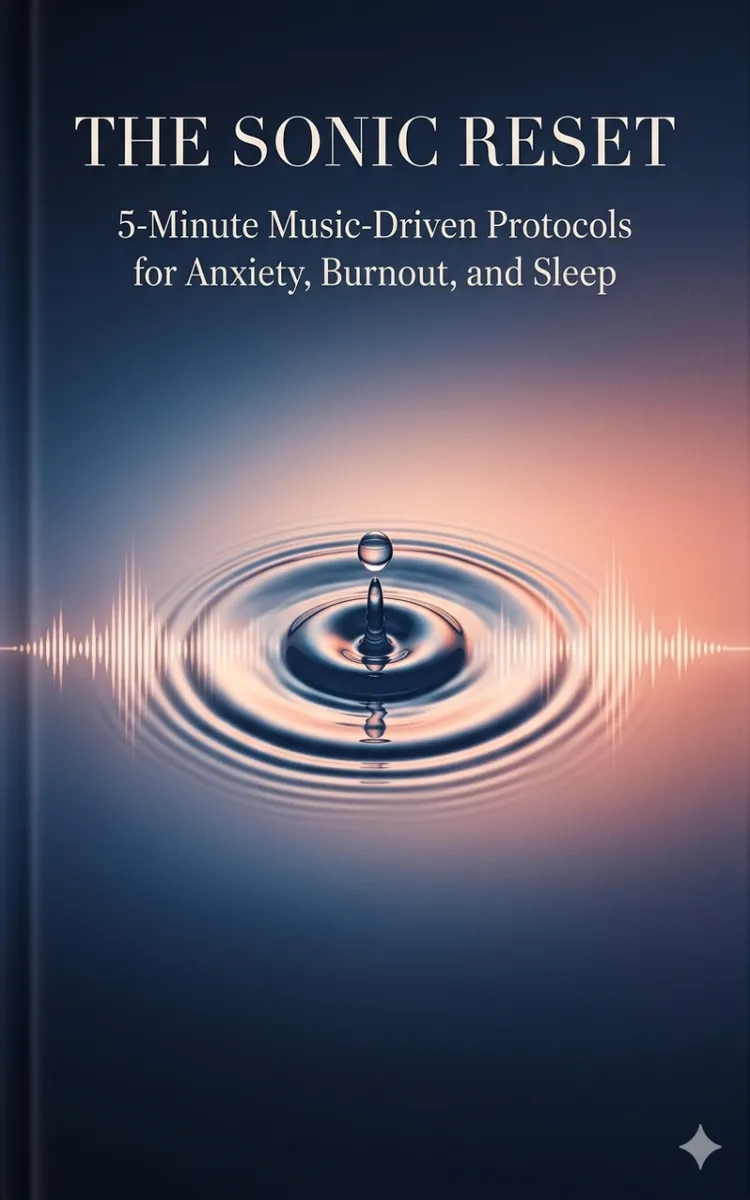
"The Sonic Reset" is a health & wellness book by JM. Albarado with 8 chapters and approximately 14,766 words. Music-based neurological protocols for anxiety, burnout, and sleep.
This book was created using Inkfluence AI, an AI-powered book generation platform that helps authors write, design, and publish complete books. It was made with the AI Health Book Generator.
Frequently Asked Questions
What is "The Sonic Reset" about?
Music-based neurological protocols for anxiety, burnout, and sleep
How many chapters are in "The Sonic Reset"?
The book contains 8 chapters and approximately 14,766 words. Topics covered include Panic Spiral Stop Protocol, Meeting Shutdown for Burnout, Sensory Overload Calm for Parents, Anxiety Reappraisal with Music Cues, and more.
Who wrote "The Sonic Reset"?
This book was written by JM. Albarado and created using Inkfluence AI, an AI book generation platform that helps authors write, design, and publish books.
How can I create a similar health & wellness book?
You can create your own health & wellness book using Inkfluence AI. Describe your idea, choose your style, and the AI writes the full book for you. It's free to start.
Write your own health & wellness book with AI
Describe your idea and Inkfluence writes the whole thing. Free to start.
Start writingCreated with Inkfluence AI


