
Read the first chapter
The whole of chapter one, free. About 10 min. Turn the pages with the arrows, your keyboard, or a swipe.
Chapter 1
What’s Really in a Gas-Station Pill?
The Label That Promises More Than It Can Prove
In 2018, the FDA warned consumers about products sold as “gas station drugs” after laboratory testing found that some contained undeclared pharmaceutical ingredients. The packages looked ordinary - bright colors, confident names, promises of energy or performance - but the contents could not be understood from the label alone.
That is the central difficulty with many quick-energy and smoke-shop pills. The problem is not simply that an ingredient might be risky. It is that the buyer may not know which ingredient is present, how much of it is there, or whether the amount is consistent from one package to the next.
A label is supposed to be a bridge between a product and the person using it. With unregulated pills, that bridge can be missing several boards. The name may describe an effect rather than a substance. “Herbal,” “proprietary blend,” and “natural energy” can sound informative while revealing very little. Even a familiar ingredient can become difficult to judge when its dose is hidden or when the product has not been tested for contamination and substitution.
How can a small printed label carry the appearance of certainty when the product behind it remains largely unknown?
The Label-to-Lab Gap
The Label-to-Lab Gap is the distance between what a package says and what a laboratory can actually confirm. It appears in many forms: an ingredient omitted from the label, a dose concealed inside a blend, a plant extract described only by its common name, or a product whose contents vary between batches.
Historically, food and medicine developed different expectations around labeling. Packaged food gradually acquired rules about ingredients, quantities, and contamination. Prescription medicines became tied to controlled manufacturing, standardized doses, and clinical testing. Supplements occupy a more complicated position. In the United States, the Dietary Supplement Health and Education Act of 1994 allowed many supplements to reach the market without the same premarket approval required for prescription drugs. Manufacturers generally remain responsible for ensuring that their products are safe and accurately labeled, but the system does not require every product to prove its safety and effectiveness before sale.
That distinction matters at a gas station or smoke shop, where a pill may sit beside snacks, phone chargers, and motor oil. The setting suggests convenience, not pharmacology. Yet the product may contain concentrated botanical extracts, stimulants, sexual-enhancement compounds, or combinations of substances that have never been evaluated together.
“Proprietary blend” is a particularly efficient form of uncertainty. It may list several ingredients but withhold the amount of each one. A consumer can see that caffeine, herbs, amino acids, or other compounds are included, but cannot tell whether an ingredient is present in a meaningful amount, a trace amount, or a quantity that could contribute to side effects. The label technically communicates while practically concealing.
The gap widens when a product uses a brand name instead of a clear description. A name such as “energy,” “royal,” or “power” may signal the desired outcome without identifying the chemical route used to produce it. Two products with nearly identical promises may have entirely different contents. Two packages with the same name may not contain identical contents at all.
A pill can therefore be legal to sell, easy to purchase, and difficult to identify.
Why “Natural” Is Not a Chemical Description
The word natural carries a powerful cultural suggestion: something taken from a plant, lightly processed, and therefore gentler than a manufactured drug. Chemistry does not recognize that distinction. Caffeine from a coffee bean and caffeine added to a tablet are the same molecule. A plant extract, however, may contain dozens of compounds, and its effects can change with the plant species, growing conditions, extraction method, storage, and concentration.
This is one reason labels for botanical products can be deceptively simple. “Kratom,” for example, identifies a plant, not a single standardized substance. Its leaves contain several alkaloids, including mitragynine and 7-hydroxymitragynine, and the balance can vary. Products sold as powders, capsules, liquids, or concentrated extracts may differ sharply in strength even when they use the same broad name.
The same problem appears in smoke-shop products marketed as herbal relaxants, mood enhancers, or legal alternatives to controlled substances. A label may point to a plant or blend without saying how the raw material was processed. Extraction can concentrate certain compounds. Chemical conversion can alter others. Added stimulants or pharmaceutical substances may not appear anywhere on the package.
A surprising single sentence captures the problem: A longer ingredient list can create more uncertainty, not less.
That happens when the list names many substances but gives no amounts, no standardized extract ratio, and no reliable batch testing. A consumer may interpret detail as transparency. In reality, the decisive information can remain hidden.
Dose is where chemistry becomes personal. A small amount of caffeine may feel unremarkable to one person and produce palpitations or severe anxiety in another, especially when combined with other stimulants. Concentrated extracts can make ordinary serving language - one capsule, one shot, one tablet - almost meaningless. The physical size of the pill tells the buyer very little about its pharmacological strength.
Even the word serving can mislead. A package may define a serving as two capsules while a consumer takes one, or it may contain several servings in a single small bottle intended to be consumed quickly. Without a clear amount of each active compound, the label cannot provide a dependable map from swallowing to effect.
The History of the Quick Fix
The modern gas-station pill belongs to a long history of products sold at the edge of medicine. In the nineteenth and early twentieth centuries, patent medicines often promised relief, vigor, or restored masculinity while disclosing little about their contents. Some contained alcohol, opium, cocaine, or other active substances. Their appeal came partly from the promise and partly from the absence of a medical gatekeeper.
Today’s packaging looks more polished, but the commercial logic is familiar. A memorable name, a dramatic image, and a claim of rapid effect turn uncertainty into a selling point. “Fast,” “extra strength,” and “maximum” suggest that the product has already solved the difficult question of dose. The buyer is invited to focus on the result rather than the contents.
Retail location changes the social meaning of the purchase. A prescription medicine is surrounded by diagnosis, instructions, and a record of who supplied it. A smoke-shop pill may be bought with cash during a stop for fuel. That ordinary setting can make an unusual product feel ordinary too.
The supply chain adds another layer. Products may pass through manufacturers, importers, wholesalers, online sellers, and small retailers. Each transfer can make it harder to determine who selected the ingredients, who tested the batch, and who would be accountable if the contents were wrong. A package can carry a domestic-looking brand while the manufacturing history remains difficult to trace.
The FDA has repeatedly issued warnings about sexual-enhancement and energy products containing undeclared drug ingredients. These cases are not merely labeling mistakes. They show how a product marketed as a supplement can cross into the world of potent pharmaceuticals without giving the buyer the safeguards associated with pharmaceutical use.
An undeclared ingredient also changes the meaning of other risks. Someone taking a hidden erectile-dysfunction drug may use prescription medication that interacts dangerously with it. Someone consuming an undisclosed stimulant may already have a heart condition or may combine the pill with caffeine, decongestants, or other stimulants. The danger is not always the ingredient in isolation. It is the ingredient’s presence inside a chain of decisions made without accurate information.
The Counterintuitive Problem: Familiarity Can Increase Risk
The most counterintuitive feature of these products is that a familiar label may be less protective than an unfamiliar one. A recognizable word such as caffeine, herbal, or kratom can create confidence even when the product provides no reliable dose or batch history.
That matters because people do not assess risk from chemistry alone. They use context. A bottle purchased at a pharmacy feels different from a bottle purchased at a smoke shop, even when both use similar language. A bright package with a supplement-style label can make a concentrated or adulterated product seem manageable. Familiar words reduce suspicion without necessarily reducing uncertainty.
The result is a kind of confidence without calibration. The buyer may understand the general purpose of the pill but have no accurate sense of its strength. A person can know that a product is intended to increase energy and still not know whether its effect comes from caffeine, a stimulant combination, a plant extract, an undeclared drug, or some mixture of them.
Laboratory testing exposes this mismatch. Testing can identify compounds, measure concentrations, and reveal contaminants or undeclared ingredients. But testing a sample does not automatically establish that every package in the same brand line contains the same substances in the same amounts. A single result can describe one batch, one bottle, or one tablet. Manufacturing consistency is a separate question.
That distinction changes how “tested” should be understood. A test result may show what was found in a particular sample. It does not necessarily prove that the label is accurate across time, that the next batch matches the first, or that all relevant compounds were examined. The Label-to-Lab Gap can shrink without disappearing.
The Package on the Counter
The abstract problem became visible in the FDA’s investigation of Rhino products, a line of sexual-enhancement supplements sold in gas stations, convenience stores, and smoke shops. Beginning in the 2010s, FDA warnings identified multiple Rhino products containing undeclared active pharmaceutical ingredients, including sildenafil or related compounds. The products were often presented as supplements, but their effects could depend on substances associated with prescription erectile-dysfunction drugs.
The physical setting mattered. These were not products encountered through a physician’s office or a conventional pharmacy consultation. They were small packages placed near the register, often promising extended performance or rapid results. Their labels used the visual language of supplements and enhancement products, while laboratory findings revealed a different pharmacological reality.
For consumers, the danger was not limited to an unexpectedly strong effect. Undeclared sildenafil-like ingredients can interact with nitrate medications, which are used for certain heart conditions. Such an interaction can cause a dangerous drop in blood pressure. The purchaser could not make a sound decision about that risk because the crucial ingredient was absent from the label.
The Rhino warnings also show why a recall or public notice cannot fully repair the system. A product may be sold under changing names, distributed through several channels, or replaced by a similar product with a new package. The retail shelf remains easy to access, while the information needed to interpret it is scattered across laboratory findings, regulatory alerts, and reports from people who became ill.
A small package can therefore contain two different products at once: the one described by its marketing and the one revealed by testing. The first is designed for quick recognition. The second may require specialized equipment to see.
What Uncertainty Does to Judgment
Unregulated pills are often discussed as though the central question were whether a particular ingredient is “safe.” That question is too narrow when the contents are uncertain. Safety depends on identity, dose, purity, combinations, timing, and the person taking the product. A label that fails at the first two tasks leaves every later judgment unstable.
This is why vague labeling is not a minor paperwork problem. It changes the relationship between risk and responsibility. The consumer may appear to be choosing among products, but the choice is made with incomplete information. The package offers a promise of control while withholding the details that would make control possible.
The broader lesson reaches beyond gas stations and smoke shops. Modern commerce is very good at making an object look finished. A sealed bottle, a barcode, and a professional logo create a sense that someone has already checked what is inside. Sometimes that assumption is justified. Sometimes the packaging is the strongest evidence available - and the weakest.
Human beings have always been drawn to compressed promises: more energy in one pill, calm in one capsule, confidence in one dose. The unusual feature of today’s unregulated market is not that such promises exist, but that they can travel through ordinary retail channels with so little dependable information attached. Between the printed label and the laboratory result lies a space where confidence grows faster than knowledge. What else, hidden in plain sight, might a package persuade us to believe?
End of chapter one. 7 more chapters and about 13,313 words in the full book.
Swipe or use the arrows to turn the page


What's inside: 8 chapters
- 1. What’s Really in a Gas-Station Pill?
- 2. When Kratom Extracts Outpace the Leaf
- 3. The Loophole Behind the Counter
- 4. Why One Batch Isn’t the Next
- 5. The Warning Signs That Get Missed
- 6. The Claims That Borrow Medical Trust
- 7. Who Pays When Products Fail?
- 8. Safety Without a Reliable Rulebook
About this book
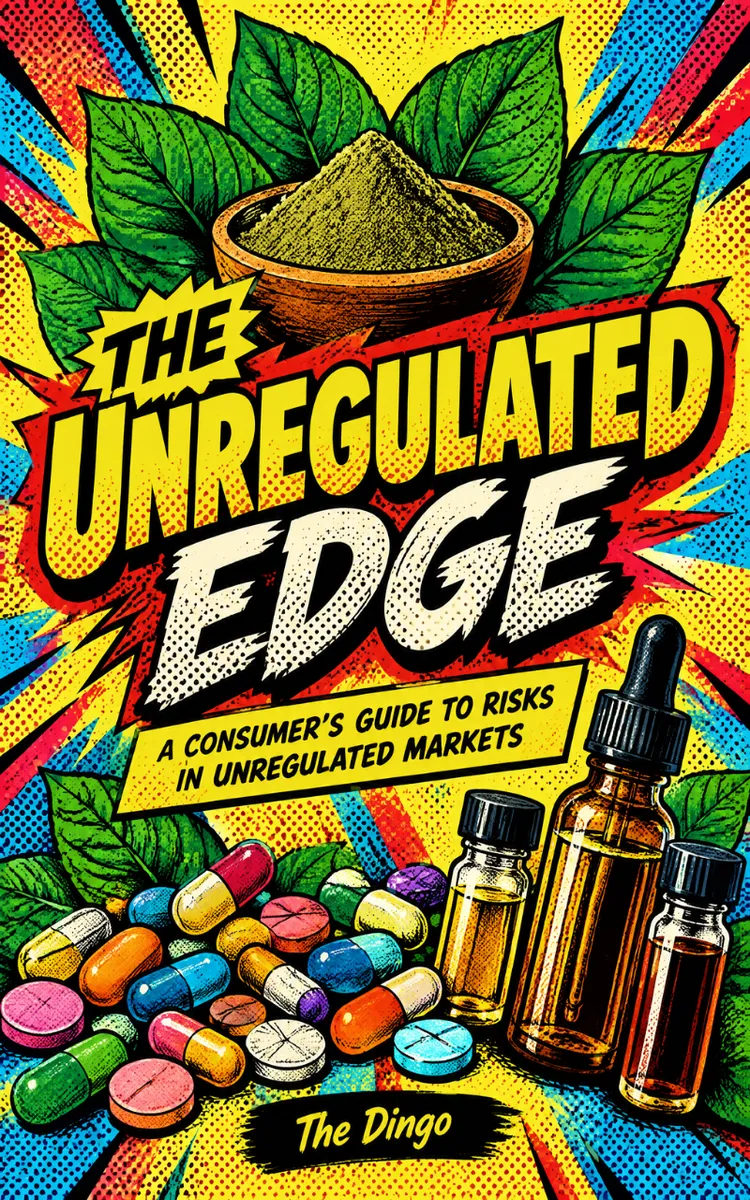
"The Unregulated Edge" is a curiosity book by The Dingo with 8 chapters and approximately 13,313 words. Risks posed by unregulated products such as Kratom, gas station energy pills, smoke shop pills, and extracts.
This book was created using Inkfluence AI, an AI-powered book generation platform that helps authors write, design, and publish complete books.
Frequently Asked Questions
What is "The Unregulated Edge" about?
Risks posed by unregulated products such as Kratom, gas station energy pills, smoke shop pills, and extracts
How many chapters are in "The Unregulated Edge"?
The book contains 8 chapters and approximately 13,313 words. Topics covered include What’s Really in a Gas-Station Pill?, When Kratom Extracts Outpace the Leaf, The Loophole Behind the Counter, Why One Batch Isn’t the Next, and more.
Who wrote "The Unregulated Edge"?
This book was written by The Dingo and created using Inkfluence AI, an AI book generation platform that helps authors write, design, and publish books.
Write your own curiosity book with AI
Describe your idea and Inkfluence writes the whole thing. Free to start.
Start writingCreated with Inkfluence AI


