
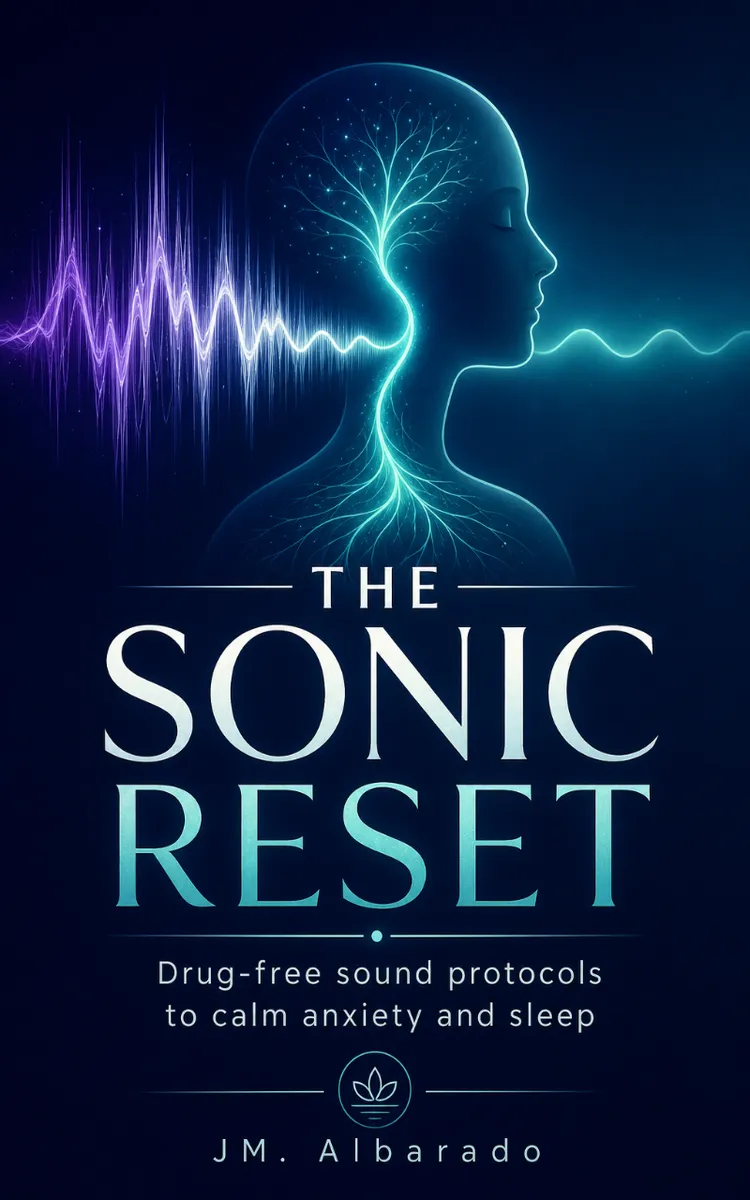
Read the first chapter
The whole of chapter one, free. About 9 min. Turn the pages with the arrows, your keyboard, or a swipe.
Chapter 1
Chronic Stress and Psychoacoustic Biology
A single night of interrupted sleep can leave your body running “hot” for days - but it’s not just willpower. When your nervous system stays in sympathetic arousal (fight-or-flight), your ear doesn’t merely “hear” sound. It can translate vibration into signals that your brain reads as threat, which then worsens anxiety and keeps sleep from landing. In fact, many people notice that the very sounds they used to tolerate - alarms, traffic, a partner’s breathing - start to feel sharper, more demanding, and harder to ignore. That shift is not imaginary. It’s biology.
Nadia, 34, an ICU nurse working rotating night shifts, described it like this: “My headset used to be soothing. Now even soft music feels like it’s poking me.” She didn’t need more information - she needed a map of what was happening under the hood, so she could choose sound intentionally instead of hoping her nervous system would “calm down on its own.” This chapter gives you that map, using our Stress-Sound Loop Model: stress changes how your body processes sound, and sound feedback can either keep the loop stuck or help loosen it.
Chronic Stress and the Ear - Brain Loop: What Changes and Why
Chronic stress doesn’t only make you feel tense. It reshapes how your nervous system regulates arousal, attention, and sensory filtering. Under sympathetic arousal, the body prioritizes readiness: faster breathing, tighter muscles, heightened vigilance, and a brain that scans for “something to fix.” Your sleep system has to compete with that scanning. When it loses, you fall asleep lighter, wake more often, and feel like your brain never fully powers down. Over time, the brain learns from what happens repeatedly - especially the moments when you couldn’t turn off.
Here’s what this chapter helps you expect: you’ll understand why anxiety and insomnia often come with sound sensitivity, why calming playlists sometimes fail, and how “noise” can become emotionally charged. You’ll also learn how vibration becomes nervous system signals - so you can stop blaming yourself for feeling overwhelmed and start working with your physiology.
Who this is for: people with anxiety and insomnia (and the therapists supporting them) who want a science-grounded, sound-focused explanation of how stress reshapes the ear - brain loop. Key benefits you can feel quickly: - clearer sense of why your nervous system responds “too strongly” to sound - practical language to describe your experience to a therapist (or to yourself) - a foundation for later protocols that use precise frequencies and timing to shift arousal
Mechanistically, think of two systems working in opposite directions. When the sympathetic system dominates, the brain and body become more reactive. When the parasympathetic system dominates, the body becomes more restorative. The ear is the bridge between the physical world and your nervous system state.
To make this real, use the Stress-Sound Loop Model:
1. Sympathetic arousal changes sensory processing. The brain becomes better at detecting potential threat and quicker to flag “important” sensations. 2. The ear converts vibration into neural signals. Sound waves move through the outer ear, vibrate the eardrum and ossicles, and then stimulate the cochlea. Inside the cochlea, tiny hair cells convert mechanical vibration into electrical activity. 3. The brain interprets those signals through the current state. With sympathetic arousal high, the same acoustic input can be tagged as more urgent - so it grabs attention, disrupts downshifting, and interferes with sleep onset.
Plain language version: sound isn’t just sound. It’s sound traveling through an organism that’s either ready to rest or ready to react.
Ask yourself: when you’re most anxious, does sound feel louder - or does it feel more “meaningful,” like it demands action? That “meaning” is where the loop lives.
Health Foundations: Risk Factors and Common Drivers of the Loop
Chronic stress primes the loop through repeated patterns: short sleep, irregular schedules, ongoing hypervigilance, and constant scanning. Several risk factors make the sympathetic-to-parasympathetic shift harder:
• Shift-work and circadian disruption, which repeatedly pulls your brain out of its usual sleep timing. - Long-term stress exposure (work pressure, caregiving load, trauma history), which keeps threat-detection circuits more active. - Sleep fragmentation, where frequent awakenings train the brain to stay alert. - High baseline anxiety, which lowers the threshold for “sound = significance.” - Sensory oversensitivity (sometimes felt as sound intolerance), where the ear - brain system amplifies the emotional impact of auditory input.
For readers who like precision: sympathetic arousal is not a diagnosis - it’s a state. You can feel it in your body (jaw tightness, shallow breathing, racing thoughts) and in your perception (sound feels sharp, distracting, or intrusive). That state matters because psychoacoustics - the way sound properties affect perception - interacts with it.
Here’s the key psychoacoustic idea for this chapter: your nervous system is more sensitive not only to loudness, but also to rapid changes, abrupt onsets, and frequency content that your brain tags as attention-grabbing. When you’re in a sympathetic state, the brain tends to treat “novel” or “spiky” acoustic patterns as relevant. That’s how ordinary sound can become a sleep blocker.
Clinical takeaway: If you want your future protocols to work, you first need to reduce the “threat tag” that your brain attaches to sound while you’re trying to sleep.
Practical Protocol: A “Sympathetic-Downshift” Sound Reset (45 Minutes)
You don’t need to start with Delta brainwave claims or fancy gear. You need a structured downshift that gives your nervous system a predictable sequence: predictable input, gradual change, and a clear boundary between “day vigilance” and “night restoration.” Use this as your first experiment - especially if you notice sound sensitivity at night.
What you’ll do - Gradually reduce arousal with controlled sound characteristics. - Train your ear - brain loop to stop treating sound as urgent. - Measure your response by tracking two simple outcomes: (1) how fast you feel calmer, and (2) whether you stay asleep longer.
Setup (do this the same way every time) Choose one audio method and stick to it for the first week: - Headphones if you’re very reactive to room noise (keep volume comfortable, not “pushing”). - Speakers if you feel trapped by headphones or tend to tense your jaw when wearing them.
If you’re using headphones, keep volume at a level where you could still hear your room if you needed to.
The 45-minute “Stress-Sound Loop” evening protocol 1) Minutes 0-10: Downshift the alarm response (brown noise bed) - Play brown noise at a steady level. - Duration: 10 minutes. - Target: a smooth, non-rhythmic sound with minimal peaks. - Completion check: ask yourself, “Did I stop scanning for specific sounds?”
2) Minutes 10-25: Stabilize attention with slow rhythmicity (isochronic-style pacing) - Use a simple tone track designed for slow pacing: 10 Hz pulses. - Duration: 15 minutes. - Keep it steady - no volume swells. - Completion check: ask, “Do I feel less ‘pulled outward’ by sound?”
3) Minutes 25-35: Soften frequency edges (low, warm tone) - Use a single sustained tone around 120 Hz (or a gentle harmonic pad centered near that range). - Duration: 10 minutes. - Target: fewer abrupt changes; let the ear stop “working.” - Completion check: notice if your breathing becomes slower without you forcing it.
4) Minutes 35-45: Let the mind stop negotiating (quiet interval + fade) - Reduce sound intensity gradually over the last 5 minutes (a fade-down). - Then finish with 5 minutes of near-quiet (stillness is part of the training). - Completion check: ask, “Did I feel safer with less sound?”
Progression milestones (use for 7 nights) - Nights 1-2: stick to the exact sequence and durations above. Aim for “less scanning,” not instant sleep. - Nights 3-5: if you felt calmer but didn’t sleep well, keep the sequence but reduce volume slightly during minutes 10-25 (sympathetic brains can interpret strong pulsing as demanding). - Nights 6-7: if you tolerated it well, you can replace the 10 Hz pulses with 8 Hz pulses for minutes 10-25 to encourage slower downshifting.
Warning signs: when to get professional help Sound therapy is not a substitute for care. If you notice any of the following, pause and involve a licensed clinician or a therapist trained in sensory sensitivity: - sound suddenly feels intolerable, panicky, or physically painful - sleep disruption worsens over several sessions instead of gradually improving - you have severe anxiety symptoms, panic attacks, or persistent insomnia that isn’t improving with structured routines
If you’re a therapist reading this: include a sound-sensitivity screen (how someone reacts to volume, sudden sounds, and rhythm) before recommending protocols.
Comparison table: headphones vs speakers for sympathetic downshift
| If you… | Choose… | Why it helps in this loop | |---|---|---| | feel “jolted” by room noise | Headphones | reduces unpredictable external peaks your ear has to process | | tense up with headphones | Speakers | keeps the input softer and less “contained,” often easier on the nervous system | | wake easily to sounds | Either (but controlled) | you’re training predictability; the key is consistent sound characteristics |
Practical takeaway: Your first goal is not “perfect sleep tonight.” It’s to teach your brain that predictable sound can arrive without triggering sympathetic alarm. That’s how the loop starts to change.
Common Mistakes That Keep the Loop Stuck
When Nadia tried a random calming playlist, she felt worse - not because she did anything wrong in a moral sense, but because the acoustic pattern didn’t match the nervous system state. Here are the most frequent errors that keep the Stress-Sound Loop from loosening.
Mistake: Starting with “pretty” music that has abrupt changes - Why it happens: Many songs include dynamic rises, percussive onsets, and changing timbre. In a sympathetic state, those changes get tagged as “new information,” which pulls attention outward. - What to do instead: Use steady noise first (brown noise for 10 minutes), then add slow pacing (10 Hz for 15 minutes). Keep changes predictable.
Mistake: Turning volume up to “feel it” - Why it happens: Louder input can increase cochlear stimulation and perceived urgency. If your nervous system is already on high alert, louder can mean “more threat signal,” not more relaxation. - What to do instead: Keep volume at a comfortable level where the sound supports your body, not competes with it. If you want progression, adjust frequency (like moving from 10 Hz to 8 Hz) before turning volume up.
Mistake: Skipping the near-quiet fade-out - Why it happens: The brain learns through endings. If sound cuts off abruptly or stays present right up until you try to sleep, the ear - brain loop doesn’t get the message that “we’re done with input.” - What to do instead: In the last 10 minutes, fade down and include 5 minutes of near-quiet. This is the training moment that helps the nervous system stop negotiating with sound.
Practical takeaway: In sympathetic arousal, the nervous system often interprets complexity as demand. Your job is to simplify the acoustic environment until your body can downshift on its own terms.
As you practice this, watch for one specific shift: the moment you stop “checking” the sound and start letting your attention soften. That’s the Stress-Sound Loop Model working - quietly, physically, and in a way you can build on next.
End of chapter one. 7 more chapters in the full book.
Swipe or use the arrows to turn the page


What's inside: 8 chapters
- 1. Chronic Stress and Psychoacoustic Biology
- 2. Polyvagal Sound Tuning for Vagus Reset
- 3. Binaural Beats and Solfeggio Frequency Matrix
- 4. Sonic First Aid for Acute Anxiety
- 5. Sonic Wind-Down for Delta Sleep Architecture
- 6. Bhramari Toning for Instant Vagal Tuning
- 7. Clinical Sound Safety for Hyperacusis and Consent
- 8. Your 30-Day Sonic Blueprint and Biomarker Tracking
About this book
"The Sonic Reset" is a health & wellness book by JM. Albarado with 8 chapters and approximately 15,709 words. Sound healing protocols for chronic anxiety and insomnia.
This book was created using Inkfluence AI, an AI-powered book generation platform that helps authors write, design, and publish complete books. It was made with the AI Health Book Generator.
Frequently Asked Questions
What is "The Sonic Reset" about?
Sound healing protocols for chronic anxiety and insomnia
How many chapters are in "The Sonic Reset"?
The book contains 8 chapters and approximately 15,709 words. Topics covered include Chronic Stress and Psychoacoustic Biology, Polyvagal Sound Tuning for Vagus Reset, Binaural Beats and Solfeggio Frequency Matrix, Sonic First Aid for Acute Anxiety, and more.
Who wrote "The Sonic Reset"?
This book was written by JM. Albarado and created using Inkfluence AI, an AI book generation platform that helps authors write, design, and publish books.
How can I create a similar health & wellness book?
You can create your own health & wellness book using Inkfluence AI. Describe your idea, choose your style, and the AI writes the full book for you. It's free to start.
Write your own health & wellness book with AI
Describe your idea and Inkfluence writes the whole thing. Free to start.
Start writingCreated with Inkfluence AI


