

Read the first chapter
The whole of chapter one, free. About 8 min. Turn the pages with the arrows, your keyboard, or a swipe.
Chapter 1
Why Is There No Balm?
The Question Hidden Inside the Wound
What kind of question begins by naming the medicine it cannot find? Jeremiah’s words - “Is there no balm in Gilead?” - sound at first like a request for information, but they are really an examination of absence. The physician and the remedy are both mentioned; what remains painfully uncertain is why neither has healed the people.
The line appears in Jeremiah 8:22, amid a passage shaped by invasion, grief, and national collapse. Gilead lies east of the Jordan, a region associated in the biblical imagination with resinous medicines and fragrant substances. Yet the prophet does not present its balm as a cure already applied. He turns the existence of a known remedy into a sharper question: if healing is available, why does suffering continue?
That tension gives the phrase its unusual durability. It is not a simple promise that wounds will disappear. It is a record of the moment when evidence of healing exists somewhere in the world, while the afflicted person still sees no relief.
What does it mean when the name of a cure becomes the language of an unanswered cry?
Gilead and the Reputation of Balm
Gilead was not a single town but a highland region east of the Jordan River, extending through parts of what are now Jordan and northwestern Saudi Arabia. In biblical geography, it belonged to the lands beyond the river, a place of wooded slopes, grazing country, and trade routes connecting the interior with the Levant. Its location helped make it a cultural borderland: products, armies, and stories moved through it.
The “balm” associated with Gilead was probably not one standardized substance. The Hebrew term ṣori refers to a resin or aromatic gum, and ancient sources connect such materials with trees and shrubs that produced sticky, strongly scented exudations. These substances could be used in perfumes, ritual preparations, and medicinal compounds. Balm was not a modern pharmaceutical with a fixed formula and controlled dose. It belonged to the practical world of ancient healing, where plant resins were gathered, mixed, stored, and traded.
That distinction matters. The phrase does not depend on the existence of a miraculous ointment hidden in one precise location. Its force comes from Gilead’s reputation as a place where useful medicine could be obtained. The prophet draws on a familiar cultural association, much as a modern speaker might mention a renowned hospital while asking why a patient remains untreated.
Ancient medicine often worked through substances that had several roles at once. Fragrant resins could soften irritated skin, protect a wound, mask unpleasant smells, or serve as ingredients in compound preparations. Egyptian medical papyri, Greek writers, and later Roman sources describe extensive use of plant oils, gums, and resins. Their explanations of illness differed from modern biology, but their attention to materials was often exact: where a substance grew, how it was collected, how long it lasted, and what it seemed to do.
The balm’s reputation therefore carried a practical credibility. Gilead was not merely an imaginary paradise of cure. It represented a real kind of expertise, a regional knowledge of valuable natural substances. Jeremiah’s question becomes more severe because the remedy is not unknown. It is known, named, and apparently still insufficient.
Jeremiah’s Question in a Time of Collapse
The question appears after a sequence of images that are unusually physical. Jeremiah describes harvests failing, mourners grieving, and the people asking why they remain seated while danger advances. The chapter’s language moves between public disaster and bodily pain. A nation is wounded, but the wound is not only political. It is felt in the flesh.
Jeremiah prophesied during the final decades of the kingdom of Judah, when Assyrian power had weakened and Babylon had become the dominant force in the region. Jerusalem fell to Babylon in 586 BCE, after a period of military pressure, political uncertainty, and internal division. Jeremiah’s words belong to that atmosphere of approaching catastrophe, though the book gathers material from different moments and settings.
Within this context, “Is there no balm in Gilead?” is followed by another question: “Is there no physician there?” The parallel is important. The problem is not simply that medicine has run out. The prophet asks whether a healer exists and whether the treatment is available, then answers with the devastating observation that the health of the people has not been restored.
The Wound-to-Question Lens begins here. A wound is visible, but the question searches for the failed connection between suffering and healing. If there is balm, where is it? If there is a physician, why is the patient still sick? The lens does not turn the passage into a formula. It reveals how Jeremiah converts a public crisis into an inquiry about the distance between a remedy’s existence and its actual use.
A brief comparison clarifies the structure. A bridge may stand on a map while a flooded river makes it unreachable. A medicine may be stored in a city while war prevents it from reaching the sick. Availability is not the same as access, and access is not the same as recovery. Jeremiah’s language holds all three possibilities in suspension.
The question also resists a narrow reading of healing as comfort. In the surrounding passage, the people’s suffering is connected to deception, injustice, and refusal to face reality. The wound has social causes. Balm alone cannot repair a society that continues to produce the injury. This is why the verse feels less like a prescription than an indictment: the presence of a remedy does not cancel the conditions that make healing necessary.
When a Remedy Becomes an Absence
The surprising fact is that the biblical phrase does not originally function as a straightforward promise of consolation. Its first setting is closer to a lament over failed restoration than to an assurance that healing is already at hand. The balm is present in the imagination, but absent in effect.
That reversal changes the way the phrase is heard. Later readers often treat Gilead as a symbol of spiritual medicine, and that meaning is real within the phrase’s long history. Yet the original question keeps that symbolism from becoming sentimental. Healing is not assumed simply because a cure has a name. The existence of balm makes the lack of healing more difficult to explain.
This is the counterintuitive connection at the center of Jeremiah’s image: hope can become most visible through the language of disappointment. The prophet can ask about balm because his culture believes that wounds ought to be treated. The question contains an expectation of repair, but it expresses that expectation as grief rather than confidence.
The same pattern appears in public life whenever a society possesses knowledge without delivering its benefits. A city may have hospitals but lack transport for patients. A community may understand the source of contamination while political interests delay action. A person may know the language of reconciliation while remaining trapped in an injury that language cannot touch. The gap between knowing and healing is not a minor technical problem; it is where much human anguish accumulates.
Jeremiah’s physician is therefore more than an individual practitioner. The figure stands for the possibility that the wound can be diagnosed and treated. When the people remain unhealed, the question reaches beyond medicine. It asks what has happened to judgment, responsibility, and communal care.
The passage also explains why the phrase could later travel so successfully into art. Its structure is open. It does not close suffering with a neat answer, yet it does not abandon the idea of cure. A lyricist, preacher, or poet can enter that space between the question and the missing response.
A People Wounded in Public
The abstract tension becomes clearer when placed beside the historical experience of Judah under Babylonian pressure. The threat was not an isolated illness affecting one household. Military defeat could mean destroyed crops, broken trade routes, forced movement, political subordination, and the loss of the temple as the center of national life. The wound was distributed across bodies, families, institutions, and memory.
Jeremiah’s prophetic work was bound to that public crisis. He spoke in Jerusalem during the reigns of kings including Josiah, Jehoiakim, and Zedekiah, a period marked by reform, resistance, and competing hopes about foreign alliances. His message was often unwelcome because it treated catastrophe not as a temporary inconvenience but as a consequence requiring moral and political reckoning.
Against that background, Gilead’s balm becomes almost painfully concrete. A trader could know the value of resin. A healer could apply a preparation to damaged skin. But neither commercial knowledge nor medical skill could by itself restore a city threatened by imperial power. The image brings a household remedy into contact with a national disaster and exposes the scale of the mismatch.
Jeremiah’s question does not deny that balm may soothe a wound. It asks whether soothing is enough when the wound keeps being inflicted. That distinction separates treatment from cure. A salve can protect damaged tissue while the larger danger remains; a physician can identify disease while the patient lacks food, safety, or the ability to follow treatment. The prophet’s language is medically familiar and politically unsettling.
The community at the center of the passage is therefore not simply searching for comfort. It is confronting the failure of restoration at every level. The people have wounds, but also habits and structures that deepen them. They possess religious language, political arguments, and inherited knowledge, yet none has produced health. The absence of balm is partly an absence of effective response.
The Question That Refuses to Close
Human beings often name remedies before they can provide them. We preserve the word for the medicine, the memory of the physician, and the story of the place where healing was once found. Jeremiah shows that these names can serve two purposes at once: they keep the possibility of repair alive, and they make unhealed suffering harder to ignore.
That double meaning is why “Is there balm in Gilead?” has endured beyond its original setting. It carries the ache of a wound and the stubborn evidence that healing is not an absurd idea. The question does not resolve the distance between the two. It leaves that distance audible.
A remedy becomes a symbol not when it erases pain, but when its absence forces a society to ask what healing would require. Somewhere between Gilead’s fragrant resin and Jeremiah’s devastated people, a larger mystery remains: how can the world contain medicines, physicians, and knowledge, yet still leave so many wounds waiting?
End of chapter one. 14 more chapters in the full book.
Swipe or use the arrows to turn the page


What's inside: 15 chapters
- 1. Why Is There No Balm?
- 2. Gilead’s Famous Healing Resin
- 3. Jeremiah’s Grief Behind the Phrase
- 4. What the Hebrew Word Heals
- 5. From Scripture to Common Speech
- 6. A Hymn Turns Balm into Hope
- 7. The Spiritual’s Hidden History
- 8. How Singers Make Healing Audible
- 9. When Writers Borrow the Balm
- 10. Marilynne Robinson’s Gilead Reimagined
- 11. The Balm in Public Mourning
- 12. Healing Without Easy Answers
- 13. Who Gets to Name the Wound?
- 14. Balm Beyond the Bible
- 15. The Question That Keeps Healing
About this book
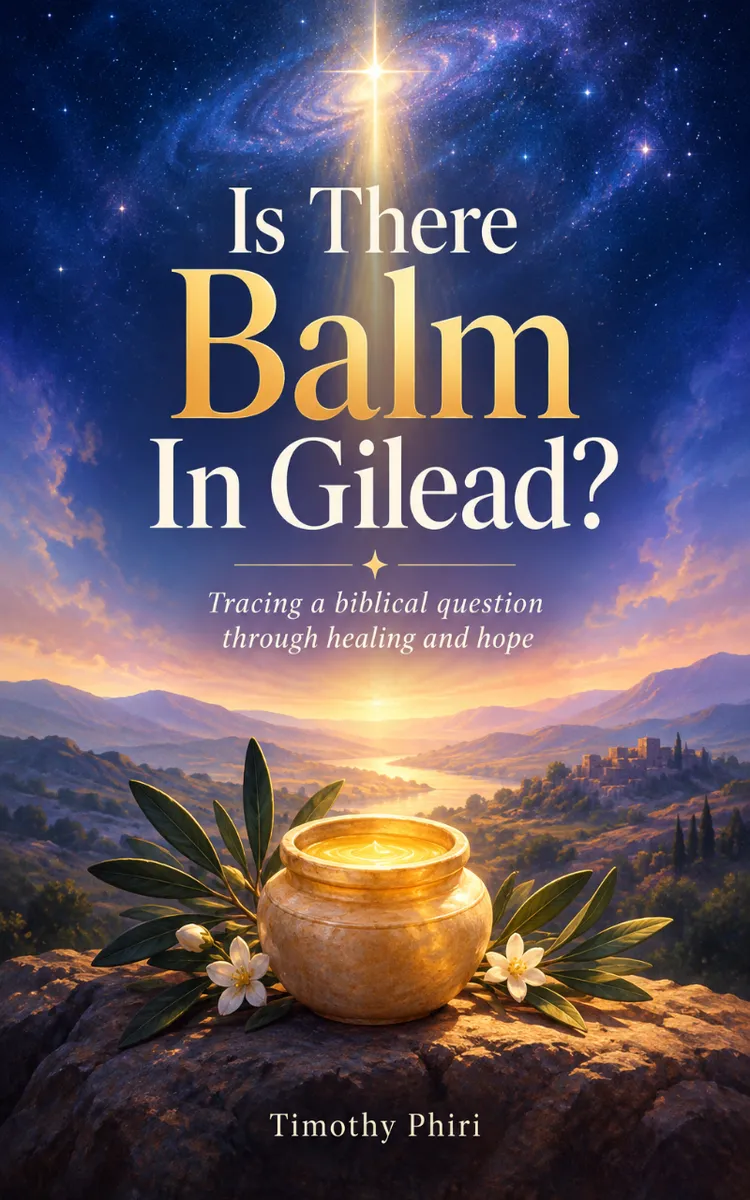
"Is There Balm In Gilead?" is a curiosity book by Timothy Phiri with 15 chapters and approximately 24,165 words. The biblical phrase’s origins and its influence in literature and music.
This book was created using Inkfluence AI, an AI-powered book generation platform that helps authors write, design, and publish complete books.
Frequently Asked Questions
What is "Is There Balm In Gilead?" about?
The biblical phrase’s origins and its influence in literature and music
How many chapters are in "Is There Balm In Gilead?"?
The book contains 15 chapters and approximately 24,165 words. Topics covered include Why Is There No Balm?, Gilead’s Famous Healing Resin, Jeremiah’s Grief Behind the Phrase, What the Hebrew Word Heals, and more.
Who wrote "Is There Balm In Gilead?"?
This book was written by Timothy Phiri and created using Inkfluence AI, an AI book generation platform that helps authors write, design, and publish books.
Write your own curiosity book with AI
Describe your idea and Inkfluence writes the whole thing. Free to start.
Start writingCreated with Inkfluence AI


