

Read the first chapter
The whole of chapter one, free. About 9 min. Turn the pages with the arrows, your keyboard, or a swipe.
Chapter 1
A Box of Copper Pans
The elevator opened straight into a kitchen.
Elena stepped out with a cardboard box pressed against her hip. Copper pans peeked over the top, their round bottoms glowing like small suns. Behind her, the elevator doors slid shut without a sound.
She stood still for a moment.
The penthouse kitchen spread beneath walls of glass. The city glittered beyond them, bright and busy, but inside, everything was quiet. White stone covered the counters. Brushed steel shone beneath the lights. Not one spoon, towel, or crumb sat out of place.
Elena shifted the box in her arms. The cardboard rubbed against her sleeve, and the pans gave a soft, familiar clink.
“This is the last one,” she whispered.
The box held the final pieces of her old bistro: two saucepans, a wide frying pan, a dented little pot for warming milk, and her favorite copper kettle. She had carried them through years of early mornings, busy lunches, and warm evenings filled with the smell of bread.
Now the bistro was closed.
Ten days remained before collection proceedings began over the lease. Ten days to find a way to keep what she had built. Ten days to make a new plan.
She set the box on the nearest counter.
A tiny white mark showed on the shining stone.
Elena reached for her sleeve to wipe it away, but a voice came from the doorway.
“Please don’t put boxes there.”
She turned.
Julian stood near the hall, one hand resting on the doorframe. He wore a neat gray shirt with the sleeves rolled to his elbows. His dark hair was still damp, as if he had just washed it. He looked at the box first, then at the mark.
“Sorry,” Elena said. “I’ll move it.”
“There’s a table near the pantry.”
“I didn’t see it.”
“It’s behind you.”
Elena looked. A narrow table stood against the wall. It was the same pale color as the counters, so pale that it nearly vanished.
She lifted the box again. The pans shifted inside.
Julian watched her carry it across the room. “That’s the last box?”
“Yes.”
“Then you’re finished unpacking.”
“I suppose I am.”
He nodded, as if she had answered a question on a form. “Good.”
Elena placed the box on the hidden table. The copper kettle knocked gently against a pan.
The sound made the kitchen feel less empty.
Julian walked to the island. A thin folder lay there, lined up exactly with the edge. He opened it and took out a single sheet of paper.
“These are the house rules,” he said.
Elena glanced at the page. “House rules?”
“For the kitchen.”
She looked around. The room already seemed to have rules written into every surface.
Julian held out the paper. Elena took it.
“No food outside the kitchen,” she read.
“Yes.”
“No guests.”
“Yes.”
“No changes to the counters, shelves, or appliances without asking.”
“That one makes sense,” Elena said.
Julian’s mouth moved, almost like a smile, but it disappeared quickly.
“Meals should be planned in advance,” he added. “The kitchen is cleaned after use. Nothing is left in the sink.”
Elena looked at the empty sink. It was so clean that she could see the lights reflected in it.
“Do you ever cook here?” she asked.
“Sometimes.”
“What do you make?”
“Whatever is easy.”
“That sounds lonely.”
Julian’s fingers tightened around the folder. “It’s efficient.”
Elena heard the small change in his voice. She looked back at the page.
At the bottom, in smaller letters, was one more rule.
“No guests.”
She tapped the line. “Not even one?”
“No.”
“What if someone brings you a gift?”
“They can leave it with the building staff.”
“What if someone needs to sit down?”
“There are chairs in the hall.”
Elena studied him. He wasn’t angry. He didn’t look unkind, either. He looked tired, though, in a way that made the bright kitchen seem even brighter around him.
“Your kitchen has more rules than my bistro ever did,” she said.
“Your bistro had rules?”
“Of course. Wash your hands. Keep the bread covered. Don’t put a hot pan on the wooden table.” She rested her hand on the copper box. “But people were allowed to laugh.”
Julian looked toward the glass wall. Far below, tiny cars moved along the streets. Their lights slipped between the tall buildings like beads on a string.
“People make messes,” he said.
“They do.”
“They leave things behind.”
“They do that, too.”
“Then why invite them in?”
Elena thought of her old bistro. She could almost smell tomato soup simmering in the big pot. She could hear chairs scraping the floor and the bell above the door ringing again and again. The place had never been perfect. A floury handprint might appear on a wall. Someone might spill tea. A child might drop a biscuit.
Still, people had come back.
“Because they bring things, too,” she said. “Stories. Good news. Sometimes a very funny hat.”
Julian looked at her.
“A very funny hat?” he asked.
“One customer wore a yellow hat shaped like a lemon.”
For the first time, Julian smiled. It was small, but it stayed.
Then his eyes moved to the copper box.
“You won’t need those here.”
Elena’s smile faded. “I might.”
“The kitchen has pans.”
“I can see that.”
“They’re newer.”
“They’re also not mine.”
Julian folded the rules sheet in half. “You’re here to work, Elena. I need the kitchen kept in order.”
“And I need to cook.”
“You can cook with what’s here.”
Elena opened the box.
The copper pans shone under a layer of brown paper. One handle was dark from years of use. The little milk pot had a small dent near its rim. She touched it with two fingers.
“My mother gave me this,” she said. “It came to the bistro with me on the first day.”
Julian said nothing.
“I’m not asking to change your kitchen,” Elena continued. “I’m asking for one shelf.”
“Which shelf?”
“The one by the stove.”
“That shelf is empty.”
“Exactly.”
Julian looked at the shelf, then at the box. “It’s empty for a reason.”
“What reason?”
“So it stays empty.”
The words landed softly, but they still hurt.
Elena closed the box. She had hoped this place might be a beginning. Instead, it felt as if she had brought a piece of her life into a room that did not want pieces.
She lifted the box from the table.
“I’ll keep them in my room,” she said.
“That’s fine.”
“My room is not a kitchen.”
“I know.”
“And a copper pan doesn’t like being packed away.”
Julian’s brow creased. “Pans don’t have feelings.”
“No,” Elena said. “But people do.”
The kitchen grew quiet again.
She carried the box toward the hall. It was heavier now, though the pans had not changed. At the doorway, she stopped.
Julian had returned to the folder. His shoulders were straight, and his face was calm. Yet his hand rested on the same page without turning it.
Elena looked at the empty shelf.
Then she looked at the spotless counters, the unused chairs, and the wide room meant for cooking.
“Where do you eat?” she asked.
“At the island.”
“Alone?”
“Usually.”
“Usually?”
“When I’m here.”
“And when you’re not here?”
“I eat elsewhere.”
Elena nodded. She understood something then. Julian had built a kitchen that could not surprise him. Nothing could spill. No one could arrive without warning. No pan could remind him of a time before the room became so still.
The rules were not only about cleaning.
They were about keeping everything away.
That did not mean she could break them. It meant she needed to listen before trying to help.
Elena set the box down once more.
“I won’t use the shelf without asking,” she said.
Julian looked up.
“But may I ask now?”
His eyes moved from her face to the box. He seemed to consider the question carefully.
“One shelf,” he said at last. “The lower one.”
“The lower one is hard to reach.”
“It’s still a shelf.”
Elena smiled a little. “Fair enough.”
She carried the pans to the lower cupboard. The door opened with a soft click. Inside, rows of white plates waited in perfect stacks.
She placed the copper kettle at the front.
Julian watched.
“Not there,” he said.
Elena paused. “Why not?”
“It will scratch the plate.”
She lifted the kettle. “Then where?”
He pointed to a cloth tucked beside the sink. “Put that underneath.”
Elena spread the cloth on the shelf and set the kettle down. The copper looked warm against all the white.
Julian studied it.
“It’s brighter than the plates,” Elena said.
“I noticed.”
“Does that bother you?”
He looked at the kettle again. “No.”
It was a small answer, but it felt like a door opening.
Elena placed the pans beside it, one inside another. The dented milk pot went last. She left the cupboard door open.
Julian glanced at it.
“Is that allowed?” she asked.
“The cupboard should be closed.”
She closed it.
The copper disappeared.
For a moment, neither of them spoke.
Then Elena opened the cupboard again.
Julian blinked. “What are you doing?”
“I’m checking whether the kettle is still there.”
“It is.”
“Good.” She closed the door. “Now I know.”
A quiet breath escaped him. It might have been a laugh.
Elena picked up the rules sheet and handed it back. “I’ll follow your rules. But I need you to tell me when a rule is about the kitchen and when it’s about being alone.”
Julian’s face changed. Not much. Just enough for her to see that the question had reached him.
“I don’t know if I can tell the difference,” he said.
“That’s all right. We can take our time.”
“We?”
“If I’m working here, yes. A kitchen is easier to understand when two people look at it.”
Julian glanced at the empty room. “There will be no guests.”
“I heard you.”
“And meals will be planned.”
“I heard that, too.”
“No food outside the kitchen.”
“I promise.”
He nodded, but he did not pick up the folder.
Elena opened the box of copper pans again and lifted out the little milk pot. “I’m going to make tea.”
“The kettle is in the cupboard.”
“I know.”
“You’ll need to take it out.”
“That’s usually how kettles work.”
This time, Julian did laugh. It was quiet and quick, but it warmed the room.
Elena filled the kettle. Water rushed against the copper with a bright, ringing sound. She set it on the stove, and soon a soft hiss rose into the air.
Julian stood beside the island, listening.
“Would you like some?” Elena asked.
He looked at the empty chairs in the hall, then at the cup she had placed on the counter.
“Tea is food?”
“No. It’s tea.”
“Then it doesn’t break the rule.”
“That depends. Are you planning to drink it in the kitchen?”
“Yes.”
“Then you’re safe.”
He came closer, but stopped a few steps away.
Elena noticed. She didn’t move toward him.
She poured the tea into two cups and placed one near the edge of the island. Then she stepped back.
Julian waited.
“You can choose,” she said.
He looked at the cup. He looked at her. Finally, he picked it up.
The copper kettle gleamed behind him. The city shone through the glass. Nothing in the kitchen was quite as perfect as before. A cloth lay folded by the stove. Two cups stood on the island. A box had left a faint mark on the counter.
Julian took a sip.
“It’s good,” he said.
Elena wrapped both hands around her cup. “It tastes better when someone else makes it.”
“Is that another rule?”
“No. That one is just true.”
They sat at the island, with space between them and the rules still in place.
For the first time, the kitchen did not feel empty. It felt like a room waiting to learn what it was for.
Elena looked at the copper pans tucked safely away. Her old life was not fixed. The ten days still waited for her. But the pans had found a place, and Julian had chosen to share a cup of tea.
Sometimes, a beginning could be that small.
A kitchen becomes a home when people care for one another, not when every surface is perfect.
End of chapter one. 11 more chapters in the full book.
Swipe or use the arrows to turn the page


What's inside: 12 chapters
- 1. A Box of Copper Pans
- 2. Three Meals and a Warm Bowl
- 3. The Garden Behind the Lock
- 4. A Cup of Assam Tea
- 5. The Name in the Ledger
- 6. The Gate Must Open
- 7. A Quiet Recipe for Trust
- 8. A Table Set by Choice
- 9. The Garden That Listened
- 10. A Cup Between Two Choices
- 11. A Table Set by Choice
- 12. You Took The Lead
About this book
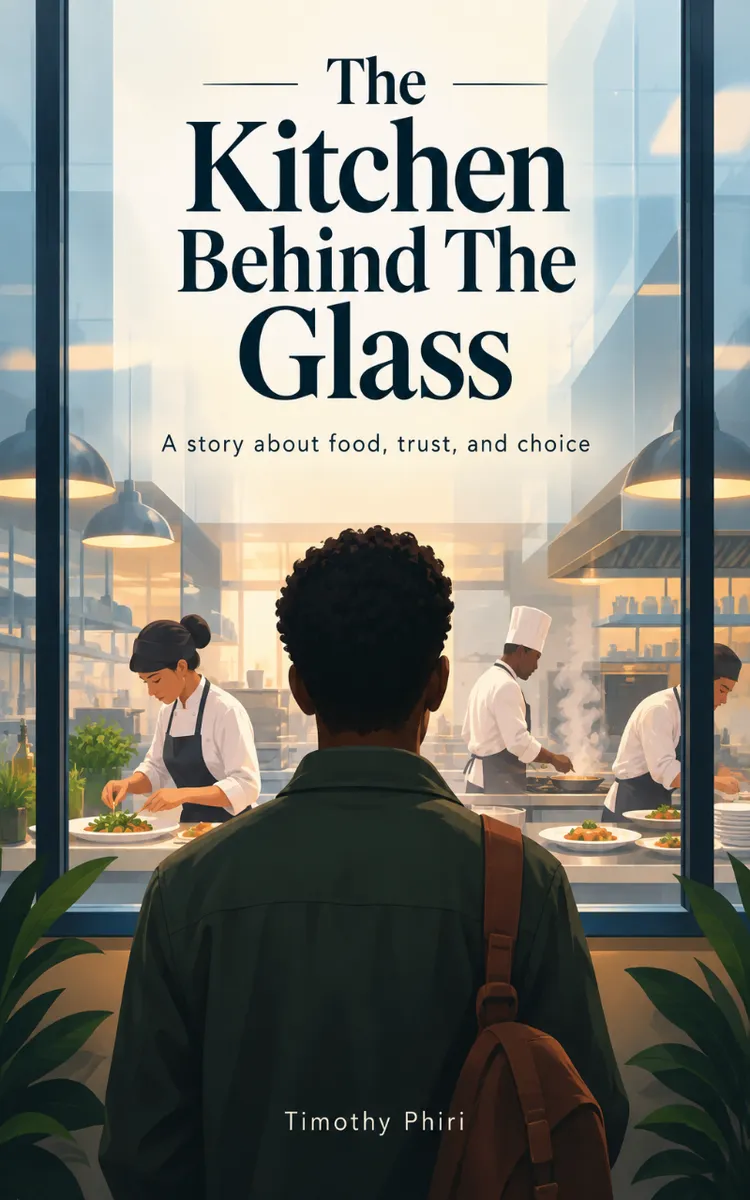
"The Kitchen Behind the Glass" is a children's book by Timothy Phiri with 12 chapters and approximately 20,187 words. In a shining city penthouse, a determined cook and a lonely businessman learn that caring for someone means listening, respecting boundaries, and letting them choose..
This book was created using Inkfluence AI, an AI-powered book generation platform that helps authors write, design, and publish complete books. It was made with the AI Children's Book Creator.
Frequently Asked Questions
What is "The Kitchen Behind the Glass" about?
In a shining city penthouse, a determined cook and a lonely businessman learn that caring for someone means listening, respecting boundaries, and letting them choose.
How many chapters are in "The Kitchen Behind the Glass"?
The book contains 12 chapters and approximately 20,187 words. Topics covered include A Box of Copper Pans, Three Meals and a Warm Bowl, The Garden Behind the Lock, A Cup of Assam Tea, and more.
Who wrote "The Kitchen Behind the Glass"?
This book was written by Timothy Phiri and created using Inkfluence AI, an AI book generation platform that helps authors write, design, and publish books.
How can I create a similar children's book?
You can create your own children's book using Inkfluence AI. Describe your idea, choose your style, and the AI writes the full book for you. It's free to start.
Write your own children's book with AI
Describe your idea and Inkfluence writes the whole thing. Free to start.
Start writingCreated with Inkfluence AI


