

Read the first chapter
The whole of chapter one, free. About 9 min. Turn the pages with the arrows, your keyboard, or a swipe.
Chapter 1
Reclaiming Your Identity After Divorce
The Moment Tanya Stopped Calling Herself “Her Job”
The first thing Tanya did after the divorce papers were filed wasn’t buy a new planner or decorate a fresh start. It was stand in her kitchen with her coffee cooling, staring at a tote bag from the school office like it had suddenly turned into evidence. She kept thinking, I’m going to lose my identity. And then, like a slap of cold water, she realized she’d been saying that for years - just without the divorce part. The marriage had simply put a name on what she’d already been doing: shrinking herself to fit.
The next morning she walked into her middle-school office and felt the weirdest double-life sensation. The principal voice was still there - calm, competent, ready for whatever the day threw at her. But underneath it, she had this hollow feeling like she was acting out a role someone else wrote. A student asked about a science fair, a parent asked about a schedule change, and Tanya answered… beautifully. Then, at lunch, she stared at her own handwriting on a permission slip and couldn’t recognize the woman who wrote it. Not because she didn’t know how to do her job. Because she didn’t know how she wanted to live.
That’s the tension you’re living with too: you’re not just grieving a marriage - you’re grieving the self you built while you were trying to keep it alive.
---
When Your Worth Gets Caught in the Marriage: Identity Rebuild Map Signals
Tanya’s identity problem wasn’t that she lacked strengths. It was that she’d been using the marriage like a mirror - measuring herself by whether it was “working,” whether he was pleased, whether things stayed calm. When the mirror shattered, she didn’t just lose a relationship. She lost her internal reference point.
Here are a few real-life patterns I’ve seen show up again and again - each one with its own label, because naming it makes it less slippery.
Example 1: “I’m Only Valuable When I’m Needed” Tanya had it in a school-safe way: people depended on her. When the divorce happened, that dependency didn’t vanish - just the marriage shifted her into a different kind of responsibility. She started catching herself trying to earn peace the way she earned trust at work.
Example 2: “My Feelings Are a Problem” You might recognize this as the habit of tightening your chest when you feel angry, sad, or hurt - like emotions are something you have to manage before they “cause trouble.” Tanya did it with competence. If she could stay organized, she didn’t have to feel how abandoned she felt.
Example 3: “I Don’t Know Who I Am Without the Story” After divorce, the old story ends, but the mind keeps replaying it. Tanya would catch herself narrating her life like a courtroom case: Here’s what he did, here’s what I endured, here’s what I should’ve seen. The story kept her busy. It also kept her from asking a different question: Who am I when I’m not defending the past?
• What all these have in common: They’re all forms of worth being outsourced - handed over to a marriage dynamic, a role, or a narrative that decides who you are.
Underneath those patterns is a simple truth that can feel unfair: your nervous system learns “belonging” the way a body learns a routine. If your marriage taught you that safety came from being useful, agreeable, or constantly on guard, your identity grew around that survival structure. So when the marriage ends, the survival structure doesn’t instantly disappear. It just loses its job - and then you feel lost.
That’s where the Identity Rebuild Map comes in. Not as a fancy concept. As a way to separate you from the marriage’s job description. The Map helps you notice what you used to do to keep your worth intact - and then rebuild a self-concept you can trust even when your life is messy.
---
The Psychology Shift That Lets You Stop Drowning in “Me vs. Him”
Here’s what changes everything: you shift from evaluating your worth based on the marriage to observing how the marriage influenced your sense of self. That might sound like a word game, but it’s not. It’s the difference between, “I’m failing because it ended” and “I adapted. I can un-adapt.”
When a relationship breaks, many women don’t just lose a person - they lose the meaning they used to hang their identity on. The brain hates a missing label. It wants to fill the gap fast. So it reaches for familiar patterns: over-explaining, over-functioning, trying to be “reasonable,” trying to control the outcome through being perfect. Those strategies might have made sense when you were trying to keep the peace. They don’t serve you now.
Tanya noticed it most in small moments. She’d catch herself preparing for conflict even when nothing was happening - like her body had memorized the marriage’s weather. Then she’d try to “fix” herself. If she was calmer, maybe he would be calmer. If she was more organized, maybe she’d feel whole. But the marriage wasn’t a solution anymore. It was the past. And her worth couldn’t be negotiated with what already happened.
A few clear signs you need this chapter:
1. You still measure your days by whether you’re “handling things well,” instead of by whether you’re living as yourself. 2. You find yourself speaking and acting from the old role - teacher, caretaker, fixer - even when no one asked. 3. When you try to picture your future, you feel foggy, not excited - like your self is missing a name. 4. You keep returning to the same internal debate: Was I too much? Not enough? - as if the marriage is still grading you.
Bold truth-summary: Your identity doesn’t rebuild by thinking harder about the marriage - it rebuilds by choosing what you stand for when the marriage has stopped speaking.
That choice is uncomfortable at first, because it means you can’t rely on the old feedback system. No more reading his moods like weather reports. No more “if I do X, maybe I’ll get Y.” You’re building a self that answers from inside.
And yes, that’s work. But it’s the kind of work that makes you feel more like you - because it’s not about proving anything. It’s about returning.
---
Naming What’s Yours Again: Journal Prompts to Rebuild Your Self-Concept
You don’t need a dramatic breakthrough. You need a set of honest conversations with yourself - on paper, with no audience and no negotiation.
1. “What did I do in the marriage that I mistook for my personality?” Write one example from daily life: how you handled conflict, how you managed money, how you responded to criticism. Then circle the part that feels like “me,” and underline the part that feels like “adaptation.”
2. “When I feel worthy, what am I actually doing?” Tanya wrote: I’m usually fixing, preparing, preventing. She realized her worth wasn’t a feeling - it was a behavior. Now she could ask, “What would I do if I didn’t have to prevent anything?”
3. “Where do I still outsource my self-trust?” Maybe it’s checking his social media, replaying conversations, or waiting for someone else’s approval to feel okay. Name the exact place your mind hands over the steering wheel.
4. “What parts of me did the marriage shrink?” Not the obvious ones - the deeper ones. Did you stop sharing opinions? Did you stop dressing in a way that felt like you? Did you stop saying “no”? Write it plainly, even if it makes you feel sad.
5. “If my identity wasn’t on trial, what would I start doing this month?” Make it small enough to be real: one appointment you’ve been avoiding, one friend you want to call, one boundary you can practice. Keep it grounded in action, not fantasy.
If you’re tempted to make your answers “nice,” try this instead: write what’s true, then add one sentence that begins with, And I’m learning… That second sentence is where rebuilding starts.
---
The 7-Day “Identity Back in the Driver’s Seat” Challenge
You don’t have to overhaul your life in a week. You do have to interrupt the old pattern - the one where your worth depends on the marriage’s ghost still roaming your mind.
Challenge Name: Identity Back in the Driver’s Seat (7 Days)
Difficulty level: Moderate (because it asks for honesty, not just organization)
Daily instructions (pick a time you can keep): - Day 1: Write one sentence: “My worth is not up for evaluation by ____.” Fill in the blank with the exact person, dynamic, or outcome that still runs your internal courtroom. - Day 2: Choose one role you performed in the marriage (the peacemaker, the organizer, the silent one). Then write: “That role helped me survive, but it cost me __.” - Day 3: Do one “identity micro-action” that has nothing to do with him or the divorce. Examples: a walk route you love, a hobby you used to claim, a meal you choose without checking anyone’s preferences. - Day 4: Create a “self-trust sentence” and say it out loud once today: “I can trust myself to __, even when I feel unsettled.” - Day 5: Write a short letter you won’t send. The goal is not closure. The goal is to stop feeding the same loop with the same unanswered questions. - Day 6: Notice one moment you start outsourcing worth (approval-seeking, rumination, overexplaining). Write: “I’m doing this because ____.” Then write one alternative action you can do instead (drink water, step outside, text a friend, take ten minutes). - Day 7: Review your seven days and pick one sentence that feels most true. Put it somewhere you’ll see it tomorrow.
Celebrate when… (observable wins): - You catch yourself outsourcing worth and name it within the same day (even once). - You complete at least one identity micro-action that belongs to you, not the marriage. - You write a self-trust sentence and mean it - at least 10% of the time. - You stop turning every thought into an argument with your past.
If you miss a day, don’t punish yourself. Just restart at the next day. Rebuilding is about returning, not performing.
---
Your Worth Isn’t a Case File: The Identity Rebuild Map Takeaway
Here’s the core lesson, in plain language: when you separate your worth from the marriage, you stop treating your life like it needs a verdict - and you start building a self you can trust again.
• You’ll recognize how worth gets outsourced through roles, feelings-as-problems, and story-holding. - You’ll shift from evaluating your worth based on the marriage to observing how it shaped you. - You’ll use the Identity Rebuild Map approach to reconnect to your actions, values, and self-trust. - You’ll practice real rebuilding through journaling and a 7-day challenge that creates new evidence.
You don’t need to feel “fully healed” to reclaim your identity. You just need to start collecting proof - small, steady proof - that you’re not only what the marriage happened to you. And the momentum you build here becomes the foundation for the next step: letting go of the old story without losing the parts of you that survived.
End of chapter one. 7 more chapters in the full book.
Swipe or use the arrows to turn the page


What's inside: 8 chapters
- 1. Reclaiming Your Identity After Divorce
- 2. Breaking the Divorce Story You Believe
- 3. Building Boundaries Without Guilt
- 4. Communicating Clearly When It’s Hard
- 5. Healing Your Nervous System Daily
- 6. Rebuilding Finances With Confidence
- 7. Creating a Life You Actually Want
- 8. Rising Stronger Through Resilient Habits
About this book
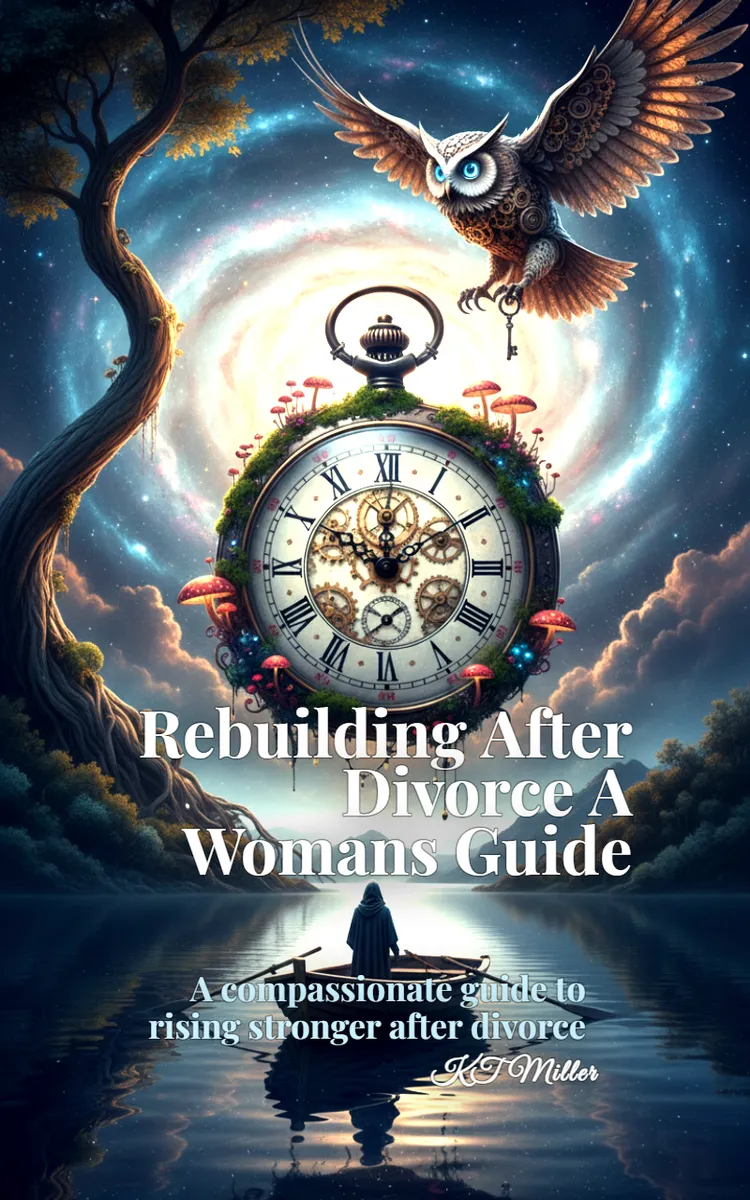
"Rebuilding After Divorce A Womans Guide" is a self-help book by KT Miller with 8 chapters and approximately 13,682 words. You can survive the divorce papers and still feel like you lost yourself. The hard part is not the separation, it is the quiet identity shift you did to keep the peace, the way your mind keeps replaying the breakup story, and the moment you realize your “new life” still runs on old scripts.
This book was created using Inkfluence AI, an AI-powered book generation platform that helps authors write, design, and publish complete books. It was made with the AI Self-Help Book Writer.
Frequently Asked Questions
What is "Rebuilding After Divorce A Womans Guide" about?
You can survive the divorce papers and still feel like you lost yourself. The hard part is not the separation, it is the quiet identity shift you did to keep the peace, the way your mind keeps replaying the breakup story, and the moment you realize your “new life” still runs on old scripts. This book helps you reclaim who you are when your worth got tangled in the marriage. You will learn how to break the narrative loop that keeps you braced for impact, and how to build boundaries that protect your nervous system, not just your schedule. If you are tired of healing that never seems to stick, read this now and start rebuilding with clarity, structure, and self-respect.
How many chapters are in "Rebuilding After Divorce A Womans Guide"?
The book contains 8 chapters and approximately 13,682 words. Topics covered include Reclaiming Your Identity After Divorce, Breaking the Divorce Story You Believe, Building Boundaries Without Guilt, Communicating Clearly When It’s Hard, and more.
Who wrote "Rebuilding After Divorce A Womans Guide"?
This book was written by KT Miller and created using Inkfluence AI, an AI book generation platform that helps authors write, design, and publish books.
How can I create a similar self-help book?
You can create your own self-help book using Inkfluence AI. Describe your idea, choose your style, and the AI writes the full book for you. It's free to start.
Write your own self-help book with AI
Describe your idea and Inkfluence writes the whole thing. Free to start.
Start writingCreated with Inkfluence AI


