
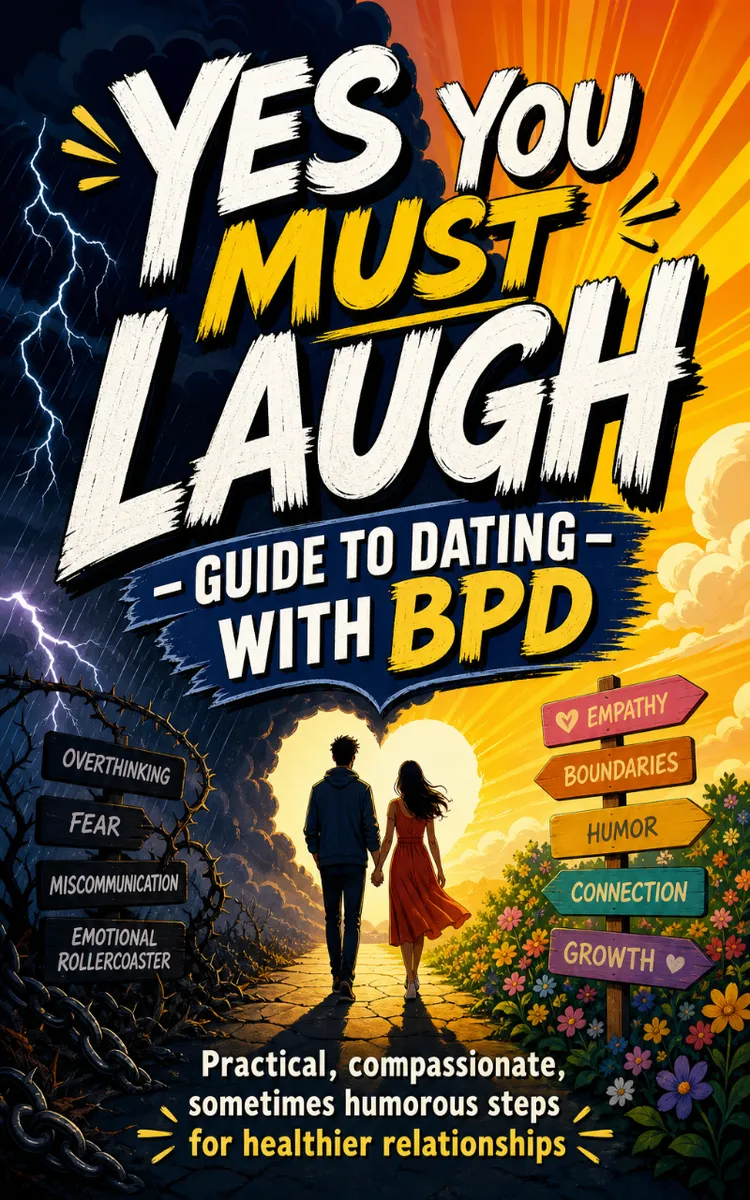

Read the first chapter
The whole of chapter one, free. About 8 min. Turn the pages with the arrows, your keyboard, or a swipe.
Chapter 1
BPD Dating Basics and Boundaries
She texted “Where are you?” fifteen minutes after the coffee shop said your table would be ready. Then, right when you typed “I’m on my way,” she sent: “Forget it. You don’t care.” That combo - swift switches plus intense meaning - can feel like you just got hit with emotional whiplash… while you’re still holding the receipt.
If you’re dating someone with borderline personality disorder (BPD), this chapter gives you something practical: a way to recognize what BPD can look like in dating, and a way to set boundaries that protect you without turning every date into a courtroom hearing. You’ll walk away knowing what to watch for, how to respond in the moment, and how to keep your relationship vibe alive even when feelings get loud.
You’re not trying to “fix” BPD. You’re trying to keep your reality intact: clear expectations, calm communication, and boundaries that don’t depend on whether their mood cooperates today.
What BPD Can Look Like in Dating (and Why Boundaries Still Matter)
BPD can show up in dating as fast changes in emotions, big reactions to perceived rejection, and a strong need for closeness - often paired with fear that closeness won’t last. In real dating life, this can look like intense texting, quick shifts from “I miss you” to “You’re the worst,” or disagreements that turn into “you never care” statements instead of staying about the actual issue.
Here’s the key problem this chapter solves: you might start guessing what you “should” do to prevent a blow-up. You’ll end up over-explaining, apologizing for things you didn’t do, or dropping your own plans just to avoid conflict. Boundaries stop that spiral. They tell both of you: you can care deeply and still have limits.
Also, boundaries don’t “kill the vibe.” Boundaries keep the vibe from getting hijacked by chaos. When you set them early and stick to them, you reduce the guessing game and replace it with predictable behavior.
Ask yourself: When emotions spike, do you try to win the moment - or do you keep your rules and guide the interaction back to something workable?
Quick definitions that will help you spot patterns
• Borderline personality disorder (BPD): A mental health condition that often includes difficulties with emotion regulation, fear of abandonment, and unstable relationship patterns.
• Boundary: A clear limit on what you will or won’t do, plus what you do instead when things cross the line.
• Perceived rejection: When something small gets interpreted as “you’re leaving me” (even if you didn’t intend anything like that).
Practical takeaway: Your goal is not to predict every mood swing. Your goal is to recognize the pattern and respond with boundaries that you can actually keep.
The Radar-Compass Boundary Map: Spot the Signal, Set the Limit
The Radar-Compass Boundary Map helps you move from “What is happening?!” to “Okay, I know what this is and what I’m doing next.”
Think of Radar as your pattern detector. It helps you notice the specific BPD dating triggers that show up in messages, tone, and conflict style. Think of Compass as your boundary guide. It helps you choose what you’ll do, what you won’t do, and how you’ll steer the conversation back to something safe.
Before you use it, you need one simple mindset shift: you don’t need to solve their feelings. You do need to manage your responses.
Step 1: Run the Radar scan (10 seconds, not 10 minutes)
Look at what just happened and pick the closest match:
• Rejection alarm: “You don’t care,” “You left me,” “You’re doing this on purpose.”
• Closeness panic: Rapid clingy texts, constant check-ins, “Promise you won’t leave.”
• Conflict escalation: Disagreement turns into character attacks or sweeping statements (“always,” “never”).
• Reality distortion: They treat your normal delay as proof of betrayal.
Example: If your partner sends “I knew it. You’re ignoring me” because you replied an hour later, that’s a rejection alarm. Your radar should light up, not your self-blame.
Why this matters: You respond faster when you name the pattern. Naming stops you from getting pulled into the story they’re writing.
Step 2: Pick your Compass boundary (one limit per moment)
Choose the boundary that fits the moment. Use this simple boundary menu:
• Communication boundary: “I will talk when we both speak respectfully.”
• Time boundary: “I’m not doing intense texting while I’m at work. I’ll respond at 8.”
• Behavior boundary: “I won’t stay in a conversation that includes insults.”
• Plan boundary: “If we can’t reschedule calmly, we pause plans for tonight.”
Example: If they text “Where are you?” followed by “Forget it,” your time boundary might be: “I’m running late; I’ll call when I’m there. I won’t do blame-texting.”
Why this matters: Picking one limit keeps you from negotiating your boundary in the middle of the storm.
Step 3: Use the “Validate + Limit + Next step” script
When you respond, do it in three parts:
• Validate the feeling (not the accusation): “I get that you’re upset.”
• Limit the behavior: “I won’t talk if we’re using ‘you don’t care’ language.”
• Next step: “We can talk in 30 minutes after I’m settled.”
Example text you can copy:
“Hey, I hear you’re hurt. I won’t do blame texts. I’m on my way - let’s talk when I arrive.”
Why this matters: You keep connection without rewarding the chaos.
Step 4: Decide the consequence you will actually follow through on
Your boundary needs a follow-through action. Not a threat. An action.
• If insults start → you end the call and text once: “I’m stepping away. We can try again later.”
• If accusations continue → you pause the conversation and resume at a set time.
• If they demand instant reassurance → you set a response window you can keep.
Why this matters: If you don’t follow through, your partner learns they can push harder next time.
Practical takeaway: When you can clearly identify the pattern and set a specific boundary, you stop improvising under pressure.
Using the Radar-Compass Boundary Map With Talia’s Real Dating Moment
Let’s use the assigned case study: Talia, 26, barista and first-time dater with a BPD partner. She’s learning the hard way that “answering fast” doesn’t always help. Sometimes it makes the storm bigger.
One evening, she’s finishing her shift. Her partner texts:
• “Are you coming?”
• “You said you would.”
• Then: “You don’t care. You never care.”
Talia feels guilty and wants to type a whole apology essay. Instead, she uses the Radar-Compass Boundary Map.
Step-by-step (what she does and what she expects)
• Radar scan: She notices a rejection alarm (“You don’t care”) and conflict escalation (meaning-making + character judgment).
• Expected outcome: She stops trying to debate the accusation.
• Compass boundary choice: She chooses a communication boundary:
• “I won’t keep texting if we’re using ‘you don’t care’ language.”
• Expected outcome: She sets a rule that protects her, not a rule that tries to control them.
• Validate + Limit + Next step: She sends:
• “I hear you’re hurt. I’m finishing work and I’m not doing blame-texting. I can talk when I’m off at 9.”
• Expected outcome: She stays kind, but she doesn’t accept the accusation as the discussion topic.
• Consequence action (the part many people skip): If more blame texts come in, she stops replying for the rest of her shift and sends one final message at 9:
• “Hey, I’m off now. If we can talk respectfully, I’m here.”
• Expected outcome: Her partner learns the boundary is real and predictable.
• After the storm (repair, not surrender): When they talk at 9, Talia keeps it practical:
• “I’ll keep you updated about timing. If you feel scared, you can say ‘I’m feeling scared’ instead of ‘you don’t care.’”
• Expected outcome: They move from accusation to a shared language.
Quick checklist (do this in order)
• Spot the pattern: rejection alarm, closeness panic, escalation, or reality distortion
• Pick one boundary: communication or time or behavior
• Send a three-part message: validate + limit + next step
• Follow through: pause replies or end the convo if blame-insults keep happening
• Repair with a plan: agree on timing updates and respectful wording
Practical takeaway: Talia doesn’t “win” the argument. She protects the relationship by making it safer to communicate.
Common Mistakes (and the Fix) When You Set Boundaries
You’re going to run into edge cases. Good news: you can handle them without becoming a robot or a doormat.
Mistake 1: You debate the accusation
When they say “You don’t care,” you might feel forced to prove you do. You start listing reasons, times, and intentions. That can turn your boundary into a courtroom exhibit.
Do this: Validate the feeling, then repeat the limit and move to the next step.
Not this: “That’s not true, I care so much. Let me explain everything you’re getting wrong.”
Fix: Keep your response short enough that you can repeat it calmly.
Mistake 2: You set a boundary but you don’t follow through
If you say “I won’t text during work” but you reply ten times anyway, your Compass becomes decorative. Your partner may push harder next time because they learned your boundary isn’t real.
Do this: Pick a boundary you can keep for the next 24 hours.
Not this: “I’m done with all arguments forever.” (That’s too big to follow through.)
Fix: Start smaller. Example: “I’ll reply at 8:00” is easy to keep. “I’ll never be triggered again” is not.
Mistake 3: You over-fix the vibe
Sometimes people try to prevent conflict by saying “Sorry, sorry, sorry” and then silently cancel everything they planned. That prevents the blow-up today, but it trains a painful pattern: your partner learns that their worst moment controls your whole schedule.
Do this: Keep your plans unless the behavior becomes unsafe or disrespectful.
Not this: “Sure, I’ll cancel” when your boundary was “We can talk later.”
Fix: Choose a “pause,” not a “give up.” Example: “I’m still coming at 7. We can talk about timing when we’re both calm.”
Practical takeaway: Boundaries work best when you can repeat them without losing your mind.
Your Takeaway: Clear Limits Create Safer Closeness
Dating with BPD can feel like you’re walking across moving ice. The Radar-Compass Boundary Map helps you stop panicking and start responding with a plan: spot the pattern, pick a limit, use the validate-limit-next step script, and follow through.
When you do that, you don’t just protect yourself - you also lower the pressure your partner feels. Predictability steadies the emotional weather. And once the weather gets steadier, you both get more room for real connection.
Next, you’ll want to build your boundary language so it sounds like you - clear, kind, and firm - without turning every conversation into a negotiation.
End of chapter one. 7 more chapters in the full book.
Swipe or use the arrows to turn the page


What's inside: 8 chapters
- 1. BPD Dating Basics and Boundaries
- 2. Spotting Triggers Before They Explode
- 3. The De-Escalation Script for Texts
- 4. Repair After Blowups: The Apology Ladder
- 5. Managing Jealousy Without Mind-Reading
- 6. Creating a Relationship Safety Plan
- 7. Humor That Helps, Not Hurts
- 8. When to Stay, When to Exit
About this book
"Yes You Must Laugh - Guide to Dating with BPD" is a how-to guide book by KT Miller with 8 chapters and approximately 13,281 words. Stop guessing what to do when dating gets intense. You will learn a repeatable, beginner-friendly process for guiding yourself and your communication when your partner has borderline personality disorder.
This book was created using Inkfluence AI, an AI-powered book generation platform that helps authors write, design, and publish complete books. It was made with the AI Ebook Generator.
Frequently Asked Questions
What is "Yes You Must Laugh - Guide to Dating with BPD" about?
Stop guessing what to do when dating gets intense. You will learn a repeatable, beginner-friendly process for guiding yourself and your communication when your partner has borderline personality disorder. Inside, you will identify what BPD can look like in dating, including fast emotional shifts and trigger timelines that escalate quickly. Then you will practice practical boundary setting that does not depend on their mood. You will also get ready-to-use tools for the real moments that derail couples, like de-escalating texts with a step-by-step script and slowing spirals before they grow legs. By the end, you will have clear expectations, calmer responses, and boundaries that help you stay grounded while you build a relationship that still feels like yours.
How many chapters are in "Yes You Must Laugh - Guide to Dating with BPD"?
The book contains 8 chapters and approximately 13,281 words. Topics covered include BPD Dating Basics and Boundaries, Spotting Triggers Before They Explode, The De-Escalation Script for Texts, Repair After Blowups: The Apology Ladder, and more.
Who wrote "Yes You Must Laugh - Guide to Dating with BPD"?
This book was written by KT Miller and created using Inkfluence AI, an AI book generation platform that helps authors write, design, and publish books.
How can I create a similar how-to guide book?
You can create your own how-to guide book using Inkfluence AI. Describe your idea, choose your style, and the AI writes the full book for you. It's free to start.
Write your own how-to guide book with AI
Describe your idea and Inkfluence writes the whole thing. Free to start.
Start writingCreated with Inkfluence AI


