

Read the first chapter
The whole of chapter one, free. About 9 min. Turn the pages with the arrows, your keyboard, or a swipe.
Chapter 1
Before-Launch Vessel and Gear Checks
You crack the throttle and your PWC answers fast - until it doesn’t. Offshore fishing gives you chop, spray, and distractions, and those conditions punish small problems you could’ve caught at the dock. Tanya learned that the hard way: she had her rods ready, bait packed, and tackle organized, but she still felt the boat “pull” differently once she hit open water. When she slowed down and checked later, it wasn’t a mystery - it was a loose strap and a fuel cap that didn’t seat cleanly. You don’t need drama offshore. You need a fast sweep that catches the stuff that turns a normal trip into a scramble.
This chapter focuses on your Pre-Launch Five-Minute Sweep - your quick, hands-on check of PWC condition, fuel, straps, and launch readiness before you ever enter the water. You’ll run it the same way every time so you stop relying on memory and start relying on a routine. Ask yourself one question as you work: “If this fails right now, do I know what to do and do I have the right fix?” That mindset keeps the sweep practical, not theoretical.
You Run a Fast Checklist of PWC Condition
Start with the basics you can’t “power through.” You check the hull and intake areas because offshore debris and loose hardware turn into overheating, steering issues, or sudden vibration. You check the engine and controls because a bad lanyard connection, a stuck lever, or a problem with throttle response doesn’t wait for you to get comfortable. Keep your eyes moving from front to back and your hands ready to tighten or reseat anything that looks questionable.
You run the sweep in a tight order so you don’t miss things when you’re busy. Walk around the PWC and do a quick visual for obvious damage: gouges, cracks, loose mounts, and anything that looks like it could snag a line. Then check the intake area and pump area for weeds, fishing line, or anything wrapped around a moving part. If you see line or weeds, you remove them before you start the engine again. Don’t “start it and see” - you want to remove the cause, not test the failure.
Next, you verify controls before you enter the water. Make sure the throttle and steering move smoothly. You check that you can engage and disengage the system without anything binding. You confirm your kill switch lanyard (the lanyard you attach to your body that stops the engine if you fall away) fits correctly and that the engine responds as expected when you test it at the dock. You don’t guess here. You either get a clean response or you fix the connection before you launch.
Now you check the “small stuff” that creates big hassle offshore: drain plugs, access panels, and any removable covers that protect wiring or storage areas. You inspect them for correct seating and you make sure they’re latched or tightened the way the manual shows. Then you check your steering nozzle area and anything you can access quickly for looseness. If you feel vibration or see a mounting gap, you stop and correct it right then. Offshore chop magnifies loose hardware until it becomes a problem you can’t ignore.
Practical takeaway: Treat the PWC like a machine that runs best when you remove uncertainty. If you can’t confidently answer “Is it seated, connected, and responsive?” during the sweep, you don’t launch.
Launch Readiness Before You Ever Enter the Water
Fuel and straps decide whether you start clean and come back the same way. You don’t “hope” the cap is tight. You don’t “assume” the fuel level matches your plan. You also don’t let gear shift because you’re rushing - offshore speed and spray will turn loose gear into a safety issue fast.
Start with fuel. You open the fuel gauge and you confirm you have enough fuel for your planned ride and return, using the fuel reserve rule you’ll follow for the trip. You check the tank level before you launch and you keep your focus on the return, not just the fishing spot. Then you confirm the fuel cap seats fully and locks if your model has a locking cap. If you smell fuel or you see a cap that sits crooked or loose, you fix it before you ever go past the break.
Then you check every strap and tie-down point you use for fishing gear, storage, and anything mounted on the deck. You tug-test it the way you would if you hit a wake hard: you grab the item and you try to move it firmly with your hands. If it shifts, you retighten the strap or remount the gear. You also check straps for proper routing - don’t let a strap run across a sharp edge, and don’t let it rub on a place that will wear through in chop. If you use bungee cords, you still secure the load so it can’t float upward or slide when the boat pitches.
You also check your cooler and any storage areas you access while you’re on the water. You make sure lids latch and that nothing inside can become a projectile. You confirm that wet gear and loose tackle don’t slide around on the deck. If you store bait, keep it in a container that stays put and doesn’t loosen when the deck tilts. You want the deck to feel “quiet” when you move around - no clinks, no shifting, no rattling.
Finally, you do a launch readiness check that focuses on you being able to operate the PWC safely right after launch. You confirm you’re wearing your PFD (personal flotation device) before you go into the water and that anything you’ll need quickly is easy to reach. You check your lanyard attachment and you confirm you know where the controls sit for your model so you don’t fumble under stress. You also confirm you have a way to stay in contact and navigate, but you don’t rely on it yet - you verify your phone case is sealed and that your VHF radio (very high frequency radio) and GPS (global positioning system) are ready for use. You’re not setting up a whole system here; you’re making sure it’s on and working before you leave the dock.
You can tighten this into a routine you don’t have to think about. When Tanya runs her Pre-Launch Five-Minute Sweep, she doesn’t stop at “looks good.” She still checks strap tension by hand, confirms the fuel cap seats, and verifies drain plugs and access panels. She keeps her checklist short enough that she actually finishes it, and consistent enough that she can spot what’s different each trip.
Practical takeaway: You launch when the PWC feels stable, the fuel cap is sealed, and your gear doesn’t move under a hard tug. Everything else gets handled before you ever clear the dock.
The Pre-Launch Five-Minute Sweep: PWC, Fuel, and Straps
You run the Pre-Launch Five-Minute Sweep with a stopwatch mindset. You don’t take “as long as it takes.” You take five minutes, and you use that time to catch the big failures you can still prevent.
You begin at the engine and intake area, then you move outward. You look for visible damage, weeds, line, and anything wrapped where it shouldn’t be. You check steering and throttle response while you’re still close enough to the dock that you can correct the problem without improvising. You confirm the kill switch lanyard connection is correct and that the engine stops the way it should when you test it at the dock.
Then you hit fuel and sealing points. You confirm the fuel level matches your return plan and you verify the fuel cap seats and locks correctly. You check drain plugs and any access covers so water can’t get where it doesn’t belong. You inspect for loose fasteners you can reach quickly, especially mounts that support fishing gear.
Next you move to straps and deck security. You tug every strap and tie-down point. You check rod holders and mounted items for movement, not just “they’re on there.” You check that cooler lids latch and that tackle storage doesn’t open when the deck bounces. You make sure anything that could slide is restrained so it stays in place when you hit chop.
You end the sweep with a quick “ready to operate” check of your immediate surroundings. You confirm you can reach your controls, you can stay stable while you move, and you can start the trip without scrambling for something you forgot. Ask yourself: “If I had to start right now, do I have everything seated and connected?” If the answer isn’t a clear yes, you fix it before you launch.
Practical takeaway: Five minutes of hands-on checks saves you from the offshore version of “I’ll deal with it later.” Run the sweep the same way every time and you cut your risk without adding stress.
Quick Comprehension Checks You Do While You Work
As you move through the sweep, you keep your attention on failure points. You don’t need to memorize a long list - you need to catch the things that stop you from controlling the PWC or make your gear unsafe at speed.
Ask yourself three quick questions while you tug-test and inspect. First: “Does anything move when I apply force by hand?” If it does, you tighten or remount now. Second: “Is the fuel cap fully seated, and does the tank level match my plan?” If you can’t confirm both, you don’t launch. Third: “Do the controls respond cleanly, and does the kill switch lanyard connection look correct?” If anything feels off, you fix it at the dock.
Keep your checks concrete. “Looks fine” isn’t a check. You check by trying - tighten by hand, test by tug, confirm by reseating. If you catch a problem, you correct it immediately and you repeat the same check on the item you fixed. That’s how you avoid creating a new issue while you solve the old one.
You also watch your own habits. If you pack gear first and check the PWC last, you’ll rush and miss something. If you launch without walking the deck and checking strap tension, you’ll discover problems offshore when you don’t have time to fix them. You build your routine so the PWC gets verified before fishing gear becomes “the priority.”
Practical takeaway: Use questions to stay sharp. If you can’t answer with confidence while you’re still working, you slow down and finish the sweep correctly.
Closing Beat: Your Dock-Side Advantage
The best time to catch a loose strap, a questionable fuel cap, or a problem in the intake area is when you still have shore support and calm conditions. Offshore doesn’t give you extra chances. Your Pre-Launch Five-Minute Sweep gives you control back - because you handle the preventable stuff while you still can.
When you finish your sweep, you should feel a specific kind of calm: the calm that comes from knowing you checked the stuff that actually causes trouble, not just the stuff that looks good. That calm matters when you hit chop, when you move around to fish, and when you need your PWC to behave exactly the same on the way back.
Now you’re ready to make sure you carry the right emergency items and that your fishing setup stays secured and reachable - so your trip stays safe even when things get busy.
End of chapter one. 7 more chapters in the full book.
Swipe or use the arrows to turn the page


What's inside: 8 chapters
- 1. Before-Launch Vessel and Gear Checks
- 2. Safety Equipment You Must Carry
- 3. Secure Fishing Gear for Offshore
- 4. VHF, GPS, and Float Plan Setup
- 5. Tide, Current, and Launch Timing
- 6. Weather Safety Go/No-Go Rules
- 7. Distance-from-Shore Limits and Buddy System
- 8. Fuel Reserve Rule and Return Planning
About this book
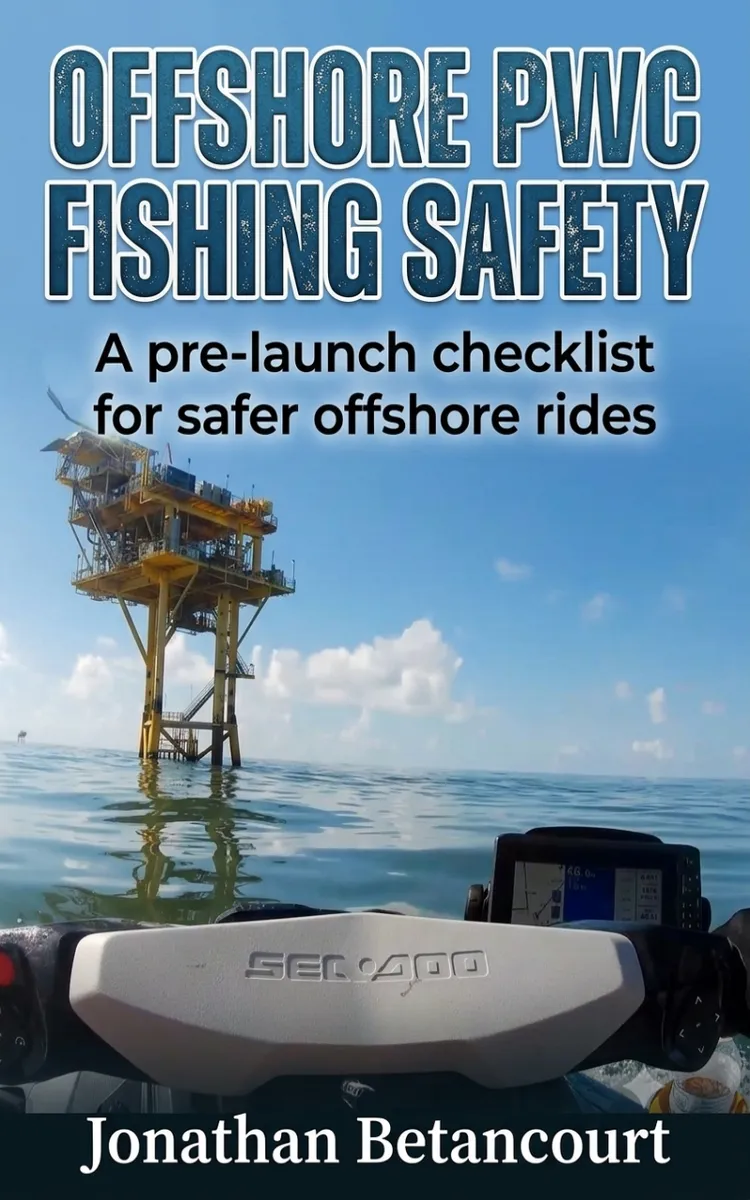
"Offshore PWC Fishing Safety" is a how-to guide book by Jonathan Betancourt with 8 chapters and approximately 14,229 words. Pre-launch safety checklist for using a personal watercraft offshore fishing.
This book was created using Inkfluence AI, an AI-powered book generation platform that helps authors write, design, and publish complete books. It was made with the AI Ebook Generator.
Frequently Asked Questions
What is "Offshore PWC Fishing Safety" about?
Pre-launch safety checklist for using a personal watercraft offshore fishing
How many chapters are in "Offshore PWC Fishing Safety"?
The book contains 8 chapters and approximately 14,229 words. Topics covered include Before-Launch Vessel and Gear Checks, Safety Equipment You Must Carry, Secure Fishing Gear for Offshore, VHF, GPS, and Float Plan Setup, and more.
Who wrote "Offshore PWC Fishing Safety"?
This book was written by Jonathan Betancourt and created using Inkfluence AI, an AI book generation platform that helps authors write, design, and publish books.
How can I create a similar how-to guide book?
You can create your own how-to guide book using Inkfluence AI. Describe your idea, choose your style, and the AI writes the full book for you. It's free to start.
Write your own how-to guide book with AI
Describe your idea and Inkfluence writes the whole thing. Free to start.
Start writingCreated with Inkfluence AI


