

Read the first chapter
The whole of chapter one, free. About 14 min. Turn the pages with the arrows, your keyboard, or a swipe.
Chapter 1
Low Tide, No Signal
The phone lost its bars as the left front wheel sank to its axle.
Mason stared through the windscreen at the blank signal icon, then at the brown water trembling around the tyre. A mangrove root jutted from the mud like a black knuckle. Beyond it, the tidal river spread under the white blaze of afternoon, flat and glittering except where something large had disturbed the surface far out in the channel.
“Don’t stop,” Callum said from the passenger seat. “Keep it moving.”
“I’m not stopping by choice.”
Mason pressed the accelerator. The SUV lurched, dug deeper, and threw a fan of mud against the doors. The engine revved high. The wheel spun without grip.
Behind him, Tessa swore. Elena made a small, frightened sound.
“Reverse,” Callum said.
Mason took his foot off the pedal. The river made a soft sucking noise beneath them. He shifted into reverse and tried again. The rear wheels clawed at the track. Nothing happened. The vehicle rocked once, then settled lower.
A warning beep sounded from the dashboard.
Mason looked at the phone in his hand. The screen showed no bars, no data, no little arrow marking the route. The map had frozen in a pale square of green and blue. He tapped it twice.
“Come on.”
“It’s gone?” Tessa leaned between the seats. Her hair was stuck to her temple with sweat. “Mason.”
“I know what it says.”
“There’s nothing,”
Callum twisted in his seat. “There’s a rise behind us. We can get out, push it back.”
“Out where?” Mason pointed through the windscreen. The track behind them was already filling with a thin sheet of brown water. It slid around the tyre marks and gathered in the low places, carrying leaves, sticks, and a pale strip of foam. “That’s the tide coming in.”
For a moment nobody spoke.
The riverbank had seemed harmless when they turned off the main road. A shortcut, Callum had called it, grinning as he unfolded the paper map over the steering wheel. The track followed the tidal river for several kilometres before cutting inland toward the swimming hole. They had enough fuel. They had time, barely, to reach the pool, sleep for a few hours, and make their flight from Darwin the following evening.
That had been before the mud took them.
That had been before the phone went dead.
Mason shoved open his door. Hot water rushed over his boot.
“Mason,” Elena said.
“I’m getting a look.”
He stepped down into mud that swallowed him to the ankle. Heat pressed against his face. Cicadas rattled in the trees, loud enough to make the silence between them feel deliberate. The river lay twenty metres away, its edge hidden beneath reeds and tangled roots. A flock of white birds lifted from the mangroves and wheeled inland.
Mason crouched beside the front wheel. The tyre was buried almost to the rim. Black mud clung to the tread in thick ropes. He dug his fingers into it and felt something hard beneath.
“Root,” he said. “It’s jammed under the chassis.”
Callum climbed out on the other side. “We need the jack.”
“The jack will sink.”
“Then find something to put it on.”
Tessa opened the rear door and pulled out the recovery strap. “We can tie it to a tree.”
“There aren’t any trees that won’t pull out,” Mason said.
“Then we dig.”
Callum gave him a sharp look. “That’s what I said.”
Mason stood. The horizon beyond the river was a thin line of mangrove and sky. No road showed ahead. The track disappeared under the water in both directions, as if the river had been waiting for them to commit before closing its hand.
Elena came around the rear of the SUV with the shovel. “How long until the tide covers this?”
Mason checked the time. “An hour. Maybe less.”
“Maybe?”
“I don’t know.”
“You said you knew the route.”
“I said the map showed a crossing.”
“You said it was a shortcut,” Tessa snapped.
Callum swung the shovel into the mud. “Argue after we’re moving.”
The blade struck something with a dull crack. Callum pulled it free, mud sliding from the metal. He swung again. Mason joined him with his hands, clawing at the sludge around the tyre. Every handful released the sharp stink of rotting leaves. Water seeped into the hole as fast as they cleared it.
The mud was warm against Mason’s wrists. A sudden silver flash skimmed the shallow water through the shallow water beside his hand. He jerked back.
“What?” Elena asked.
“Fish.”
Callum laughed once, too loudly. “Congratulations.”
Mason kept digging. He could feel the vehicle’s weight through the ground. Each movement of the tyre pressed down on the root. It was not trapped by mud alone. The front end had slid into a buried tangle of timber, and the rising water was loosening everything beneath them.
A low vibration passed through the earth.
Mason stopped.
“What was that?” Elena whispered.
The river surface had gone smooth again. A line of bubbles rose near the reeds, travelled ten metres, and vanished.
Callum rested both hands on the shovel. “Boat?”
“There’s no boat.”
“Then a fish.”
Mason looked toward the water. The bubbles had appeared close to the bank, where the reeds made a dark, unbroken wall. He could not see through them.
Tessa came down beside him. “Don’t stare at it.”
“I’m not.”
“You are.”
“I’m checking the bank.”
“For what?”
Mason did not answer. He had seen the warning signs at the visitor centre outside Darwin. Crocodile territory. Do not approach the water. Do not stand at the edge. Do not assume shallow water is safe. The signs had shown a cartoon reptile with its mouth open, ridiculous and yellow-eyed.
The real river had no sign. No fence. No voice telling them where to stand.
A splash broke the silence.
Not large. Not dramatic. Just the sound of something slipping beneath the surface.
Elena backed toward the SUV. “We need to go.”
“We can’t,” Callum said.
“Then make it go.”
Mason took the shovel from Callum. “Get the boards from the roof rack.”
“The boards are under the bags.”
“Then move the bags.”
Callum stared at him. “You want us to unload everything into this?”
“I want the car out before the tide reaches the axles.”
Callum’s jaw tightened. He turned away.
Tessa caught Mason’s arm. Her fingers were slick with sweat. “We should leave the car.”
“Walk where?”
“Back to the main road.”
“The track behind us is flooding.”
“Then forward.”
Mason looked downriver. The water had spread over the track ahead, a broad brown sheet slipping between the reeds. Beyond it, the bank narrowed to a strip of mud beneath overhanging trees. The road might continue there. It might not.
“Our bags, food, water, passports,” Elena said. “Everything’s in the car.”
“And the flight,” Callum added. “We miss it, we’re stuck in Darwin.”
Mason drove the shovel into the mud. “We’re not missing it.”
The first board came free from the roof rack after Callum cut through the straps with Elena’s knife. It was a short length of plywood, warped and dusty. The second was buried beneath the packs. They dragged the bags out one by one and dropped them on the higher side of the track.
Mason kept digging.
Sweat ran into his eyes. His shoulders burned. The hole around the wheel widened, but the water rose with it, filling the space to his knuckles. Every time he cleared a clump, the mud slumped back in.
“Try it,” Callum said.
Mason climbed into the driver’s seat. The others stood clear. He shifted into low range and eased onto the accelerator.
The tyre spun. Mud struck the windscreen in heavy splats.
“More!” Callum shouted.
Mason pushed harder. The engine roared. The SUV shook so violently that the rear-view mirror blurred. The front wheel climbed an inch, slipped, and dropped.
A crack sounded beneath them.
The vehicle tilted toward the river.
Elena screamed.
Mason released the pedal. The engine settled into a rough idle. For a few seconds the SUV leaned there, held by the buried root and the mud packed around the other tyre.
Then the water touched the bottom of the door.
Callum ran to the front. “Shut it off.”
Mason killed the engine.
The sudden quiet was worse. The river whispered at the bank. Water tapped against the metal under the SUV. In the mangroves, something gave a slow, wet cough.
Tessa turned toward the sound. “Was that - ”
“Back up,” Mason said.
They moved together toward the bags. Mason kept his eyes on the reeds. The water around the front wheel trembled in widening rings.
Callum grabbed the recovery strap. “We tie it to the rear and pull from the other side.”
“With what?”
“Us.”
Mason looked at him.
“Three people pulling,” Callum said. “Four.”
“Where do we anchor?”
Callum pointed to a paperbark tree above the bank. Its trunk leaned over the river, roots exposed like fingers. “There.”
“That tree is half dead.”
“It’s better than standing here.”
They hauled the strap through the mud. Mason looped it around the tree while Callum threaded the hook through the tow point. The metal scraped against his knuckles. Blood welled bright against the brown sludge.
“Get in,” Mason told Callum. “I’ll drive. Tessa, Elena, pull when I say.”
Tessa looked at the water. “We’re standing too close.”
“We don’t have a better place.”
“That isn’t an answer.”
“It’s the only one I’ve got.”
They took their positions. Mason climbed into the SUV and started the engine. The dashboard lit up, then flickered. The phone on the console went black.
He pressed the power button.
Nothing.
He held it down.
Nothing.
“Signal?” Elena called.
“Phone’s dead.”
“What do you mean dead?”
“It won’t turn on.”
Callum shouted from the front. “Mason!”
He looked up. The strap had tightened. The tree bent toward the river.
“Pull!”
Tessa and Elena leaned back. Callum braced his boots in the mud. Mason eased forward.
The strap snapped tight enough to sing.
The SUV groaned. The front wheel turned half a rotation. Mud bulged beneath it. Mason pressed harder. The engine screamed, and the tree’s exposed roots tore free with a grinding sound.
“Stop!” Tessa yelled.
Mason braked.
The tree gave, shifting several centimetres as the strap sagged like a held breath
“Again,” Callum said.
“We’ll pull it over.”
“Again!”
Mason looked at the river. The water had risen over the track behind them. It crept toward the rear tyres in narrow channels, dividing around stones and roots. The vehicle was trapped between the river and the road that had become a stream.
He put the SUV into reverse.
The strap tightened in the opposite direction. Tessa cried out as her boot slid. Elena dropped to one knee. Callum grabbed the tree to keep from falling.
“Stop!” Mason shouted.
The left front wheel lifted clear of the mud for one clean second.
Mason saw the chance and took it. He shifted into drive, released the brake, and drove.
The wheel slammed down onto the plywood board. It buckled but held. The SUV surged forward, throwing mud across the bonnet. Mason kept the accelerator down. The rear wheels spun, caught, spun again.
The vehicle moved.
A metre.
Then another.
The strap dragged through the mud. Callum ran beside the bonnet, shouting. Tessa and Elena scrambled after him.
Mason steered toward the narrow strip of higher bank. The front wheel climbed onto firmer ground. The SUV lurched sideways, nearly rolling into the reeds, then caught itself with a violent jolt.
He braked hard.
The engine coughed.
The front wheel was free.
For three seconds, Mason thought they had done it.
Then the GPS screen went dark.
The map vanished. The blue route disappeared. The only road ahead was a flooded ribbon sliding along the riverbank, and beyond it the mangroves closed together in a wall of green.
Callum slapped the bonnet. “Go!”
Mason looked at the fuel gauge, the black phone, the water rising behind them.
“There’s no road,” he said.
“Then drive where the road was.”
“I can’t see it.”
“Use your eyes!”
Mason climbed out. The mud reached the soles of his boots, but the wheel sat on the plywood and packed earth now. They had enough traction to move. The track ahead, however, had been swallowed entirely. A brown current crossed it from the river to the trees.
Tessa came to his side. “Can we turn around?”
Mason looked back. The route behind them was underwater to the depth of a boot. The river had covered the low stretch, and the surface was spreading toward the SUV.
“No.”
“Can we go forward?”
He followed the bank with his eyes. The only clear ground lay beside the water, narrow and uneven. It disappeared around a bend beneath trees whose roots twisted into the river.
Callum came up behind them. “We can make it.”
“You don’t know that.”
“Neither do you.”
“We need to camp,” Elena said.
Callum turned on her. “We need to get out of here.”
“It’s already nearly dark.”
“It’s afternoon.”
“Look at the water.”
They all did.
The tide had risen quickly, swallowing the track in less than an hour. The sky remained bright, but the mangroves had gone black beneath the trees. In the distance, a bird called once and stopped.
Mason felt the decision settle inside him, heavy as wet sand. Forward meant driving blind along a river that was climbing. Back meant walking through floodwater with their packs and no signal. Staying meant waiting beside a tidal channel in crocodile country.
He wanted to say they would be fine. The words would not come.
“We make camp on the high side,” he said.
Callum stared at him. “Here?”
“Not at the water. Up there.” Mason pointed toward a low rise beneath the paperbarks. “We keep the bags off the ground. We don’t go near the river. At first light, we follow the bank until we find the track.”
“And the car?”
“We leave it.”
“For what? To come back with a tow truck?”
Mason took the dead phone from his pocket and held it up between them. “There’s no service. The GPS is gone. The road is underwater. This is what we’ve got.”
Callum’s face hardened. “You got us onto this track.”
“I know.”
“You said it was safe.”
“I know.”
Tessa stepped between them. “Enough.”
Callum looked at her. “You were happy to take the shortcut.”
“I was happy because I trusted him.”
The words landed harder than the shovel striking timber.
Mason looked away. The river moved beside them with a quiet, patient force. He could feel the place watching through the reeds, though he knew that was impossible. He knew it and did not believe it.
They carried the bags to the rise. The ground there was drier, covered in brittle leaves and seed pods that cracked under their boots. They set up the small tent between two paperbarks, then changed their minds and moved it farther inland when Tessa noticed the slope ran toward the river.
There was no firewood worth gathering. The branches nearest the water were wet, and the rest of the trees stood behind curtains of grass. They ate warm crackers and a crushed packet of nuts. Elena passed around bottles of water, counting them under her breath.
“Stop counting,” Callum said.
“I’m not counting for you.”
“You’re counting because you think we’re going to run out.”
“We are going to run out.”
Tessa took the bottle from her. “We’ll find the swimming hole.”
Callum laughed. “The swimming hole is the problem now?”
“It’s inland. The map showed - ”
“The map is dead.”
“Callum.”
“What? We’re camping beside a river full of crocodiles because Mason wanted to save an hour.”
Mason sat with his back against the SUV’s rear tyre. The rubber was warm through his shirt. He stared at the flooded track. The current carried a branch past them, turning slowly. For an instant it looked like a long, dark body with a pointed head.
He blinked.
The branch bumped against the reeds and stopped.
“Listen,” he said.
They fell quiet.
A faint scrape came from below the bank.
Not the river. The mud.
Mason stood.
Callum reached for the shovel. “What is it?”
The scrape came again, followed by a soft collapse. A section of wet earth slid into the water. The river closed over it without a splash.
Tessa’s voice dropped. “Could be the bank giving way.”
“Could be,” Mason said.
The reeds shifted.
A dark ridge appeared between them, low and broad. It moved against the current, too smooth to be timber. Two eyes rose above the waterline, black and glassy, then vanished.
Elena stopped breathing.
Mason felt the blood drain from his hands.
The water settled back into its slow, indifferent skin
Callum whispered, “Did you see that?”
Nobody answered.
The sun lowered behind the trees. Gold light spread across the water, turning the mud to copper. The SUV sat on its freed wheel, angled toward the river, its doors open and bags piled on the bank. The route ahead was gone. The route behind was gone. Their phones were dark in their hands.
Mason tightened the strap around the paperbark and checked it twice. The tree leaned over the water, roots exposed, but it was the only anchor they had. He dragged the remaining bags farther up the rise. Tessa moved the tent again, this time beneath the tallest paperbark.
“Not there,” Mason said.
She looked at him. “Why?”
He pointed to the ground. A narrow trail ran through the leaves, pressed flat and shining with dampness. It led from the water toward the trees.
No one spoke.
They moved the tent a final time, away from the trail.
Night came fast. The insects rose in a shrill cloud, then quieted whenever the river made one of its slow, heavy movements. Mason sat outside the tent with the shovel across his knees. Callum sat opposite him, holding a tyre iron. Tessa and Elena stayed close together beneath the tent flap.
“We should take shifts,” Callum said.
Mason looked at him. “For what?”
Callum glanced toward the river. “So somebody’s awake.”
Mason listened to the water.
A long pause.
Then something struck the far bank with a wet, solid thump.
The sound travelled through the dark.
Mason gripped the shovel.
The river kept moving, and somewhere beyond the reach of their torchlight, something large moved with it.
End of chapter one. 7 more chapters and about 23,635 words in the full book.
Swipe or use the arrows to turn the page


What's inside: 8 chapters
- 1. Low Tide, No Signal
- 2. The Scent That Won’t Leave
- 3. Solid Ground That Moves
- 4. Why the River Watches
- 5. The Knife-Quiet Drag
- 6. When the Fire Won’t Light
- 7. The Swimming Hole Is a Mouth
- 8. A Bleeding Path to Help
About this book
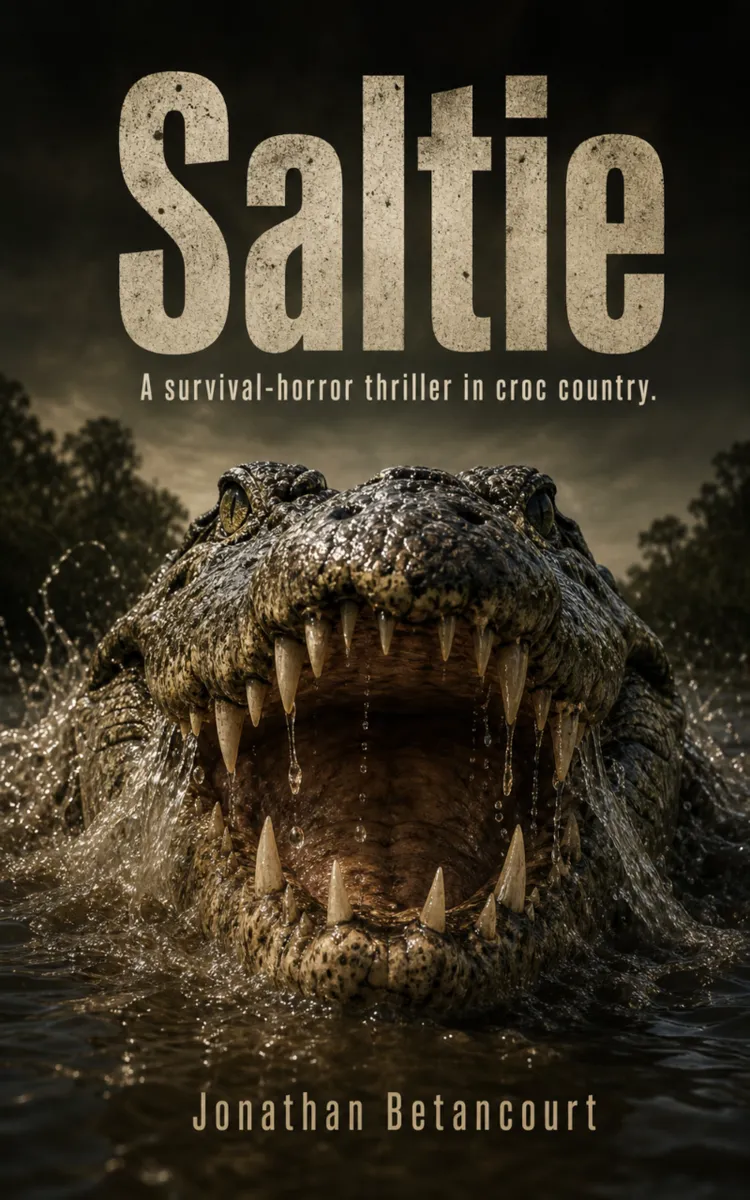
"Saltie" is a fiction book by Jonathan Betancourt with 8 chapters and approximately 23,635 words. Four friends. One outback tidal river.
This book was created using Inkfluence AI, an AI-powered book generation platform that helps authors write, design, and publish complete books. It was made with the AI Novel Writer.
Frequently Asked Questions
What is "Saltie" about?
Four friends. One outback tidal river. And the worst kind of territory, saltwater crocodiles that do not wait. When their SUV sinks and their phones go dead, the group tries to hold the line, sheltering by mangroves that look solid until the water answers with impact. Night brings movement, then loss, and every decision becomes a gamble between staying together and staying alive. Saltie is a visceral survival-horror thriller where the land itself feels hunted. If you like outback danger, tight dread, and survival choices that get worse by the minute, start reading now.
How many chapters are in "Saltie"?
The book contains 8 chapters and approximately 23,635 words. Topics covered include Low Tide, No Signal, The Scent That Won’t Leave, Solid Ground That Moves, Why the River Watches, and more.
Who wrote "Saltie"?
This book was written by Jonathan Betancourt and created using Inkfluence AI, an AI book generation platform that helps authors write, design, and publish books.
How can I create a similar fiction book?
You can create your own fiction book using Inkfluence AI. Describe your idea, choose your style, and the AI writes the full book for you. It's free to start.
Write your own fiction book with AI
Describe your idea and Inkfluence writes the whole thing. Free to start.
Start writingCreated with Inkfluence AI


