

Read the first chapter
The whole of chapter one, free. About 8 min. Turn the pages with the arrows, your keyboard, or a swipe.
Chapter 1
Holiday Boundaries in One Sentence
Why One Sentence Beats a Holiday Debate
What if you could answer the holiday question without opening a courtroom, a family group chat, or a three-hour hearing chaired by Aunt Linda?
A boundary works best when you state it before everyone starts submitting evidence. “We’re leaving at 7:00,” “I’m not discussing my divorce,” or “We won’t host this year” gives people useful information. A long explanation gives them something else: handles to grab. Each reason invites a counterargument. Each apology suggests a negotiation. Soon, your simple decision sits on trial while someone waves a casserole dish like Exhibit A.
The One-Sentence Boundary Protocol solves that problem. It helps you state what you will do, name the limit, and stop talking before the family debate committee forms. After practicing it, you can deliver one calm sentence, repeat it without changing the wording, and follow through with an action. You will not control whether relatives complain. You will control whether their complaints rewrite your plans.
Ask yourself one practical question: What decision do I need to communicate, and what part of it am I willing to discuss? If the answer is “none,” your sentence should not contain an invitation to negotiate. Your takeaway: a boundary does not need a persuasive essay. It needs a clear sentence and a matching action.
The One-Sentence Boundary Protocol
The One-Sentence Boundary Protocol uses three parts:
1. State the decision. Say exactly what you will do, not what you hope other people will understand. “I’m leaving at 7:00” gives a time. “I don’t want to stay too late” gives relatives a puzzle and a chance to suggest midnight.
2. Name the limit. Identify the topic, behavior, or request you will not accept. “I’m not discussing my medical treatment” closes one door. “I’d rather not talk about it” leaves the door cracked open with a welcome mat.
3. End the sentence. Stop. Do not attach a defense, apology, historical timeline, or bibliography of reasons. The silence may feel awkward because your family has trained you to fill it. Let the awkwardness sit there. It has nowhere to go unless you feed it.
Put the parts together in a sentence such as: “I’ll join dinner from 4:00 to 7:00, and I’m not discussing my relationship.” That sentence sets the schedule and the subject limit. It does not accuse anyone. It does not ask permission. It does not mention the eleven previous holidays when someone cornered you beside the pie.
Use “I” language because you can control your actions more reliably than someone else’s behavior. Say, “I’ll leave if the conversation turns insulting,” rather than, “You need to stop being rude.” The first sentence tells people what you will do. The second tries to manage a relative who may treat instructions as a competitive sport.
Keep the wording short enough to repeat without editing. Try this basic template:
“I will [action], and I’m not [limit].”
Examples include:
• “I’ll bring one dessert, and I’m not taking on extra cooking.” - “I’ll answer that once, and I’m not debating my decision.” - “I’m staying at a hotel, and I’m not discussing where I sleep.” - “I’ll attend lunch, and I’m leaving at 2:00.” - “I’m not drinking, and I’m not explaining that choice.”
The sentence should sound firm, not theatrical. You do not need to announce it like a royal decree from the Department of Holiday Affairs. Use a normal voice, make eye contact if you can, and keep your face relaxed. A calm delivery reduces the chance that relatives can shift the conversation from your boundary to your “attitude.”
Before the gathering, write your sentence in your phone’s notes app and say it aloud three times. Notice where you add extra words. Remove phrases such as “I’m sorry,” “maybe,” “I just,” and “if that’s okay.” Those words often weaken the message because they make a decision sound like a request. Your practical takeaway: build one sentence with a decision, a limit, and no debate bait.
Putting the Protocol Into Practice
Nina, 31, works as an event planner, so she knows exactly how quickly a holiday meal can become a badly managed production. Last December, relatives expected her to coordinate the menu, decorate the house, pick up two guests, and explain why she had not bought a home yet. This year, she decides to attend her parents’ dinner for three hours and decline the hosting duties.
She uses the One-Sentence Boundary Protocol instead of sending a twelve-paragraph message titled “A Few Things Before Christmas.” Here is her process:
1. Choose the decision. Nina decides to attend from 4:00 to 7:00 and bring one store-bought pie. Expected outcome: Her schedule and contribution become specific. Relatives cannot reasonably mistake “I’ll help” for “I will run the entire event.”
2. Choose the limit. She decides not to discuss buying a home or accept last-minute tasks. Expected outcome: She prepares for the two pressure points most likely to pull her into explanations.
3. Write the sentence. Nina writes: “I’ll be there from 4:00 to 7:00 with one pie, and I’m not discussing my housing plans or taking on extra tasks.” Expected outcome: One sentence covers the time, the contribution, and the limits.
4. Remove debate bait. Nina deletes “I’m sorry,” “because work has been crazy,” and “I hope that’s okay.” Expected outcome: The message sounds like a plan rather than a proposal awaiting family approval.
5. Practice the repeat. When someone says, “You can’t leave before dessert,” Nina repeats, “I’ll be there from 4:00 to 7:00, and I’m not taking on extra tasks.” She does not invent a new reason. Expected outcome: The conversation loses fresh material. Repetition makes the boundary boring, and boring can be wonderfully powerful.
6. Match the sentence with action. At 6:50, Nina thanks the hosts, picks up her coat, and leaves at 7:00. If someone starts criticizing her housing plans, she says, “I’m not discussing that,” then moves toward the door or changes rooms. Expected outcome: Her behavior confirms the sentence. A boundary without follow-through becomes a seasonal suggestion.
Notice what Nina does not do. She does not prove that her job matters, list her expenses, explain her five-year plan, or ask whether everyone feels emotionally prepared for her departure. She communicates the information once, repeats it when needed, and acts on it.
Try your own version now. Write it on one line, then test it against three questions: Does it say what I will do? Does it name what I will not discuss or accept? Can I repeat it without adding a new explanation?
Quick checklist
• Choose one holiday decision before the gathering. - Add one clear limit. - Use “I will,” “I’m leaving,” or “I’m not discussing.” - Remove apologies, excuses, and long reasons. - Say the sentence aloud three times. - Repeat the same wording when someone pushes. - Pair the boundary with a visible action. - Track the result: less debate, a shorter conversation, or an on-time exit.
The practical test does not involve getting everyone to applaud. It involves communicating your plan clearly and carrying it out. If Nina leaves at 7:00 without accepting three new jobs, the sentence worked - even if someone sighs like a Victorian widow.
What to Watch For
Mistake: Turning the boundary into a courtroom statement
You may feel tempted to explain every reason. “I can’t host because the project deadline moved, my apartment is small, groceries cost more, and last year I spent two days cleaning up after everyone.” Those facts may feel necessary, but they give relatives four separate points to challenge.
Do this: “I’m not hosting this year, and I’ll bring one dish.”
Not this: “I’m not hosting because I’m exhausted, work is busy, the apartment is a mess, and nobody helped last time.”
The fix: keep one reason private unless you genuinely want to share it. A boundary communicates a decision; it does not require a successful closing argument.
Mistake: Using a threat instead of a boundary
A threat tries to punish someone: “If you ask about my weight again, I’ll ruin Christmas.” A boundary states your response: “I’m not discussing my weight, and I’ll leave the conversation if it continues.” The second version gives you a clear action without turning the room into a hostage negotiation involving mashed potatoes.
Do this: Name the behavior and your response.
Not this: Predict revenge, humiliation, or a dramatic family exile.
The fix: choose an action you can perform immediately. You can end a call, leave a room, stop answering questions, or go home. You cannot force another adult to become thoughtful through the power of seasonal outrage.
Mistake: Changing the sentence every time someone pushes
Relatives may test your boundary with familiar lines: “Just this once,” “You’re being difficult,” or “We’re family.” If you answer each version with a new explanation, you create a fresh debate every thirty seconds.
Do this: Repeat the same sentence: “I’m staying until 7:00, and I’m not discussing my housing plans.”
Not this: Add a new defense each time: “I know, but I have work tomorrow, and traffic might be bad, and I promised myself…”
The fix: use the “broken record” approach, which means repeating the same calm words without raising your volume. After two repetitions, add the action: “I’ve answered this. I’m leaving at 7:00.” Then leave when the time arrives.
Edge case: Someone ignores the limit immediately
A person may ask the forbidden question before your sentence finishes. Do not rush to answer just because they filled the silence. Say, “I’m not discussing that,” and redirect only if you want to continue the conversation. If they ask again, repeat the sentence and move your body: stand up, take your plate to the kitchen, or join another group.
The goal does not involve winning the exchange. The goal involves ending your participation in it. Your boundary becomes real when your words and actions point in the same direction.
Before the next holiday interaction, write one sentence that you can say without apology. Deliver it once, repeat it when necessary, and let your follow-through provide the punctuation. A family gathering may still contain noise, opinions, and a suspicious amount of gravy, but your decision no longer needs a committee vote.
End of chapter one. 11 more chapters in the full book.
Swipe or use the arrows to turn the page


What's inside: 12 chapters
- 1. Holiday Boundaries in One Sentence
- 2. The Compliment Sandwich, Satirically
- 3. Pre-Game Exit Plans and Codes
- 4. Conversation Steering Without Drama
- 5. The Weaponized ‘Just Asking’ Filter
- 6. Family Group Chat Survival Rules
- 7. Gift-Giving Without Emotional Receipts
- 8. Food Politics: The Side-Quest Strategy
- 9. Alcohol, Energy Drinks, and Escalation
- 10. Kids, Grandparents, and Role Confusion
- 11. The ‘Respectfully No’ Escalation Ladder
- 12. Post-Holiday Debrief and Damage Control
About this book
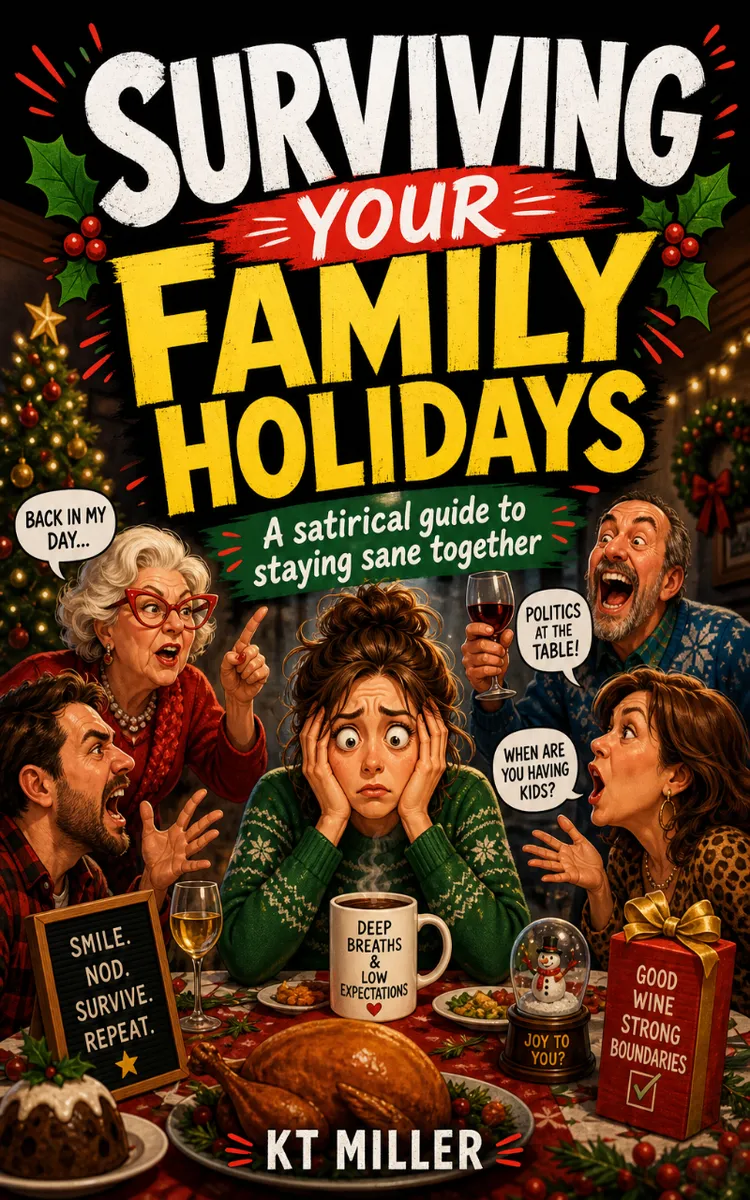
"Surviving Your Family Holidays" is a how-to guide book by KT Miller with 12 chapters and approximately 21,587 words. Satirical strategies for handling family interactions during holidays.
This book was created using Inkfluence AI, an AI-powered book generation platform that helps authors write, design, and publish complete books. It was made with the AI Ebook Generator.
Frequently Asked Questions
What is "Surviving Your Family Holidays" about?
Satirical strategies for handling family interactions during holidays
How many chapters are in "Surviving Your Family Holidays"?
The book contains 12 chapters and approximately 21,587 words. Topics covered include Holiday Boundaries in One Sentence, The Compliment Sandwich, Satirically, Pre-Game Exit Plans and Codes, Conversation Steering Without Drama, and more.
Who wrote "Surviving Your Family Holidays"?
This book was written by KT Miller and created using Inkfluence AI, an AI book generation platform that helps authors write, design, and publish books.
How can I create a similar how-to guide book?
You can create your own how-to guide book using Inkfluence AI. Describe your idea, choose your style, and the AI writes the full book for you. It's free to start.
Write your own how-to guide book with AI
Describe your idea and Inkfluence writes the whole thing. Free to start.
Start writingCreated with Inkfluence AI


