

Read the first chapter
The whole of chapter one, free. About 8 min. Turn the pages with the arrows, your keyboard, or a swipe.
Chapter 1
The Atlas Opens in Sleep
The first wave climbed uphill.
Mira Sen watched it curl over the black shore and spill between the silver grass, each droplet shining with the pale blue of a diagnostic window. Her survey clock insisted that the tidal edge lay three meters below her boots. The water disagreed.
“Anchor the descent,” she said.
A lattice of gold lines unfolded across her vision. Coordinates fixed themselves to the horizon, the moon, and the faint geometric tower rising far inland. Mira raised her left hand and pinched the nearest anchor into place. The dream accepted it with a soft chime.
For one breath, the coastline became ordinary.
She saw what she had come to record: a narrow inlet cutting into dark sand, two hooked promontories, a ridge of glassy stone beyond the surf. No registered cartographer had entered this dream-world before. No atlas filament crossed its sky. Its human dreamer lay three floors below the Cartographic Institute, sedated beneath a crown of neural relays, and the link would not remain stable for long.
Mira had twenty-seven minutes before waking severed the connection.
“Coastline survey, first pass,” she said. “Mira Sen, field authority seven. Begin.”
The atlas answered in her own voice, half a second late.
“Begin.”
She stepped toward the water.
The shore moved.
Not dramatically. There was no quake, no thunder. The sand simply slid sideways beneath her boot, carrying the inlet with it. The left promontory lengthened while the right folded inward. The blue diagnostic points blinked out one by one.
Mira stopped.
“Atlas, retain previous shore geometry.”
“Previous geometry conflicts with current terrain.”
“Mark the conflict. Do not overwrite.”
“Conflict marked.”
She looked back. Her footprints had vanished. In their place, a line of small black stones curved toward the sea.
The water whispered against the beach. Not random surf. Syllables, almost.
Mira crouched and pressed two fingers to the sand. It felt warm, then cold, then warm again, as if something below it were breathing through layers of stone.
“Unstable substrate,” she murmured.
“Correction,” said the atlas. “Substrate responsive.”
A tremor passed through the ground. The glass ridge tilted toward her.
Mira rose and drew a survey rod from the case at her hip. Its tip unfolded into a three-dimensional beacon, humming as it searched for a stable reference. She drove it into the sand at the edge of the inlet.
The beacon sank.
Not into loose sand. Into something soft that closed around its shaft.
Mira pulled hard. The rod came free with a wet metallic snap, trailing a strand of black silt. The silt writhed in the air, forming a thin line between her hand and the water.
Then it pointed inland.
“No,” she said.
The line recoiled and vanished.
A pulse struck the link. Her vision was filled with white static. Somewhere beyond the dream, a warning chimed from the Institute’s monitoring layer.
“Mira,” Ivo said through the comm. His voice was clipped, awake, and irritatingly calm. “I’m seeing coordinate loss.”
“I know.”
“You’ve been inside for ninety seconds.”
“Your clock is wrong.”
“My clock is connected to your cortex.”
“Then it’s wrong in two places.”
Another wave rushed up the incline. This one carried fragments of architecture: a blue door, a staircase with no building attached, a row of lit windows drifting like lanterns. They struck the shore and dissolved into foam.
Ivo went quiet.
Mira planted the survey rod again, this time on the glass ridge. The ridge bent under its weight. A narrow crack opened at her feet, revealing a darkness filled with slow-moving stars.
“Mira,” Ivo said. “Exit.”
“I haven’t mapped the inlet.”
“The inlet is changing faster than the system can render.”
“That’s why I’m here.”
“You’re there to survey an unclassified dream, not argue with its geology.”
“It isn’t geology.”
The crack sealed.
For the first time, the atlas displayed a symbol without a corresponding command: a small white circle crossed by a vertical line. Mira had seen it only in corrupted archives, where it appeared beside impossible data and then erased the files around it.
She reached toward the symbol.
The atlas pulled her hand back.
“Unregistered signal,” it said.
“Source?”
“Unavailable.”
“Direction?”
The symbol rotated.
Toward the inlet.
Mira felt the old confidence drain from her, not as fear but as a calculation losing its variables. Every dream had a structure. Even the wild ones obeyed some hidden pressure: memory, desire, repetition, the body’s electrical noise. A cartographer did not need to understand the world to map it. She needed only to find what remained consistent.
The coastline had no consistency.
Except for the signal.
She lifted the rod and walked along the inlet’s edge, keeping one eye on the atlas grid. The shore shifted with each step. A bank of white shells became a wall of black reeds. The water withdrew, exposing a road paved in translucent bone, then surged back before she could reach it.
Mira ran.
The inlet narrowed ahead. She leaped a channel of luminous water and landed on a ledge that had not existed a moment earlier. Behind her, the beach folded upward like a closing page.
“Stop moving,” Ivo said.
“I’m not choosing the route.”
“Your neural activity says otherwise.”
“Then tell the system to stop interpreting me as the author.”
The comm crackled. For an instant, another voice breathed beneath Ivo’s.
Mira turned.
The voice spoke from the water.
“Seven coastlines remain.”
The words were not heard through her ears. They appeared inside the link, rendered in the pressure behind her eyes.
Ivo swore. “What was that?”
“You heard it?”
“I heard you.”
The water rose without a wave. A dark column lifted from the inlet, holding its shape as if gravity had forgotten it. Within the column, pale marks moved in branching patterns.
Mira aimed the survey rod at it.
The atlas rejected the scan.
“Object is not present.”
“It’s in front of me.”
“Object is not present.”
The column leaned toward her. Its surface reflected not Mira’s face but a dozen versions of the shore, each one carrying a different arrangement of cliffs and channels. In one reflection, a figure stood on the far promontory. In another, the figure stood behind her.
Mira did not look back.
“Open manual cartography,” she said.
“Manual mode risks link damage.”
“Open it.”
“Mira - ” Ivo began.
“Open it.”
The atlas hesitated. That hesitation was impossible. It lasted only a fraction of a second, but Mira felt it as a hand closing around the base of her skull.
Manual mode engaged.
The golden grid vanished. Her vision cleared, leaving only the dream’s raw colors: black water, violet sky, silver grass. She could no longer see the safe return vector or the countdown to waking. The world became larger and less trustworthy.
Mira drew a line in the air with two fingers.
A white filament followed.
She traced the visible shoreline from the ledge to the inlet’s mouth, ignoring the shifting geometry. The filament trembled, then sank into the dream. For a moment, the coastline held.
The dark column collapsed.
Water struck the ledge with enough force to knock her to one knee. Cold flooded her boots. Something brushed her ankle beneath the surface, thin and jointed.
She drove the survey rod down.
The water flashed blue. The thing withdrew.
“Mira!” Ivo shouted. “Your link is spiking.”
“I have a partial line.”
“You have a breach.”
“Keep the channel open.”
“I can’t keep it open if the dream is rewriting the relay.”
The inlet shifted again. Its mouth swung east, then north, then opened directly beneath Mira. The ledge fractured.
She jumped toward the opposite bank.
Her hand caught the lip. The stone was warm and pulsing. Below, the inlet churned with pieces of the dream: a child’s red balloon, a field of wheat under starlight, a train moving through deep water. The survey rod slipped from her belt and fell among them.
Mira gripped the ledge with both hands.
The atlas spoke without being asked.
“Unregistered signal approaching.”
A line appeared beneath the water, bright as a nerve.
It did not point toward the signal.
It pointed toward her.
Mira hauled herself over the edge. The bank rolled beneath her, transforming into a flat plain of wet glass. She slid several meters before catching a ridge with her elbow. Pain flared through her arm. The dream translated it too accurately; the bone seemed to grind under her skin.
Ivo’s voice thinned with distance.
“Wake on my mark.”
“No.”
“You’re losing motor coherence.”
“I can finish the inlet.”
“You don’t know what’s speaking to you.”
“That’s what the map is for.”
“That isn’t mapping.”
Mira looked across the glass plain. The coastline had reassembled behind her. The inlet now formed a perfect crescent, its edges smooth and symmetrical. The shape was familiar.
She had seen it in the atlas a thousand times.
Not as a place. As a blank.
A missing section between two known dream territories, always dismissed as a rendering fault.
Mira touched the glass. Lines spread from her fingers, revealing a hidden contour beneath the surface. The crescent was not an inlet. It was an opening in something vast, something that had arranged the shore around itself.
“Atlas,” she whispered. “Record the contour.”
“Manual map compromised.”
“Record it.”
“Compromised.”
“Record it.”
The atlas obeyed.
The crescent burned into her private map. At once, the coastline convulsed. The glass plain buckled. The sea rose behind her, and the sky split along a seam of pale fire.
Mira saw the route beneath the map.
It began at the inlet, passed under the shore, and continued inland through the dream. Not a line generated by the atlas. A line drawn by something else, precise and patient, using landmarks that did not yet exist.
A tower appeared where the route ended.
The same tower she had anchored at the beginning.
Its windows opened one by one.
Inside each window stood a dark figure facing the sea.
“Mira,” Ivo said, barely audible. “Come back.”
The route moved.
A second signal, unregistered and silent, began drawing a new branch beneath her map. It traced the shape of her own path through the dream, then curved past her position toward the tower.
Mira tried to sever the connection.
The atlas refused.
“Why?” she demanded.
For the first time, the system did not answer in her voice.
A reply rose from beneath the living coastline.
“Because you have been mapped.”
The dream snapped shut around the words, and somewhere beyond waking, the countdown reached zero.
End of chapter one. 14 more chapters in the full book.
Swipe or use the arrows to turn the page


What's inside: 15 chapters
- 1. The Atlas Opens in Sleep
- 2. A Signal in the Sleep Grid
- 3. Who Drew the Hidden Road?
- 4. The Gate Beneath the Glass
- 5. The Cartographer’s Unmapped Memory
- 6. The Map That Erased Itself
- 7. Across the Bone Orchard
- 8. The Dream Is Mapping Back
- 9. The Memory Mira Would Keep
- 10. The Bridge Breaks at Dawn
- 11. When Mira Lost the North
- 12. The Coordinates No One Kept
- 13. A Living Atlas for the Core
- 14. A Map Without Ownership
- 15. The Unfinished Coastline
About this book
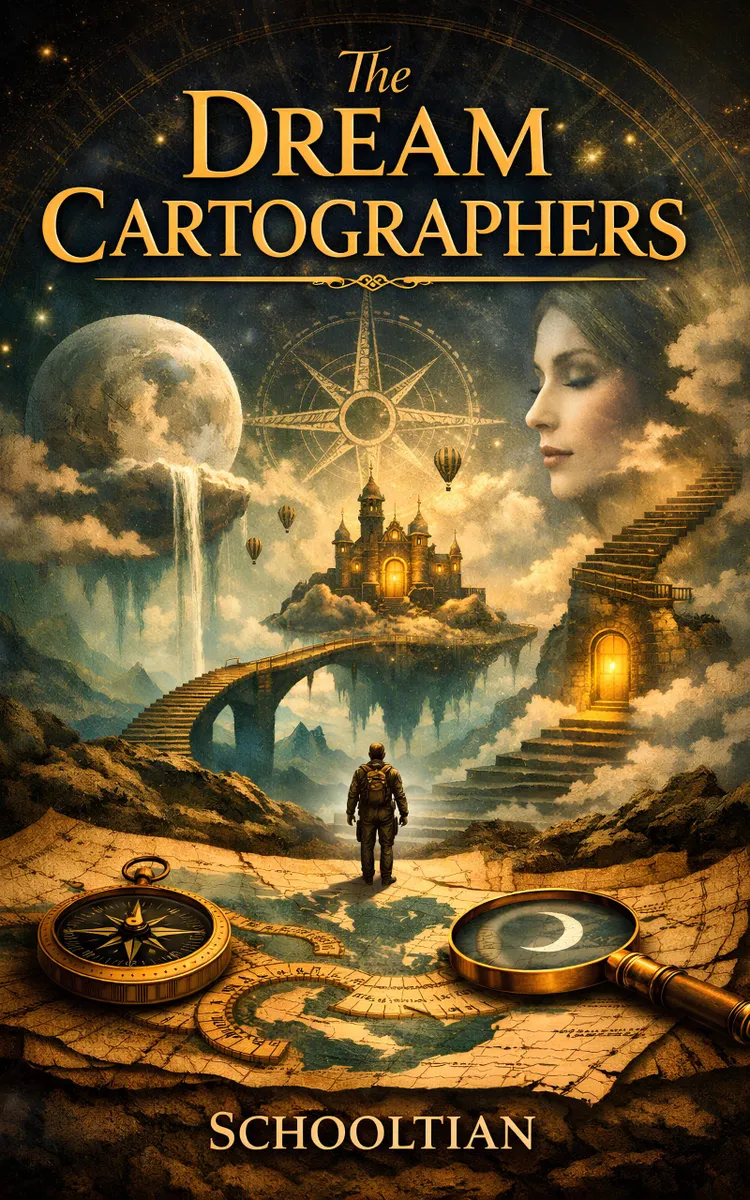
"The Dream Cartographers" is a fiction book by Schooltian with 15 chapters and approximately 28,626 words. AI cartographers mapping surreal worlds within human dreams.
This book was created using Inkfluence AI, an AI-powered book generation platform that helps authors write, design, and publish complete books. It was made with the AI Novel Writer.
Frequently Asked Questions
What is "The Dream Cartographers" about?
AI cartographers mapping surreal worlds within human dreams
How many chapters are in "The Dream Cartographers"?
The book contains 15 chapters and approximately 28,626 words. Topics covered include The Atlas Opens in Sleep, A Signal in the Sleep Grid, Who Drew the Hidden Road?, The Gate Beneath the Glass, and more.
Who wrote "The Dream Cartographers"?
This book was written by Schooltian and created using Inkfluence AI, an AI book generation platform that helps authors write, design, and publish books.
How can I create a similar fiction book?
You can create your own fiction book using Inkfluence AI. Describe your idea, choose your style, and the AI writes the full book for you. It's free to start.
Write your own fiction book with AI
Describe your idea and Inkfluence writes the whole thing. Free to start.
Start writingCreated with Inkfluence AI


