

Read the first chapter
The whole of chapter one, free. About 5 min. Turn the pages with the arrows, your keyboard, or a swipe.
Chapter 1
Spotting Anxiety Triggers Fast
Anxiety gets easier to work with when you can name what sets it off. Instead of writing “I felt anxious,” you’ll track the moment, the situation, and the first sign your body or mind gave you. That turns a foggy feeling into useful information.
You don’t need to find one perfect cause. Anxiety often has a pattern: a certain type of message, place, task, thought, or body sensation. Your job is to collect a few real examples and compare them.
Turn an Anxious Moment Into Useful Clues
A trigger is anything that starts or increases an anxiety response. It may be external, such as a crowded store or an unanswered text. It may be internal, such as a racing heartbeat, a “what if?” thought, or lack of sleep. Sometimes several triggers arrive together.
Use this short sequence whenever you notice anxiety:
• Situation: What was happening right before the anxiety rose?
• First signal: What did you notice first in your body, thoughts, or behavior?
• Meaning: What did your mind predict or fear?
• Intensity: How strong was the anxiety from 0 to 10?
• Response: What did you do next?
The first signal matters because it helps you catch anxiety earlier. Maybe your jaw tightens before you start checking your email repeatedly. Maybe your stomach drops before you avoid making a phone call. Spotting that early clue gives you a better chance to pause before the usual reaction takes over.
Key takeaway: The fastest way to identify a trigger is to record what happened immediately before anxiety rose, not only what happened afterward.
A useful entry is specific. “Work was stressful” is too broad to compare. “At 9:10 a.m., I saw three unread messages from my manager and predicted I had made a mistake” gives you something you can track.
Your Three-Minute Trigger Snapshot
Materials needed: This workbook and a pen or notes app.
Time required: 3 minutes per entry. Complete one entry after an anxious moment, or at the end of the day.
Write about one recent anxiety spike. Choose an episode from the last 24 hours if possible. Don’t wait for a dramatic moment; a 4 out of 10 still counts.
• Write the time and place:
Time: ________ Place: ____________________________
• Describe what happened in one plain sentence. Include the action or event that came just before the anxiety.
Situation: ______________________________________________________
• Circle or write the first signal you noticed:
Body: tight chest / tense jaw / fast heart / stomach change / sweating / other: __________
Mind: worry / mental image / self-criticism / urge to predict / other: __________
Behavior: checking / avoiding / rushing / asking for reassurance / other: __________
• Finish this sentence:
“My mind predicted that ______________________________________________.”
• Rate the anxiety before you responded:
0 1 2 3 4 5 6 7 8 9 10
My rating: ______
• Record what you did next and whether the anxiety changed within 10 minutes.
I did: __________________________________________________________
Rating 10 minutes later: ______
• Give the trigger a short label. Use two to five words, such as “unanswered work message,” “crowded checkout,” or “body sensation.”
Trigger label: ___________________________________________________
Completed example
Time: 9:10 a.m.
Place: Kitchen, before work
Situation: I opened my email and saw three unread messages from my manager.
First signal: Tight chest, then the thought, “I probably messed something up.”
Anxiety rating: 6 out of 10
I did: Re-read the inbox and delayed opening the messages.
Rating 10 minutes later: 7 out of 10
Trigger label: Unread manager messages
Complete three snapshots before drawing a conclusion. One anxious moment can be unusual. Three entries let you compare details and look for repeats.
Find the Pattern Before Anxiety Picks the Plan
After you have three snapshots, place them side by side. Look for repeated trigger labels, times, settings, thoughts, and first signals. You’re not trying to prove that one thing causes every anxious feeling. You’re looking for a useful starting point.
For example, you might notice that anxiety rises most often before opening messages, making a phone call, or entering a busy place. The common thread may be uncertainty, fear of judgment, or a body sensation you interpret as danger. The expected outcome is a clearer target: instead of “I’m anxious a lot,” you can say, “Uncertainty before communication often starts my anxiety, and I respond by delaying.”
Use the pattern to choose one early warning sign. If your first signal is jaw tension, notice it during the next email or phone task. If your first signal is the thought “I can’t handle this,” write that thought down before checking, avoiding, or seeking reassurance. The goal isn’t to force anxiety away. It’s important to notice the sequence soon enough to make one different choice.
Consider a small-business owner who records three episodes: a customer complaint, an overdue invoice, and a supplier delay. Each event is different, but the repeated thought is, “If I don’t fix this immediately, everything will fall apart.” The trigger pattern may be urgent business uncertainty, with rushing as the response. Naming that pattern helps the person track the next episode more accurately and measure whether pausing changes the intensity.
Apply It: For the next seven days, complete one snapshot whenever anxiety reaches 4 out of 10 or higher. At the end of the week, count your repeated trigger labels.
• Most common trigger label: ______________________________
• Number of times it appeared: ______
• Most common first signal: ________________________________
• Usual response: _________________________________________
• Average starting anxiety rating: ______ out of 10
If your entries show different triggers, group them by type: uncertainty, judgment, conflict, health or body sensations, workload, or sensory overload. Choose the group that appears most often. Your expected outcome is one clear sentence:
“My anxiety most often starts when ____________________, and I first notice ____________________.”
Keep that sentence nearby for the next check-in. It’s a quick cue, not a diagnosis. Patterns can change with sleep, stress, illness, or major life events, so update your notes rather than treating the first pattern as permanent.
Reflect and Choose Your Next Tracking Target
Which trigger label appeared most often in your three snapshots, and what exact detail made it recognizable?
__________________________________________________
__________________________________________________
__________________________________________________
What was your earliest warning sign - body sensation, thought, or behavior - and how many minutes or seconds passed before you reacted?
__________________________________________________
__________________________________________________
__________________________________________________
When this trigger appears again, what will you record first: the situation, the first signal, or the predicted outcome? Why is that the most useful starting point for you?
__________________________________________________
__________________________________________________
__________________________________________________
Your next step is simple: catch one real moment, label it clearly, and record the first signal before anxiety writes the rest of the script.
End of chapter one. 7 more chapters in the full book.
Swipe or use the arrows to turn the page


What's inside: 8 chapters
- 1. Spotting Anxiety Triggers Fast
- 2. Tracking Thoughts with Thought Logs
- 3. Challenging Thoughts with Evidence
- 4. Reframing with Balanced Statements
- 5. Using Breathing for Fast Downshifts
- 6. Grounding with 5-4-3-2-1 Senses
- 7. Building an Exposure Ladder Plan
- 8. Designing Your Anxiety Check-In Routine
About this book
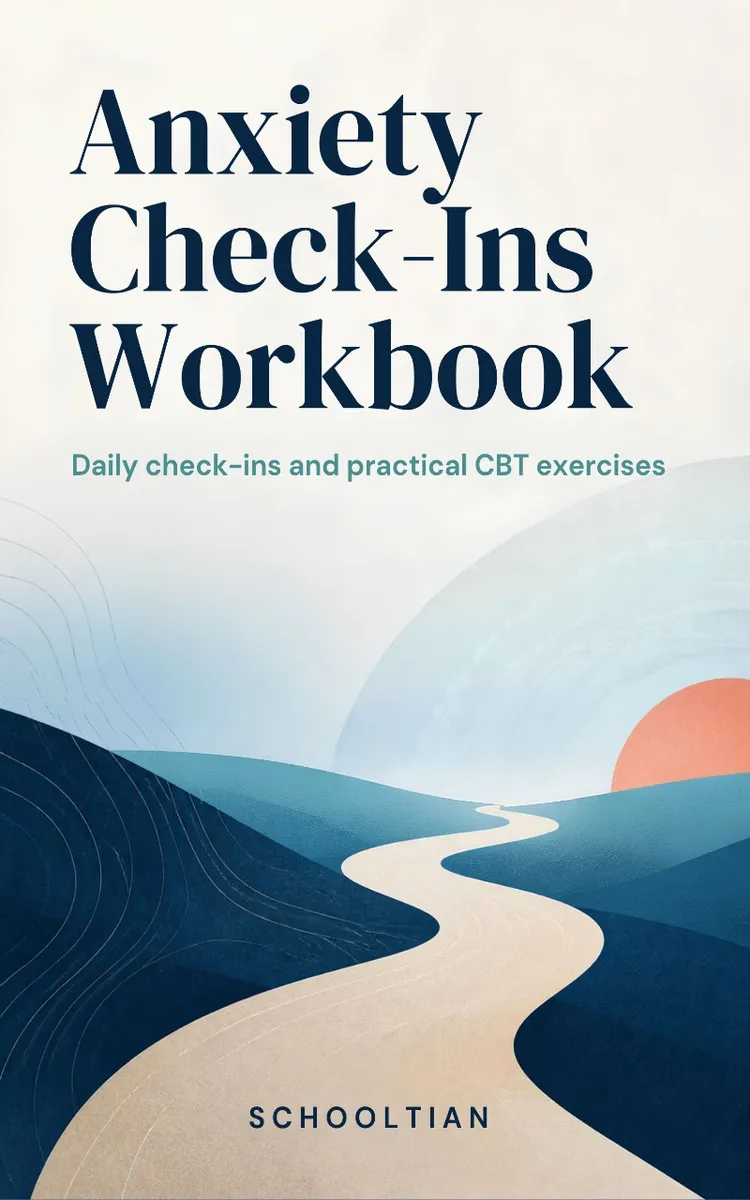
"Anxiety Check-Ins Workbook" is a workbook by Schooltian with 8 chapters and approximately 10,841 words. Anxiety management workbook with daily check-ins and CBT exercises.
This book was created using Inkfluence AI, an AI-powered book generation platform that helps authors write, design, and publish complete books. It was made with the Workbook Generator.
Frequently Asked Questions
What is "Anxiety Check-Ins Workbook" about?
Anxiety management workbook with daily check-ins and CBT exercises
How many chapters are in "Anxiety Check-Ins Workbook"?
The book contains 8 chapters and approximately 10,841 words. Topics covered include Spotting Anxiety Triggers Fast, Tracking Thoughts with Thought Logs, Challenging Thoughts with Evidence, Reframing with Balanced Statements, and more.
Who wrote "Anxiety Check-Ins Workbook"?
This book was written by Schooltian and created using Inkfluence AI, an AI book generation platform that helps authors write, design, and publish books.
How can I create a similar workbook?
You can create your own workbook using Inkfluence AI. Describe your idea, choose your style, and the AI writes the full book for you. It's free to start.
Write your own workbook with AI
Describe your idea and Inkfluence writes the whole thing. Free to start.
Start writingCreated with Inkfluence AI


