
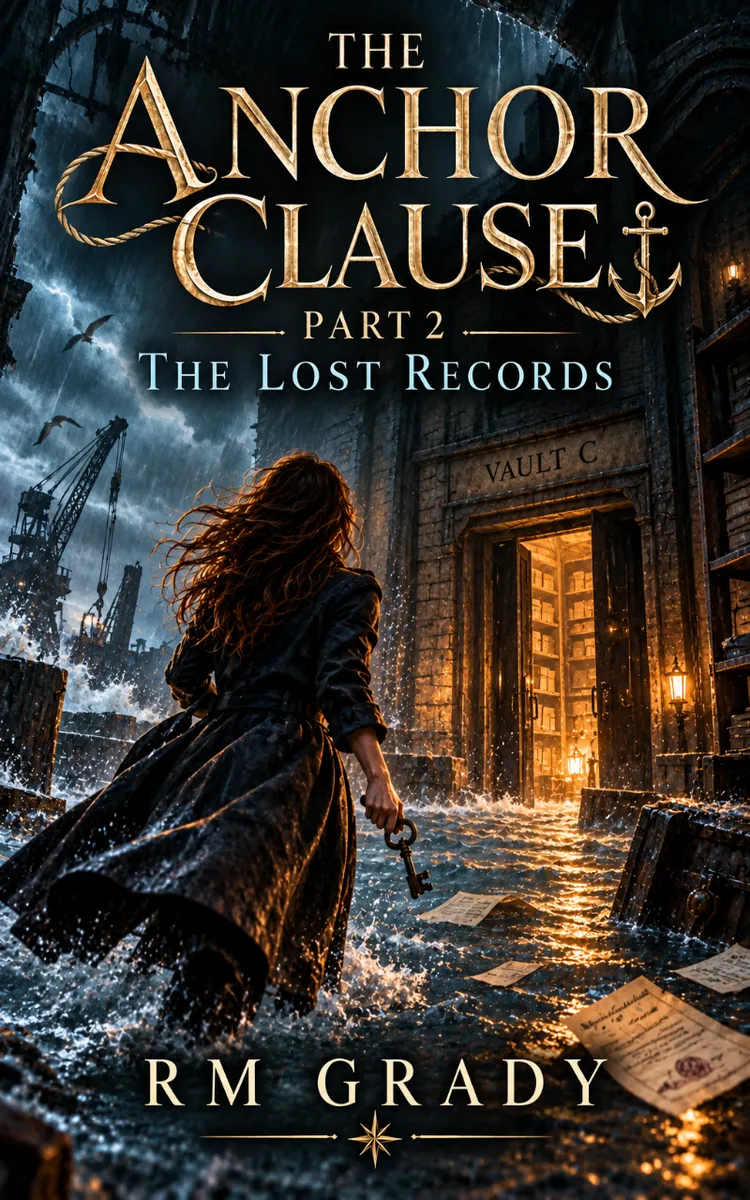

Read the first chapter
The whole of chapter one, free. About 10 min. Turn the pages with the arrows, your keyboard, or a swipe.
Chapter 1
The Clause Beneath the Floodline
The demolition siren began while Mara Voss was still three streets from Bellwether Harbor, its low note shuddering through the rain and rattling the loose window of the truck beside her.
She ran beneath the harbor lamps, one hand clamped around the iron key she had stolen from the archive office, the other pressed against the stitches beneath her coat. The Bellwether Archive rose ahead through the storm, six stories of black brick and salt-stained glass. Red condemnation marks crossed its doors. Beyond them, the lower floors were already dark with floodwater.
At the end of the quay., the demolition crew waited beside two yellow machines. Their engines growled in the rain.
Mara reached the chain-link gate as a man in a yellow slicker lifted the bolt.
“Thirty minutes,” he said.
“I need ten.”
“You need a miracle.”
“I need the records.”
He looked past her to the archive. “Records are why they’re tearing it down.”
Mara slipped through before he could close the gate.
The archive’s front doors had been chained, but the side entrance yielded to the iron key after three hard turns. A pressure of cold water shoved against the threshold. It spread across the floor inside, carrying scraps of paper and a dead gull’s feather through the lobby.
Mara stepped in.
The old brass directory hung crooked on the wall. Most of the names had been scraped away, but one line remained beneath the dust.
ANCHOR HOLDINGS - FOUNDING CHARTERS - VAULT C.
She took out her flashlight. The beam trembled across the flooded lobby.
The original anchor clause had been filed in Vault C forty years ago, before the harbor ownership records were transferred to the city. Mara had seen its copy once, in her grandmother’s locked desk: a narrow page of legal script, witnessed and sealed, binding the harbor’s title to the families who had built it. The clause was the reason the new authority could not simply sell the docks. It was also the reason men had come to Mara’s house two nights ago and searched every room without taking a single piece of silver.
The original would prove whose hands held the harbor.
If it still existed.
A crack sounded overhead.
Mara looked up. Water dripped through the ceiling tiles. Somewhere in the building, metal groaned under strain.
She moved toward the stairwell.
The first flight was dry. The second had collapsed halfway down, leaving a jagged opening into darkness. She swung the flashlight beneath the broken steps. Water flowed below, black and fast, filling the archive’s sunken ground floor.
A service ladder had been bolted to the wall beside the stairwell. Mara tested the lowest rung. It shifted under her weight.
Behind her, the demolition siren sounded again.
She climbed.
The ladder ended at the third floor, where a fire door stood open by a hand’s width. She pushed through and found rows of shelving stretching into the dark. The archive’s upper stacks had escaped the flood, but the floor had not escaped the years. Books and ledgers leaned against one another in sagging columns. Every step brought a small complaint from the boards.
Mara checked the brass directory again. Vault C lay in the records annex, beyond the locked municipal stacks.
She crossed the aisle.
A voice came from the far side of the shelves.
“You’re late.”
Mara stopped.
Silas Rook stepped into the flashlight beam wearing a soaked wool coat and carrying a pry bar. His gray hair was plastered to his forehead. He had been the archive’s deputy registrar until the city dismissed him last winter, after he refused to certify the harbor transfer.
“You knew I was coming,” Mara said.
“I knew someone would come.” His gaze dropped to her hand, where the stolen key glinted. “I hoped it would be you.”
“Move.”
Silas smiled without warmth. “That’s what the city said when it sent the wreckers.”
“What did you do with the clause?”
“Nothing.”
“Then why are you here?”
He looked toward the dark end of the aisle. “Because the locks were changed.”
A deep boom rolled through the building. Dust sifted from the ceiling. Far below, machinery answered with a grinding roar.
Mara stepped closer. “How long?”
“Twenty-two minutes, perhaps less.”
“Show me the annex.”
Silas did not move. “Before I do, understand this. The archive has been opened twice since the condemnation order. Once by the city surveyors. Once by whoever came after them.”
“Whoever?”
“The locks were replaced from the inside.”
Mara tightened her grip on the flashlight. “You’re wasting time.”
“I’m trying to keep you alive.”
“Then stop talking.”
He gave a short, bitter laugh and led her between the shelves.
The locked municipal stacks occupied the north wing. Iron grilles divided them from the public records, each bar furred with rust. Silas knelt at the gate and wedged the pry bar into the lock. Mara held the flashlight while he worked.
“Why didn’t you open this before?” she asked.
“Because I had no reason to believe the clause was still here.”
“And now?”
“Now I’ve seen the inventory.”
The lock snapped.
Silas pushed the gate inward. A stale draft moved through the stacks, cold enough to sting Mara’s cheeks. The shelves here were taller, packed with gray boxes and bound volumes. Water dripped steadily from somewhere overhead.
“Vault C is at the end,” he said. “Third cabinet from the wall.”
Mara entered.
The floor dipped beneath her first step. She caught herself against a shelf. A row of city ledgers slid forward, their leather spines knocking together.
“Don’t lean there,” Silas warned.
The boards beneath the aisle had swollen from the flood. A dark seam ran across them, widening toward the far wall.
Mara moved sideways, placing each foot where the wood looked least damaged. The storm struck the building in hard bursts. Rain hammered the windows. Somewhere below, a door slammed again and again in the rising water.
At the end of the aisle, she found the cabinet.
Its lock had been cut.
Silas came up behind her. “There.”
Mara pulled the drawer open.
Empty.
For one moment, the siren outside seemed to vanish beneath the blood rushing in her ears. She searched the neighboring drawers. Maps. Tax rolls. Dock permits. Nothing bearing the seal of Anchor Holdings.
“You said you saw the inventory.”
“I saw the clause listed.”
“Then someone removed it.”
“Or moved it.”
Mara turned. “Where?”
Silas pointed upward.
The ceiling above the cabinet had buckled. A narrow iron stair climbed through a service hatch into the old survey room. Mara caught the edge and pulled. The hatch groaned open.
“You stay here,” Silas said.
“No.”
“The room is worse than this floor.”
“Then you should have mentioned that before bringing me here.”
She climbed.
The survey room had no windows, only a long table bolted to the floor and a ceiling crowded with pipes. Water streamed through a split joint, striking the table in a hard silver line. Cabinets lined the walls. Their doors hung open.
Mara swept the flashlight across the room.
One cabinet remained closed.
Its brass plate read ANCHOR HOLDINGS - PRIVATE INSTRUMENTS.
The key in her palm fit the lock.
She opened it.
A leather portfolio rested inside, wrapped in oilcloth. Mara lifted it out. The leather was warm from the sealed cabinet, and beneath the cloth she felt the stiff edges of several pages.
Silas climbed through the hatch. “Mara.”
She unwrapped the portfolio.
The anchor clause lay within, written in dense black lines on cream paper. The harbor seal marked the lower corner. Her grandmother’s handwriting appeared in the margin beside the first paragraph: Boundary confirmed against lighthouse survey.
Mara’s breath caught.
This was it. The document that had kept the harbor from being divided. The promise that had bound her family to the owners before the city learned to call the docks its own.
Then she saw the final page.
The signature sheet was too clean.
The body of the clause had browned at the edges, the paper rippled by age and damp. The last page was bright, uncreased, and cut to a slightly different width. Its seal had been pressed in red wax, but the wax bore no harbor mark. Instead, someone had stamped a small crown over the original impression.
Silas reached for it.
Mara pulled the portfolio against her chest. “Don’t.”
“I know that seal.”
“Whose?”
“Not the city’s.”
A violent shudder passed through the floor. The table bolts tore loose on one side. Mara grabbed the cabinet as the room tilted. The portfolio slid from her arm and struck the boards.
Below them, something enormous collapsed. The sound rose through the building in a wave of timber, glass, and rushing water.
Silas pointed to the hatch. “We leave now.”
Mara snatched up the papers. “The signature page is false.”
“I told you someone had been here.”
“This isn’t a replacement made for the city transfer.” She held the page beside the older sheets. “Look at the alignment. The clause ends mid-sentence on the previous page. This signature page belongs to another instrument.”
Silas stared at the text. “Read it.”
Mara’s flashlight shook as she followed the lines.
“‘The harbor shall remain in the possession of those who maintain the eastern boundary, provided the anchor stone remains under their authority.’”
Silas went pale.
“What?” Mara asked.
“That isn’t the ownership clause.”
“What is it?”
“A condition.”
“For what?”
He looked toward the ceiling, toward the unseen lighthouse standing beyond the flooded harbor.
“For whoever controls the anchor stone.”
The building lurched again.
A crack split the floor between them. Water burst upward through the boards, carrying splinters and a brass drawer handle. Mara shoved the old pages inside her coat and folded the altered sheet around them.
Silas grabbed her wrist. “Leave it.”
“No.”
“It’s compromised.”
“It’s evidence.”
“It’s bait.”
Mara looked at the false signature, at the crown stamped into wax. The person who had replaced the page had wanted the document found. Wanted someone to carry the altered clause beyond the archive.
The demolition siren sounded a third time.
Mara folded the page into the portfolio. “Then they can regret giving me both.”
They descended through the hatch as the survey room began to come apart. Silas went first, dropping to the lower floor. Mara followed, but the ladder shifted beneath her. One rung tore free. She struck the wall, pain flashing through her shoulder, and nearly lost the portfolio.
Silas caught her coat.
“Let go of the papers,” he shouted.
“Not a chance.”
He hauled her down. Behind them, the hatch collapsed, burying the cabinet beneath a rain of plaster and iron.
The municipal stacks had changed. Water now streamed between the shelves, ankle-deep and rising. A ledger floated past Mara’s boots, its pages opening and closing like pale hands.
They moved toward the gate.
A shelf broke loose behind them.
Silas shoved Mara forward. The shelf crashed where she had stood, crushing boxes and sending a surge of water through the aisle. Mara hit the gate hard enough to bruise her ribs. The iron bars resisted.
“Open it!”
“It’s jammed.”
She wedged the pry bar into the gap and pulled. The gate shifted a fraction. Water pressed against her legs.
“Mara,” Silas said.
She pulled again.
The lock tore free.
They stumbled into the public stacks as the aisle behind them filled. Mara slipped, went down on one knee, and held the portfolio above the water. Silas dragged her toward the stairwell.
The lower stairs were gone. They crossed to the freight lift, where an emergency ladder climbed toward the roof access. The lift shaft yawned below, black water climbing through its cables.
Mara climbed first. Her shoulder burned. Her wet boots slipped on the rungs. Above her, the roof door banged in the wind.
Behind them, the archive groaned.
“Faster,” Silas called.
“I’m moving.”
“You’re bleeding.”
“So are you.”
They reached the roof access just as the floor beneath the ladder buckled. Silas shoved the door open. Rain struck Mara’s face. She crawled onto the roof and rolled clear.
The demolition crew stood beyond the safety barrier, shouting. One of the yellow machines had begun to move.
Mara rose, clutching the portfolio beneath her coat.
The archive’s north wall shuddered. Brick spilled into the flooded street. The sound of its collapse swallowed the harbor bells.
For several seconds, Mara could do nothing but stare at the ruin.
Then she opened the portfolio.
The original pages were still there. The seal, the boundary notation, the old signatures - all intact.
The final page was not.
Mara lifted it toward the gray light. Beneath the false signature, almost invisible in the paper’s lower margin, someone had written a second line in fresh ink.
ASK THE LIGHTHOUSE WHO OWNS THE STONE.
Silas read it over her shoulder.
Across the harbor, beyond the cranes and the broken pilings, the condemned lighthouse stood against the storm. Its lantern was dark.
Then, far above them, something inside it turned once and flashed.
End of chapter one. 7 more chapters in the full book.
Swipe or use the arrows to turn the page
What's inside: 8 chapters
- 1. The Clause Beneath the Floodline
- 2. The Promise Mara Cannot Break
- 3. Across the Breakwater
- 4. The Witness in the Registry
- 5. The Harbor Goes Dark
- 6. The Silence She Inherited
- 7. The Clause Read Aloud
- 8. A New Anchor
About this book
"The Lost Records" is a fiction book by R.M. Grady with 8 chapters and approximately 17,810 words. The archive is scheduled for demolition. The only document that can save the harbor is hidden inside.
This book was created using Inkfluence AI, an AI-powered book generation platform that helps authors write, design, and publish complete books. It was made with the AI Novel Writer.
Frequently Asked Questions
What is "The Lost Records" about?
The archive is scheduled for demolition. The only document that can save the harbor is hidden inside. And someone has already killed to keep it buried. Mara Voss has one chance to find the original Anchor Clause before the Bellwether Archive comes down. With the building flooding and demolition crews already waiting outside, Mara enters the condemned archive carrying a stolen iron key—and a secret her enemies will do anything to recover. The Anchor Clause was supposed to be a simple founding agreement. Instead, it may be the key to determining who truly owns Bellwether Harbor. But the records Mara finds suggest something far more disturbing. Someone erased the harbor’s history. Someone hid the original clause. And someone has been protecting that secret for forty years. As the flood rises and the archive begins to collapse, Mara must descend into the forgotten vaults and uncover the truth before the evidence is destroyed. Because the lost records don’t just reveal who owns the harbor. They reveal who has been controlling it. And Mara may be the next thing they intend to erase. The Anchor Clause: Part 2 — The Lost Records is a dark, atmospheric mystery of buried secrets, deadly conspiracies, forbidden records, and a race against time to uncover the truth.
How many chapters are in "The Lost Records"?
The book contains 8 chapters and approximately 17,810 words. Topics covered include The Clause Beneath the Floodline, The Promise Mara Cannot Break, Across the Breakwater, The Witness in the Registry, and more.
Who wrote "The Lost Records"?
This book was written by R.M. Grady and created using Inkfluence AI, an AI book generation platform that helps authors write, design, and publish books.
How can I create a similar fiction book?
You can create your own fiction book using Inkfluence AI. Describe your idea, choose your style, and the AI writes the full book for you. It's free to start.
Write your own fiction book with AI
Describe your idea and Inkfluence writes the whole thing. Free to start.
Start writingCreated with Inkfluence AI


