
Read the first chapter
The whole of chapter one, free. About 8 min. Turn the pages with the arrows, your keyboard, or a swipe.
Chapter 1
Why Your Clock Feels Wrong
When Two Correct Clocks Disagree
What if two clocks were placed side by side, synchronized perfectly, and then separated? Both remain correct, but they show different times when reunited. That is not a defect in either clock. It is a consequence of motion itself.
For centuries, people treated time as the quiet background of the universe: one invisible flow, shared by every place and every observer. Albert Einstein overturned that picture in 1905. His special theory of relativity showed that motion can change the rate at which time passes, while his general theory, published in 1915, added gravity to the story. The result was not that clocks became unreliable. It was that time stopped being universal.
The disagreement begins with something ordinary: one observer moves relative to another. From there, the familiar world loosens. A fast-moving spacecraft, a beam of light, and the satellites guiding a phone’s map all belong to the same strange account of reality.
If every observer carries a truthful clock, what does it mean for time to be the same?
The First Crack in Universal Time
Before Einstein, the most influential description of time came from Isaac Newton. In Newtonian physics, time flowed evenly everywhere, independent of matter and motion. A minute on Earth and a minute beside a distant star were, in principle, the same minute. Clocks could run fast or slow, but time itself remained fixed.
That view worked remarkably well for bridges, cannonballs, planets, and pendulums. It also matched ordinary experience. People walked, rode horses, sailed ships, and later traveled by train without noticing any disagreement between their clocks. At everyday speeds, the effect is far too small for human senses to detect.
The trouble appeared when physicists tried to understand light. In the nineteenth century, experiments showed that light travels through empty space at a constant speed - about 299,792 kilometers per second. That speed did not behave like the speed of a thrown stone, which changes depending on whether the observer is moving toward or away from it.
Einstein took the constancy of light seriously. If every observer measures the same speed for light, then something else must adjust. Space can no longer keep all distances fixed, and time can no longer keep all durations fixed. The adjustment is not a flaw in measurement. It is the structure of the universe preserving the same speed of light for everyone.
The simplest way into this idea is the Clock-Disagreement Ladder. At the first rung, two clocks are together and agree. At the second, one begins moving relative to the other. At the third, their readings diverge slightly. At the highest rung, the difference becomes large enough to matter for spacecraft, satellites, and journeys across the solar system. The ladder does not lead from correct time to incorrect time. It leads from one shared reading to several equally valid readings.
Motion Makes the Minutes Stretch
The effect is called time dilation. A clock moving relative to an observer is measured to run more slowly than a clock at rest with that observer. The moving clock does not feel damaged or sluggish. Its mechanism works normally, its heartbeat remains regular, and its owner experiences each second as a second. The difference appears when the clocks are compared.
A useful comparison is the light clock. Picture a pulse of light bouncing between two mirrors. When the clock is at rest, the light travels straight up and down. To an observer watching the clock move sideways, the light follows a longer, diagonal path between the mirrors. Because light’s speed must remain the same for both observers, the longer path takes more time. The moving clock therefore marks fewer ticks during the observer’s interval.
The strange part is that the moving observer sees the same kind of effect in the other direction. Each observer regards the other as moving, so each sees the other’s clock running slow. This is not a contradiction because the observers are not sharing one universal present. Their measurements of distance and time are linked to their motion.
At ordinary speeds, the disagreement is tiny. A passenger on a commercial flight will age an almost immeasurably different amount from someone who stayed on the ground. But “almost immeasurable” is not the same as zero. Atomic clocks are precise enough to detect such differences when they are flown around the world or placed at different altitudes.
A surprising single sentence captures the issue: speed does not merely change where you are; at high enough levels, it changes how much time you have experienced.
The famous “twin paradox” makes the situation more vivid. One twin remains on Earth while the other travels at high speed and returns. The traveling twin is younger at reunion. The apparent paradox comes from treating the two journeys as perfectly symmetrical. They are not. The traveler turns around, changes frames of reference, and follows a different path through spacetime. The clocks disagree because the paths differ.
The Surprise: There Is No Master Clock
The counterintuitive finding is this: time dilation is not a visual illusion, and it is not merely a problem with comparing clocks. Different observers genuinely accumulate different amounts of time. A clock moving rapidly through space records less elapsed time along its path than a clock following a different path.
That changes the question. Instead of asking which clock gives the “real” time, physics asks how much proper time - the time measured along an observer’s own path - has passed. Each clock reports its own journey accurately. There is no hidden master clock above the universe assigning the final answer.
This matters because human language quietly assumes that “now” is shared. We say that a distant star is shining now, or that a spacecraft is now passing a planet, as though all observers can agree on one present moment. Relativity denies that assumption for events separated across space. Two observers moving differently can disagree about which distant events happen at the same time, and neither needs to be mistaken.
The disagreement is not a failure of communication. It is built into the relationship between space and time. What one observer calls a distance in space, another partly describes as a difference in time. Spacetime is not a stage where events occur; it is the combined pattern that determines how observers measure those events.
The Clocks Above the Earth
The most practical witnesses to this strange arrangement are the satellites of the Global Positioning System. Their clocks are not decorative instruments. They are part of the system’s measurement machinery.
A GPS receiver determines its location by comparing the arrival times of signals from satellites. The signals travel at the speed of light, so an error of just a few billionths of a second can shift the calculated position by meters. The satellites move rapidly relative to receivers on Earth, producing special-relativistic time dilation. They also orbit higher above Earth, where gravity is weaker, producing a general-relativistic effect that makes their clocks run faster than clocks on the ground.
These two effects pull in opposite directions. Motion slows the satellite clocks; weaker gravity speeds them up. Engineers account for both before the satellites are used for navigation. Without relativistic corrections, GPS positions would drift rapidly and become useless for ordinary navigation.
Here the abstract disagreement between clocks becomes a public service. A route calculated on a phone, an aircraft guided across an ocean, and a rescue team locating an emergency signal all depend on clocks that do not share one universal rate.
The same principle appeared dramatically in experiments with atomic clocks carried on aircraft. When the clocks were compared after flight, their readings differed in agreement with relativity. The result was not that the airplane clock had malfunctioned. Its path through spacetime had simply been different from the path of the clock left behind.
Einstein’s thought experiments often began with trains, platforms, and beams of light. Modern technology has supplied the moving trains, the flying clocks, and the orbiting observers. The universe has become a laboratory large enough to test the argument in daily life.
The Traveler and the Path Through Time
One of the clearest historical figures connected to this subject is Joseph Hafele, a physicist who, with Richard Keating, carried atomic clocks aboard commercial airliners in 1971. The clocks traveled eastward and westward around the world, then were compared with reference clocks at the United States Naval Observatory in Washington, D.C.
The experiment was modest in appearance: clocks placed in aircraft, airline routes, and careful comparisons after landing. Yet the flights turned Earth into a moving platform for relativity. The eastbound and westbound clocks did not show the same differences, because their directions combined differently with Earth’s rotation. Their motion through space was not identical, so their elapsed times were not identical either.
No passenger felt any perceptible stretching of time. No clock hand visibly paused. The difference emerged only when the clocks’ histories were placed beside one another. Each clock had faithfully recorded the time along its own route.
That is the human difficulty at the center of relativity. We experience time from within one path, one body, one moving frame. Memory then gathers those experiences into a story that feels continuous and singular. Physics reveals that another observer may have traveled through the same world along a different temporal route, carrying a different amount of elapsed time without either person having lived through a false reality.
A clock is therefore more than a device that counts an external substance. It is a record of a journey. Change the journey - by changing speed, direction, or gravitational surroundings - and the record changes with it.
A Present with More Than One Shape
Relativity does not make time unreal. It makes time local. The second measured by a wristwatch remains meaningful to the person wearing it, while the elapsed time measured by another clock can differ because the two clocks have taken different routes through spacetime.
Human societies still need shared time. Railways, laboratories, courts, computers, and satellite networks depend on agreed standards. Coordinated time is a remarkable social achievement, but it is not the same as a universal cosmic present. Our schedules are negotiated; the universe is relativistic.
The old image of time as a single river flowing beneath every life gives way to something more intricate: many paths through a four-dimensional landscape, each carrying its own measure of duration. The Time Keepers’ Towers may be imagined as high places and low valleys, but motion adds another secret passage between them. A traveler can return to the same place and find that the clock has not kept the same story.
Every clock is right about the time along its own path. The wonder is not that they disagree, but that the universe has made room for several truths at once - and left us asking how much of our present is shared at all.
End of chapter one. 7 more chapters in the full book.
Swipe or use the arrows to turn the page


What's inside: 8 chapters
- 1. Why Your Clock Feels Wrong
- 2. The Twin Who Comes Back Younger
- 3. Light’s Speed Is a Cosmic Contract
- 4. Gravity Bends Time Like a Lens
- 5. Free-Fall: The Fastest Way to Forget Gravity
- 6. GPS Proves Relativity in Your Pocket
- 7. Memory Rewrites the Present Moment
- 8. Letting Go of Past-Time Traps
About this book
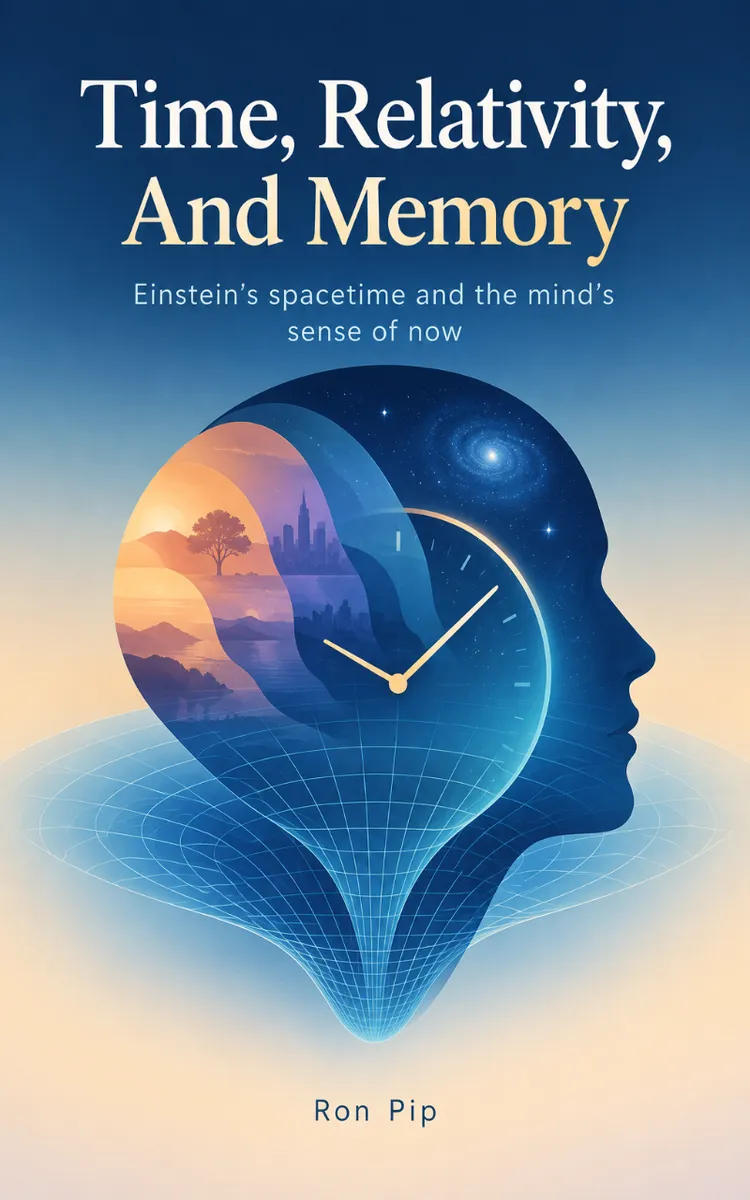
"Time, Relativity, And Memory" is a curiosity book by Ron Pip with 8 chapters and approximately 13,724 words. Relativity, spacetime curvature, and how we perceive time.
This book was created using Inkfluence AI, an AI-powered book generation platform that helps authors write, design, and publish complete books.
Frequently Asked Questions
What is "Time, Relativity, And Memory" about?
Relativity, spacetime curvature, and how we perceive time
How many chapters are in "Time, Relativity, And Memory"?
The book contains 8 chapters and approximately 13,724 words. Topics covered include Why Your Clock Feels Wrong, The Twin Who Comes Back Younger, Light’s Speed Is a Cosmic Contract, Gravity Bends Time Like a Lens, and more.
Who wrote "Time, Relativity, And Memory"?
This book was written by Ron Pip and created using Inkfluence AI, an AI book generation platform that helps authors write, design, and publish books.
Write your own curiosity book with AI
Describe your idea and Inkfluence writes the whole thing. Free to start.
Start writingCreated with Inkfluence AI


