

Read the first chapter
The whole of chapter one, free. About 9 min. Turn the pages with the arrows, your keyboard, or a swipe.
Chapter 1
The Bible as a Library
Scripture’s Many Voices and One Witness
A Bible opened to Genesis, Amos, Luke, and Romans presents four very different literary worlds. Genesis tells stories of ancestors and beginnings; Amos speaks as a prophet confronting injustice; Luke carefully narrates the ministry of Jesus; Romans develops a sustained theological argument. These books differ in style, setting, and purpose, yet Christians read them together as Scripture. Learning to see both their differences and their relationship is essential for responsible Bible study.
This overview connects the study of Scripture’s larger shape with the work of historical and literary interpretation. Before examining a verse closely, a reader should know what kind of book it belongs to, when and why it was written, and how it contributes to the Bible’s shared witness. The Bible is not a single-volume work written in one setting. It is a library of sixty-six books in the Protestant canon, written across many centuries, in Hebrew, Aramaic, and Greek, and received by the church as a unified testimony to God’s work.
Learning Objectives
• Identify the major divisions, genres, and historical settings of the Bible. - Explain how literary diversity affects interpretation without destroying Scripture’s unity. - Trace how individual books contribute to the Bible’s shared witness.
The practical takeaway is simple: read every biblical passage as part of a book, and read every book as part of the whole library.
A Library with Shape, Genre, and History
Canon - the recognized collection of books received as Scripture by a particular faith community. The Protestant Old Testament contains thirty-nine books, and the New Testament contains twenty-seven. Other Christian traditions include additional books in their Old Testament collections, often called the Deuterocanonical books or Apocrypha. When studying a passage, identify which canonical tradition your edition follows, especially when consulting commentaries or historical sources.
The Bible’s arrangement gives readers a broad map. The Old Testament is commonly grouped as the Pentateuch, historical books, wisdom literature, and the Prophets. The Pentateuch consists of the first five books: Genesis, Exodus, Leviticus, Numbers, and Deuteronomy. The New Testament includes the four Gospels, Acts, letters, and Revelation. These categories are useful, but they are not identical to the original order or to every ancient classification. The Hebrew Bible, for example, arranges its books as Torah, Prophets, and Writings. That arrangement highlights a different pattern of emphasis than the familiar Protestant order.
Genre - a recognizable kind of writing with conventions that guide how it should be read. Narrative tells events through characters, setting, and plot. Poetry uses imagery, parallel lines, and compression. Wisdom literature reflects on faithful living, suffering, work, and the fear of the Lord. Prophecy speaks God’s covenant word into particular situations, often combining warning, judgment, and hope. A letter addresses real communities or individuals with teaching, correction, encouragement, and instruction. Apocalyptic writing uses visions and symbolic images to reveal God’s purposes and the final defeat of evil.
Genre does not determine a passage’s truthfulness. It determines how truth is communicated. Psalm 23 should not be read as a scientific report about sheep, and Revelation’s seven-headed dragon should not be handled in the same way as Luke’s account of Jesus’ trial. Both texts communicate theological truth, but they use different literary tools.
Historical setting also matters. Historical setting - the political, social, religious, and geographical circumstances surrounding a text’s composition and first audience. Exodus remembers Israel’s deliverance from Egypt and establishes covenant identity at Sinai. Amos addresses the northern kingdom of Israel during the eighth century BCE, a time of economic prosperity for some and severe exploitation of the poor. Paul’s letter to the Romans addresses a Christian community in the capital of the Roman Empire, shaped by Jewish and Gentile relationships, imperial power, and questions about the place of the law.
Dates are often debated, and responsible study distinguishes strong evidence from uncertain reconstruction. The Babylonian exile, for example, is a major historical setting for understanding several biblical books. Jerusalem fell to Babylon in 586 BCE, the temple was destroyed, and many Judeans were deported. Texts such as Lamentations and parts of Ezekiel speak from the pain of that crisis, while later restoration texts address life after the exile. The same broad historical event can therefore be remembered, interpreted, and applied in different literary forms.
The Bible’s unity does not mean that every book says the same thing in the same way. Shared witness - the common testimony that emerges across distinct biblical books and voices. Genesis presents God as Creator and covenant maker. Exodus shows God redeeming Israel and dwelling among the people. The Prophets call Israel back to covenant faithfulness and announce restoration. The Gospels identify Jesus as the Messiah and narrate his death and resurrection. Acts and the letters explain the significance of Christ and describe the formation of the church. Revelation brings the biblical story toward the renewal of creation.
This unity is often described through themes such as creation, covenant, kingdom, exile, redemption, holiness, justice, presence, and new creation. Yet themes must be traced carefully. “Kingdom,” for example, does not mean exactly the same thing in every passage. The kingdom may refer to God’s rule over Israel, the promised reign of the Davidic king, Jesus’ announcement of God’s reign, or the final renewal of all things. A theme gains meaning from each book’s particular contribution.
Ask yourself: What kind of writing am I reading? What situation produced it? What does this book emphasize that another book may express differently? Those questions protect interpretation from two opposite errors: flattening every book into one voice or treating the books as unrelated fragments.
A useful study tool is a simple three-column chart:
| Question | Example: Amos 5:21-24 | |---|---| | Genre | Prophetic speech using poetic imagery | | Historical setting | Eighth-century Israel, marked by worship alongside injustice | | Shared witness | God rejects worship separated from covenant justice |
The practical takeaway is that genre tells you how to listen, historical setting tells you why the message mattered, and shared witness shows how the passage belongs to the Bible’s larger testimony.
A Worked Example: Reading Amos 5:21-24
Amos 5:21-24 is a strong example because its form, setting, and theology must be held together. God says that festivals, offerings, and songs are rejected, then declares, “Let justice roll down like waters, and righteousness like an ever-flowing stream.” A careless reading might conclude that worship itself is unimportant. A more careful reading asks what kind of text this is, what problem it addresses, and how its message relates to the whole Bible.
1. Identify the literary form. Amos 5:21-24 is prophetic poetry within a larger prophetic speech. The language is vivid and forceful: God “hates” festivals, refuses offerings, and will not listen to songs. These are not neutral descriptions of every act of worship. They are covenant accusations delivered through poetic exaggeration and sharp contrast.
2. Locate the historical setting. Amos prophesied to the northern kingdom of Israel during the reign of Jeroboam II, commonly dated to the eighth century BCE. The kingdom had political strength and economic growth, but the book repeatedly condemns the exploitation of the poor, dishonest trade, bribery, and legal corruption. The specific setting matters because the worship being criticized was not happening in a vacuum. Religious activity continued while vulnerable people were being mistreated.
3. Observe the immediate context. Amos 5 begins with a lament over Israel’s fall and calls the people to seek the Lord and live. Verses 18-20 challenge those who expected “the day of the Lord” to bring automatic victory. Verses 21-24 then expose the contradiction between religious celebration and social injustice. The passage is therefore part of an argument, not an isolated slogan.
4. Define the central terms from the passage’s use. “Justice” refers to right judgment and the protection of what is right in community life. “Righteousness” describes conduct aligned with God’s covenant purposes. The water imagery suggests something continuous and abundant, not a brief act performed when convenient.
5. Compare the passage with other biblical witnesses. Isaiah 1 likewise condemns worship joined to violence and calls for the oppressed to receive justice. Micah 6 asks what the Lord requires and emphasizes justice, steadfast love, and humble walking with God. Jesus also denounces religious practice that neglects “the weightier matters of the law,” including justice, mercy, and faithfulness. These texts do not erase differences among Amos, Isaiah, Micah, and Jesus. They show a recurring biblical witness: worship cannot be separated from faithful treatment of neighbors.
6. State what the passage does not mean. Amos is not teaching that festivals, offerings, or songs are inherently evil. The Old Testament contains commands for worship, sacrifice, music, and sacred gatherings. The target is worship that claims to honor God while refusing God’s demand for justice. The passage confronts hypocrisy, not worship as such.
7. Formulate the interpretive result. The meaning of Amos 5:21-24 is that God rejects religious observance when it is used to cover persistent injustice. Genuine worship must be joined to covenant faithfulness expressed in public and personal conduct.
Final result: Amos 5:21-24 is prophetic poetry addressing an unjust worshiping community; its central claim is that God requires worship joined to justice and righteousness, a witness that harmonizes with the broader biblical concern for faithful love of God and neighbor.
The example demonstrates a repeatable method. Genre prevented a wooden reading of the imagery. Historical setting explained the force of the accusation. Context clarified the argument. Comparison with other books located Amos within Scripture’s shared witness without treating every text as identical.
The practical takeaway is to resist extracting a memorable verse before identifying its literary form, historical crisis, immediate argument, and relationship to the Bible’s larger testimony.
Practice and Answer Key
1. Compare Genesis 1 and Psalm 104. What genre features distinguish them, and what shared witness do they offer about creation? Hint: Look for narrative sequence in Genesis and poetic imagery in the psalm. Ask what both texts say about God’s authority and provision.
2. Why should Romans be read as a letter rather than as a collection of detached doctrinal statements? Hint: Consider the real audience in Rome, Paul’s pastoral purpose, and the way arguments develop across the letter.
3. What historical event helps explain the emotional and theological force of Lamentations? Hint: Identify the destruction of Jerusalem and the temple, then notice how grief and hope appear together.
4. How does Revelation’s genre affect the way you read its beasts, numbers, and heavenly visions? Hint: Treat the imagery as symbolic communication shaped by apocalyptic conventions, while still asking what concrete realities the symbols address.
5. Choose one biblical theme - covenant, kingdom, exile, or new creation - and trace it through two books from different genres. Hint: Record each book’s setting, genre, and distinctive contribution before describing their relationship.
Answer Key: Genesis 1 uses ordered narrative, while Psalm 104 uses poetry; both testify that God creates and sustains the world. Romans is a pastoral letter whose theology serves a particular community and argument. Lamentations responds to Jerusalem’s destruction in 586 BCE. Revelation’s visions communicate through symbolic apocalyptic imagery rather than ordinary historical description. A sound thematic comparison names both continuity and difference, showing how each book adds a distinct voice to Scripture’s shared witness.
The Bible’s unity becomes clearer, not weaker, when its diversity is taken seriously. Its books speak from different centuries, communities, crises, and literary forms, yet together they bear witness to the God who creates, judges, redeems, dwells with his people, and promises the renewal of all things. To study the Bible as a library is therefore to learn how each book deserves careful attention - and how no book speaks alone.
End of chapter one. 26 more chapters and about 54,933 words in the full book.
Swipe or use the arrows to turn the page


What's inside: 27 chapters
- 1. The Bible as a Library
- 2. Canon Formation and Biblical Authority
- 3. Manuscripts, Texts, and Translations
- 4. The Ancient Near Eastern World
- 5. Israel’s History and Biblical Timeline
- 6. Reading Biblical Genres
- 7. Historical and Literary Context
- 8. Observation, Interpretation, Application
- 9. Word Studies and Biblical Languages
- 10. The Pentateuch and Covenant
- 11. Israel’s Historical Books
- 12. Psalms, Worship, and Prayer
- 13. Wisdom Literature and Human Experience
- 14. Prophets, Judgment, and Hope
- 15. Second Temple Judaism
- 16. The Gospels and Jesus’ World
- 17. Parables, Miracles, and Kingdom
- 18. Acts and the Early Church
- 19. Paul’s Letters and Their Communities
- 20. General Epistles and Christian Practice
- 21. Revelation and Apocalyptic Imagery
- 22. Biblical Theology and Canonical Themes
- 23. Interpreting Difficult Passages
- 24. Theology, Tradition, and Interpretation
- 25. Archaeology and Historical Evidence
- 26. Research Tools and Scholarly Sources
- 27. From Study to Teaching and Formation
About this book
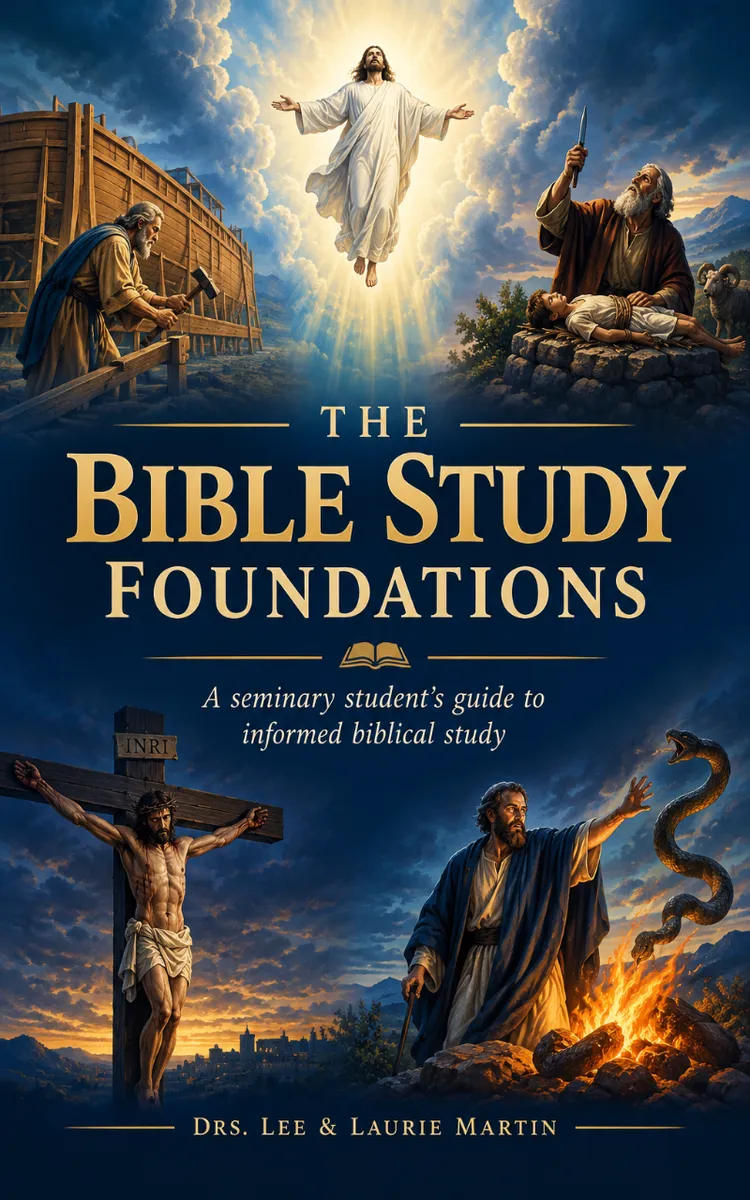
"The Bible Study Foundations" is a education book by Drs. Lee & Laurie Martin with 27 chapters and approximately 54,933 words. Biblical books, historical background, and foundational methods for Bible study.
This book was created using Inkfluence AI, an AI-powered book generation platform that helps authors write, design, and publish complete books. It was made with the AI Lesson Plan Generator.
Frequently Asked Questions
What is "The Bible Study Foundations" about?
Biblical books, historical background, and foundational methods for Bible study
How many chapters are in "The Bible Study Foundations"?
The book contains 27 chapters and approximately 54,933 words. Topics covered include The Bible as a Library, Canon Formation and Biblical Authority, Manuscripts, Texts, and Translations, The Ancient Near Eastern World, and more.
Who wrote "The Bible Study Foundations"?
This book was written by Drs. Lee & Laurie Martin and created using Inkfluence AI, an AI book generation platform that helps authors write, design, and publish books.
How can I create a similar education book?
You can create your own education book using Inkfluence AI. Describe your idea, choose your style, and the AI writes the full book for you. It's free to start.
Write your own education book with AI
Describe your idea and Inkfluence writes the whole thing. Free to start.
Start writingCreated with Inkfluence AI


