
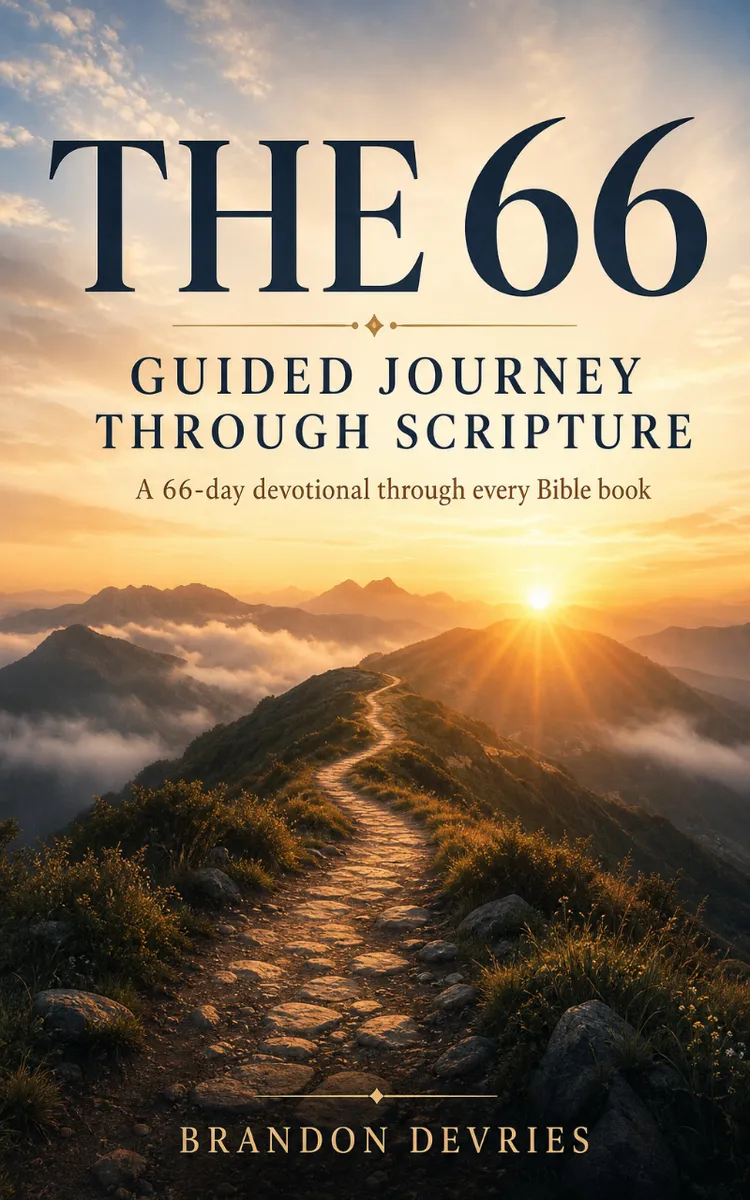

Read the first chapter
The whole of chapter one, free. About 12 min. Turn the pages with the arrows, your keyboard, or a swipe.
Chapter 1
Days 1-10: Foundations of God’s Word
Chapter 1
Days 1–10: Foundations — Trusting the God Who Speaks First
There is a kind of pressure that can sneak into Bible reading before we even notice it.
You open the Bible, and somewhere in the back of your mind there’s this quiet thought: I need to get something out of this. I need to understand it. I need to feel close to God. I need to be more disciplined. I need to become the kind of Christian who actually sticks with this.
And yes, of course, desire matters. Discipline matters too. But Genesis does something merciful right at the beginning.
It does not start with you.
It starts with God.
“In the beginning God created the heavens and the earth.” — Genesis 1:1
Before there is human striving, there is divine speaking. Before there is obedience, there is creation. Before anyone can build, fail, pray, wander, repent, or worship, God is already present. God is already acting. God is already good.
That may sound simple, maybe even too simple, but it changes the whole posture of these first ten days. You are not beginning this journey by trying to prove yourself to God. You are beginning by learning to receive what God has already revealed about Himself.
And honestly, that takes practice.
Most of us are better at reacting than receiving. We react to stress. We react to disappointment. We react to the news, our schedules, our families, our fears, our phones. Then we bring that same hurried, anxious energy into Scripture and wonder why our souls still feel thin.
So these first ten days are not about racing through the opening books of the Bible just so you can say you did it. They are about slowing down enough to notice the foundation underneath the whole story.
God speaks. God creates. God judges sin. God makes covenant. God calls people to trust Him before they can see the full outcome.
That is where we begin.
Not with you trying harder.
With God speaking first.
Why Genesis Starts With God Speaking, Not You Trying
If you have ever read Scripture and felt like you had to “perform” your way into God’s attention, Genesis will gently — and sometimes not so gently — break that habit.
The Bible opens with God creating by His word. He speaks light into darkness. He forms order out of emptiness. He fills what is barren. He blesses what He has made. He calls creation good.
Then, almost immediately, we see the heartbreak of sin. Humanity distrusts God’s word, reaches for wisdom apart from Him, and the fracture begins. Shame enters. Blame enters. Hiding enters.
Actually, that detail is worth sitting with for a moment: the first human instinct after sin is not repentance. It is hiding.
And if we are honest, we know that instinct.
We hide behind busyness. We hide behind religious language. We hide behind “I’m fine.” We hide behind good intentions and delayed obedience.
But God comes looking.
“Where are you?” — Genesis 3:9
That question is not because God lacks information. It is an invitation. A painful one, yes, but still an invitation. God draws humanity out of hiding and into truth.
This is the foundation of Scripture’s message: God is holy, and sin is real. But God is also merciful, and He moves toward sinners with both judgment and promise.
That balance matters. If we only talk about God’s love and ignore His holiness, we end up with sentimentality. If we only talk about God’s judgment and ignore His mercy, we end up with despair. Genesis refuses both extremes.
It gives us a God who is utterly pure and deeply personal.
A God who judges evil.
A God who covers shame.
A God who makes promises before humans have earned them.
And that, maybe, is the first great relief of this journey.
You do not have to manufacture a relationship with God from scratch. He has already spoken. He has already acted. He has already begun the rescue story.
Your first task is to listen.
The Trust-Building Rhythm: Read, Notice, Obey
During Days 1–10, you are practicing a rhythm that will carry you through the rest of this book:
Read. Notice. Obey.
That may sound almost too plain. But plain things are often the things we most need.
1. Read
Start by reading the assigned Scripture for the day without rushing to “use” it immediately.
This is harder than it sounds.
We live in a world that trains us to scan, skim, extract, and move on. But Scripture is not merely content to consume. It is the living Word of God, and it forms us slowly, sometimes quietly, often beneath the surface before we can explain what is happening.
So read attentively.
Not perfectly. Not dramatically. Just attentively.
Ask: What is God doing here? What does this passage reveal about His character? What is broken in humanity? What promise, warning, command, or invitation appears?
You are not looking first for a motivational quote. You are looking for God.
That is important.
Because if you jump straight to “What does this mean for me?” before asking “What does this show me about God?” you may accidentally turn Bible reading into self-improvement with religious language.
And Scripture is far better than that.
It does not merely improve you. It reorients you.
2. Notice
After you read, notice.
This is where you slow down and let the passage tell the truth about your actual life — not your ideal life, not your church face, not the version of yourself you wish were already more mature.
Your actual life.
Maybe you notice that you relate to Adam and Eve’s hiding more than you want to admit. Maybe you notice that you often want God’s promises but resist His timing. Maybe you notice that Abraham ’s faith was real, but not always clean and uncomplicated. Maybe you notice that God keeps being faithful in places where people keep being messy.
And that can be strangely comforting.
The people in Genesis are not polished heroes. They are complicated. Sometimes faithful, sometimes fearful. Sometimes obedient, sometimes deeply foolish. They build altars and tell lies. They receive promises and still try to control outcomes.
In other words, they are more like us than we may want to admit.
While writing this, I’m reminded again that the Bible does not seem embarrassed by human weakness. We often are, but Scripture is not. It tells the truth because grace is never threatened by truth.
So notice honestly.
Ask: Where am I resisting God’s word? Where am I trying to control what God has asked me to trust? Where do I see fear talking louder than faith? What does this passage expose, heal, or invite?
Not every day will feel profound. That is okay. Some days will feel ordinary. Some days you may feel distracted. Some days you may read the passage and think, I’m not sure I got much from that.
Keep going.
Formation is often quieter than inspiration.
3. Obey
Finally, obey in one concrete way.
Not ten ways. Not a vague spiritual ambition. One step.
This matters because obedience turns reflection into formation. It gives your faith a body. It takes what you have read and places it into your schedule, your words, your habits, your relationships, your choices.
For example:
• If God’s Word reveals that you have been hiding, your step might be confession.
• If you see God calling Abraham to trust without the full map, your step might be surrendering a decision in prayer.
• If you notice that fear has been driving your reactions, your step might be choosing silence before responding.
• If you see God’s patience toward broken people, your step might be extending patience to someone else.
Small obedience is still obedience.
Actually, small obedience is often where the deepest change begins.
We tend to want dramatic transformation. God often begins with the next faithful step.
What You Are Learning in Days 1–10
These first ten days are not merely about the beginning of the Bible. They are about the beginning of trust.
You are learning that God is the main character of Scripture.
That sounds obvious, but it is easy to forget. We naturally read the Bible looking for ourselves: our problems, our guidance, our encouragement, our next answer. God is kind enough to meet us there, but He also lifts our eyes higher.
The Bible is first about Him.
His holiness. His mercy. His authority. His patience. His covenant love. His faithfulness when humans fail.
Once you see that, you begin to read differently.
Noah ’s story is not mainly about being brave in a corrupt generation, though that matters. It is about God judging evil and preserving life.
Abraham’s story is not mainly about becoming adventurous for God, though obedience matters. It is about God making covenant promises that depend ultimately on His faithfulness.
Joseph ’s story is not mainly about personal success after suffering, though there is encouragement there. It is about God’s providence working through betrayal, delay, injustice, and unexpected mercy.
Do you see the shift?
The stories are not less personal when God becomes central. They become more stable.
Because if Scripture is mainly about you, then your weakness becomes the biggest problem in the story. But if Scripture is mainly about God, then His faithfulness becomes the deepest reality.
That is a better foundation.
When Trust Is Tested
One of the surprises in these early readings is how quickly trust gets tested.
Adam and Eve are tested in the garden. Noah is tested in a violent generation. Abraham is tested by waiting. Sarah is tested by barrenness and delay. Joseph is tested through betrayal, slavery, false accusation, and prison.
Faith does not grow in theory only. It grows when God’s word and your circumstances appear to be in tension.
That may be the most uncomfortable part.
God promises, but fulfillment takes time. God calls, but the path is not fully explained. God is present, but He is not always obvious. God is faithful, but people still suffer.
And if you have walked with God for more than a few minutes, you already know this. The life of faith is not a straight line from promise to fulfillment. There are detours. There are silences. There are confusing chapters you would not have chosen.
So what do you do when fear talks?
Because it will.
Fear will say, You need to take control. Fear will say, God has forgotten. Fear will say, You are on your own. Fear will say, Obedience is too costly. Fear will say, You better protect yourself because no one else will.
Courage-faith does not mean fear never speaks. It means fear does not get the final vote.
Maybe that is what Abraham had to learn. Not perfectly — definitely not perfectly — but truly. He had to keep returning to the God who promised.
And so do we.
Covenant: God Binds Himself to His Promise
The word covenant may feel formal, maybe even distant, but it is one of the richest words in Scripture.
A covenant is not a casual agreement. It is a binding commitment. In Genesis, God makes covenant promises that shape the entire biblical story. He promises blessing, offspring, land, and ultimately a blessing that will extend to all nations through Abraham’s line.
At first, it may seem like a family story.
Then you realize it is much bigger.
God is preparing the way for redemption. He is narrowing the storyline through one family, not because He has stopped caring about the nations, but because He intends to bless the nations through that family.
This is where the Bible’s long arc begins to take shape.
Creation. Fall. Judgment. Promise. Covenant. A people. A coming Messiah.
Of course, Abraham could not see all of that clearly. Neither could Isaac, Jacob, or Joseph. They lived inside promises they did not fully understand.
That is not so different from us.
We also obey with partial understanding. We trust with limited visibility. We follow God without having the whole map.
And honestly, that can be frustrating.
I would prefer a detailed itinerary. Most of us would. But God often gives enough light for obedience, not enough control for comfort.
That distinction matters.
A Simple Practice for Each Day
For Days 1–10, use this simple practice after each reading.
You may want to write your answers in a journal, in the margins of this book, or in a notes app. The method matters less than the honesty.
Daily Guided Questions
• What does this passage reveal about God? Look first for His character, His actions, His promises, His warnings, or His mercy.
• What does this passage reveal about people? Notice human faith, fear, sin, weakness, obedience, pride, repentance, or need.
• Where do I see myself in this passage? Be specific. Avoid vague answers if you can.
• What is God inviting me to trust or obey today? Name one concrete step.
• How can I pray this passage back to God? Turn what you saw into prayer.
Here is a very simple example.
If you read Genesis 12 and notice God calling Abram to go before Abram knows all the details, you might write:
God reveals Himself as: the One who calls and promises. People are: called to trust before they can see everything. I see myself: wanting certainty before obedience. Today I will obey by: praying over the decision I keep delaying and taking one faithful step. Prayer: “Lord, teach me to trust You when I do not have the whole map.”
That is enough.
Do not despise simple responses. A sincere sentence can become a doorway.
Do Not Rush the Foundation
There is a temptation at the beginning of any reading plan to go fast. The energy is fresh. The goal is clear. You feel motivated.
That is good.
But motivation is not the same as formation.
Formation requires returning. Again and again. Read, notice, obey. Read, notice, obey. Not because the rhythm is impressive, but because it is steady.
Think of these first ten days like laying stones in the ground. You may not see the whole structure yet, but the foundation matters. If you rush it, everything later becomes unstable.
So let Genesis and the early story of Scripture do its work.
Let God be God before you try to solve your life.
Let His word confront the places where you have been hiding.
Let His covenant faithfulness steady the parts of you that are tired of waiting.
Let the stories of flawed, called, stumbling people give you courage to keep walking.
And when you do not know what else to do, come back to the basic rhythm:
Read. Notice. Obey.
Then do it again tomorrow.
Day 1–10 Focus
Main Theme
God speaks first, forms His people through trust, and keeps His covenant promises even when human beings fail.
Key Formation Goal
To build a steady habit of reading Scripture with attention to God’s character before rushing to personal application.
Core Practice
Each day, answer this question:
What is God inviting me to trust or obey today?
Prayer for These Days
Lord, teach me to begin where Scripture begins — with You. Slow down my anxious striving. Open my ears to Your Word. Show me where I am hiding, controlling, rushing, or resisting. Give me faith to trust Your promises and courage to obey in small, concrete ways. Form me through Your Word, not just for information, but for love, surrender, and faithful living. Amen.
End of chapter one. 16 more chapters in the full book.
Swipe or use the arrows to turn the page

Christian Faith Healing And The Power Of Miracles

The Overthinker’s 90-Day Prayer Journal

The Empty Nester's Next-Chapter Devotional
What's inside: 17 chapters
- 1. Days 1-10: Foundations of God’s Word
- 2. Days 11-20: Faith Tested, Faith Strengthened
- 3. Days 21-30: Wisdom for the Ordinary Days
- 4. Days 31-40: Prophets Calling You Back
- 5. Days 41-50: The Messiah Revealed-Trust in the Savior
- 6. Days 51-60: Spirit-Formed Life and Mission
- 7. Days 61-66: Hope That Endures-God’s Final Word
- 8. The 66-Book Canon Tracker
- 9. Weekly Prayer Focus Page
- 10. Scripture Memory & Meditation Guide
- 11. Sermon & Teaching Notes Page
- 12. S.O.A.P. Method Study Sheet
- 13. Weekly Spiritual Discipline Log
- 14. Weekly Growth & Heart Check
- 15. Daily Quiet Time & Thanksgiving Log
- 16. Word & Character Deep Dive Sheet
- 17. Spiritual Fasting & Prayer Planner
About this book
"The 66:" is a devotional book by Brandon DeVries with 17 chapters and approximately 28,667 words. A 66-day Christian devotional covering all 66 Bible books.
This book was created using Inkfluence AI, an AI-powered book generation platform that helps authors write, design, and publish complete books. It was made with the AI Devotional Book Generator.
Frequently Asked Questions
What is "The 66:" about?
A 66-day Christian devotional covering all 66 Bible books
How many chapters are in "The 66:"?
The book contains 17 chapters and approximately 28,667 words. Topics covered include Days 1-10: Foundations of God’s Word, Days 11-20: Faith Tested, Faith Strengthened, Days 21-30: Wisdom for the Ordinary Days, Days 31-40: Prophets Calling You Back, and more.
Who wrote "The 66:"?
This book was written by Brandon DeVries and created using Inkfluence AI, an AI book generation platform that helps authors write, design, and publish books.
How can I create a similar devotional book?
You can create your own devotional book using Inkfluence AI. Describe your idea, choose your style, and the AI writes the full book for you. It's free to start.
Write your own devotional book with AI
Describe your idea and Inkfluence writes the whole thing. Free to start.
Start writingCreated with Inkfluence AI


