

Read the first chapter
The whole of chapter one, free. About 7 min. Turn the pages with the arrows, your keyboard, or a swipe.
Chapter 1
Reclaiming Your Changing Identity
The Person You Keep Postponing
At 3:17 a.m., the baby finally settles. You put the bottle in the sink, step over yesterday’s laundry, and notice the guitar leaning against the wall. You haven’t touched it in weeks. Your sketchbook is still on the shelf, open to the same unfinished page. Your running shoes are tucked behind the stroller, as if they’ve been quietly retired.
Then morning arrives. You answer messages with one hand while changing a diaper with the other. Someone asks how you’re doing, and you say, “Fine,” because explaining the full answer would take longer than the baby’s next nap. You care deeply about this new life. You also miss the parts of yourself that used to have room to breathe.
So you make a private deal: when things calm down, you’ll return to yourself. When the baby sleeps better. When feeding gets easier. When the house is less chaotic. But “later” keeps moving. You may even feel guilty for wanting anything beyond your baby, then guilty again when you realize you’re disappearing inside the role of parent. Do you recognise yourself in this pattern?
The Both-Selves Compass
What if becoming a parent isn’t asking you to replace your old self, but to stop making your old self prove it deserves a place?
That question changes the job. You’re not trying to recreate your life before the baby arrived. That version of you had different hours, energy, and responsibilities. But you also don’t need to erase the person who loved late-night cooking, quiet mornings, lifting weights, making music, seeing friends, or working toward something that was yours.
The Both-Selves Compass helps you hold two truths at once: you’re becoming someone new, and you’re still connected to who you were. One side points toward your present responsibilities. The other points toward your lasting values, interests, and ways of feeling like yourself. The goal isn’t perfect balance. With a baby, perfect balance is mostly a myth wearing clean socks. The goal is regular contact with both sides.
Before parenthood, you might have spent Saturday morning cycling for an hour and meeting a friend afterward. Now, a full morning ride may be unrealistic. But the old need underneath it might be movement, challenge, fresh air, or time with a friend. A fifteen-minute ride around the block while the baby naps in the stroller won’t copy the old routine. It can still meet part of the same need. That’s the shift: preserve the meaning, resize the habit.
Try saying, “I’m a parent who still needs…” and finish the sentence with something specific. Maybe it’s “quiet,” “creative work,” “conversation,” or “strength.” That answer isn’t selfish. It’s information from the person you’re becoming and the person you’ve always been.
How the Disappearing Happens - and How to Interrupt It
1. When the baby needs you for the fifth time before breakfast... 2. You feel pulled apart, tired, and unsure where your own needs fit. 3. So you postpone the old parts of yourself, telling yourself they can wait until life is easier. 4. Which leads to resentment, numbness, or the strange feeling that you’re performing parenthood instead of living as a whole person.
The alternative chain looks different:
1. When the baby’s needs interrupt your plan... 2. You name one part of yourself that still needs care, without demanding a full return to your old life. 3. So you choose a small version of an old value, such as ten minutes of drawing, one voice note to a friend, or a shower with the bathroom door closed. 4. Which leads to evidence that parenthood has changed your life without claiming every corner of it.
That evidence matters. Identity doesn’t return because you think the right thought once. It grows through repeated moments when your actions say, “I still count here.”
You don’t have to choose between being a devoted parent and being a recognisable person to yourself.
Your Both-Selves Check-In
Use these questions when the days blur together. Rate yourself honestly; there’s no impressive answer.
1. On a scale of 1-10, how connected do you feel to one interest or value you had before becoming a parent? A low number may mean that interest needs a tiny doorway back in. A high number suggests you’ve protected some continuity, even if the form has changed.
2. On a scale of 1-10, how often do you describe your needs as less important than the baby’s? A high number can reveal guilt or an all-or-nothing idea of care. A lower number may show that you’re beginning to treat your wellbeing as part of family life, not a reward for finishing it.
3. Yes or no: Can you name one thing you do because it makes you feel like yourself, not because it benefits the household? “No” doesn’t mean you’ve failed. It shows that your personal identity may need a clearer place on the daily map.
4. On a scale of 1-10, how willing are you to do a smaller, messier version of an old habit? A low number often points to perfectionism or grief for the old routine. A higher number means you’re ready to let the habit evolve instead of waiting for ideal conditions.
If your ratings are mostly 1-3, start with ten minutes and one familiar value. If they’re around 4-7, look for a repeatable weekly slot and share the plan with someone who can protect it. If they’re 8-10, keep going - but check that your chosen habits genuinely restore you rather than becoming another task to perform.
The Two-Sides Appointment
Action title: Put both versions of you on the calendar
1. Name the thread - 10 minutes today. Difficulty: Easy. Set a timer and write three things you miss from before parenthood. Beside each one, write the deeper thread underneath it. “Reading in bed” might mean quiet. “Cooking elaborate meals” might mean creativity. “Seeing friends” might mean being known outside your role as a parent. Circle one thread you can touch in fifteen minutes.
2. Choose the smallest honest version - within the next 48 hours. Difficulty: Medium. Put one appointment in your phone for a specific time. Try “Tuesday, 1:10-1:25 p.m.: sketch at the kitchen table,” rather than “make time for creativity.” If the baby wakes, resize the plan instead of cancelling your identity. Sketch for three minutes while holding the baby, or return to it later that day. The appointment is with the value, not with a perfect block of silence.
3. Tell one person and repeat it - once this week, then weekly for two weeks. Difficulty: Medium. Tell your partner, friend, or family member what the appointment protects. Ask for practical help if needed: “Can you take the baby for twenty minutes after lunch on Thursday?” After each attempt, write one sentence about how it felt before and after. Don’t judge the quality of what you did. Notice whether you felt more present, less resentful, or more familiar to yourself.
You’ll know it’s working when...
• You stop waiting for a perfect hour and start using a real fifteen-minute window. - You can explain what an old interest means to you now. - You feel a small lift, steadiness, or sense of recognition after making room for yourself.
The first attempt may feel awkward. You might sit down to read and spend five minutes listening for the baby. That still counts. Your nervous system has learned to stay on call, so returning to yourself may take practice. You aren’t failing because relaxation doesn’t arrive instantly.
Making Room Without Moving Backward
Parenthood can change your identity without requiring you to abandon your history.
The Both-Selves Compass isn’t a demand to keep every old habit. Some parts of your former life may no longer fit, and that can be sad. Others may matter more than you realised. The useful question is not, “How do I get my old life back?” It’s, “What part of that life still helps me feel alive, grounded, or known - and what shape can it take now?”
• Your old routines often carried deeper needs, such as creativity, movement, freedom, friendship, or quiet. - A smaller habit can protect the meaning of an old habit without pretending your schedule is unchanged. - Guilt may be a sign that you’re treating your needs as competition with the baby’s, rather than part of a sustainable family life. - Identity grows through repeated proof: small actions that show both your parent-self and your earlier self still belong.
Tonight, when the house is finally quiet, notice what you reach for before you talk yourself out of it. That impulse may be a clue, not an inconvenience. As you begin rebuilding routines around the person you are now, what would change if the next habit you created supported not just the parent your baby needs, but the whole person you’re still becoming?
End of chapter one. 16 more chapters and about 24,432 words in the full book.
Swipe or use the arrows to turn the page


What's inside: 17 chapters
- 1. Reclaiming Your Changing Identity
- 2. Letting Go of Perfect Parenting
- 3. Choosing What Matters Most
- 4. Starting Smaller Than You Think
- 5. Anchoring Habits to Baby Care
- 6. Designing a Flexible Daily Rhythm
- 7. Protecting Sleep Where Possible
- 8. Making Space for Your Body
- 9. Eating Well Without Extra Work
- 10. Calming Overwhelm in the Moment
- 11. Asking for Help Clearly
- 12. Sharing the Mental Load
- 13. Setting Boundaries Without Guilt
- 14. Reconnecting Beyond the Baby
- 15. Recovering After a Routine Breaks
- 16. Adapting Habits as Baby Grows
- 17. Building a Sustainable Parent Life
About this book
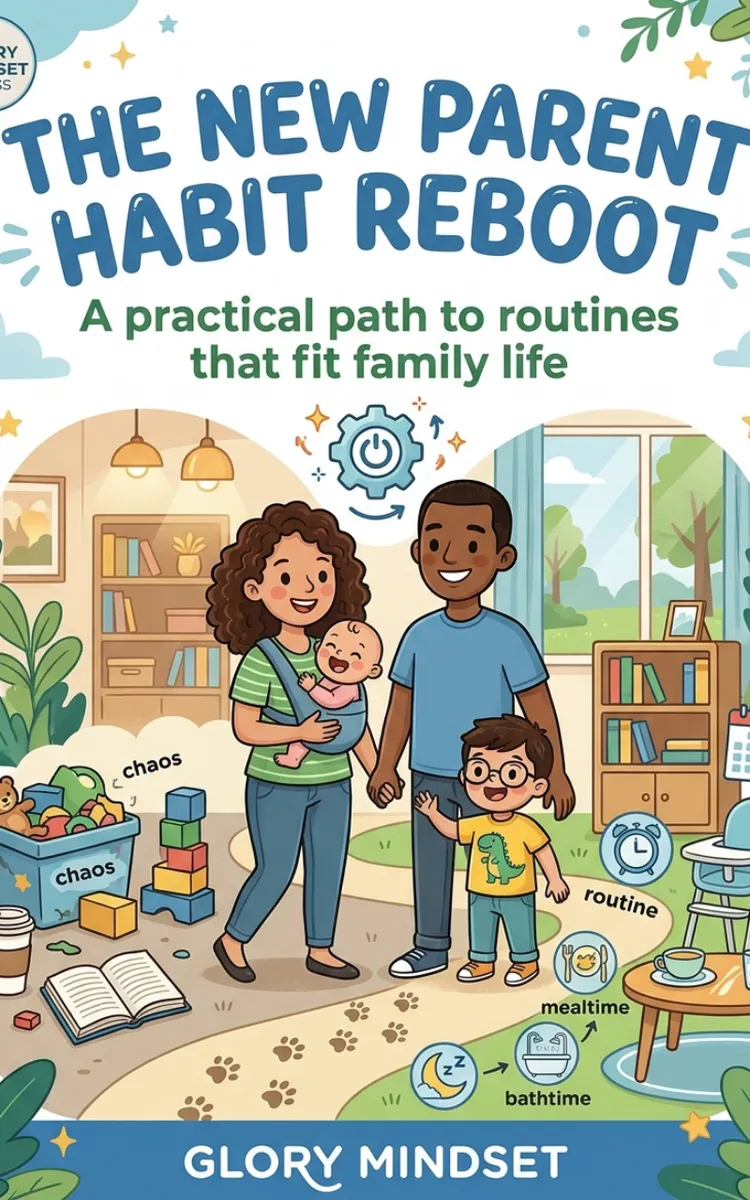
"The New Parent Habit Reboot" is a self-help book by Glory Mindset with 17 chapters and approximately 24,432 words. Rebuilding sustainable habits and routines during early parenthood.
This book was created using Inkfluence AI, an AI-powered book generation platform that helps authors write, design, and publish complete books. It was made with the AI Self-Help Book Writer.
Frequently Asked Questions
What is "The New Parent Habit Reboot" about?
Rebuilding sustainable habits and routines during early parenthood
How many chapters are in "The New Parent Habit Reboot"?
The book contains 17 chapters and approximately 24,432 words. Topics covered include Reclaiming Your Changing Identity, Letting Go of Perfect Parenting, Choosing What Matters Most, Starting Smaller Than You Think, and more.
Who wrote "The New Parent Habit Reboot"?
This book was written by Glory Mindset and created using Inkfluence AI, an AI book generation platform that helps authors write, design, and publish books.
How can I create a similar self-help book?
You can create your own self-help book using Inkfluence AI. Describe your idea, choose your style, and the AI writes the full book for you. It's free to start.
Write your own self-help book with AI
Describe your idea and Inkfluence writes the whole thing. Free to start.
Start writingCreated with Inkfluence AI


