

Read the first chapter
The whole of chapter one, free. About 8 min. Turn the pages with the arrows, your keyboard, or a swipe.
Chapter 1
Foundation Phase (Weeks 1-2)
Phase Overview
A long day in the cab can leave your hips stiff, your upper back rounded, and your legs unready for the next load. The Road-Ready Baseline uses short, joint-friendly strength sessions, daily mobility, and easy cardio to rebuild movement without beating up your knees, back, or shoulders.
During Weeks 1 and 2, the goal is practice, not exhaustion. You will train three times each week, add short mobility work on most days, and use walking or another simple cardio option between loads. Luis, 34, who hauls refrigerated freight, can use this phase to establish steady movement around loading times rather than trying to fit in long gym sessions. Finish most sets with two or three good repetitions still available.
Workouts
The weekly schedule is simple: strength on three nonconsecutive days, mobility on the other days, and easy cardio whenever your route and loading schedule allow. A sample layout is strength on Monday, Wednesday, and Friday; mobility and cardio on Tuesday, Thursday, and Saturday; and light mobility or rest on Sunday. If a delivery changes your schedule, keep at least one day between strength sessions when possible.
Before every strength session, complete the five-minute movement warm-up below. Move slowly enough to notice stiffness, but do not force a stretch. The warm-up should raise your body temperature slightly and prepare the joints you will use.
| Exercise | Sets × Reps | Load | Rest | | --- | --- | --- | --- | | Easy walk or march in place | 1 × 2 minutes | Body weight | - | | Shoulder circles | 1 × 10 each direction | Body weight | - | | Hip hinge drill | 1 × 10 | Body weight | - | | Sit-to-stand from a bench | 1 × 8 | Body weight | - | | Wall push-up | 1 × 8 | Body weight | - |
Strength Session A builds the basic patterns of sitting, pushing, pulling, and carrying. Use a stable bench, a truck step, or a firm platform for support. The load should feel controlled from the first repetition through the last. A backpack filled with water bottles, a resistance band, or light dumbbells can work when no gym is available.
| Exercise | Sets × Reps | Load | Rest | | --- | --- | --- | --- | | Bench sit-to-stand | 2 × 8-10 | Body weight or light backpack | 60 seconds | | Incline push-up on stable surface | 2 × 6-10 | Body weight | 60 seconds | | Resistance-band row | 2 × 10-12 | Light band | 60 seconds | | Glute bridge | 2 × 10-12 | Body weight | 45 seconds | | Suitcase carry | 2 × 20-30 seconds per side | Light dumbbell or loaded bag | 60 seconds |
Strength Session B uses a hip hinge, a supported single-leg movement, an overhead press, and core control. A hip hinge means moving from the hips while keeping the spine steady; it is the movement used to pick up a box without rounding through the lower back. Use a shorter range of motion if your hips, knees, or back feel restricted.
| Exercise | Sets × Reps | Load | Rest | | --- | --- | --- | --- | | Elevated hip hinge | 2 × 8-10 | Body weight or light backpack | 60 seconds | | Supported split squat | 2 × 6-8 per side | Body weight | 60-75 seconds | | Half-kneeling one-arm press | 2 × 8 per side | Light dumbbell or band | 60 seconds | | Dead bug | 2 × 6 per side | Body weight | 45 seconds | | Standing calf raise | 2 × 12-15 | Body weight | 45 seconds |
Strength Session C repeats the main movement patterns with small changes. Repeating patterns helps you learn safe positions and makes progress easier to measure. Keep the step-up low enough that you can place the whole foot on it and control the way down. If no safe step is available, replace step-ups with another set of bench sit-to-stands.
| Exercise | Sets × Reps | Load | Rest | | --- | --- | --- | --- | | Low step-up with support | 2 × 6-8 per side | Body weight | 60 seconds | | Wall or incline push-up | 2 × 8-12 | Body weight | 60 seconds | | One-arm supported row | 2 × 8-10 per side | Light dumbbell or loaded bag | 60 seconds | | Glute bridge march | 2 × 6-8 per side | Body weight | 60 seconds | | Farmer carry | 2 × 20-30 seconds | Two light dumbbells or bags | 60 seconds |
On mobility days, complete the following sequence once or twice. It should take about eight minutes. This is not a contest to see how far you can stretch. Use smooth breathing and stop before sharp pain, tingling, or joint pinching. The sequence is especially useful after driving, before walking, or after unloading.
| Exercise | Sets × Reps | Load | Rest | | --- | --- | --- | --- | | Standing chest opener | 1 × 8 slow reps | Body weight | - | | Thoracic rotation, standing or half-kneeling | 1 × 6 per side | Body weight | - | | Hip flexor stretch with glute squeeze | 1 × 20 seconds per side | Body weight | - | | Supported squat hold | 1 × 20 seconds | Body weight | - | | Ankle knee-to-wall movement | 1 × 8 per side | Body weight | - | | Easy walk | 1 × 5 minutes | Body weight | - |
Cardio in this phase should feel easy enough that you can speak in full sentences. The simplest choice is brisk walking around a safe truck stop, warehouse perimeter, or rest area. A stationary bike is also suitable. Start with ten minutes in Week 1 and build to fifteen minutes in Week 2. If your schedule is broken into short gaps, use two five-minute walks instead of one longer walk.
| Exercise | Sets × Reps | Load | Rest | | --- | --- | --- | --- | | Brisk walk or easy stationary bike, Week 1 | 1 × 10 minutes | Comfortable pace | - | | Brisk walk or easy stationary bike, Week 2 | 1 × 15 minutes | Comfortable pace | - |
For progression, keep the same exercises during both weeks. In Week 1, choose the lower end of each repetition range and use the lightest load that allows clean movement. In Week 2, add one or two repetitions per set, move slightly farther on carries, or add two to five pounds only when every repetition remains controlled. Do not increase repetitions, load, and speed at the same time.
A useful check is the talk test: if you cannot say a full sentence during cardio, slow down. For strength work, use a simple effort scale from zero to ten, where zero feels like no effort and ten is a maximum effort. Keep most sets around five or six. If a set reaches eight or higher, reduce the load or repetitions at the next session. The purpose of the Road-Ready Baseline is to leave you ready to drive, load, and recover - not worn out before the next task.
Training Notes
Keep your feet planted during sit-to-stands and step-ups. Push through the whole foot, especially the heel and the base of the big toe, and let the knees track in the same direction as the toes. Do not drop onto the bench. A controlled two-second lowering phase is enough to build strength while protecting the knees.
For push-ups and rows, brace your midsection as if preparing for a firm bump in the road. Keep the ribs from flaring and avoid shrugging toward the ears. Raise the support height for push-ups if your back sags or your shoulders hurt. Lower the support only after you can complete all prescribed repetitions with a straight line from shoulders to hips.
The hip hinge and glute bridge should be felt mainly in the hips and back of the legs, not as pressure in the lower back. Keep the spine neutral, which means maintaining its natural shape rather than rounding or over-arching. If you feel the movement in your back, shorten the range, slow down, and squeeze the glutes at the top without pushing the ribs upward.
Carries are valuable between loads because they train your trunk to stay steady while you walk. Hold the weight close, keep your shoulders level, and take short steps. For suitcase carries, resist leaning away from the weight. For farmer carries, avoid racing; steady posture matters more than distance.
Use a safe setup every time. Do not exercise beside moving traffic, on wet pavement, or on an unstable trailer step. Set bags and dumbbells where they cannot roll under a tire. Wear shoes with a firm sole, especially for step-ups and carries. If a joint produces sharp pain, stop that exercise and switch to an easier version. Normal muscle effort and mild stiffness are different from pain that changes your movement.
Recovery is part of the baseline. Drink water during the day, especially in hot loading areas, and take a few easy steps after long periods in the seat before starting mobility work. Ask yourself after each session: Did I move better at the end than at the beginning? If the answer is no, reduce the load, shorten the session, or take an extra recovery day.
By the end of Week 2, you should know which exercises fit your equipment, which movements need a smaller range, and what pace keeps cardio comfortable. That information is the foundation for adding strength and work capacity without losing control. When your joints move well and your basic patterns feel steady, every later workout has a safer place to start.
End of chapter one. 9 more chapters in the full book.
Swipe or use the arrows to turn the page

AI Automation for Freelancers: Automate the Business Behind Your Work

The 10-Minute Office Fitness Plan

Fitness for Shift Workers: Staying Active on an Unusual Schedule
What's inside: 10 chapters
- 1. Foundation Phase (Weeks 1-2)
- 2. Posture Reset Phase (Weeks 3-4)
- 3. Strength Intro Phase (Weeks 5-6)
- 4. Core Bracing Phase (Weeks 7-8)
- 5. Cardio Engine Phase (Weeks 9-10)
- 6. Volume Building Phase (Weeks 11-12)
- 7. Intensity Push Phase (Weeks 13-14)
- 8. Unloading Week Phase (Weeks 15-16)
- 9. Peak Performance Phase (Weeks 17-18)
- 10. Maintenance & Testing Phase (Weeks 19-20)
About this book
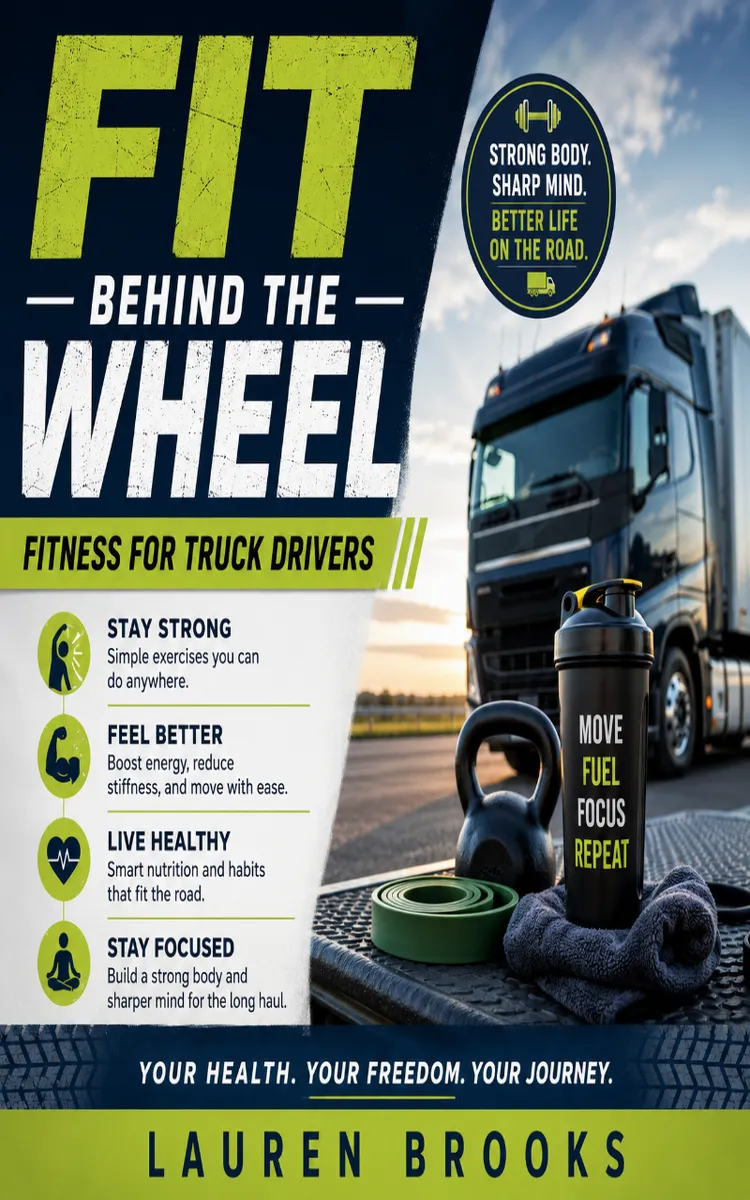
"Fit Behind the Wheel: Fitness for Truck Drivers" is a fitness book by Lauren Brooks with 10 chapters and approximately 17,414 words. Fitness program and exercises tailored for truck drivers.
This book was created using Inkfluence AI, an AI-powered book generation platform that helps authors write, design, and publish complete books. It was made with the AI Workout Plan Generator.
Frequently Asked Questions
What is "Fit Behind the Wheel: Fitness for Truck Drivers" about?
Fitness program and exercises tailored for truck drivers
How many chapters are in "Fit Behind the Wheel: Fitness for Truck Drivers"?
The book contains 10 chapters and approximately 17,414 words. Topics covered include Foundation Phase (Weeks 1-2), Posture Reset Phase (Weeks 3-4), Strength Intro Phase (Weeks 5-6), Core Bracing Phase (Weeks 7-8), and more.
Who wrote "Fit Behind the Wheel: Fitness for Truck Drivers"?
This book was written by Lauren Brooks and created using Inkfluence AI, an AI book generation platform that helps authors write, design, and publish books.
How can I create a similar fitness book?
You can create your own fitness book using Inkfluence AI. Describe your idea, choose your style, and the AI writes the full book for you. It's free to start.
Write your own fitness book with AI
Describe your idea and Inkfluence writes the whole thing. Free to start.
Start writingCreated with Inkfluence AI


