
Read the first chapter
The whole of chapter one, free. About 10 min. Turn the pages with the arrows, your keyboard, or a swipe.
Chapter 1
Introduction to YouTube in 2027
What YouTube Looks Like in 2027 (Formats, Creator Ecosystem, and Beginner Success)
If you’re starting YouTube in 2027, the biggest surprise isn’t “how do I upload videos?” It’s that YouTube isn’t just a place for long videos anymore - it’s a full platform with multiple content formats working together, plus a creator ecosystem that rewards consistency, clarity, and good audience retention across formats.
This chapter gives you a grounded picture of what YouTube is like right now: what viewers see, how creators typically publish, what “success” looks like for beginners (not for celebrities), and how the platform’s different surfaces - Watch (long-form), Shorts, Live, and community features - fit together. You’ll use this understanding to make better decisions in the next chapters about niches, planning, branding, and how to measure progress.
Learning Objectives - Identify the main YouTube content formats in 2027 and what each one is best for - Understand the creator ecosystem you’ll compete and collaborate inside (without needing “producer” skills) - Know what beginner success looks like and how you’ll track it
The 2027 YouTube Platform: Formats and What They’re For
YouTube in 2027 is still built around video, but it behaves more like a media system. Viewers move between formats without thinking about it, and your channel should be set up so those formats reinforce each other instead of competing for your attention.
Main Formats You’ll Use
Watch (long-form videos) - The traditional YouTube experience: videos that usually run from several minutes to hours. These are where you build depth, trust, and long-lasting search traffic. Viewers often decide to “learn something” here.
Shorts - Vertical videos designed for quick viewing. Shorts are usually under 60 seconds. They can bring new viewers fast, especially when your content matches what people already watch repeatedly.
Live - Real-time streams. Live helps you build a “regular” audience and creates a different kind of engagement than pre-edited videos.
Community posts - Text, images, and polls that let you talk with viewers between uploads. They’re not a replacement for videos, but they can keep momentum when you’re waiting on your next upload.
YouTube Studio tools - The dashboard where you manage everything: upload, trim, captions, check performance, moderate comments, and view monetization and copyright status.
A key 2027 reality: beginners often focus only on long-form. That’s fine to start, but you’ll grow faster if you understand how Shorts and long-form can feed each other, and how Live/community can deepen the relationship with the viewers you already have.
The Creator Ecosystem You’re Joining
YouTube creators in 2027 are not all “big channels with editors.” Many creators are solo or small teams. What matters is how clearly they match a viewer’s need.
Here’s the ecosystem in plain terms:
• Search-led creators make videos that answer a question people type into YouTube. Their growth often comes from steady discovery. - Browse-led creators make videos that fit what people enjoy watching in the moment (recommended videos and homepage feeds). Their growth can be faster but may be less stable if retention dips. - Shorts-led creators use quick formats to earn attention and then convert viewers to long-form. - Community builders use consistency and interaction (comments, Live, polls) to turn viewers into regulars.
You don’t have to pick only one lane forever. Many beginners start with Shorts to learn what hooks work, then use that learning in long-form. Other beginners start with long-form because they already have knowledge and want to teach it.
What “Success” Means for Beginners in 2027
Success for beginners usually isn’t “millions of views.” It’s measurable progress that becomes repeatable:
• You publish consistently enough that you can learn from your own results. - Your videos earn views from more than one source (not just one lucky upload). - Your retention (how long people stay) improves as you refine your structure. - You start getting returning viewers and subscribers who watch more than one video.
A simple benchmark mindset: aim for evidence of learning, not perfection. In 2027, YouTube rewards creators who can improve over time - your job is to create enough uploads that you have data to improve with.
Ask yourself: when you picture success, are you imagining a number (views/subscribers), or are you imagining behaviors (better retention, clearer topics, stronger upload rhythm)? The platform cares much more about behaviors than fantasies.
Practical takeaway: treat YouTube like a multi-format system. Your early goal is to find what format(s) you can publish reliably and improve quickly.
How YouTube Channels Earn Views: Surfaces, Discovery, and Audience Fit
Now that you know the formats, you need to understand how viewers actually find your content in 2027. This is where beginners often get stuck, because they think it’s “one trick.” It’s not. It’s matching your content to viewer intent and then earning enough engagement for YouTube to keep showing it.
Discovery Surfaces You’ll See in Your Data
Home feed - The “recommended for you” area. It’s driven by viewer behavior and your video’s performance signals.
Browse features - Things like suggested videos next to what a viewer is already watching.
Search results - People typing questions or topics. If your video clearly matches their query, it can keep earning views long after upload.
Shorts shelf - The main place Shorts are served. It’s heavily affected by how people respond quickly (rewatches, swipe-away behavior, likes, and retention).
Subscriptions and notifications - When people already follow you and want updates. This matters because it gives your newer uploads an early push.
In YouTube Studio (which you’ll learn more about later), you’ll see performance signals that point to these discovery types. The exact labels and layout can change over time, so always confirm inside YouTube Studio and YouTube’s official Creator resources.
Key Idea: “Audience Fit” Over “Going Viral”
Beginners often chase virality. Virality is unpredictable. Audience fit is buildable.
Audience fit - How well your video matches the viewer’s reason for pressing play. If someone clicks your video expecting one thing and gets another, retention drops and YouTube learns that mismatch.
A concrete example: if your title says “How to start strength training at home” but the video mostly talks about gym supplements, viewers will leave faster. Even if your click-through rate is decent, poor retention can limit distribution.
What Signals Matter (Without Turning This Into Guesswork)
YouTube uses many signals, but your practical focus as a beginner should be simple:
• Clicks: Did people choose your video after seeing it? (This depends on title/thumbnail and how clearly the video matches a viewer’s expectation.) - Watch time / retention: Did they stay and watch? (This depends on the first 10-30 seconds, pacing, and whether the content delivers what it promised.) - Engagement: Did people interact? (Likes, comments, sharing, and for Shorts, rewatch behavior matter.) - Consistency and channel reliability: Do you keep delivering content that fits your topic promise?
Important: YouTube policies and how ranking works can change. Treat these signals as your “creation checklist,” not as a forever rule. For the latest explanations, always check YouTube’s official Creator resources and Creator Insider updates.
Practical takeaway: your job is to earn clicks and then protect retention. If you build that loop, your channel gets more chances to be shown.
Worked Example: Mapping a Beginner Plan to 2027 Formats and “Success” Signals
Let’s walk through a realistic beginner setup using numbers and decisions you can actually make. This example focuses on the topic in this chapter: what YouTube is like in 2027, and what beginner success looks like across formats.
Scenario (No fiction - just a typical starting point)
You want to start a channel about “home organization.” You can talk to a camera, and you can record with decent audio. You’re not trying to be a Hollywood production team.
Your goal for the first 30 days is not to “go viral.” It’s to learn what works and build a foundation you can repeat.
Step-by-step thinking
1. Choose a primary format for your first 30 days. You pick Watch (long-form) as your main format because organization tips benefit from demonstration and step-by-step structure. Decision: publish 2 long videos in 30 days.
2. Add a secondary format that teaches you hooks fast. You add Shorts because it’s easier to test titles/angles and learn what gets rewatched. Decision: publish 10 Shorts in 30 days.
3. Use community posts to reduce “dead time.” Between uploads, you post once or twice a week. Decision: 2 community posts in 30 days (for example: a poll about which room people struggle with most).
4. Define what “success” means after 30 days. You choose beginner-friendly targets that indicate learning, not luck. Decision targets (reasonable for many new creators): - Your long videos get at least one clear signal of interest: either consistent watch time across viewers, or steady search/browse traffic over the month. - Your Shorts earn enough retention to tell you which topics and openings work. - You start seeing returning viewers (not just one-off clicks).
5. Plan your first long video around viewer intent. You pick a specific query: “How to organize a pantry step by step.” Why this matters: search-led viewers want a direct solution. You’ll structure the video like a process, not a general rant.
6. Plan your Shorts as “mini chapters” pulled from the long videos. If your long video is about pantry organization, your Shorts might be: - “3 pantry categories that make everything easier” (hook + quick list) - “How to label shelves so you actually maintain it” (one method + proof) - “The 10-minute reset you can do weekly” (clear routine)
7. Track outcomes in YouTube Studio and compare patterns. After upload, you look for two things you’ll repeat later: - Which videos keep viewers watching past the first few seconds? - Which topics trigger more replays (especially for Shorts) or more comments (for long-form)?
8. Adjust based on evidence, not vibes. If one Short gets strong rewatch behavior, you create more Shorts in that exact style. If one long video has clicks but low retention, you revise your opening and tighten your structure.
Final result (what success looks like here): by day 30, you don’t just “have content.” You have proof of audience fit in at least one format, plus clear patterns you can reuse in your next 30-day cycle.
Practical takeaway: in 2027, beginner success is building repeatable evidence across formats - long-form teaches depth, Shorts teach hooks, and community reduces silence.
Check Your Understanding: YouTube in 2027 (Formats, Ecosystem, and Beginner Success)
Test your understanding with practice questions that match this chapter’s topic. After each question, use the hint to find the right angle.
1. What is the main difference between Watch (long-form) and Shorts in how viewers consume content? Hint: Think about viewing time and the viewer’s expectation when they press play.
2. Name two discovery surfaces where your videos can get views, and explain what type of viewer behavior each one usually represents. Hint: One should be “people searching,” and one should be “people browsing.”
3. What does “audience fit” mean, in simple terms, and how can you tell when you missed it? Hint: Look at what happens after the click (especially retention and leaving early).
4. In a beginner plan, why might you publish both long-form and Shorts instead of only one format? Hint: One format helps depth; the other helps quick learning about hooks.
5. Choose a definition of beginner success that does not rely on “going viral.” Then list one practical signal you could check in YouTube Studio. Hint: Use improvement and repeatability - watch time/retention patterns, rewatch behavior, or steady discovery.
Answer Key 1. Watch is for deeper, longer viewing where viewers expect explanation; Shorts are quick, vertical clips where viewers expect fast value in seconds. 2. Search results (people with intent typing a query) and the Home feed/browse (people browsing based on recommendations). 3. Audience fit is whether your video matches why viewers clicked; you miss it when retention drops because expectations aren’t met. 4. Long-form builds trust and depth; Shorts help you test hooks and learn quickly, and they can funnel viewers into your channel. 5. Beginner success can be repeatable improvement (better retention and consistent discovery signals). A practical check is retention/watch patterns or Shorts rewatch behavior in YouTube Studio.
Chapter summary: YouTube in 2027 is a multi-format platform. Beginners succeed by building audience fit, using the right mix of Watch, Shorts, and community, and defining success in measurable learning signals - not luck.
End of chapter one. 19 more chapters in the full book.
Swipe or use the arrows to turn the page

How To Start A Handyman Business

How to Start a Lawn Care Business

How to Start a Mobile Pet Grooming Business
What's inside: 20 chapters
- 1. Introduction to YouTube in 2027
- 2. Creating Your Google and YouTube Accounts
- 3. Choosing a Profitable YouTube Niche
- 4. Understanding How the YouTube Algorithm Works
- 5. Planning Your Channel for Long-Term Success
- 6. Creating Your Channel Branding
- 7. Recording Videos on Any Budget
- 8. Basic Video Editing for Beginners
- 9. Writing Better Titles and Descriptions
- 10. Creating Click-Worthy Thumbnails
- 11. Uploading and Optimizing Videos
- 12. YouTube SEO and Keyword Research
- 13. Growing Your Audience Organically
- 14. Understanding YouTube Analytics
- 15. YouTube Shorts Strategy
- 16. Reaching YouTube Monetization Requirements
- 17. Making Money Beyond Ad Revenue
- 18. AI Tools Every YouTube Creator Should Know
- 19. Common Beginner Mistakes and How to Avoid Them
- 20. Your YouTube Growth Action Plan
About this book
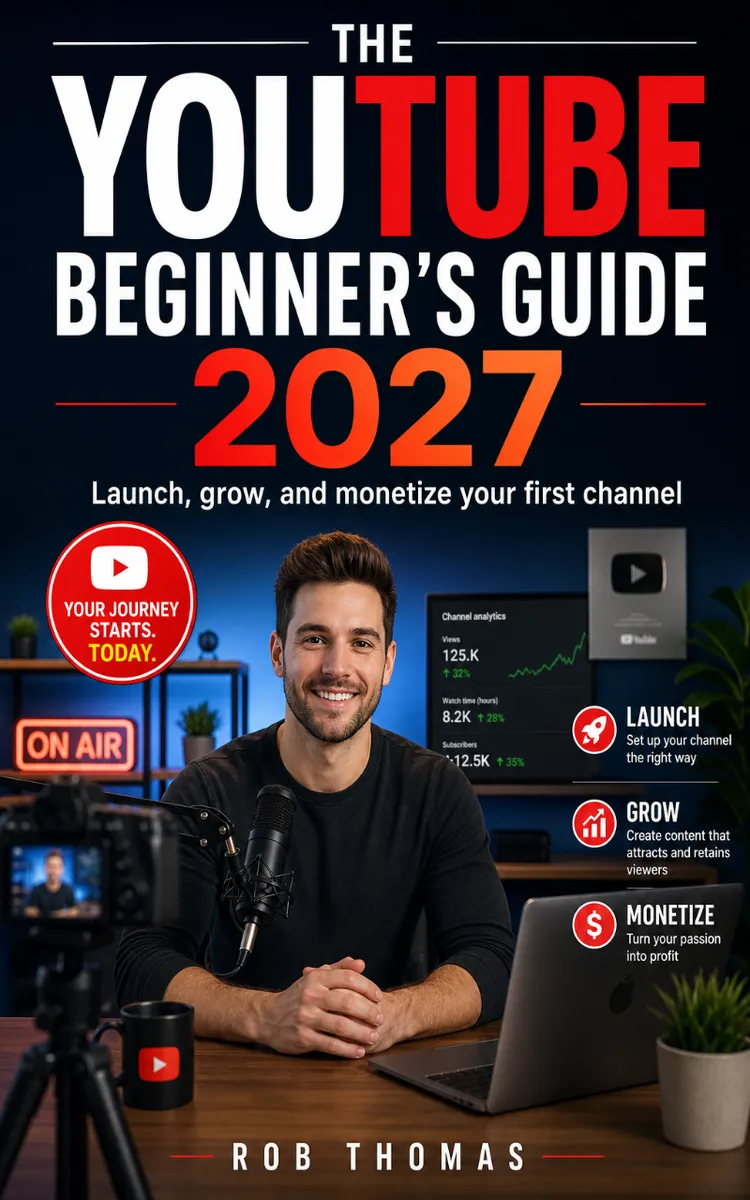
"The Youtube Beginner's Guide 2027" is a education book by Rob Thomas with 20 chapters and approximately 40,053 words. Step-by-step guide to starting and monetizing a YouTube channel.
This book was created using Inkfluence AI, an AI-powered book generation platform that helps authors write, design, and publish complete books. It was made with the AI Lesson Plan Generator.
Frequently Asked Questions
What is "The Youtube Beginner's Guide 2027" about?
Step-by-step guide to starting and monetizing a YouTube channel
How many chapters are in "The Youtube Beginner's Guide 2027"?
The book contains 20 chapters and approximately 40,053 words. Topics covered include Introduction to YouTube in 2027, Creating Your Google and YouTube Accounts, Choosing a Profitable YouTube Niche, Understanding How the YouTube Algorithm Works, and more.
Who wrote "The Youtube Beginner's Guide 2027"?
This book was written by Rob Thomas and created using Inkfluence AI, an AI book generation platform that helps authors write, design, and publish books.
How can I create a similar education book?
You can create your own education book using Inkfluence AI. Describe your idea, choose your style, and the AI writes the full book for you. It's free to start.
Write your own education book with AI
Describe your idea and Inkfluence writes the whole thing. Free to start.
Start writingCreated with Inkfluence AI


