
Read the first chapter
The whole of chapter one, free. About 9 min. Turn the pages with the arrows, your keyboard, or a swipe.
Chapter 1
Introduction
“Plans don’t fail because you lack motivation; they fail because you can’t see the next move.”
Mobile pet grooming looks simple from the outside: you show up, wash, dry, and send a happy customer home. The reality is messier. You have to fit grooming into travel time, keep sanitation tight, price services so you still make money, and handle the small-but-costly issues that pop up when you work out of a van or trailer. This chapter gives you a practical, step-by-step roadmap so you stop guessing and start building a business you can actually run.
After you read this chapter, you will know exactly what you need to decide first, what to set up before you take your first appointment, and how to measure whether your early launch is working. You will also learn how to use the KDP Roadmap Map - a simple planning layout you will reuse throughout the book - so every chapter turns into actions instead of notes you never execute.
The Mobile Launch Roadmap You Can Actually Follow
Let’s name the problem plainly: most first-time mobile grooming owners don’t fail because grooming skills are missing. They fail because they build the wrong order of operations. They buy equipment before they price services. They collect customers before they set up sanitation and scheduling. They start marketing before they know what their real time per appointment looks like. That creates a chain reaction: long days, missed appointments, unhappy customers, and “why isn’t this working?” frustration.
This chapter solves that by setting expectations for the entire launch and early operation. You will learn what you must have ready, what you can test cheaply, and what you should avoid until you can handle it. You will also get a clear reader avatar in mind: someone switching careers or starting fresh who needs a straight line from idea to first paid bookings - without turning their life into chaos.
Credibility matters here because mobile grooming punishes sloppy planning. When you work from a vehicle, every mistake costs time and money. You also deal with animals that can react unpredictably, which means you need repeatable routines, not “wing it” habits. If you want a business that survives your first busy month, you need a roadmap that respects real-world constraints: travel, setup, teardown, water and waste handling, and customer communication.
The Reader Avatar, Promise, and Why This Works
Let’s talk about the reader you’re aiming to serve with your business and the way you’re building it. This book targets a practical builder: someone like Avery Chen, 34, a career switcher who already has work habits and basic business sense but lacks grooming-industry experience. Avery can learn grooming technique, but Avery needs a system to keep decisions from piling up. Avery also needs a path that fits into limited time, because career switchers rarely have months of free runway.
Here is the transformation promise for you: you will leave this chapter with a launch plan you can follow week by week, a checklist of what to prepare before your first appointment, and a repeatable way to review what happened after each early booking. You will not rely on “it’ll work out.” You will build from concrete steps, and you will know what numbers to watch as you test your pricing and schedule.
Why this works: the roadmap forces you to match your setup to how mobile grooming actually runs. Mobile grooming is a time-and-process business as much as it is a grooming service. You must create a repeatable appointment flow (arrive, prep, groom, sanitize, pack up) and a customer flow (book, confirm, show up, follow-up). When those two flows work together, your days get shorter, your quality stays consistent, and your marketing leads convert into appointments.
A quick author credibility note: I wrote this guide for people who want to run a real business, not collect ideas. I built the KDP Roadmap Map because I saw how often new owners “collect” tasks - equipment lists, marketing ideas, and legal reminders - without organizing them into a workable sequence. The roadmap fixes that by giving you a place to put each decision so you can execute it in order.
The KDP Roadmap Map: Your Chapter Road Sign
To keep you from getting lost, you will use the KDP Roadmap Map throughout this book. Think of it like a planning board with four blocks you fill in as you learn.
• K - Know Your Starting Point: what you already have (skills, savings, work schedule, vehicle options) and what you still must learn or buy. - D - Define Your First Offer: the services you will sell first, how you will price them, and what “good” looks like for quality and customer experience. - P - Prepare Your Operations: the systems you need before bookings start (sanitation routine, appointment flow, scheduling method, supplies). - Map - Launch and Learn: a short test period where you track results, fix problems, and decide what to keep or change.
This map gives you a framework for every chapter. As you read, you will translate each topic into one of these blocks. That keeps you from repeating yourself and helps you build momentum.
Here are the core components you will set up using the KDP Roadmap Map. Each one ties directly to mobile grooming realities.
1. Your “one-van” appointment flow (time + steps). You will write down the exact order you follow from arrival to departure. This matters because mobile grooming punishes wasted minutes. When you plan the flow, you reduce overtime and keep service quality consistent.
2. Your “first offer” menu (limited and clear). You will pick a small set of services to start and price them so you can cover labor, supplies, and travel time. This matters because you can’t test marketing if your offer changes every week.
3. Your sanitation routine (clean, disinfect, store). You will set a repeatable method for cleaning tools, managing waste, and keeping your grooming area orderly. This matters because sanitation issues don’t show up as “a little inconvenience” - they show up as failed appointments, complaints, and legal risk.
4. Your launch test window (track, adjust, repeat). You will run a short period of bookings and measure what happened: how long appointments took, how customers responded, and whether your schedule held. This matters because mobile grooming depends on your daily capacity.
Putting the Roadmap Into Practice: Avery’s First 30 Days (Real Numbers)
You will use the KDP Roadmap Map with a concrete plan. Avery Chen wants to switch careers without burning through savings. Avery’s goal for the first month is simple: get to consistent paid appointments while proving the appointment flow and pricing under real conditions.
A practical way to do that looks like this:
1. Week 1: Fill the KDP Roadmap Map with your current reality. Write your starting point (K): what vehicle you have access to, how many hours per week you can work, and what grooming skills you currently have. Then define your first offer (D): pick 2-4 common services you can perform safely and consistently. Example: “Bath and blow-dry,” “Full haircut,” and “Nail trim add-on.” Keep it small so you can learn fast. Expected outcome: you can describe your business in 60 seconds and list your first services without changing them daily.
2. Week 2: Build your appointment flow and sanitation routine on paper. Prepare operations (P): write the steps from “arrive at the home” to “pack up.” Include setup time, tool cleaning time, and a way to separate clean and dirty items. Expected outcome: you can estimate the length of an appointment and you know what you will do if you get delayed.
3. Week 2-3: Create a simple booking system you can actually run. Use one scheduling method you can check every day. This can be a booking link or an appointment calendar you manage consistently. Add a confirmation message that tells customers what to expect before arrival. Expected outcome: customers show up with the right expectations, and you stop losing time to avoidable questions.
4. Week 3: Price your first offer using time + materials, then sanity-check it. Define your pricing (D) so it covers the time you spend, not just the grooming work. Count travel time, setup, and cleanup. Expected outcome: when you run a full day, you still have room for profit after basic expenses.
5. Week 4: Launch with a controlled test and a fixed learning routine. Map your launch (Map): run appointments on a tight schedule, then review each appointment using a short log. Record appointment length, any issues, and customer feedback. Expected outcome: you know your real capacity and you can adjust your offer or schedule before you scale.
Quick checklist (use it before you take your first real booking): - Write your KDP Roadmap Map for your current situation (K, D, P, Map). - Choose 2-4 starter services and keep them stable for at least a month. - Draft your appointment flow from arrival to pack-up. - Create a sanitation routine you can follow every time, in the same order. - Pick one scheduling method and check it daily. - Price using time + supplies + travel time, then review your day plan. - Launch with a short test window and keep an appointment log.
What to Watch For: Common Mistakes and Fixes
Mobile grooming punishes shortcuts. Here are the mistakes you will see most often, plus the fixes that keep you moving.
Buying equipment before you finalize your first offer If you buy tools and supplies while your service menu still changes, you’ll waste money and end up with the wrong setup for your actual appointments. Do this: lock your first offer (2-4 services) before you purchase. Then match equipment to those services and your appointment flow. Not this: collecting “everything you might need” and hoping it all fits into your schedule later.
Underestimating appointment time because you only count grooming Many new owners plan as if grooming happens in isolation. In mobile work, you also spend time on setup, travel, customer communication, and teardown. If you ignore that, your schedule collapses fast. Do this: time your dry runs. Use your planned appointment flow and time each segment (setup, grooming, cleanup). Then add a buffer for delays. Not this: using a single “grooming time” estimate and assuming travel and sanitation will somehow take care of themselves.
Skip the sanitation routine because “it’s obvious” Sanitation needs a written routine because you work under stress: tight schedules, wet tools, fur everywhere, and customers asking questions at the wrong moment. If you don’t standardize, you’ll improvise. Do this: write your sanitation steps in order and store supplies so you can grab them without searching. Not this: relying on memory, especially when the day gets busy.
Chapter Summary: Your Next Action and the Bridge to Chapter 2
You now have the core expectation-setting piece: a practical roadmap that turns “starting a business” into a sequence of decisions you can execute. The KDP Roadmap Map gives you a place to put what you learn, so you build in the right order instead of collecting tasks.
Your practical action today: open a blank page and draw the KDP Roadmap Map (K, D, P, Map). Write one sentence for each block answering these questions: Where are you starting? What services will you sell first? What steps and sanitation routine will you follow? How will you test and learn in your first 30 days?
Once you lock that foundation, you’ll be ready to check whether mobile grooming fits your life and your goals. Next up: Is a Mobile Pet Grooming Business Right for You?
End of chapter one. 19 more chapters in the full book.
Swipe or use the arrows to turn the page

The Youtube Beginner's Guide 2027

How To Start A Handyman Business

How to Start a Lawn Care Business
What's inside: 20 chapters
- 1. Introduction
- 2. Is a Mobile Pet Grooming Business Right for You?
- 3. Understanding the Mobile Pet Grooming Industry
- 4. Creating a Business Plan
- 5. Startup Costs and Budgeting
- 6. Financing Your Business
- 7. Choosing the Right Grooming Van or Trailer
- 8. Essential Grooming Equipment and Supplies
- 9. Licenses, Permits, Insurance, and Legal Requirements
- 10. Pet Safety, Animal Handling, and Sanitation
- 11. Grooming Services and Pricing
- 12. Scheduling, Route Planning, and Time Management
- 13. Marketing and Building Your Brand
- 14. Finding and Retaining Loyal Customers
- 15. Daily Operations and Customer Service
- 16. Hiring Employees and Expanding Your Team
- 17. Bookkeeping, Taxes, and Financial Management
- 18. Growing and Scaling Your Business
- 19. Common Mistakes and How to Avoid Them
- 20. Your Mobile Pet Grooming Business Launch Plan
About this book
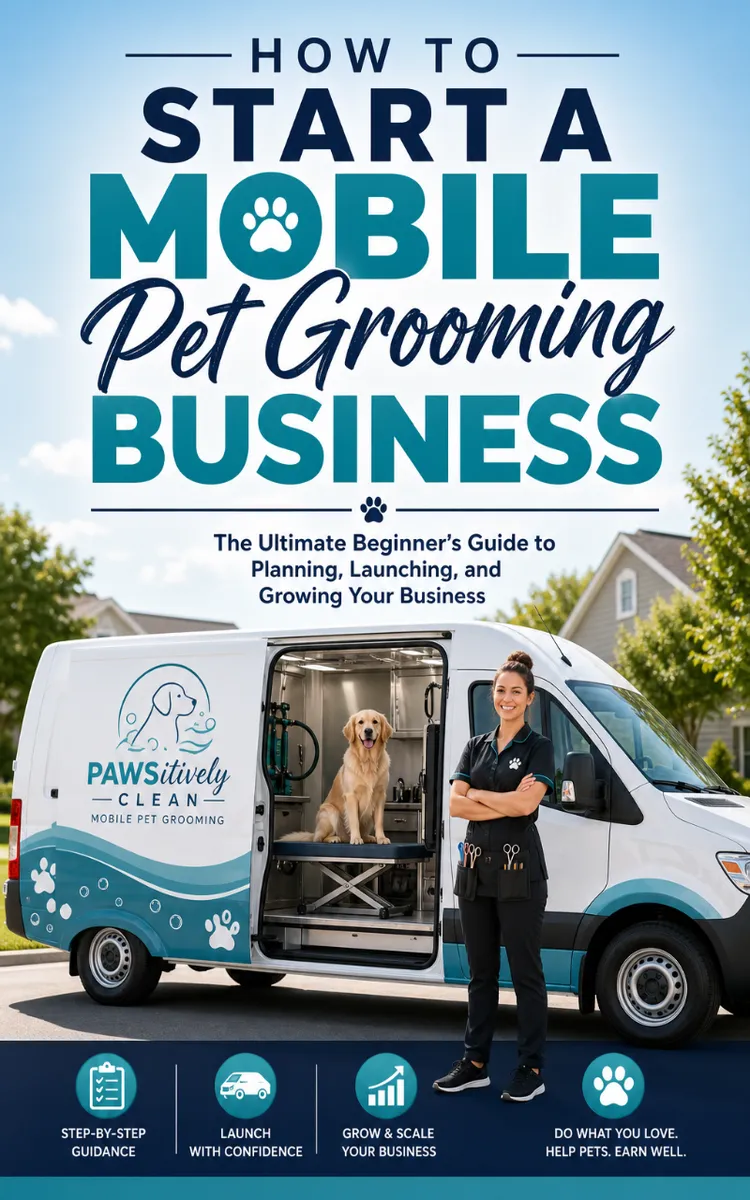
"How to Start a Mobile Pet Grooming Business" is a business book by Rob Thomas with 20 chapters and approximately 45,155 words. Starting, operating, and scaling a mobile pet grooming business.
This book was created using Inkfluence AI, an AI-powered book generation platform that helps authors write, design, and publish complete books. It was made with the AI Business Book Writer.
Frequently Asked Questions
What is "How to Start a Mobile Pet Grooming Business" about?
Starting, operating, and scaling a mobile pet grooming business
How many chapters are in "How to Start a Mobile Pet Grooming Business"?
The book contains 20 chapters and approximately 45,155 words. Topics covered include Introduction, Is a Mobile Pet Grooming Business Right for You?, Understanding the Mobile Pet Grooming Industry, Creating a Business Plan, and more.
Who wrote "How to Start a Mobile Pet Grooming Business"?
This book was written by Rob Thomas and created using Inkfluence AI, an AI book generation platform that helps authors write, design, and publish books.
How can I create a similar business book?
You can create your own business book using Inkfluence AI. Describe your idea, choose your style, and the AI writes the full book for you. It's free to start.
Write your own business book with AI
Describe your idea and Inkfluence writes the whole thing. Free to start.
Start writingCreated with Inkfluence AI


