
Read the first chapter
The whole of chapter one, free. About 12 min. Turn the pages with the arrows, your keyboard, or a swipe.
Chapter 1
Final
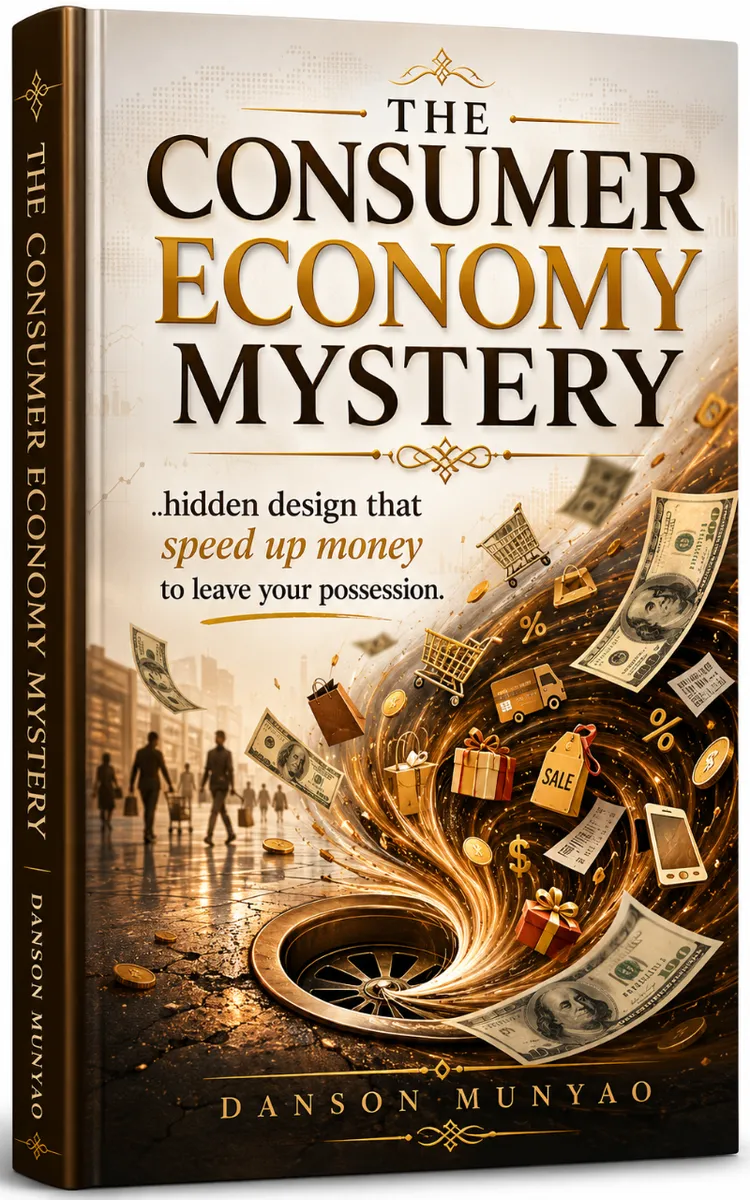
THE CONSUMER ECONOMY MYSTERY
Hidden Design that Speeds Up Money to Leave Your Possession
By Danson Munyao
ABOUT THE AUTHOR
Danson Munyao is the Founder and Chief Executive Officer of Paradigm Shifts Africa, Kenya, and Director of Chakam Community Hub, a Rural Innovation Centre within the Kimana–Amboseli Corridor Economic Bloc.
He is a business model developer and systems architect focused on designing practical models for economic transformation, enterprise development, and value creation. His work includes the Money Approach Strategy, The Shift Code–3M Code, and Digital Economy models.
The Consumer Economy Mystery is an eBook that reveals how money leaves the possession of its owner to become revenue for other systems. It serves as the entry point to the Money Approach Strategy Masterclass
INTRODUCTION
The Consumer Economy is not a marketplace. It is a dispersal architecture. A marketplace exists to facilitate exchange. A dispersal architecture exists to accelerate movement. The distinction is not semantic. It is structural.
Most people have been taught to see the Consumer Economy as a collection of products, services, transactions, brands, retailers, and financial institutions operating inside a neutral economic environment. That perception is incomplete.
The Consumer Economy is an engineered environment organized around a single economic outcome. The continuous movement of money away from its owner. This is not a conspiracy. It is a business model. And it is one of the most successful business models ever constructed.
Its success is not measured by how much money enters the system. Its success is measured by how little money remains stationary once it does. The architecture is elegant. It reduces resistance to spending. It increases the speed of transactions. It normalizes recurring expenditure. It extends consumption beyond current income. It transforms spending into identity.
Most importantly, it performs these functions while appearing completely ordinary.
That is the mystery.
The most powerful systems rarely hide themselves. They hide their design. People see the transactions. They rarely see the architecture producing them. People see the spending. They rarely see the mechanisms accelerating it. People see the financial outcome. They rarely see the engineered pathway that made the outcome increasingly likely long before the decision was made.
The Consumer Economy benefits from this invisibility. Not because its mechanisms are secret. Because they are familiar. Familiarity is one of the most effective forms of concealment ever created. What is encountered every day eventually disappears from examination.
The result is a peculiar financial condition. Millions of people attempt to improve their financial position while operating inside an environment they have never been taught to identify, map, or understand.
They study money. They study income. They study investing. They study saving. Yet the architecture surrounding all four often remains invisible.
This book is an examination of that architecture. Not to condemn it. Not to escape it. Not to argue against it. To see it. Because perception changes the relationship between a person and the environment they inhabit.
An invisible architecture shapes behavior. A visible architecture becomes observable. A visible architecture can be studied. A studied architecture can be understood. And understanding begins with seeing what was there all along.
The Consumer Economy Mystery is not hidden because it is secret. It is hidden because almost nobody thinks to look for design inside normality. This book does. And the first step is understanding what the Consumer Economy actually is.
TABLE OF CONTENTS
Introduction
Chapter 1: What the Consumer Economy Actually Is
Chapter 2: The Friction Elimination Engine — Removing Every Barrier Between You and an Empty Pocket
Chapter 3: The Invisibility Architecture — Making You Feel Like You Are Living While You Are Actually Losing
Chapter 4: The Behavioral Compulsion System — Converting Your Desire Into Someone Else's Revenue Before You Think Twice
Chapter 5: The Debt Normalization Engine — Spending Tomorrow's Money on Today's Dispersal
Chapter 6: The Identity Consumption Trap — Engineering Your Identity So That Stopping Feels Like Shrinking
Closing Bridge: The Counter-Architecture
CHAPTER 1
WHAT THE CONSUMER ECONOMY ACTUALLY IS
The greatest success of the Consumer Economy is not the products it sells. It is the perception it creates. People see commerce. They rarely see coordination. People see transactions. They rarely see direction. People see individual spending decisions. They rarely see the environment systematically influencing those decisions long before they are made.
This is why the Consumer Economy is so difficult to understand from the inside.
Everything appears disconnected. A purchase here. A subscription there. A loan somewhere else. An upgrade later. A convenience improvement somewhere in between. Each event appears independent. Each decision appears personal. Each transaction appears isolated. Viewed individually, they are. Viewed collectively, they reveal something far more interesting. A pattern. And patterns are where architecture becomes visible.
The Consumer Economy is often described as a marketplace because marketplaces are familiar. They are easy to understand. Buyers meet sellers. Money changes hands. Transactions occur. The description is accurate. But it is incomplete.
A marketplace explains where exchange happens. It does not explain why money moves with increasing speed, increasing frequency, and increasing regularity once it enters the system. For that, a different lens is required.
The Consumer Economy is better understood as a dispersal architecture. An environment organized around the continuous circulation of money. Money enters. Money moves. Money leaves. The system performs best when money remains in motion. Stationary money contributes little to the architecture. Moving money contributes everything.
This changes how many familiar features of modern economic life are understood. Convenience is no longer just convenience. It becomes transaction acceleration. Recurring payments are no longer just payment preferences. They become continuity mechanisms. Consumer credit is no longer merely access to purchasing power. It becomes future-income mobilization. Identity consumption is no longer simply self-expression. It becomes dispersal reinforcement.
The individual features remain the same. The perception changes. And perception changes everything. Because once the architecture becomes visible, previously unrelated phenomena begin to connect. The upgrades connect. The subscriptions connect. The financing connects. The incentives connect. The rewards connect. The convenience connects. The result is not a collection of isolated financial experiences. It is a coordinated dispersal environment operating through multiple mechanisms simultaneously.
This is where the mystery begins to dissolve. The question is no longer: "Why do people spend money?" The more interesting question becomes: "What kind of environment consistently increases the probability that money will leave its owner?" The answer emerges through five mechanisms. Each performs a different function. Together they form the operational structure of the Consumer Economy. And the first mechanism begins with something so ordinary that most people never notice it. Friction.
CHAPTER 2
THE FRICTION ELIMINATION ENGINE
The first objective of the Consumer Economy is not persuasion. It is acceleration. Persuasion influences decisions. Acceleration shortens the distance between desire and transaction. The difference matters. A person can resist persuasion. A person cannot evaluate what arrives before evaluation has time to engage. This is why friction occupies such an important position inside the Consumer Economy.
Friction is the pause between impulse and action. The hesitation between wanting and spending. The brief interruption where rational evaluation has an opportunity to enter the process. Friction creates distance. And distance creates visibility.
The Consumer Economy treats both as obstacles.
Every second spent evaluating a purchase is a second in which the transaction may not occur. Every additional step creates another opportunity for reconsideration. Every interruption introduces uncertainty into a process that performs best when it remains uninterrupted. The solution is obvious.
Remove the interruption.
Remove the distance.
Remove the pause.
Remove the friction.
The result is what can be described as the Friction Elimination Engine. A continuously evolving set of mechanisms designed to reduce the effort required for money to leave your possession. Its success is measured by a simple outcome. How quickly can desire become dispersal? The answer becomes visible almost everywhere.
Purchasing becomes faster. Payment becomes easier. Access becomes immediate. Waiting becomes unnecessary. The time between wanting and having steadily contracts. What once required deliberate action increasingly requires only intention. The transformation appears beneficial. And in many respects it is. Convenience is valuable. Efficiency is valuable. Speed is valuable.
The mystery begins when these developments are viewed collectively rather than individually. Collectively, they reveal a consistent pattern. The reduction of transactional resistance. The elimination of spending friction. The acceleration of dispersal. This changes the meaning of convenience. Convenience is often understood as a service to the consumer. The Friction Elimination Engine reveals another function. Convenience is also a dispersal technology. It increases the velocity with which money moves through the architecture.
The faster the movement, the greater the dispersal capacity. The greater the dispersal capacity, the more effective the architecture becomes. The consequence is subtle but profound. Spending begins to occur at a speed that exceeds evaluation. The transaction completes. The evaluation follows. Money leaves. The mind arrives afterwards. This is the first hidden design of the Consumer Economy. Not the creation of desire. The acceleration of desire into transaction.
CHAPTER 3
THE INVISIBILITY ARCHITECTURE
The most effective forms of dispersal are not the fastest. They are the least visible. Speed attracts attention. Invisibility avoids it. A person notices a large financial decision. A person notices a significant purchase. What often goes unnoticed are the countless smaller movements occurring beneath the threshold of conscious observation.
The Consumer Economy understands a principle that appears repeatedly throughout its design. Visible dispersal invites scrutiny. Invisible dispersal invites continuity. The distinction is profound. A person rarely questions what they continuously notice. A person almost never questions what they no longer notice at all.
This is where the Invisibility Architecture begins.
Its objective is not to accelerate the movement of money. Its objective is to make the movement disappear into normality. The architecture performs best when dispersal no longer feels like dispersal. When expenditure feels like routine. When payment feels like background. When financial outflow becomes indistinguishable from daily life.
The architecture performs best when attention stops following the money. Financial movement and financial awareness are not the same thing. Money can continue moving long after attention has stopped tracking it. The cumulative effect is remarkable. Individual dispersals appear insignificant. Collectively they become substantial. Each movement appears harmless. Together they form a stream. And streams possess a characteristic that individual drops do not.
They carry volume.
People evaluate individual transactions. The architecture operates through cumulative flows. Money rarely disappears through a single dramatic event. More often, it leaves through continuous and largely unnoticed movement. The Friction Elimination Engine accelerates movement. The Invisibility Architecture conceals it. What accelerates movement can be noticed. What conceals movement often cannot.
CHAPTER 4
THE BEHAVIORAL COMPULSION SYSTEM
The Consumer Economy does not depend on need. Need is too limited. Need is finite. A dispersal architecture requires something more renewable.
Desire.
Unlike need, desire rarely reaches completion. The satisfaction of one desire often becomes the foundation for another. A fulfilled desire creates temporary resolution. A new desire restores movement.
The cycle repeats.
This makes desire an extraordinary dispersal resource. The challenge is obvious. Desire is unpredictable. It competes with rational evaluation. The solution is behavioral engineering. Not the creation of desire. The amplification of it. The acceleration of it. The conversion of it into transaction intent before rational evaluation can fully engage. This is the Behavioral Compulsion System.
A mechanism designed to reduce the distance between wanting and acting. Its objective is simple. Collapse the evaluation window. The evaluation window is the brief period between desire and decision. It is where comparison occurs. Reflection occurs. Calculation occurs. Alternative possibilities emerge.
The Behavioral Compulsion System seeks to minimize that uncertainty. The strongest spending decisions are often not the most rational. They are the most immediate. Immediacy creates momentum. Momentum creates action. Action completes the dispersal.
Urgency.
Scarcity.
Exclusivity.
Anticipation.
Reward.
Belonging.
Recognition.
These are not products. They are psychological accelerants. Their function is not to increase value. Their function is to increase movement. The Friction Elimination Engine accelerates transactions. The Invisibility Architecture conceals transactions. The Behavioral Compulsion System increases the probability that transactions occur in the first place.
CHAPTER 5
THE DEBT NORMALIZATION ENGINE
Every dispersal architecture eventually encounters a boundary.
Income.
No matter how effective the preceding mechanisms become, a simple constraint remains. A person cannot continuously disperse money they do not possess. The Debt Normalization Engine exists to eliminate that gap. Its function is not to create desire. Its function is not to remove transaction friction. Its function is to make future income available for present dispersal.
This is one of the most important innovations in the history of the Consumer Economy. The architecture no longer needs to wait for money to arrive. It can claim it before it exists.
The implication is profound.
Dispersal is no longer limited by current possession. It becomes connected to future earning potential. The transaction occurs now. The payment obligation remains. Future income inherits the decision. The architecture extends beyond the present and establishes a claim on tomorrow.
The Debt Normalization Engine performs with extraordinary efficiency because it transforms a limitation into an opportunity. Insufficient capital no longer prevents movement. It merely changes the timing of payment. The dispersal proceeds. The obligation remains. The architecture advances. Its greatest achievement is not financial.
It is perceptual.
Debt becomes normal. Once debt becomes ordinary, resistance declines. The mechanism becomes self-sustaining. The transaction ends. The obligation remains. The dispersal event concludes. The dispersal claim continues. Dispersal has reached into the future and claimed capital before it arrives.
CHAPTER 6
THE IDENTITY CONSUMPTION TRAP
The deepest mechanisms are rarely the most visible. They are the most personal. The Consumer Economy understands a principle that extends far beyond products, transactions, and spending behavior. People do not merely purchase utility. They purchase meaning. Meaning changes everything. A transaction based on utility is evaluated. A transaction based on identity is defended.
The distinction is profound.
Utility asks: "What does this do?"
Identity asks: "What does this say about me?"
Once consumption enters the realm of identity, the architecture reaches its most durable form.
The transaction is no longer connected only to ownership. It becomes connected to self-perception. The expenditure becomes expression. This is the Identity Consumption Trap. Its objective is not to increase spending. Its objective is to make spending feel personally meaningful. People are willing to question transactions. They are less willing to question identity.
When consumption becomes intertwined with self-definition, withdrawal no longer feels like a financial decision. It feels like a personal reduction. A contraction. A loss of belonging. A loss of expression. The transaction no longer requires strong utility. It only requires strong symbolism. Meaning performs the work that necessity once performed. The purchase becomes reinforcement. The expenditure becomes confirmation. The dispersal becomes self-expression.
The Identity Consumption Trap is the deepest expression of the Consumer Economy. It is where financial dispersal no longer depends primarily on convenience, visibility, behavior, or debt. It is sustained through meaning. The architecture has reached its highest level of integration.
CLOSING BRIDGE
THE COUNTER-ARCHITECTURE
This book has walked you through the Consumer Economy, revealing the architecture of money dispersal that creates a gap: for one to survive in this economy, there has to be a system for compounding the money being dispersed.
The Money Approach Strategy Masterclass offers that solution through three key areas:
Mindset — Right Perception
Skillsets — Right Interception
Assets — Right Conceptualization
I warmly invite you to continue your journey through the Money Approach Strategy Masterclass.
End of chapter one.
Swipe or use the arrows to turn the page
What's inside: 1 chapter
- 1. Final
About this book
"Final" is a business book by Danson Munyao with 1 chapters and approximately 2,565 words. It covers key insights and practical takeaways on the topic.
This book was created using Inkfluence AI, an AI-powered book generation platform that helps authors write, design, and publish complete books. It was made with the AI Business Book Writer.
Frequently Asked Questions
What is "Final" about?
"Final" is a business book by Danson Munyao covering key insights and practical takeaways on the topic.
How many chapters are in "Final"?
The book contains 1 chapters and approximately 2,565 words. Topics covered include Final.
Who wrote "Final"?
This book was written by Danson Munyao and created using Inkfluence AI, an AI book generation platform that helps authors write, design, and publish books.
How can I create a similar business book?
You can create your own business book using Inkfluence AI. Describe your idea, choose your style, and the AI writes the full book for you. It's free to start.
Write your own business book with AI
Describe your idea and Inkfluence writes the whole thing. Free to start.
Start writingCreated with Inkfluence AI


