

Read the first chapter
The whole of chapter one, free. About 9 min. Turn the pages with the arrows, your keyboard, or a swipe.
Chapter 1
What Biblical Theology Studies
Scripture as One Story with Many Voices
Genesis opens with creation, the Psalms teach God’s people to pray, the Prophets confront covenant failure, and Paul explains the saving work of Christ. These books differ in setting, style, audience, and purpose, yet they speak about the same God and unfold one saving purpose. Biblical theology studies how that unity appears through the Bible’s own words, events, promises, and patterns.
The subject matters because teachers can easily make one of two errors. We may treat the Bible as a collection of isolated verses, or we may flatten its differences into a system that sounds orderly but no longer resembles Scripture’s actual presentation. Biblical theology holds both truths together: Scripture is one coherent revelation, and it comes to us through many writers, periods, genres, and covenant settings.
Earlier study of Scripture’s inspiration, canon, and interpretation provides the foundation for this work. If the Bible is God’s written Word, then its parts deserve careful attention as parts of a whole. Biblical theology therefore asks how a theme develops from Genesis to Revelation, how later passages interpret earlier ones, and how the history of redemption reaches its fulfillment in Jesus Christ.
Learning Objectives
• Define biblical theology and distinguish it from systematic and historical theology. - Explain how Scripture’s unity and diversity guide responsible interpretation. - Apply a clear method to a biblical theme using specific passages and decisions.
A practical takeaway is this: read every passage closely, but never read it alone.
Three Ways Theology Studies Scripture
Biblical theology - the study of God’s self-revelation as it unfolds through the Bible’s history, books, themes, and redemptive story.
This definition includes several important features. First, biblical theology is grounded in Scripture rather than in abstract ideas detached from the biblical text. Second, it pays attention to development. The promise to Abraham in Genesis 12:1-3 is not identical in form to the kingdom hope in 2 Samuel 7:12-16, yet the passages belong to a growing story. Third, biblical theology respects the Bible’s own categories. Instead of beginning with a modern question and forcing every passage into it, the interpreter asks what Scripture emphasizes and how its writers connect their claims.
Consider the theme of God’s presence. In Eden, God dwells with humanity (Genesis 2-3). After sin, humanity is driven from the garden, but God continues to make his presence known through covenant, tabernacle, temple, and prophetic promise. In John 1:14, the Word becomes flesh and “dwelt” among us. In Revelation 21:3, God’s dwelling is finally with humanity in the renewed creation. A biblical-theological study follows this movement. It does not merely collect verses containing the word “presence.”
Systematic theology - the organized study of what the whole Bible teaches about particular doctrines.
Systematic theology gathers Scripture’s teaching on subjects such as God, humanity, sin, salvation, the church, and last things. It seeks clarity and faithful synthesis. For example, a systematic study of justification may bring together Genesis 15:6, Romans 3-5, Galatians 2-3, and James 2. It asks, “What does the whole Bible teach about justification, and how do these passages fit together?”
Biblical and systematic theology serve one another. Biblical theology helps systematic theology preserve the Bible’s historical movement and varied vocabulary. Systematic theology helps biblical theology state the Bible’s teaching clearly and guard against treating one stage of revelation as the whole truth. Biblical theology may trace sacrifice from Leviticus to Hebrews; systematic theology may then explain the doctrine of Christ’s atoning work across the full canon.
Historical theology - the study of how Christians have understood, taught, and defended biblical doctrine across the history of the church.
Historical theology examines the early church’s confession of Christ’s deity, the Reformation debates about justification, and later discussions of Scripture, baptism, the Lord’s Supper, or the church. Its primary question is not, “How does this theme develop within the Bible?” but, “How has the church interpreted this teaching over time?”
These approaches can be distinguished by their usual questions:
| Approach | Main question | Typical movement | |---|---|---| | Biblical theology | How does Scripture reveal this truth across its unfolding story? | Genesis to Revelation | | Systematic theology | What does the whole Bible teach about this doctrine? | Texts gathered by subject | | Historical theology | How has the church understood this teaching? | Early church to the present |
The distinctions are useful, but they are not walls. A teacher preparing a lesson on the Lord’s Supper might trace Passover and covenant meals through Scripture, clarify the doctrine of communion, and then explain how major Christian traditions have understood the practice. Each task is legitimate, but each requires its own method.
Scripture’s unity means that its books ultimately testify to one divine purpose. The same God creates, judges, promises, redeems, and restores. The promise of blessing to Abraham reaches beyond one family toward the nations (Genesis 12:3; Galatians 3:8). The exodus becomes a pattern for later salvation, and the Davidic kingdom points toward the reign of Christ (Luke 1:32-33). Scripture’s diversity means that this one purpose is communicated through different authors, genres, historical moments, covenants, and audiences.
Unity without diversity produces distortion. If the Psalms, Proverbs, prophetic oracles, Gospel narratives, and Pauline letters are all read as though they were written in the same way, their meaning is damaged. Diversity without unity produces fragmentation. If each passage is treated as an independent religious statement, the Bible’s covenant story disappears.
Ask yourself: What does this passage mean in its immediate setting, and where does it stand in the Bible’s larger story? Both questions are necessary. The answer should honor the particular passage while also recognizing Scripture’s unified witness.
The practical takeaway is to distinguish methods without separating them. Begin with the Bible’s unfolding testimony, then use systematic clarity and historical awareness to teach responsibly.
Worked Example: Tracing the Temple Theme
The temple provides a useful test case because it shows how biblical theology handles both continuity and development. A careless approach may say only, “The temple is where God lives,” while a fuller study asks how that idea changes across Scripture and reaches its goal.
1. State the theme precisely. Rather than studying every reference to buildings, define the question as: How does Scripture present God’s dwelling with his people?
2. Begin with the earliest setting. Genesis 2-3 presents Eden as the place of God’s presence with humanity. The garden is not called the temple in the text, so we should not erase that distinction. Yet the passage establishes the foundational pattern: God gives humanity a holy place and a commission to serve him there.
3. Examine the tabernacle. Exodus 25:8 gives the purpose plainly: “Let them make me a sanctuary, that I may dwell in their midst.” The tabernacle shows that God’s presence accompanies Israel after the exodus. It also shows that access is holy and ordered. The veil, priesthood, sacrifices, and cleansing laws teach that sinful people cannot approach God casually.
4. Trace the movement to the temple. Solomon’s temple gives Israel a permanent center of worship in the land (1 Kings 8). At its dedication, Solomon recognizes that the heavens cannot contain God (1 Kings 8:27). The temple is therefore not a box that confines God; it is the appointed sign of his covenant presence.
5. Notice judgment and promise. Because of persistent rebellion, the temple is destroyed and the people go into exile (2 Kings 25). Ezekiel sees the glory of the Lord depart from the temple (Ezekiel 10-11). Yet the prophets also promise renewed presence. Ezekiel 37:27 declares, “My dwelling place shall be with them.”
6. Read the New Testament fulfillment. John 1:14 says that the Word became flesh and dwelt among us. Jesus identifies his body with the temple in John 2:19-21. The focus has moved from a building to the person of Christ. God’s presence is now encountered decisively in the incarnate Son.
7. Follow the church’s participation. First Corinthians 3:16 calls the gathered church God’s temple, and 1 Corinthians 6:19 applies temple language to the believer’s body in relation to the Holy Spirit. These passages do not cancel the earlier temple; they show the promise advancing through Christ and the Spirit.
8. Read the final vision. Revelation 21:22 says that the renewed city has no temple, “for its temple is the Lord God the Almighty and the Lamb.” The goal is not the disappearance of God’s presence but its complete fulfillment. What was symbolized in Eden, tabernacle, and temple becomes immediate and universal.
The reasoning has produced a clear result: the temple theme traces God’s holy presence from Eden, through Israel’s tabernacle and temple, to Christ, the Spirit-filled church, and the renewed creation where God and the Lamb are the temple.
Several cautions follow from this example. We should not claim that every garden detail is a direct temple prophecy. We should not treat the church as merely a replacement building without considering Christ’s central role. We should also avoid reading Revelation as though it simply repeats Solomon’s temple. Biblical theology recognizes real continuity, but it also recognizes movement toward fulfillment.
For teaching purposes, the final summary could be written in four lines: place, presence, person, perfection. Eden and temple provide the place; God’s glory provides the presence; Christ provides the person; the new creation provides the perfected goal. That summary is useful only because it was built from the texts rather than imposed on them.
The practical takeaway is to trace a theme by stages, test each stage in its context, and state the final pattern with enough care to preserve both development and fulfillment.
Guided Practice and Answer Key
1. Which approach best fits this question: “How did the doctrine of the Trinity develop in the creeds of the fourth century?” Hint: The question concerns the church’s interpretation across time, not the Bible’s internal storyline.
2. Trace the theme of covenant from Genesis 12 to Luke 22. What remains unified, and what develops? Hint: Compare God’s promise to Abraham with Jesus’ words about the new covenant in his blood.
3. Why would it be misleading to read Proverbs 22:6 as an unconditional promise that every properly trained child will follow the faith? Hint: Consider genre, wisdom’s general patterns, and the difference between a proverb and a legal guarantee.
4. A lesson on sacrifice uses only Leviticus 16 and ignores Hebrews 9-10. What important biblical-theological connection is missing? Hint: Ask how the New Testament interprets the earlier sacrificial system.
5. Classify this statement: “The church’s teaching on baptism changed significantly from the second century to the Reformation.” Is it primarily biblical, systematic, or historical theology? Hint: Identify whether the statement studies Scripture’s development, doctrine’s full synthesis, or the church’s past interpretation.
Answer Key
1. Historical theology, because it studies the church’s doctrinal development in the fourth century.
2. The unity is God’s promise to bless and save a people; the development reaches a new-covenant expression through Jesus’ death and the gathered covenant community.
3. Proverbs gives wise instruction and ordinarily true patterns, but it is not written as an absolute covenant guarantee. Other passages also show that children make responsible choices before God.
4. Hebrews explains how Christ fulfills and surpasses the repeated Levitical sacrifices through his once-for-all offering.
5. Historical theology, because the focus is the church’s changing interpretation and practice across time.
A faithful reader of Scripture learns to hear many voices without losing the one story. Biblical theology provides that discipline: close attention to each passage, patient tracing of each theme, and confidence that the whole canon leads toward the glory of God revealed in Jesus Christ.
End of chapter one. 19 more chapters and about 39,609 words in the full book.
Swipe or use the arrows to turn the page


What's inside: 20 chapters
- 1. What Biblical Theology Studies
- 2. Reading Scripture in Context
- 3. The Biblical Canon and Its Shape
- 4. Creation, Humanity, and the Fall
- 5. Covenant with Abraham
- 6. Exodus and the Mosaic Covenant
- 7. Land, Judges, and Israel’s Kingdom
- 8. Davidic Kingship and Messianic Hope
- 9. Temple, Priesthood, and Sacrifice
- 10. Prophets, Exile, and Restoration
- 11. Wisdom, Poetry, and Suffering
- 12. The Gospels and Jesus’ Kingdom
- 13. Jesus’ Death and Resurrection
- 14. The Holy Spirit and New Covenant
- 15. Paul’s Theology of Salvation
- 16. The Church as God’s People
- 17. Christian Ethics and Discipleship
- 18. Biblical Theology Across the Canon
- 19. Apocalyptic Hope and Final Judgment
- 20. Teaching Biblical Theology Faithfully
About this book
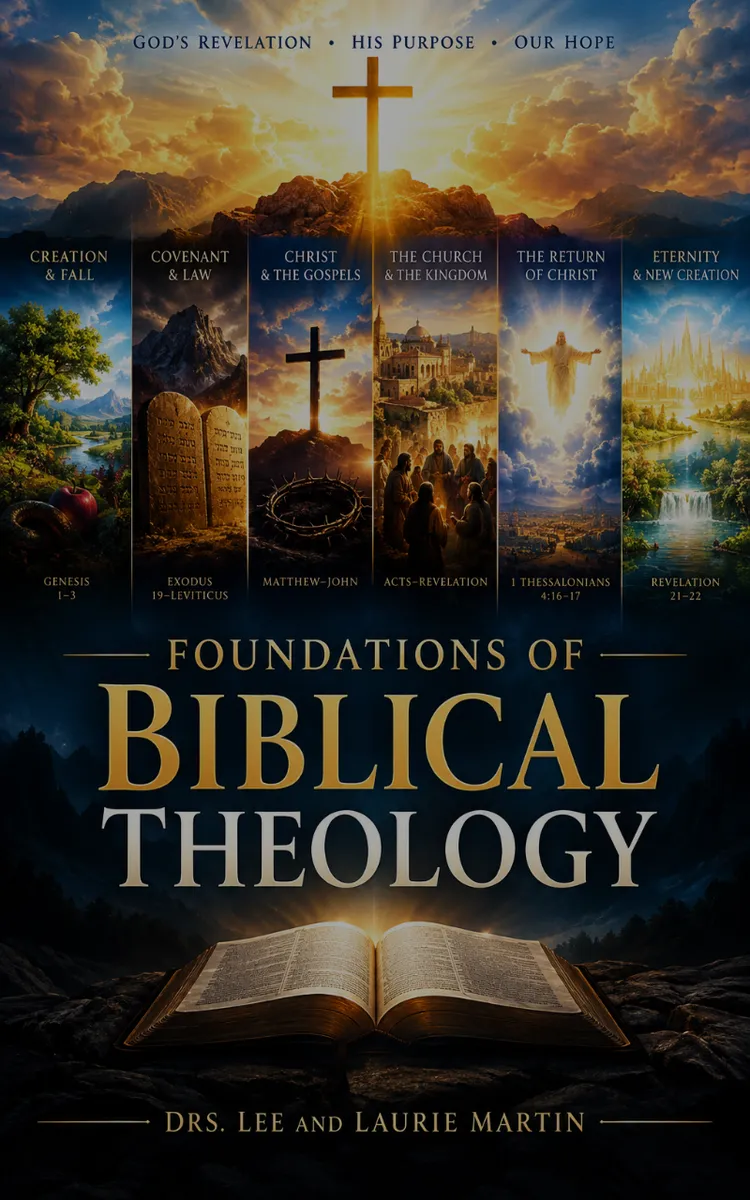
"Foundations Of Biblical Theology" is a education book by Drs. Lee & Laurie Martin with 20 chapters and approximately 39,609 words. Comprehensive biblical theology grounded in Scripture, doctrine, and biblical narratives.
This book was created using Inkfluence AI, an AI-powered book generation platform that helps authors write, design, and publish complete books. It was made with the AI Lesson Plan Generator.
Frequently Asked Questions
What is "Foundations Of Biblical Theology" about?
Comprehensive biblical theology grounded in Scripture, doctrine, and biblical narratives
How many chapters are in "Foundations Of Biblical Theology"?
The book contains 20 chapters and approximately 39,609 words. Topics covered include What Biblical Theology Studies, Reading Scripture in Context, The Biblical Canon and Its Shape, Creation, Humanity, and the Fall, and more.
Who wrote "Foundations Of Biblical Theology"?
This book was written by Drs. Lee & Laurie Martin and created using Inkfluence AI, an AI book generation platform that helps authors write, design, and publish books.
How can I create a similar education book?
You can create your own education book using Inkfluence AI. Describe your idea, choose your style, and the AI writes the full book for you. It's free to start.
Write your own education book with AI
Describe your idea and Inkfluence writes the whole thing. Free to start.
Start writingCreated with Inkfluence AI


