

Read the first chapter
The whole of chapter one, free. About 5 min. Turn the pages with the arrows, your keyboard, or a swipe.
Chapter 1
When Pain Speaks: Bringing Your Whole Heart to God
Scripture Focus
Matthew 11:28 > “Come to me, all who labor and are heavy laden, and I will give you rest.”
When pain feels loud and prayer feels hard, Jesus still invites you to bring the whole weight - no cleaned-up version required.
If your body has been aching for weeks (or years), you know what “heavy laden” feels like. It’s not just discomfort. It’s the way pain drains your attention, steals your sleep, and makes even simple thoughts feel like work. And when you try to pray, you might feel stuck - like you don’t have the right words, or you’re afraid you’ll sound faithless. Maybe you keep thinking, “God, I don’t even know how to start.”
Matthew 11:28 meets you right there. It doesn’t say, “Come to me when you’re strong enough to pray perfectly.” It says come when you’re worn out. Jesus doesn’t ask you to pretend you’re fine. He calls you by your real condition: laboring, heavy laden. That means your prayer can begin with honesty, not performance.
Reflection
Pain has a way of speaking in full sentences. It tells your mind what’s wrong, what might happen next, and how long this will last. Sometimes it even convinces you that you’re alone in it. But God’s invitation isn’t to silence pain like it never existed; it’s to bring the truth of it into His presence. That’s a big difference. You’re not ignoring the pain. You’re letting it stop being the only voice in the room.
When you bring your pain to God, you’re not failing at faith - you’re practicing it. There’s a kind of prayer that doesn’t sound polished. It sounds like: “This hurts.” “I’m tired.” “I don’t understand.” “I’m scared.” Those are not bad words. They’re honest words. And God can handle honest words. In fact, Scripture repeatedly shows people bringing their raw reality to God - tears, complaints, trembling, even questions. The common thread is that they brought it to Him, not away from Him.
Here’s the key insight to hold onto: God doesn’t require you to hide your pain to be heard - He invites you to name it so you can be helped. Naming your pain is more than describing symptoms. It’s telling the truth about what it’s doing inside you. Is your pain making you short-tempered? Is it shrinking your hope? Is it making you feel distant from God, like you have to earn closeness? Name that. God cares about the whole story, not just the body part that hurts.
Naming your pain also protects you from a subtle trap: trying to pray around it instead of through it. You might start your prayer with “Lord, I trust You,” while your stomach is tight and your heart is bracing for impact. That’s not wrong - but it’s incomplete. A more faithful starting point is to say, “Lord, I trust You, and I’m also hurting.” Both can be true at the same time. The invitation of Jesus is to come as you are, heavy laden and all.
Think about how you deal with other real-life problems. If something is wrong with a machine, you don’t fix it by pretending it’s fine - you troubleshoot. You look for the source. You name what’s happening. Prayer can be like that. Not clinical, not cold - just honest and specific enough that it can be brought to God. If your pain is a constant ache, say “constant ache.” If it spikes at night, say “night spikes.” If fatigue is the biggest enemy, say “fatigue.” God isn’t limited by your wording. He’s looking for your heart.
And when you invite Him into your whole body and spirit, you’re not only asking for relief - you’re asking for presence. Sometimes the next breath feels like a battle. Sometimes the next step feels like lifting something too heavy. God can meet you in those moments, and your prayer can be simple enough to fit inside that breath.
Practice for Today
1. Name the pain out loud (or write it) in one honest sentence. Keep it plain, like you’re telling a trusted friend who truly cares. Example: “Lord, my back pain is stealing my sleep, and I’m getting more discouraged each night.” If you want a quick template: “God, the pain in my __ is causing in my __.” (Body part → effect → inner life.)
2. Do a 5-minute “Body Invitation” prayer - set a timer. Use a simple rhythm so you don’t have to guess what to say. - Inhale and say, “Jesus, come close.” - Exhale and name one area: “My head,” “my shoulders,” “my stomach,” “my joints,” or “my whole body.” - Then add one line: “I invite You into this place.” If you don’t know what words to use, that phrase is enough: “I invite You into this place.” (You can repeat it as many times as you need for those five minutes.)
3. Journal with one prompt and one gratitude choice. Write for 3-5 minutes, then stop. Don’t turn it into a long project you can’t finish. Prompt: “What is my pain trying to communicate to me? What would I ask God to bring into it - comfort, clarity, patience, strength, or something else?” Then add one gratitude line, even if it’s small: “Today, I’m thankful for ____ (a drink of water, a quiet moment, a person who checked in, a medication that helped for a few hours).”
If you’re thinking, “I can’t be grateful while I’m hurting,” that’s okay. This isn’t pretending. It’s training your heart to notice what God is doing alongside the pain, not only what the pain is doing to you. Even a tiny “thank You” can keep your spirit from sinking into total darkness.
Closing Prayer
Jesus, I come to You heavy laden. I name what hurts, and I bring the truth of how it affects my body and my spirit. Help me pray honestly without hiding, and help me invite You into every place I’ve been trying to manage alone. Give me rest that reaches deeper than my symptoms. I receive Your nearness today - right where I am.
End of chapter one. 22 more chapters in the full book.
Swipe or use the arrows to turn the page


What's inside: 23 chapters
- 1. When Pain Speaks: Bringing Your Whole Heart to God
- 2. The God Who Sees: Healing Begins with Being Known
- 3. Prayer That Holds: Speaking to God When You Can’t Fix It
- 4. Faith in the Waiting: Trusting God’s Timing and Process
- 5. Hope That Doesn’t Lie: Receiving Strength for Today
- 6. Surrender Without Surrendering: Letting God Lead Your Healing
- 7. Healing in the Spirit: God’s Work Beyond the Body
- 8. Authority and Assurance: Praying with Confidence in God’s Character
- 9. Carrying Testimony: Sharing What God Is Doing in Your Story
- 10. The Ongoing Journey: Walking Forward with Hope After the Prayer
- 11. Staying Near: Practice After Prayer
- 12. Quiet Practice: Habits That Keep You Close
- 13. Gentle Rhythms of Return
- 14. Returning with Tender Intent
- 15. God is so near to the brokenhearted
- 16. Give your anxieties to God because He cares
- 17. Finding Rest in Active Trust
- 18. A Quiet Agreement with God
- 19. A Gentle Renewal of Trust
- 20. A Quiet Practice of Return
- 21. Gentle Habits of Coming Home
- 22. Practical Tools & Encouragement
- 23. Key Takeaways
About this book
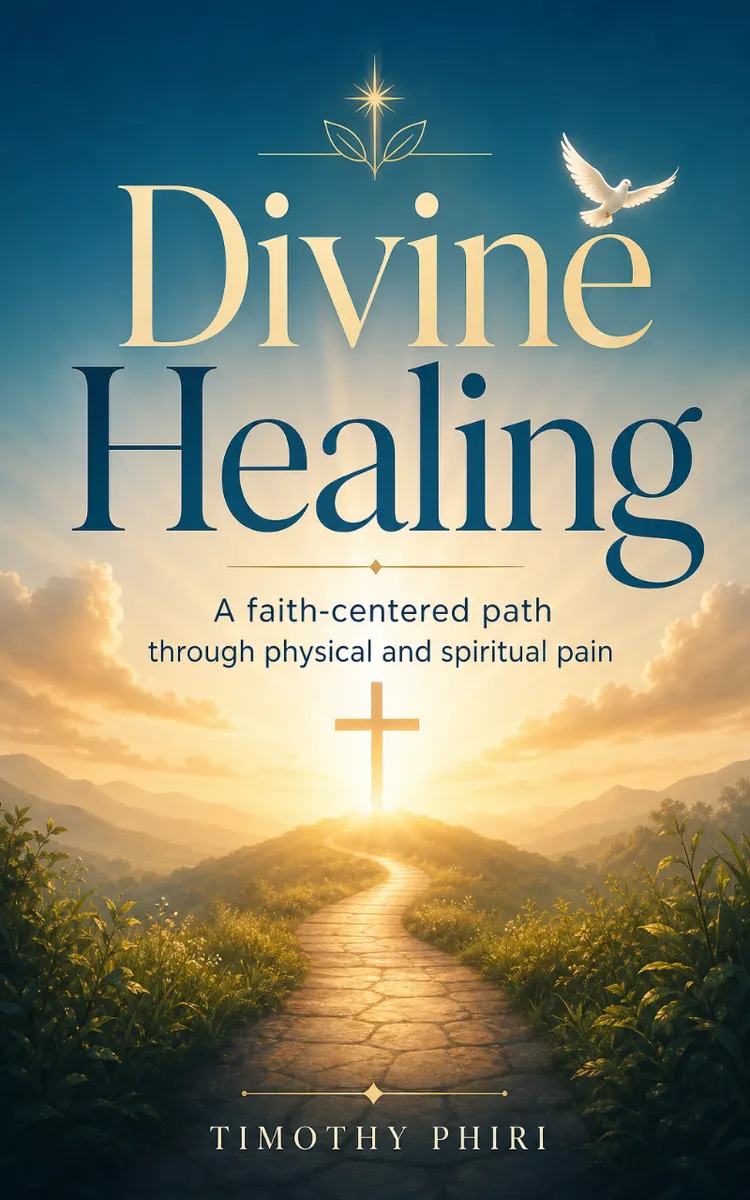
"Divine Healing" is a religious devotional book by Timothy Phiri with 23 chapters and approximately 17,971 words. Faith-based guidance on divine healing for physical and spiritual pain.
This book was created using Inkfluence AI, an AI-powered book generation platform that helps authors write, design, and publish complete books.
Frequently Asked Questions
What is "Divine Healing" about?
Faith-based guidance on divine healing for physical and spiritual pain
How many chapters are in "Divine Healing"?
The book contains 23 chapters and approximately 17,971 words. Topics covered include When Pain Speaks: Bringing Your Whole Heart to God, The God Who Sees: Healing Begins with Being Known, Prayer That Holds: Speaking to God When You Can’t Fix It, Faith in the Waiting: Trusting God’s Timing and Process, and more.
Who wrote "Divine Healing"?
This book was written by Timothy Phiri and created using Inkfluence AI, an AI book generation platform that helps authors write, design, and publish books.
Write your own religious devotional book with AI
Describe your idea and Inkfluence writes the whole thing. Free to start.
Start writingCreated with Inkfluence AI


