

Read the first chapter
The whole of chapter one, free. About 7 min. Turn the pages with the arrows, your keyboard, or a swipe.
Chapter 1
Covenant Before Compatibility
When Feelings Move, the Covenant Holds
“Marriage is not sustained by the strength of changing feelings, but by the faithfulness of a God who keeps covenant.”
That truth matters on the day affection feels effortless, but it matters even more when work pressure, parenting, illness, disappointment, or years of unresolved hurt make love feel less natural. Compatibility can help two people enjoy one another. It can’t carry a marriage through every season. God’s covenant design can.
Genesis gives us the foundation. God created humanity male and female, then said, “Therefore a man shall leave his father and his mother and hold fast to his wife, and they shall become one flesh” (Genesis 2:24, ESV). Marriage is not merely a private arrangement between two people who happen to feel strongly about each other. It’s a joining under God’s authority, with a lifelong direction.
Ephesians 5 adds the shape of that covenant. Husbands are called to love “as Christ loved the church and gave himself up for her” (Ephesians 5:25). Wives are called to respond to their husbands with willing respect, and both are called to submit “to one another out of reverence for Christ” (Ephesians 5:21). This isn’t a power contest. It’s a picture of sacrificial love, faithful care, and shared obedience to Jesus.
This Chapter Is For You If...
• You want to stop measuring your marriage by daily feelings and start measuring it by faithful obedience. - You’re in a difficult season and need a biblical way to remain tender without pretending everything is fine. - You and your spouse have strong differences in temperament, money habits, family background, or communication style. - You want a practical tool for deciding what covenant faithfulness looks like this week, not just on your wedding day.
The shift is simple to name, though it may take courage to practice: feelings are important signals, but they aren’t the final authority. God’s Word is. A covenant doesn’t deny emotion; it gives emotion a faithful place to live.
The Covenant Compass Gives Marriage Its True Direction
A healthy marriage is guided by covenant faithfulness before it is governed by changing feelings or personal compatibility.
Christian theology describes marriage as a covenant: a solemn promise made before God, marked by faithful commitment and ordered toward lifelong union. That doesn’t mean every marriage problem should be ignored. Scripture never commands a spouse to accept abuse, conceal danger, or refuse wise help. Covenant faithfulness includes truth, protection, repentance, and appropriate boundaries. It means we don’t treat discomfort as permission to abandon our vows.
The Covenant Compass has four directions: God’s Word, sacrificial love, truthful unity, and faithful perseverance. God’s Word tells us what marriage is. Sacrificial love asks what serves the other person’s good. Truthful unity refuses both pretending and contempt. Faithful perseverance keeps choosing obedience while seeking healing and wise support.
Consider a couple who regularly disagrees about spending. Compatibility language says, “We’re just too different with money.” Covenant language asks better questions: Have we told the truth? Have we agreed on a plan? Are we protecting the household? Are we treating one another as partners rather than opponents? The difference doesn’t disappear, but the marriage gains a direction.
Paul’s teaching in Ephesians doesn’t ask spouses to wait until they feel perfectly loving. It points them to Christ’s pattern. Jesus loved with action, truth, sacrifice, and purpose. So a spouse may say, “I’m hurt, and I need us to address this,” while still choosing not to punish, manipulate, or withdraw affection as a weapon. That is not weakness. It’s covenant love with a backbone.
In Practice, This Means...
• You pause before making major marriage decisions based only on anger, loneliness, or excitement. - You bring disagreements under Scripture, prayer, and wise Christian counsel rather than social-media advice. - You speak truth about harm or disappointment without using contempt, threats, or humiliation. - You ask, “What would faithful love do next?” before asking, “Do I feel like doing this?”
Daily Practices for Following the Covenant Compass
Covenant becomes visible through repeated choices. You don’t need an elaborate routine, but you do need a dependable one. These habits help feelings become honest information without allowing them to become the steering wheel.
1. Morning: surrender the marriage to God before the day gets loud. Take three minutes to pray together or separately: “Lord Jesus, make us faithful to You and tender toward each other today.” Read a short passage, such as Ephesians 5:21-33 or Genesis 2:18-25. Ask for one specific act of love you can offer before breakfast.
2. Midday: use the one-sentence Covenant Compass check. During a work break or lunch, ask yourself: “Am I moving toward God’s Word, sacrificial love, truthful unity, or faithful perseverance?” If you sent a sharp text, correct it before the day ends. A two-line message - “That came out harshly. I’m sorry. Can we talk tonight?” - can interrupt a long slide into distance.
3. Before a serious conversation: name the covenant goal. Say, “I want us to understand each other and make a faithful decision,” rather than, “I’m going to prove I’m right.” Keep the first conversation to twenty minutes if the issue is heated. Take a planned thirty-minute break, then return at a specific time.
4. Evening: review actions, not just emotions. Ask, “Where did I practice Christlike love today? Where did I protect my pride?” Confess specific sin without adding an excuse. Receive forgiveness without demanding instant emotional repair. Feelings often catch up after repeated faithful actions.
5. Weekly: make covenant decisions together. Set aside thirty minutes each week for money, schedules, intimacy, family obligations, and spiritual life. End by choosing one shared action. Also maintain connection with a biblically sound church and at least one mature Christian couple or trusted pastor who can offer honest, confidential guidance.
These practices don’t turn marriage into a machine. They create room for the Holy Spirit to reshape habits. Compatibility may influence how you solve a problem, but covenant determines whether you keep facing it together.
A Money Conflict Reoriented by Covenant
Before
A couple has argued about spending for months. One spouse makes unplanned purchases; the other responds by checking accounts repeatedly and making cutting comments. Both now use the same sentence: “We’re incompatible.” The real problem isn’t simply different preferences. It’s that fear, secrecy, and control have replaced shared stewardship.
Action
They begin with Genesis 2:24 and acknowledge that their financial decisions affect their one-flesh union. They confess their own parts without listing the other person’s failures. Then they use the Covenant Compass:
• God’s Word: They agree that honesty and wise stewardship matter. - Sacrificial love: They each identify one spending habit they’ll change. - Truthful unity: They disclose current balances and obligations without mocking. - Faithful perseverance: They create a thirty-day plan and schedule a weekly fifteen-minute review.
They also ask a trusted church leader for help because the conflict has become repetitive and emotionally charged.
Result
The budget doesn’t solve every issue in one meeting. It does something more important first: it changes the question. They stop asking whether they feel financially compatible and start asking how two covenant partners can practice truth, restraint, generosity, and care. Trust begins to grow through measurable choices - disclosed purchases, agreed limits, and calm weekly reviews.
That pattern applies beyond money. When a couple treats a difference as proof that the marriage is doomed, the difference grows teeth. When they place it under God’s covenant design, they can face it without making it their identity.
Questions for Honest Covenant Examination
1. When my feelings change, what conclusion do I immediately draw about my marriage? You may discover that disappointment quickly becomes, “This must be the wrong relationship.” Try replacing that conclusion with a question: “What do these feelings reveal, and what does Scripture call me to do next?”
2. Which part of the Covenant Compass do I neglect most: God’s Word, sacrificial love, truthful unity, or faithful perseverance? Neglect often appears in ordinary details. Maybe you pray about the marriage but avoid truthful conversation, or you speak truth while refusing patient love. Name the missing direction without defending yourself.
3. Where have I confused compatibility with covenant faithfulness? Differences in personality, energy, family culture, or problem-solving style don’t automatically signal failure. Ask whether the real issue is an unconfessed sin, an unlearned skill, an untreated wound, or simply a difference requiring patient cooperation.
4. What promise am I currently treating as optional because keeping it feels inconvenient? It may be a promise to tell the truth, return to a conversation, protect private information, pray, or seek help. Choose one promise and attach it to a specific time and action this week.
5. Who can help us see our marriage clearly without taking sides? A mature pastor, Christian counselor, or wise couple can help distinguish ordinary conflict from serious danger. If abuse, threats, coercion, or addiction is present, seek immediate qualified help and prioritize safety; covenant never requires silence about harm.
Choose Covenant Faithfulness Today
Set aside twenty minutes today with your spouse, or begin alone if your spouse isn’t ready. Read Genesis 2:24 and Ephesians 5:21-33. Then write one sentence answering this question: “What would faithful love look like in our marriage during this season?” Share the sentence without correcting or debating it. Choose one action to complete within twenty-four hours.
You will know it worked when you can name one specific behavior - not merely a feeling - that moves your marriage toward God’s Word, sacrificial love, truthful unity, or faithful perseverance.
Feelings will continue to change. Seasons will continue to shift. But a marriage anchored in God’s covenant has a compass for every change, and Christ remains faithful while husband and wife learn to follow Him together.
End of chapter one. 7 more chapters and about 12,512 words in the full book.
Swipe or use the arrows to turn the page


What's inside: 8 chapters
- 1. Covenant Before Compatibility
- 2. Practicing Honest Vulnerability
- 3. Forming Rhythms of Prayer
- 4. Repairing Conflict with Grace
- 5. Weathering Pressure as One
- 6. Rooting Marriage in Community
- 7. Renewing Love Through Change
- 8. Leaving a Legacy of Faithfulness
About this book
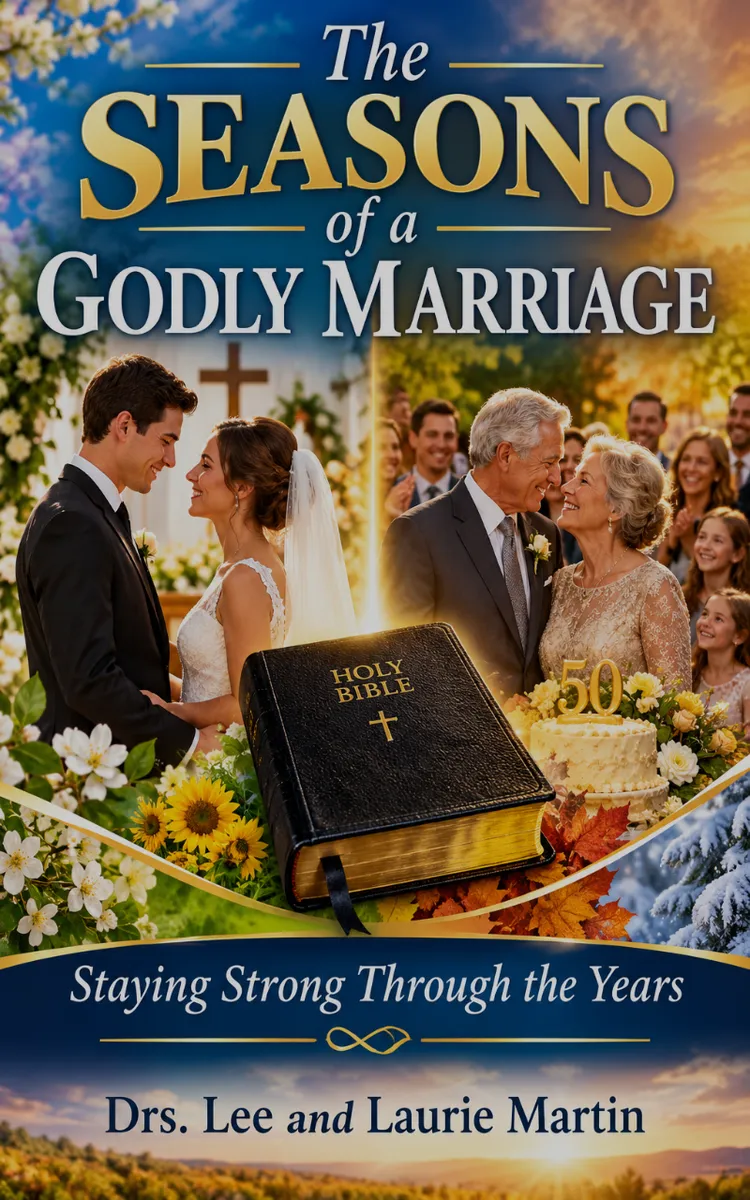
"The Seasons Of A Godly Marriage" is a inspirational book by Drs. Lee & Laurie Martin with 8 chapters and approximately 12,512 words. Biblical guidance for navigating the developmental stages of marriage.
This book was created using Inkfluence AI, an AI-powered book generation platform that helps authors write, design, and publish complete books. It was made with the AI Inspirational Book Writer.
Frequently Asked Questions
What is "The Seasons Of A Godly Marriage" about?
Biblical guidance for navigating the developmental stages of marriage
How many chapters are in "The Seasons Of A Godly Marriage"?
The book contains 8 chapters and approximately 12,512 words. Topics covered include Covenant Before Compatibility, Practicing Honest Vulnerability, Forming Rhythms of Prayer, Repairing Conflict with Grace, and more.
Who wrote "The Seasons Of A Godly Marriage"?
This book was written by Drs. Lee & Laurie Martin and created using Inkfluence AI, an AI book generation platform that helps authors write, design, and publish books.
How can I create a similar inspirational book?
You can create your own inspirational book using Inkfluence AI. Describe your idea, choose your style, and the AI writes the full book for you. It's free to start.
Write your own inspirational book with AI
Describe your idea and Inkfluence writes the whole thing. Free to start.
Start writingCreated with Inkfluence AI


