

Read the first chapter
The whole of chapter one, free. About 6 min. Turn the pages with the arrows, your keyboard, or a swipe.
Chapter 1
Chapter 1: Anatomy of the Shadow
The shadow is not born in darkness: it takes shape each time you hide an emotion so you can keep functioning. Behind a smile that comes too quickly, a curt reply, or an “I don’t care,” there may be a part of you that learned to protect itself before it learned to feel safe.
Dark psychology, understood here without sensationalism or condemnation, looks at what is usually left out of the portrait: the need for control, envy, anger, shame, the desire to be seen, and the strategies we use to avoid touching those wounds. This is not about turning yourself into a judge of your own night. It is about lighting a small candle and looking closely.
The shadow as a map of what has been repressed
We call the shadow those aspects of the personality that we reject, conceal, or consider unacceptable. It does not always contain something terrible. Sometimes it holds a legitimate need that was silenced: rest, recognition, tenderness, space, authority. At other times, it preserves impulses that can cause harm if expressed without awareness. The shadow is not a monster; it is an unsorted archive.
When someone says, “I never feel jealous,” perhaps they are not describing serenity. Maybe they are denying an emotion they find humiliating. When they say, “I don’t need anyone,” they may be protecting themselves from an old disappointment. And when they respond with irony to every show of affection, perhaps mockery lets them avoid the risk of receiving it.
Notice the difference between feeling and acting. Anger can arise without your having to hurt anyone. Envy can point to an unacknowledged desire without compelling you to take anything away from someone. Fear can alert you to a boundary, even if it is not always right. Emotion brings information; behavior requires choice.
To begin, take a sheet of paper and write down three phrases you often repeat about yourself: “I’m too sensitive,” “I don’t trust anyone,” “I always end up giving in.” Then add a question beneath each one: “What does this phrase protect?” Don’t look for a beautiful answer. Look for a true one, even if it comes out rough.
Defense mechanisms and their secret language
A defense mechanism is an automatic response that briefly reduces inner distress. It does not appear because you are weak. It appears because some part of you learned that feeling too much could be dangerous, useless, or unbearable. The problem arises when an old protection continues to govern a different life.
Denial rejects an obvious fact or emotion. You can recognize it in phrases like “I’m not hurt” while the body remains tense and the mind returns again and again to the same episode. Projection places in another person something we do not want to recognize in ourselves: accusing someone of selfishness for acting as we do, for example. Rationalization invents impeccable explanations to avoid an uncomfortable truth. Avoidance changes the subject, puts off a conversation, or fills every silence with noise.
There is also reaction formation: showing toughness when you want care, contempt when you fear rejection, indifference when something matters too much. Intellectualization turns pain into theory. You can describe a wound precisely and still not allow yourself to feel it. Humor, for its part, can be a key or a closed door; it depends on whether it helps you move through the emotion or escape it.
For seven days, record a moment of tension without interpreting it right away. Note what happened, what you felt in your body, what thought arose, and what you did next. At the end, ask: “What defense did my mind use?” Don’t write “I’m manipulative” or “I’m a coward.” Describe the mechanism. Naming a behavior precisely keeps you from turning it into an identity.
The mask of control and the wound beneath it
Control often presents itself in elegant clothes. It looks like responsibility, high standards, foresight. Sometimes it is. But it can become armor when you need every detail to unfold in a specific way so you don’t have to feel uncertain. Checking a message over and over, anticipating every possible response, or constantly correcting others can bring immediate relief. Afterward, it leaves you tired and distant.
Ask yourself what you fear will happen if you don’t stay in control. That you’ll be abandoned? That someone will discover a mistake? That someone will have power over you? The answer matters more than the visible behavior. The obsession with doing everything perfectly may conceal shame. Coldness may conceal dependence. Self-sufficiency may be a way of not asking for help.
Try a small interruption, not a feat of strength. Send a message without checking it five times. Delegate a specific task without correcting the result. Let a conversation fall silent. As you do, notice the discomfort and describe it without obeying it. The purpose is not to give up caring, but to discover that uncertainty can be endured without your world collapsing.
The mirror of projection
Projection becomes visible when a quality in someone else provokes a disproportionate reaction. This does not mean that every criticism of another person reveals something about you. Some behaviors really are harmful and deserve to be recognized. The key is to notice the intensity, the repetition, and the echo.
If someone’s arrogance enrages you for hours, ask whether your own need for recognition has been denied. If someone else’s dependence irritates you, examine which part of you considers it shameful to need anything. If another person’s freedom seems irresponsible to you, perhaps your discipline conceals a desire you never allowed yourself to explore.
Try the divided-mirror exercise. On one page, write: “What I condemn.” On the other: “What I fear finding in myself.” You don’t have to declare that you are identical to the person you criticize. It is enough to look for the shared emotion, the hidden desire, or the similar wound. The comparison excuses no one; it simply returns to your hands the part of the experience you can work on.
Integrating without obeying the shadow
Integrating the shadow does not mean justifying every impulse. It means recognizing it before it acts in secret. An integrated emotion can be heard, regulated, and directed. A denied emotion tends to seek crooked outlets: sarcasm, punitive silence, sabotage, demands, or an outburst.
When an intense reaction arises, pause and complete these four sentences in your journal: “I am feeling…”. “My body shows…”. “I fear that…”. “I need to choose…”. The last sentence is essential. It does not ask what your impulse demands, but what decision protects your values without denying what is happening inside you.
If you discover that your defenses are interfering with your relationships, your rest, or your ability to act, seeking psychological support can be a concrete form of care. Symbolic introspection can be a companion; it does not replace professional care. No symbol should be used to diagnose you or turn a wound into destiny.
The shadow stops ruling when it can sit at the table without taking up the whole space. Listen to it. Ask what it is trying to avoid, what it needs, and what price its protection has exacted. Then decide for yourself. In that sober gesture begins a freedom less dazzling than fantasy, but far more real: the freedom not to confuse yourself with what you learned to hide.
End of chapter one. 7 more chapters and about 11,308 words in the full book.
Swipe or use the arrows to turn the page
What's inside: 8 chapters
- 1. Chapter 1: Anatomy of the Shadow
- 2. Chapter 2: The Mirror of Saturn
- 3. Chapter 3: Specters of the Past
- 4. Chapter 4: Purification Rituals
- 5. Chapter 5: The Arcana of the Night
- 6. Chapter 6: Obsidian Shields
- 7. Chapter 7: Verses for the Abyss
- 8. Chapter 8: The Initiate’s Diary
About this book
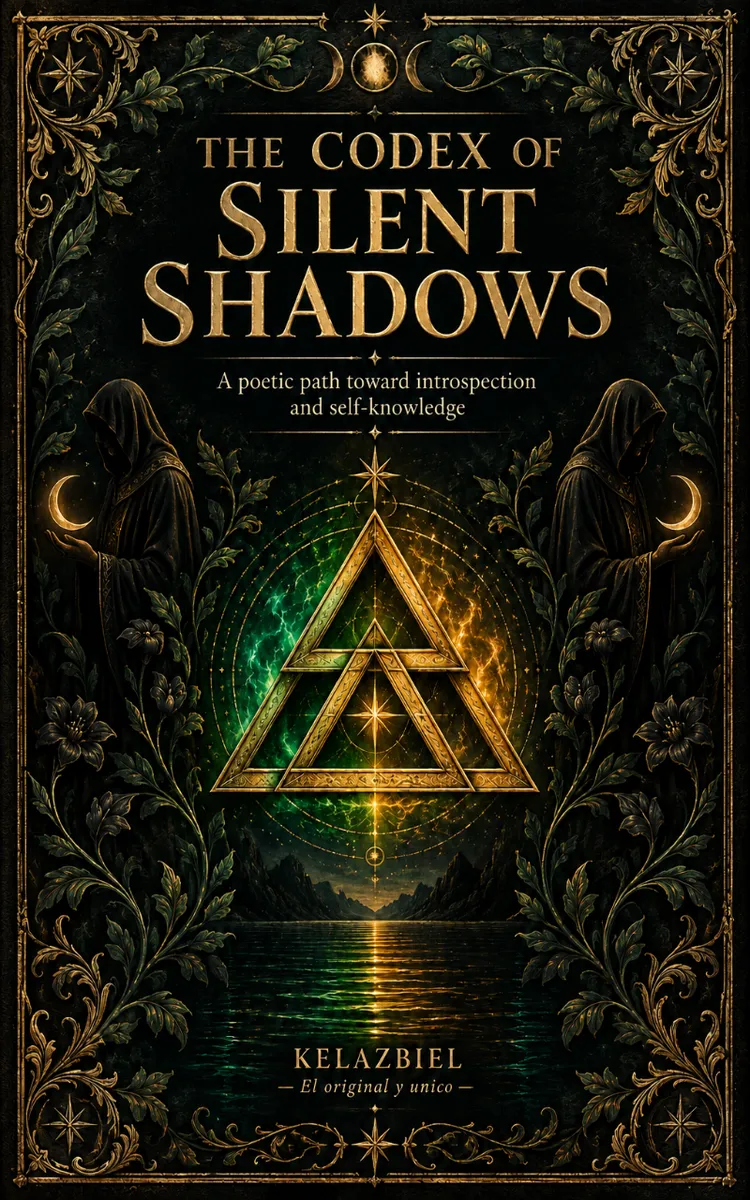
"The Codex of Silent Shadows" is a inspirational book by Kelazbiel El original y unico with 8 chapters and approximately 11,308 words. Introspection and self-knowledge through Gothic symbols, tarot, astrology, and reflective writing.
This book was created using Inkfluence AI, an AI-powered book generation platform that helps authors write, design, and publish complete books. It was made with the AI Inspirational Book Writer.
Frequently Asked Questions
What is "The Codex of Silent Shadows" about?
Introspection and self-knowledge through Gothic symbols, tarot, astrology, and reflective writing
How many chapters are in "The Codex of Silent Shadows"?
The book contains 8 chapters and approximately 11,308 words. Topics covered include Chapter 1: Anatomy of the Shadow, Chapter 2: The Mirror of Saturn, Chapter 3: Specters of the Past, Chapter 4: Purification Rituals, and more.
Who wrote "The Codex of Silent Shadows"?
This book was written by Kelazbiel El original y unico and created using Inkfluence AI, an AI book generation platform that helps authors write, design, and publish books.
How can I create a similar inspirational book?
You can create your own inspirational book using Inkfluence AI. Describe your idea, choose your style, and the AI writes the full book for you. It's free to start.
Write your own inspirational book with AI
Describe your idea and Inkfluence writes the whole thing. Free to start.
Start writingCreated with Inkfluence AI


