

Read the first chapter
The whole of chapter one, free. About 9 min. Turn the pages with the arrows, your keyboard, or a swipe.
Chapter 1
How Muscles Grow Under Load
The First Burden: What Resistance Builds
A mason once noticed that the clay blocks used in a mountain wall became firmer after each careful lift, press, and set. Blocks left untouched stayed soft and cracked easily. The lesson is simple: material changes when it meets a well-managed load. Your muscles respond in a similar way. When you ask them to produce more force than usual, by lifting, pulling, pushing, or controlling resistance, they receive a reason to rebuild.
That rebuilding can increase muscle hypertrophy, the process in which muscle fibers become larger. It can also improve strength, coordination, and the ability to repeat effort without tiring as quickly. These changes are not created by one heroic workout. They come from repeated challenges followed by enough recovery to repair and adapt.
Who this is for: This guidance is for healthy adults who want to begin or improve resistance training, whether they use dumbbells, machines, resistance bands, body weight, or physical work. It is not a substitute for individualized care when pain, injury, or a medical condition affects exercise.
With steady practice, readers can expect practical benefits such as:
• Greater force in everyday movements, including lifting, carrying, and climbing.
• Better control of movement as the nervous system learns to use muscle fibers efficiently.
• Gradual increases in muscle size when training and food support recovery.
• More confidence with resistance because the body learns that manageable load is a signal to adapt.
The key takeaway is worth holding onto: muscles do not grow because effort feels difficult by itself. They grow when a clear, repeatable load gives them a reason to become more capable.
Why Muscles Rebuild Stronger
A muscle is made of many fibers, and each fiber contains smaller structures that slide past one another to create force. During resistance exercise, these structures experience tension. Tension is the main training signal: it tells the body that the current level of muscle capacity may not be enough for the task.
The workout does not instantly make the muscle larger. Instead, it creates a short-term disturbance. Muscle proteins are broken down and rebuilt, and the body increases muscle protein synthesis, meaning the process of making new muscle proteins. When this rebuilding repeatedly exceeds breakdown over time, the fibers can become thicker.
The nervous system matters too. Early strength gains often come partly from improved coordination. Your brain becomes better at turning on the right muscles, in the right order, with less wasted effort. This is why a beginner may add weight to a lift before seeing a noticeable change in muscle size. The body is learning the skill of producing force.
Recovery supplies the conditions for rebuilding. Sleep, adequate food, and rest between hard sessions help the body complete the repair process. Protein provides amino acids, the building blocks used to make muscle proteins. Carbohydrates can help support demanding training by supplying energy. No single meal creates hypertrophy, but consistently under-fueling can make progress harder.
Several factors affect how strongly a muscle responds:
• Training tension: A load must be challenging enough to require meaningful effort. A set that ends with several easy repetitions likely provides less growth stimulus than a set that approaches technical fatigue, meaning you reach the point where another controlled repetition would be difficult without breaking form.
• Training volume: Volume is the total amount of challenging work. More is not automatically better; excessive volume can reduce performance and recovery.
• Proximity to fatigue: The closer a set comes to the point where another controlled repetition is not possible, the more muscle fibers may be called upon. Beginners usually do not need to train to complete failure.
• Recovery capacity: Sleep, nutrition, stress, age, training history, and other demands influence how much work a person can absorb.
• Movement quality: A controlled range of motion helps place the intended muscle under load and makes progress easier to measure.
The Clay Golems of the Kinetic Mountains offer a useful image here. A golem does not harden because it carries the heaviest burden once. It hardens because the burden is challenging, the structure remains intact, and the process is repeated. Muscles follow that same pattern. A load that is too light may not demand adaptation; a load that is too heavy or poorly controlled may exceed current capacity and interrupt training.
Ask yourself after a set: Could I perform another repetition with the same basic technique? If yes, the set may have been appropriately challenging without being reckless. If your form changed sharply, your joints hurt, or you had to force the weight into position, the load was probably beyond what you could control that day.
Muscle growth, then, is not damage to chase. It is a measured response to tension, repeated over time. The practical takeaway is to make resistance demanding enough to matter while keeping the movement controlled enough to repeat.
The Load-to-Legend Ladder
The Load-to-Legend Ladder is a simple way to progress without guessing. You begin with a load you can control, build reliable repetitions, and then increase one part of the challenge. The ladder has four rungs: control, capacity, progression, and consolidation.
Start with control: pick a single, manageable exercise that targets a primary movement pattern, for example a goblet squat for lower body or a push-up, row, or dumbbell press for upper body. Perform two sessions per week, leaving at least one day between them. Begin with one to three sets of roughly eight to twelve repetitions. Use a steady pace: about two seconds to lower the weight, a brief pause if needed, and one to two seconds to lift. Stop with approximately two or three good repetitions still available. This leaves room to learn the movement without turning every set into a test.
For the next two weeks, keep the same exercise and load while practicing consistency. Record the weight, repetitions, and how many controlled repetitions you believe remained. A notebook or phone note is enough. The record is useful because memory often makes yesterday’s effort seem easier or harder than it was.
Move to capacity when you can complete all planned sets at the top of your repetition range with stable technique for two sessions. For example, if your target is three sets of twelve goblet squats and you complete them twice without losing depth or control, the movement has earned a small increase. Add the smallest practical amount - often about 2-5 percent for upper-body exercises and 5-10 percent for lower-body exercises, depending on the equipment and exercise. If your equipment does not allow such small changes, add one repetition per set first, slow the lowering phase slightly, or add one set rather than making a large weight jump.
Progress only one main variable at a time. The useful variables are load, repetitions, sets, range of motion, and exercise difficulty. Changing all of them together makes it difficult to know what your body is responding to. A realistic pattern is to increase a dumbbell press by the smallest available increment after two successful sessions, then spend another one to two weeks making the new load feel controlled.
Consolidation is the often-missed rung. Every four to six weeks, consider holding the load steady for a week while keeping the same number of sets and repetitions. If fatigue has accumulated, reduce the total sets by about one-third for that week. This is not lost progress; it gives performance a chance to catch up with the training signal.
A sample weekly plan might look like this:
Exercise
Starting work
Progression signal
Goblet squat
2-3 sets of 8-12, twice weekly
Add load after two sessions at 12 controlled repetitions
Dumbbell row
2-3 sets of 8-12, twice weekly
Add the smallest weight increase when technique stays steady
Incline push-up
2-3 sets of 6-12, twice weekly
Lower the hand support or add repetitions after two successful sessions
Romanian deadlift
2-3 sets of 8-10, twice weekly
Increase load only when the back and hip movement remain controlled
Keep at least 48 hours between hard sessions for the same muscle groups when you are new to resistance training. On other days, easy walking or normal activity can be appropriate if it does not worsen soreness or pain. Aim for regular meals that include a protein source, and protect a consistent sleep schedule. Exact needs vary, so use appetite, energy, performance, and recovery as practical feedback rather than chasing a single perfect number.
Stop the exercise and seek emergency help immediately if you feel chest pressure, faintness, severe shortness of breath, or sudden weakness. For a sharp pain that does not settle when you stop, or pain that worsens, alters movement, or causes swelling, arrange a prompt professional evaluation. Arrange an evaluation for pain that is worsening, changes your movement, causes swelling, or remains present during ordinary activities for more than several days. A qualified exercise professional or licensed clinician can also help modify training when a known condition, recent injury, or medication affects exercise tolerance.
Progress should feel like a staircase, not a cliff. The practical takeaway is to earn each increase through repeated control, then give the body time to build from it.
Common Errors That Keep the Golem Soft
Adding weight every workout
Why it happens: A heavier dumbbell feels like obvious proof of progress, and beginners may assume that more weight always means more growth. But muscles respond to useful tension, not to numbers alone. A load that forces shortened range of motion or jerky repetitions can shift stress away from the target muscle and make the next session harder to recover from.
What to do instead: Use the Load-to-Legend Ladder. Keep the load until you can complete the planned repetitions for two sessions with controlled technique. Then increase by the smallest practical amount. If performance drops sharply, return to the previous load and rebuild.
Training every set to complete failure
Why it happens: The final difficult repetition feels like the point where the muscle is being challenged most. Some hard sets can be valuable, but taking every set to failure creates extra fatigue and can make technique deteriorate.
What to do instead: Most sets should finish with about two or three controlled repetitions still possible, especially during the first month. Reserve occasional near-failure work for stable exercises, such as a machine press or supported curl, where losing a repetition is easier to manage. Keep demanding free-weight movements more controlled.
Changing exercises before the body can adapt
Why it happens: A new exercise feels fresh, while repeating the same movement can seem boring. Yet changing movements too often removes the consistent signal needed to measure progress. If the squat pattern changes every week, you cannot easily tell whether your legs are becoming stronger.
What to do instead: Keep major exercises for at least four to six weeks unless they cause pain or cannot be performed safely. Record repetitions, load, and technique. Small improvements - one extra repetition, smoother control, or a modest weight increase - are evidence that the muscle is adapting.
Resistance is not a punishment the body must survive. It is information: a clear request to become more capable. Apply that request gradually, recover between challenges, and let each controlled burden harden the structure beneath it. The strongest golems are not built by one impossible climb, but by returning to the mountain with a little more capacity each time.
End of chapter one. 7 more chapters in the full book.
Swipe or use the arrows to turn the page


What's inside: 8 chapters
- 1. How Muscles Grow Under Load
- 2. Building Bone Density Through Impact
- 3. Progressive Overload for Beginners
- 4. Strength Training Technique
- 5. Rest Days and Muscle Recovery
- 6. Protein and Bone-Supporting Nutrition
- 7. Training Safely with Osteoporosis
- 8. Breaking Through Strength Plateaus
About this book
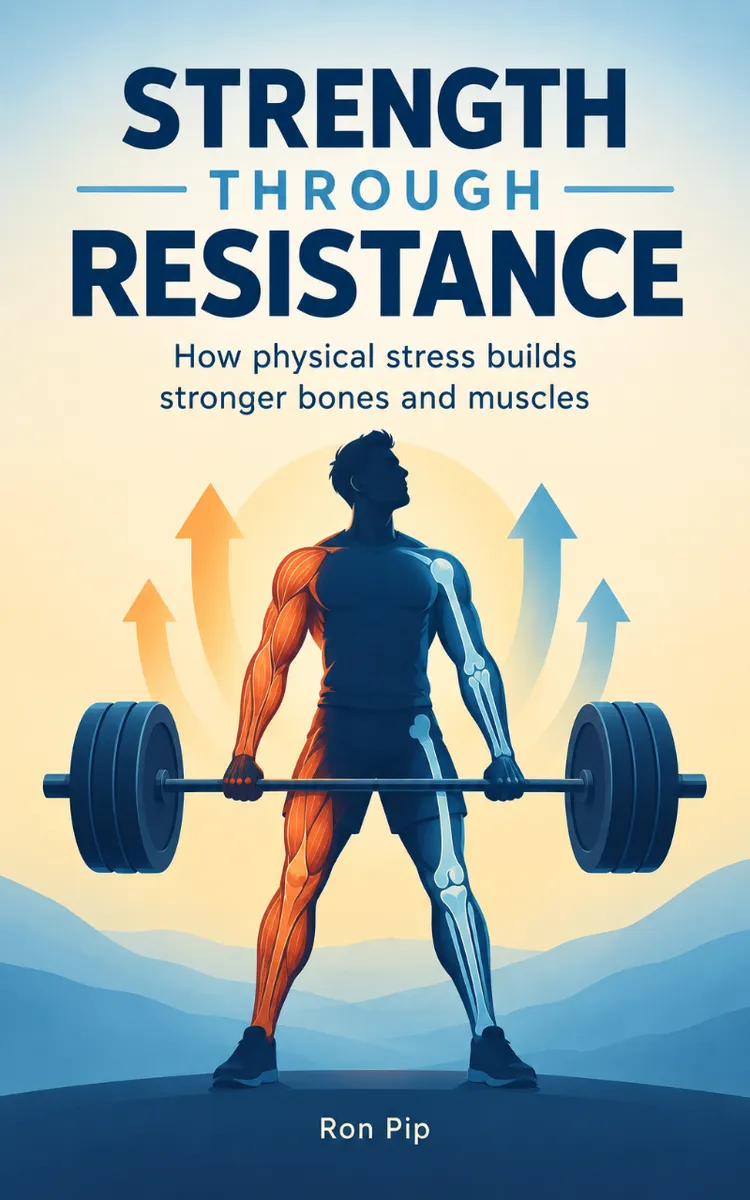
"Strength Through Resistance" is a health & wellness book by Ron Pip with 8 chapters and approximately 13,824 words. Muscle hypertrophy, bone density, and physical adaptation to stress.
This book was created using Inkfluence AI, an AI-powered book generation platform that helps authors write, design, and publish complete books. It was made with the AI Health Book Generator.
Frequently Asked Questions
What is "Strength Through Resistance" about?
Muscle hypertrophy, bone density, and physical adaptation to stress
How many chapters are in "Strength Through Resistance"?
The book contains 8 chapters and approximately 13,824 words. Topics covered include How Muscles Grow Under Load, Building Bone Density Through Impact, Progressive Overload for Beginners, Strength Training Technique, and more.
Who wrote "Strength Through Resistance"?
This book was written by Ron Pip and created using Inkfluence AI, an AI book generation platform that helps authors write, design, and publish books.
How can I create a similar health & wellness book?
You can create your own health & wellness book using Inkfluence AI. Describe your idea, choose your style, and the AI writes the full book for you. It's free to start.
Write your own health & wellness book with AI
Describe your idea and Inkfluence writes the whole thing. Free to start.
Start writingCreated with Inkfluence AI


