
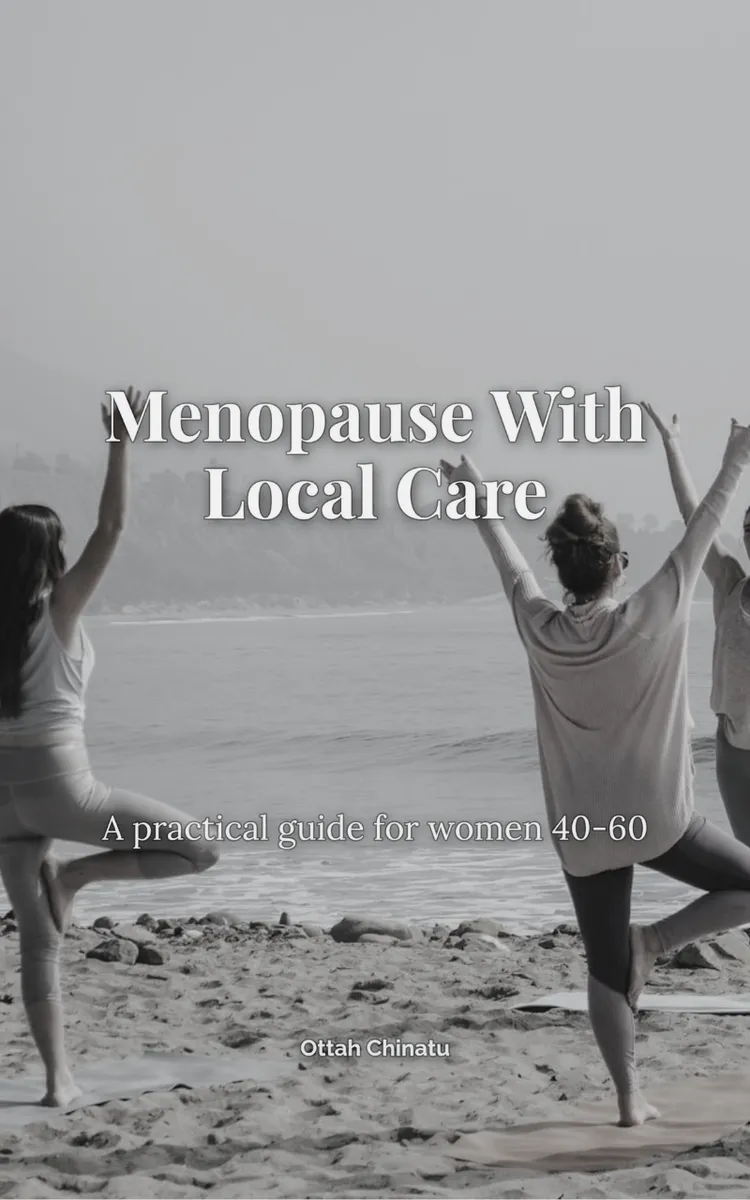
Read the first chapter
The whole of chapter one, free. About 8 min. Turn the pages with the arrows, your keyboard, or a swipe.
Chapter 1
Menopause Timeline and Symptom Map
What Your Changing Pattern May Be Telling You
Have your periods become shorter, longer, heavier, or less predictable - and are you also waking hot at night, feeling unusually tired, or noticing changes in your mood? The pattern matters. Between about 40 and 60, many women move through a gradual reproductive transition rather than one sudden event. Learning the stages can help you describe what is happening and choose sensible next steps.
This guide uses the 5-Stage Symptom Compass to connect common symptoms with likely stages: early change, clearer transition, late transition, menopause, and the years after menopause. It is not a diagnosis. Symptoms can have other causes, so a health professional should assess unusual, severe, or persistent changes.
Who this is for: Women roughly 40-60 who want a simple way to track period changes and symptoms while using familiar foods, daily movement, and timely health care.
You can expect to learn how to:
• recognise the usual pattern of each stage;
• separate common menopause symptoms from warning signs;
• track changes for four weeks before a clinic visit;
• begin safe, gradual habits that support sleep, strength, comfort, and daily energy.
The practical outcome is better information. Instead of saying, “I do not feel like myself,” you can note, “My cycle changed from 28 days to 21 days, I have night sweats three times weekly, and the tiredness began two months ago.” That level of detail helps you and your clinician make better decisions.
Ask yourself: what changed first - your bleeding pattern, your sleep, your temperature comfort, your mood, or your body strength? That first clue can help you find your place on the compass.
Why These Changes Happen
Menopause is the point when a woman has had no menstrual period for 12 continuous months, when there is no other clear cause. The years before it are called perimenopause. During this time, the ovaries gradually release eggs less regularly and produce changing amounts of oestrogen, a hormone involved in periods, body temperature, bones, the vagina, and many other body systems.
The timing is not identical for every woman. Family pattern, smoking, some medical conditions, surgery involving the ovaries, certain medicines, and treatments such as chemotherapy may influence when changes begin. A hysterectomy can also make the timing difficult to recognise if the uterus was removed but the ovaries remain. Local realities matter too: heat, crowded sleeping spaces, long workdays, caregiving, transport difficulties, and limited access to clinics can make hot flashes, poor sleep, and stress feel more intense. These factors may worsen symptoms, but they do not prove that every symptom is caused by menopause.
The 5-Stage Symptom Compass gives you a working map:
• Stage 1 - Early change: Periods may still come regularly, but sleep, mood, breast tenderness, headaches, or occasional heat may begin to change. Some women notice this in their early or mid-40s; others notice it later.
• Stage 2 - Clearer transition: Periods become less predictable. One cycle may be 24 days and the next 35 days. Bleeding may become lighter or heavier, and hot flashes or night sweats may occur more often.
• Stage 3 - Late transition: Periods may be separated by several months, then return. Symptoms may come in waves. Vaginal dryness, reduced sexual comfort, urinary urgency, and sleep disruption can become more noticeable.
• Stage 4 - Menopause: Twelve months have passed without a period. Hot flashes, sleep changes, mood shifts, and vaginal or urinary symptoms may continue for some time.
• Stage 5 - After menopause: The body settles into a new hormone pattern. Some symptoms ease, while bone strength, muscle strength, heart health, and vaginal or urinary comfort deserve ongoing attention.
A hot flash is a sudden feeling of heat, sometimes followed by sweating, a faster heartbeat, or chills. A night sweat is a hot flash that wakes you or leaves clothing or bedding damp. These can occur in several stages, so they cannot identify a stage by themselves.
Other causes can resemble menopause. Heavy bleeding may relate to fibroids, thyroid problems, pregnancy, infection, or changes in the womb. Tiredness can be linked with anaemia, poor sleep, stress, diabetes, or thyroid disease. New anxiety or low mood deserves care rather than dismissal. Seek prompt medical attention for bleeding that soaks a pad every hour for two hours, fainting, severe pelvic pain, chest pain, trouble breathing, one-sided weakness, or bleeding after 12 months without periods. A new breast lump, blood in the urine, or unexplained weight loss also needs professional assessment.
The key point is simple: a likely menopause stage is a useful guide, not a final answer. Your pattern, health history, medicines, and examination all matter.
Using the 5-Stage Symptom Compass in Daily Life
Begin with a four-week record. Each evening, write the date, whether you bled, the number of pads used, sleep quality from 0 to 10, hot flashes, mood, pain, and any urinary or vaginal symptoms. Mark each hot flash with a simple tally. Note possible triggers such as pepper-heavy meals, alcohol, caffeine, a hot room, stress, or exercise. Do not change everything at once; otherwise you will not know what helped.
Next, measure your cycle from the first day of bleeding to the first day of the next period. A phone calendar, notebook, or small wall calendar works. If you have no period for several months and then bleed again, record the date and amount. Bleeding after 12 months without a period should be discussed with a clinician, even if it is only spotting.
Use the compass at the end of each week. If periods are still mostly regular but symptoms are new, you may be seeing early change. If cycle length and bleeding vary clearly, the clearer transition is more likely. If periods are several months apart, late transition may fit. If 12 months have passed without bleeding, record menopause as the milestone - but continue tracking symptoms because they may remain.
Support your body with a gradual routine. Aim for 20-30 minutes of brisk walking, dancing, cycling, or similar movement on at least five days each week. If you are inactive, begin with 10 minutes on three days in the first week, then add five minutes every week until you reach 30 minutes. Add strength work twice weekly: two rounds of 8-12 sit-to-stands, wall push-ups, step-ups, and water-bottle rows. Rest between rounds. Stop for chest pain, severe breathlessness, faintness, or unusual weakness and seek care.
Local meals can support the changes seen across these stages without requiring special products. Include a protein source at two meals daily, such as beans, lentils, eggs, fish, chicken, or yoghurt. Add vegetables such as ugu, spinach, okra, tomatoes, or carrots, and choose fruit when available. For bone support, include calcium-rich foods such as milk, yoghurt, small fish eaten with bones, or calcium-set foods if available. Keep palm oil and other fats moderate rather than removing them completely. Drink water regularly, especially in hot weather, and avoid relying on sweet drinks for energy.
For night sweats, use light clothing, improve airflow where possible, and keep a cloth and water beside the bed. If caffeine, alcohol, or very spicy meals seem to trigger symptoms, reduce one suspected trigger for two weeks and record the result. Do not stop prescribed medicine without speaking with the prescriber.
Arrange a clinic visit if symptoms interfere with work, sleep, sex, exercise, or relationships; if bleeding becomes very heavy or frequent; if tiredness persists despite sleep; or if low mood and anxiety last more than two weeks. Take your four-week record, a list of medicines and supplements, and the date of your last period. Ask about blood pressure, anaemia, thyroid concerns, diabetes risk, and whether another examination is needed.
A useful comparison is:
Pattern
What may be happening
Helpful next action
Regular periods with new sleep or heat changes
Early change may be beginning
Track for four weeks
Unpredictable cycle and stronger symptoms
Clearer transition is possible
Book a routine review if daily life is affected
Periods separated by months
Late transition may be occurring
Record every bleed and discuss unusual bleeding
No period for 12 months
Menopause milestone
Continue symptom and health checks
Bleeding after 12 months without a period
Not assumed to be normal menopause change
Arrange prompt professional assessment
Your practical takeaway is to track first, change one habit at a time, and use the pattern - not one isolated symptom - to guide your next conversation with a health professional.
Common Errors When Reading Your Symptom Map
Mistake: Treating every symptom as menopause
Why it happens: Hot weather, family pressure, poor sleep, anaemia, thyroid problems, infection, and menopause can overlap. It is easy to blame everything on hormones.
What to do instead: Record when the symptom began, how often it occurs, and what affects it. Seek an assessment for severe tiredness, persistent sadness, palpitations, heavy bleeding, pain, or symptoms that do not improve with basic changes.
Mistake: Assuming irregular periods mean pregnancy is impossible
Why it happens: Ovulation can still occur during perimenopause, even when periods are widely spaced.
What to do instead: If pregnancy is possible and a period is late, use an appropriate pregnancy test or speak with a clinician about contraception. Continue contraception until a health professional confirms it is no longer needed, according to your age and menstrual history.
Mistake: Waiting until symptoms are unbearable before asking for help
Why it happens: Many women are told to endure changes quietly, or they may worry that a clinic visit will lead to blame or confusion.
What to do instead: Take your four-week record to a nurse, doctor, or qualified health worker when symptoms begin affecting sleep, work, sex, exercise, or mood. Ask direct questions: “Could this be menopause, or should we check another cause?” and “What warning signs should I watch for?”
Your changing pattern deserves careful attention, not panic and not dismissal. When you learn to read your periods, symptoms, environment, food, and movement together, the years from 40 to 60 become easier to navigate - and your next health decision becomes clearer.
End of chapter one. 4 more chapters in the full book.
Swipe or use the arrows to turn the page
What's inside: 5 chapters
- 1. Menopause Timeline and Symptom Map
- 2. Hot Flashes Cooling Plate Plan
- 3. Bone and Muscle Strength with Local Protein
- 4. Sleep Hygiene for Night Sweats Relief
- 5. Heart Health and Weight Control After 40
About this book
"Menopause With Local Care" is a health & wellness book by Ottah Chinatu with 5 chapters and approximately 8,838 words. Menopause education and self-care using local foods and exercise.
This book was created using Inkfluence AI, an AI-powered book generation platform that helps authors write, design, and publish complete books. It was made with the AI Health Book Generator.
Frequently Asked Questions
What is "Menopause With Local Care" about?
Menopause education and self-care using local foods and exercise
How many chapters are in "Menopause With Local Care"?
The book contains 5 chapters and approximately 8,838 words. Topics covered include Menopause Timeline and Symptom Map, Hot Flashes Cooling Plate Plan, Bone and Muscle Strength with Local Protein, Sleep Hygiene for Night Sweats Relief, and more.
Who wrote "Menopause With Local Care"?
This book was written by Ottah Chinatu and created using Inkfluence AI, an AI book generation platform that helps authors write, design, and publish books.
How can I create a similar health & wellness book?
You can create your own health & wellness book using Inkfluence AI. Describe your idea, choose your style, and the AI writes the full book for you. It's free to start.
Write your own health & wellness book with AI
Describe your idea and Inkfluence writes the whole thing. Free to start.
Start writingCreated with Inkfluence AI


