
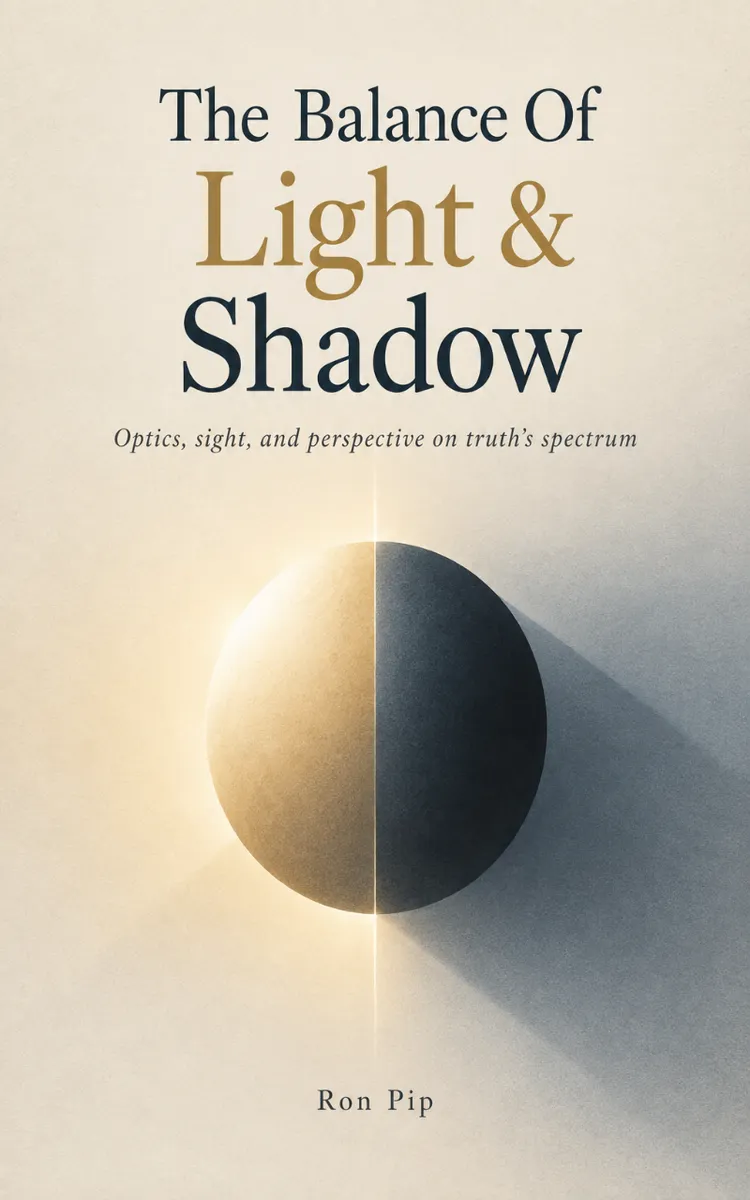
Read the first chapter
The whole of chapter one, free. About 9 min. Turn the pages with the arrows, your keyboard, or a swipe.
Chapter 1
Why Light Bends at Boundaries
The Question at the Edge of Glass
Why does a straight beam of light change direction when it crosses a sheet of glass, even though nothing appears to push it sideways?
The answer begins with a quiet fact: light travels at different effective speeds in different materials, because interactions with the material alter how its waves advance. In empty space it moves at its fastest known speed, but inside water, glass, or crystal, its progress is slowed by interactions with the atoms of that substance. When one part of a wave enters the new material before the rest, the wave turns. The bent path is not a trick of the eye. It is the visible record of a change in speed.
That turning is called refraction, from a Latin word meaning “to break back” or “to bend.” It explains why a straw seems broken in a glass of water, why eyeglasses bring a blurred world into focus, and why a prism can separate white sunlight into a fan of colors. Refraction is not an isolated curiosity found in laboratories. It is one of the quiet rules by which sight becomes possible.
The central idea can be expressed through the Speed-Slip Rule: whenever light crosses a boundary between materials and its speed changes, its direction may change as well. The amount of bending depends on the angle at which the light arrives and on how strongly the new material slows it.
If light changes direction because its speed changes, what else in the visible world is a record of speed rather than shape?
The Wave That Turns
Before refraction could be measured, it had to be noticed. Ancient observers saw that objects under water seemed displaced and that the bottom of a pool appeared closer than it really was. The Roman writer Seneca described the way a stick placed in water could look bent. For centuries, such effects were treated as optical puzzles - interesting failures of appearance rather than clues to a physical law.
The Dutch mathematician Willebrord Snellius, known in English as Willebrord Snell, identified the relationship between the incoming and bent rays in 1621. His work was later published by René Descartes, and the result became known as Snell’s law. It states that the ratio between the sines of the two angles is connected to the optical properties of the materials. The equation is precise, but the underlying event is easier to picture than the notation suggests.
Think of a row of people walking diagonally from a firm pavement onto thick sand. The person who reaches the sand first slows down while the others continue moving quickly on the pavement. The row pivots toward the slower surface. Light behaves in a related way - not because it is a line of tiny walkers, but because a wave’s advancing front changes speed unevenly across the boundary.
A wavefront is an imagined line joining points that are in the same phase of motion. When it meets a new material at an angle, the portion that enters first is slowed first. The rest of the wave continues briefly at its original speed. That difference swivels the front, and the direction of travel changes with it.
The boundary itself may be perfectly smooth: air against water, air against glass, or glass against air. No visible force reaches out to bend the ray. The change emerges from timing. One part of the wave arrives early, another arrives later, and the altered rhythm becomes a new direction.
At a perpendicular, or straight-on, entry, the wave slows without turning. The speed-slip still occurs, but both sides of the wave cross the boundary together. Refraction becomes visible when the beam arrives at an angle.
Glass, Water, and the Speed-Slip Rule
In empty space, light travels at about 299,792 kilometers per second. In air, its speed is only slightly lower. In water, it is roughly three-quarters of that value; in ordinary glass, it is often around two-thirds. These are not different kinds of light. They are different rates of travel produced by different materials.
The measure used to describe this slowing is the refractive index. Vacuum has an index of 1. Water has an index close to 1.33, while common glass is often near 1.5, though the exact value depends on its composition and on the color of the light. A higher refractive index means that light travels more slowly through the material.
The Speed-Slip Rule has a simple consequence. Moving from air into water or glass, light generally bends toward the normal - the imaginary line drawn perpendicular to the surface. Moving from glass or water into air, it bends away from that line. The normal is not a physical mark on the surface; it is a reference used to describe the geometry of the turn.
A coin at the bottom of a bowl demonstrates the effect with domestic simplicity. When the bowl is empty, the coin may be hidden by the rim. Add water, and rays from the coin bend as they leave the water and enter the air. Some of those rays now reach the observer’s eyes, creating the impression that the coin has risen. The coin has not moved. The routes by which its light reaches the eye have changed.
The same principle gives a swimming pool its deceptive shallowness. Light from the floor bends away from the normal as it leaves the water. The eye assumes that light has traveled in a straight line all the way back to its apparent source, so the floor seems higher than it is. A lifeguard, a fish, and a person standing beside the pool do not share the same visual geometry.
There is a second detail that makes refraction richer: materials do not slow every wavelength by exactly the same amount. Blue light and red light travel at slightly different speeds through glass. That difference is called dispersion, and it allows a prism to spread white light into colors. The prism is not adding color to the beam. It is separating wavelengths that were already present.
Why Lenses Make Sight Possible
A flat pane of glass bends a ray when it enters and bends it again when it leaves. If the two faces are parallel, the outgoing ray usually travels in the same overall direction as the incoming one, although it has been shifted sideways. A lens uses curved surfaces to make those small changes accumulate.
In a convex lens, thicker at the center, rays approaching parallel to the main axis are bent toward one another. They meet near a point called the focus. A concave lens, thinner at the center, bends parallel rays outward. The difference is not a matter of glass “pulling” light inward or pushing it outward. It is the result of each part of the curved surface presenting a different angle to the incoming wave.
The human eye contains a natural lens, but most of its focusing power comes from the cornea, the transparent outer surface. Light passes from air into the cornea, then through the aqueous fluid, the lens, and the vitreous humor before reaching the retina. Each boundary changes the ray’s path. The eye is therefore not a camera with one glass element placed in front of a sensor; it is a layered optical system in which several transitions work together.
The lens inside the eye can alter its shape. For distant objects it becomes flatter; for near objects it becomes rounder, increasing its focusing power. With age, the lens often becomes less flexible, making close focusing more difficult. Reading glasses compensate by adding a carefully chosen refracting surface.
Eyeglasses correct other errors by changing the paths of incoming rays before they reach the eye. In nearsightedness, the eye focuses light in front of the retina; a concave lens spreads the rays slightly so the eye can bring them to focus farther back. In farsightedness, a convex lens begins converging the rays before they enter the eye.
A lens does not create a sharp image by making light travel in a straight line. It creates one by arranging many bent paths so that they meet in the right place.
The Prism and the Hidden Colors
The familiar triangular prism became a decisive instrument in the seventeenth century. In 1666, Isaac Newton used prisms to investigate sunlight and showed that white light could be separated into a spectrum of colors. A second prism could recombine those colors into white light again. The result challenged the old notion that prisms stained or manufactured color.
Newton’s experiment mattered because it shifted attention from the object producing color to the light itself. Red, orange, yellow, green, blue, indigo, and violet are not separate ingredients added by glass. They are portions of a continuous range of wavelengths, distinguished by how light interacts with matter and by how the human visual system responds.
The red end of the visible spectrum has longer wavelengths; violet has shorter ones. In glass, violet is slowed slightly more than red, so violet bends more strongly. The difference is small, but a prism gives it room to grow. One refraction at the first surface and another at the second spread the colors into an arc that the eye can separate.
A rainbow uses the same physics inside a raindrop. Sunlight enters the drop, refracts, reflects from the back surface, and refracts again as it exits. Different wavelengths leave at slightly different angles. Millions of drops perform this work at once, though each observer sees a rainbow formed by a particular set of drops positioned relative to the Sun and the observer.
The surprise is that refraction can separate colors without any color being physically peeled away from the beam. Nothing inside the prism sorts light into little colored threads. The wavelengths simply take different routes because the material gives them slightly different speeds.
That reframes a rainbow. It is not an object hanging in the sky, but a viewing geometry produced by light, water, and an observer in the right place. Its apparent location changes as the observer moves because the relevant angles change. The rainbow is stable in its rule and unstable in its position.
Newton’s Dark Room and the Geometry of Seeing
Newton’s prism experiments took place in a darkened room at Woolsthorpe Manor, where a narrow beam of sunlight entered through a hole in a shutter. The beam crossed the room and struck a prism, producing an elongated spectrum on the opposite wall. The arrangement was simple: sunlight, an opening, glass, and a surface on which the separated colors could appear.
The details matter. A broad beam would have produced overlapping colors and a less distinct result. The narrow opening gave the light a controlled direction, while the distance allowed the small differences in bending to become visible. The experiment turned an everyday object into a device for revealing the hidden structure of sunlight.
Newton’s observation also exposed a limitation in ordinary vision. The wall showed the result of many wavelengths arriving at different positions, but the eye did not see wavelengths directly. It detected light through photoreceptor cells in the retina, whose responses overlap across the visible range. The brain interprets those patterns as color.
Refraction therefore sits between the physical world and perception. The glass changes the paths of waves; the retina records the arriving light; the brain organizes those signals into an experience of red, blue, brightness, and distance. A bent ray is not yet a visual scene. It becomes part of sight only after several layers of material and biological interpretation.
The boundary between air and glass is thus also a boundary between what light is doing and what an observer believes is there. The apparent bend of a straw, the raised floor of a pool, and the focused image on the retina all arise from the same underlying fact: a change in speed alters the route by which information travels.
Light does not reveal the world by following one unchanging path. It crosses boundaries, slips in speed, divides by wavelength, and arrives as evidence. What we call seeing is partly the art of interpreting those altered paths - and the next boundary may reveal another color the eye has not yet learned to name.
End of chapter one. 14 more chapters in the full book.
Swipe or use the arrows to turn the page


What's inside: 15 chapters
- 1. Why Light Bends at Boundaries
- 2. Wavelengths: The Hidden Color Code
- 3. Snell’s Law Without the Fear
- 4. Dispersion: Why Prisms Split Joy
- 5. Total Internal Reflection’s Cruel Gift
- 6. Why Shadows Remember Everything
- 7. Your Eye Doesn’t See Light
- 8. The Color That Isn’t There
- 9. Polarization: Light’s Directional Secret
- 10. Interference: When Shadows Cancel
- 11. Coherence: The Difference Between Noise
- 12. How Lenses Turn Light Into Meaning
- 13. The Camera Obscura Truth Test
- 14. Joy and Grief Need Their Contrast
- 15. Reweaving the Great Spectrum
About this book
"The Balance Of Light & Shadow" is a curiosity book by Ron Pip with 15 chapters and approximately 26,421 words. Light refraction, wavelengths, optics, and how sight works.
This book was created using Inkfluence AI, an AI-powered book generation platform that helps authors write, design, and publish complete books.
Frequently Asked Questions
What is "The Balance Of Light & Shadow" about?
Light refraction, wavelengths, optics, and how sight works
How many chapters are in "The Balance Of Light & Shadow"?
The book contains 15 chapters and approximately 26,421 words. Topics covered include Why Light Bends at Boundaries, Wavelengths: The Hidden Color Code, Snell’s Law Without the Fear, Dispersion: Why Prisms Split Joy, and more.
Who wrote "The Balance Of Light & Shadow"?
This book was written by Ron Pip and created using Inkfluence AI, an AI book generation platform that helps authors write, design, and publish books.
Write your own curiosity book with AI
Describe your idea and Inkfluence writes the whole thing. Free to start.
Start writingCreated with Inkfluence AI


