
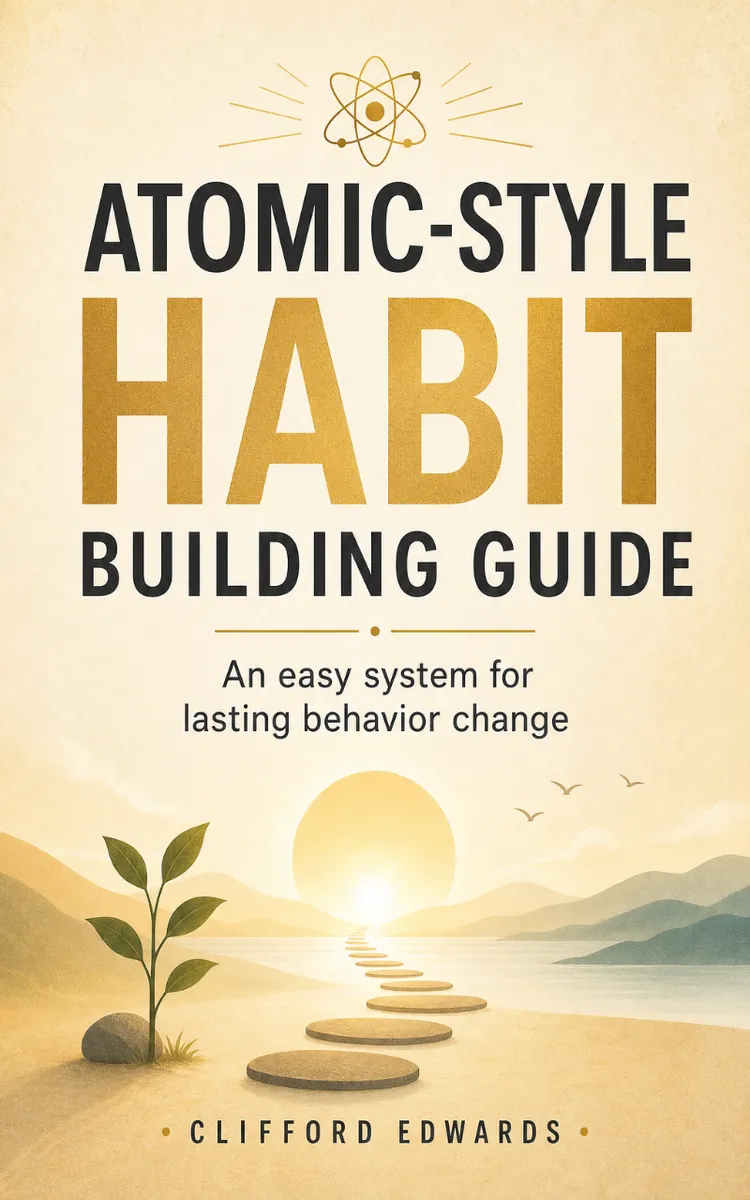
Atomic-Style Habit Building
Created with Inkfluence AI
Habit building using small changes and behavior systems
Table of Contents
- 1. Choose Your Atomic Identity
- 2. Replace Goals With Systems
- 3. Design Habits That Fit Your Life
- 4. Build Consistency With Tiny Wins
- 5. Make Habits So Small They Stick
- 6. Use Cue Engineering for Automaticity
- 7. Create Friction for Bad Habits
- 8. Reward Yourself to Reinforce Behavior
- 9. Stack Habits With the Next-Step Chain
- 10. Prevent Misses With Implementation Intents
- 11. Track Only What Moves the Needle
- 12. Build Confidence Through Evidence Logs
- 13. Break the Perfectionism Trap
- 14. Overcome All-or-Nothing Thinking
- 15. Handle Low Motivation With the 2-Minute Door
- 16. Communicate Boundaries Without Guilt
- 17. Build a Support System That Keeps You
- 18. Master Stress With the Reset Ritual
- 19. Turn Setbacks Into Habit Data
- 20. Align Habits With Purposeful Identity
Preview: Choose Your Atomic Identity
A short excerpt from “Choose Your Atomic Identity”. The full book contains 20 chapters and 29,006 words.
The Question Behind Every Tiny Habit
What are you asking a tiny habit to prove about you?
You set your shoes by the door, plan a ten-minute workout, or open your notebook before breakfast. The action is small. Almost laughably small. Yet by Tuesday, the shoes are still there, the workout is postponed, and the notebook is buried under yesterday’s receipts. Then the familiar thought arrives: “I guess I’m just not disciplined.”
But the real struggle may not be discipline. It may be identity. If a habit feels like something you’re forcing yourself to do, your brain treats it as a temporary task. If it feels like evidence of the person you’re becoming, the same action carries a different weight. You don’t have to negotiate with it quite so much.
Are your tiny habits proving the identity you want - or arguing against it?
From Performing a Habit to Becoming the Person
Old Belief: I need to achieve a result before I can see myself as that kind of person.
New Reality: Each small action is a vote for the identity I’m building, long before the result is visible.
This shift matters because results usually arrive late. You may want to become fit, but your first few walks won’t change your body in a noticeable way. You may want to become a reliable business owner, but answering one customer message promptly won’t transform your reputation overnight. If results are your only proof, early effort feels pointless.
Identity gives those early actions meaning. A ten-minute walk isn’t merely “not enough exercise.” It’s a vote for being someone who keeps promises to their body. Putting five dollars into a separate savings account isn’t “not enough money.” It’s evidence that you’re becoming someone who handles money on purpose.
That doesn’t mean pretending you’ve already mastered something. It means choosing the direction of your self-image. A person who wants to become a writer might begin by writing one paragraph each morning. The paragraph may be rough. It may never be published. Still, the action answers a useful question: “What would a writer do today?” The answer is no longer mysterious.
The Identity-First Loop makes this practical:
1. Choose the identity. Decide who you’re practicing becoming.
2. Name the proof. Pick one tiny action that person would naturally take.
3. Notice the evidence. Record that you followed through.
4. Repeat the vote. Let consistency make the identity feel familiar.
The loop works because your self-image is shaped by repeated evidence. You don’t need to make a dramatic announcement or reinvent your whole life on Monday morning. You need a small action that makes the new identity believable.
When Your Old Identity Is Still Calling the Shots
Your habits often reveal an identity you never consciously chose. “I’m always late.” “I’m terrible with money.” “I never finish anything.” These sentences sound like descriptions, but they can become instructions. Once you repeat them often enough, your brain looks for behavior that keeps the story intact.
The problem isn’t that you’re secretly lazy or broken. The old identity may simply be familiar. Familiar feels safe, even when it frustrates you. If you’ve spent years seeing yourself as someone who avoids difficult conversations, sending one honest message can feel strangely threatening. The message isn’t just a message. It challenges the role you’ve been playing.
Signs this pattern is running your life:
1. You wait to feel like the person before taking the action. You tell yourself you’ll start when you feel confident, organized, or motivated.
2. You dismiss small wins. You complete the habit but immediately say, “That barely counts.”
3. You protect the old label. One missed workout becomes proof that you’re “not a fitness person.”
4. You choose habits that impress others instead of habits that build you. You attempt an extreme routine because it looks serious, then abandon it when life gets busy.
A useful identity makes the next tiny action feel like a natural vote, not a daily courtroom trial.
Suppose you want to become a dependable team leader at your shop. You don’t need to start with a grand speech or a perfect management system. You might begin by checking tomorrow’s schedule before leaving work and sending one clear update to your team. That action is small, but it matches the identity: dependable people prepare and communicate. Repeat it for a week, and the role starts feeling less like an act.
Questions That Make the Identity Specific
1. When people trust me, what do they trust me to do?
Look for behavior, not adjectives. “They trust me to call back when I say I will” gives you a clearer identity than “I want to be dependable.”
2. What would this version of me do for two minutes today?
Keep the answer almost too easy. A future reader might read one page; a future runner might put on running shoes and walk to the end of the street.
3....
About this book
"Atomic-Style Habit Building" is a self-help book by Clifford Edwards with 20 chapters and approximately 29,006 words. Habit building using small changes and behavior systems.
This book was created using Inkfluence AI, an AI-powered book generation platform that helps authors write, design, and publish complete books. It was made with the AI Self-Help Book Writer.
Frequently Asked Questions
What is "Atomic-Style Habit Building" about?
Habit building using small changes and behavior systems
How many chapters are in "Atomic-Style Habit Building"?
The book contains 20 chapters and approximately 29,006 words. Topics covered include Choose Your Atomic Identity, Replace Goals With Systems, Design Habits That Fit Your Life, Build Consistency With Tiny Wins, and more.
Who wrote "Atomic-Style Habit Building"?
This book was written by Clifford Edwards and created using Inkfluence AI, an AI book generation platform that helps authors write, design, and publish books.
How can I create a similar self-help book?
You can create your own self-help book using Inkfluence AI. Describe your idea, choose your style, and the AI writes the full book for you. It's free to start.
Write your own self-help book with AI
Describe your idea and Inkfluence writes the whole thing. Free to start.
Start writingCreated with Inkfluence AI


