

Read the first chapter
The whole of chapter one, free. About 12 min. Turn the pages with the arrows, your keyboard, or a swipe.
Chapter 1
Biblical Foundations of Christian Teaching
Seeing the Learner as God’s Image-Bearer
A classroom becomes Christian before a Bible verse is posted on the wall. It becomes Christian when the teacher understands each learner as a person created by God, accountable to God, and invited to know and love God. That conviction shapes how a teacher corrects disruption, chooses a text, explains a scientific claim, and plans opportunities for service.
Christian education is therefore more than adding religious content to ordinary schooling. It is the intentional formation of learners under the authority of God’s Word, so that they grow in wisdom, character, skill, worship, and faithful service. Earlier attention to the teacher’s calling and classroom leadership now needs a biblical foundation: before deciding what students should do, we must ask what human beings are and what God intends education to accomplish.
This foundation matters because classroom management and curriculum planning always express beliefs about people. If students are viewed mainly as problems to control, instruction will emphasize compliance. If they are viewed as image-bearers and sinners in need of grace, the teacher will pursue both order and restoration.
Learning Objectives
• Define Christian education through creation, Scripture, discipleship, vocation, and the image of God. - Distinguish the biblical purposes of home, church, and school. - Apply these truths to a specific K - 12 classroom decision.
Christian education begins with creation. Creation - God’s purposeful act of bringing all things into being and sustaining them. Genesis 1:1 declares, “In the beginning, God created the heavens and the earth.” Because God made the world, no subject is spiritually neutral. Mathematics reveals order; language makes communication possible; history displays human sin and courage; biology invites careful study of living systems. The teacher need not force a Bible verse into every lesson, but should teach every subject within the truth that “the earth is the Lord’s, and the fullness thereof” (Psalm 24:1).
Image of God - the unique dignity and calling God gives human beings as his representatives. Genesis 1:26-28 teaches that men and women are made in God’s image and are given responsibility to rule and cultivate creation. This does not mean that humans are divine. It means that every student has worth, moral responsibility, relational capacity, and a calling to exercise wise stewardship.
That truth changes classroom practice. A struggling reader is not a defective project; a gifted mathematician is not merely a high score; a student who causes repeated disruption is not disposable. Sin has damaged every person, as Romans 3:23 teaches, but sin has not erased human dignity. Correction must therefore be firm without contempt. James 3:9 warns against praising God while cursing people made in his likeness. A teacher who humiliates a child may gain silence while violating the very doctrine being taught.
Scripture - God’s written Word, which reveals who God is, what he has done, what he commands, and how people should live. Second Timothy 3:16-17 teaches that Scripture is “profitable for teaching, for reproof, for correction, and for training in righteousness.” Scripture is not merely one resource among many. It is the final authority for Christian belief and conduct. It does not provide a separate textbook for every algebra problem or laboratory procedure, but it gives the framework in which every discipline is understood.
Discipleship - the lifelong process of following Jesus, learning his teaching, becoming like him, and helping others follow him. Jesus commanded his disciples to “make disciples of all nations,” teaching them to observe everything he commanded (Matthew 28:19-20). In a school, discipleship is not manipulation or pressure to produce outward religious behavior. It is truthful instruction, faithful modeling, wise correction, and opportunities to practice love of God and neighbor. Jesus grew in wisdom, stature, and favor with God and people (Luke 2:52), showing that growth includes intellectual, physical, spiritual, and social dimensions.
Vocation - a God-given calling to glorify him through particular responsibilities, work, relationships, and service. Ephesians 2:10 says believers are created in Christ Jesus for good works, and Colossians 3:17 directs believers to do everything in the name of the Lord Jesus. Christian education should help students recognize that learning is preparation for faithful living, not merely preparation for employment. A lesson on persuasive writing can train students to speak truthfully. A gardening project can teach stewardship. Group work can expose selfishness and cultivate patience, honesty, and service.
The purposes of home, church, and school overlap, but they are not identical. Home is the ordinary center of daily nurture and covenant responsibility. Deuteronomy 6:6-7 commands parents to teach God’s words diligently to their children throughout ordinary routines. Parents model worship, work, repentance, hospitality, and love. A school cannot transfer this responsibility to itself.
Church is the gathered body of Christ, responsible for worship, preaching, baptism, the Lord’s Supper, fellowship, discipline, and equipping believers for ministry. Ephesians 4:11-13 describes the church’s work of equipping the saints for service and maturity. A Christian school may support biblical formation, but it is not the church and must not pretend that classroom instruction replaces congregational life.
School is a structured community for teaching and learning. Its proper work includes developing knowledge, habits, skills, judgment, and stewardship. A Christian school carries out this work under biblical authority, helping students see the coherence of truth. Public, private, and home educators may differ in setting, but Christian teachers must resist confusing institutional roles. The school partners with parents and serves the church’s wider mission without claiming the church’s authority.
Ask yourself: when a student enters your room, do you see a test score, a behavior problem, or a neighbor who bears God’s image? The answer will shape every later decision.
From Biblical Truth to Classroom Practice
A teacher can move from doctrine to practice through a clear chain of reasoning. Begin with Scripture, identify the truth about the learner, determine the responsibility that follows, and then choose a practice that expresses that responsibility.
For example, Scripture teaches that God is a God of order and peace (1 Corinthians 14:33, 40). The learner is therefore not served by chaotic routines. The teacher’s responsibility is to establish predictable structures. The classroom practice may be a posted three-step arrival routine: enter quietly, place materials in the assigned location, and begin the opening task within three minutes. The routine is not Christian merely because it is efficient. It is Christian when it serves truthful learning, neighbor-love, and responsible stewardship.
A second example concerns correction. Proverbs 15:1 teaches that “a soft answer turns away wrath,” while Hebrews 12:11 acknowledges that discipline is painful but can produce righteousness. These texts together prevent two errors: harshness without love and permissiveness without formation. A teacher should name the behavior, explain its effect, require repair where possible, and restore the student to participation. The goal is not embarrassment; it is growth.
Curriculum decisions also require biblical reasoning. Ask four questions:
1. What does this subject reveal about God’s world? 2. What human abilities and responsibilities does it develop? 3. Where do sin, brokenness, injustice, or false worship distort this area? 4. How can students respond with wisdom, gratitude, repentance, or service?
Consider a seventh-grade unit on water systems. Creation directs students to study the world carefully. The image of God gives them responsibility to steward resources. Scripture exposes greed and injustice in passages such as Amos 5:24. Discipleship calls students to truthful investigation and neighbor-love. Vocation helps them see possible service in engineering, public health, farming, or policy. The unit may include measuring household water use, analyzing local data, reading a biblical passage on justice, and designing a conservation proposal. The lesson remains scientifically sound while also teaching that knowledge carries moral responsibility.
Teachers should also distinguish formation from indoctrination. Christian education clearly teaches Christian truth, but it must not reward students merely for repeating approved phrases. Students should learn to ask honest questions, examine evidence, interpret Scripture carefully, and give reasons for their conclusions. First Peter 3:15 calls believers to give a reason for their hope “with gentleness and respect.” A classroom that cannot receive sincere questions may produce silence rather than mature faith.
A useful planning tool is a four-column alignment check:
| Biblical foundation | Learner formation | Teacher action | Evidence of growth | |---|---|---|---| | Image of God | Dignity and responsibility | Correct privately and require repair | Student names harm and restores trust | | Creation | Wonder and careful study | Connect content to God’s ordered world | Student explains patterns accurately | | Discipleship | Growing obedience and wisdom | Model, practice, and reflect | Student applies truth beyond the lesson | | Vocation | Faithful service | Connect skills to real responsibilities | Student identifies a useful contribution |
The table is not a substitute for prayer, wisdom, or knowledge of students. It is a guardrail against vague Christian language. A teacher should be able to explain not only that a lesson is “biblical,” but also which biblical truth shapes it and what changed behavior or understanding should result.
A final distinction is essential: the gospel is not a classroom behavior system. Students do not earn God’s acceptance by obeying classroom rules. Salvation is by grace through faith, not by academic success or moral performance (Ephesians 2:8-9). Yet grace does not make obedience unnecessary. Titus 2:11-12 teaches that grace trains believers to live self-controlled, upright, and godly lives. Christian teachers therefore maintain standards while offering forgiveness, patient instruction, and genuine restoration.
The practical takeaway is simple: trace every major classroom decision back to a biblical truth about God, people, learning, or calling.
A Worked Example: Planning a Christian History Unit
A Christian teacher is preparing a three-week, fifteen-lesson unit for eighth-grade students on a local civil rights movement. The teacher wants the unit to be historically accurate, biblically grounded, and connected to students’ responsibilities as neighbors.
1. The teacher identifies the learning scope. Fifteen lessons are available, with forty-five minutes per lesson. Ten lessons will provide historical instruction, three will support research, and two will be used for presentations and reflection. This prevents the biblical connection from becoming an extra activity added at the end.
2. The teacher begins with creation and the image of God. Genesis 1:27 establishes equal human dignity. The teacher decides that students must examine both the movement’s public events and the personal experiences of those affected. The outcome is specific: each student will explain two ways unjust treatment denied human dignity.
3. The teacher addresses the fall. Sin distorts institutions, relationships, and judgment. Students will study primary sources showing prejudice, fear, courage, and self-interest. The teacher will not describe injustice as an abstract mistake. Students will identify choices and systems that harmed real neighbors.
4. The teacher connects the unit to discipleship. Micah 6:8 calls God’s people to do justice, love kindness, and walk humbly with God. Matthew 22:39 commands love of neighbor. Students will evaluate responses to injustice, but they will also examine their own habits of listening, speaking, and serving. The teacher sets a discussion rule: critique ideas and actions with evidence; do not mock people or assign motives without proof.
5. The teacher connects the unit to vocation. Students will consider how journalists, teachers, lawyers, pastors, parents, students, and public officials contributed to change. Each student will write a one-page “faithful responsibility statement” naming one way a person in a chosen vocation can protect human dignity.
6. The teacher clarifies the roles of home, church, and school. The school will teach historical evidence and guide discussion. Families will receive a source list and three conversation questions. The church may provide a setting for an optional service reflection, but the teacher will not require church membership or treat the classroom as a worship service.
7. The teacher designs assessment. Students will complete a source analysis worth 30 percent, a group presentation worth 30 percent, a historical essay worth 30 percent, and a reflection worth 10 percent. The essay must include three primary sources, one biblical principle, and a conclusion explaining a present responsibility. These numbers make the intended balance visible: evidence remains central, while biblical application is meaningful rather than decorative.
8. The teacher plans correction and care. Because the topic may expose family pain or provoke anger, students may request a brief private conversation. If a student makes a demeaning comment, the teacher will stop the discussion, name the violation of neighbor-love, require a revised statement supported by evidence, and restore the student to the group when ready.
9. The teacher checks the final unit against the four foundations. Creation appears in the study of the real world; the image of God governs dignity; discipleship shapes discussion and response; vocation directs application. The final result is a unit that teaches history faithfully while forming students for responsible Christian action.
Final result: the unit’s purpose is to develop historically literate students who recognize every person’s God-given dignity, identify the effects of sin, evaluate responses with biblical wisdom, and prepare to serve their neighbors faithfully.
Notice what the teacher did not do. The teacher did not attach a verse to the first lesson and call the work integrated. Biblical foundations shaped the goals, sources, discussion norms, assessment, family communication, and response to conflict. That is the difference between Christian decoration and Christian education.
Guided Practice and Answer Key
1. A fourth-grade student repeatedly interrupts a class discussion. Which biblical truths should guide the teacher’s response, and what should the teacher do first? Hint: Hold together the image of God, the call to order, and restorative correction. Begin by naming the behavior privately and asking what responsibility the student was given.
2. A science teacher wants to connect a unit on ecosystems to Christian education. What four questions should guide planning? Hint: Consider God’s world, human responsibility, the effects of sin, and faithful service.
3. A parent asks why the school is teaching a Bible-based view of vocation rather than only career skills. How should the teacher answer? Hint: Explain vocation as service through all legitimate responsibilities, not merely paid employment.
4. A church leader asks the school to replace weekly classroom instruction with a worship service. How should the teacher distinguish the roles of church and school? Hint: Affirm the church’s authority in worship and discipleship while explaining the school’s responsibility for organized teaching and learning.
5. Review one lesson you currently teach. Identify one goal related to the image of God, one skill related to vocation, and one practice that supports discipleship. Hint: Use observable actions, such as listening respectfully, analyzing evidence, serving a group, or repairing harm.
Answer Key: Question 1 requires firm, respectful correction followed by restoration. Question 2 uses the four planning questions: creation, responsibility, brokenness, and response. Question 3 explains that vocation includes faithful work, relationships, citizenship, and service. Question 4 distinguishes the school’s teaching role from the church’s worship and shepherding role. Question 5 has varied answers, but each should name a concrete student action rather than a vague religious intention.
Christian education begins when the teacher sees the whole task - content, conduct, relationships, and calling - under God’s authority. The classroom then becomes a place where students learn not only about the world, but how to live faithfully within it.
End of chapter one. 7 more chapters and about 16,226 words in the full book.
Swipe or use the arrows to turn the page


What's inside: 8 chapters
- 1. Biblical Foundations of Christian Teaching
- 2. Scripture, Interpretation, and Educational Purpose
- 3. Child Development and Christian Psychology
- 4. Christian Schooling and Educational Rights
- 5. K-12 Curriculum Design and Alignment
- 6. Lesson Planning and Assessment
- 7. Classroom Routines and Behavior Guidance
- 8. Inclusive Practice and Teacher Growth
About this book
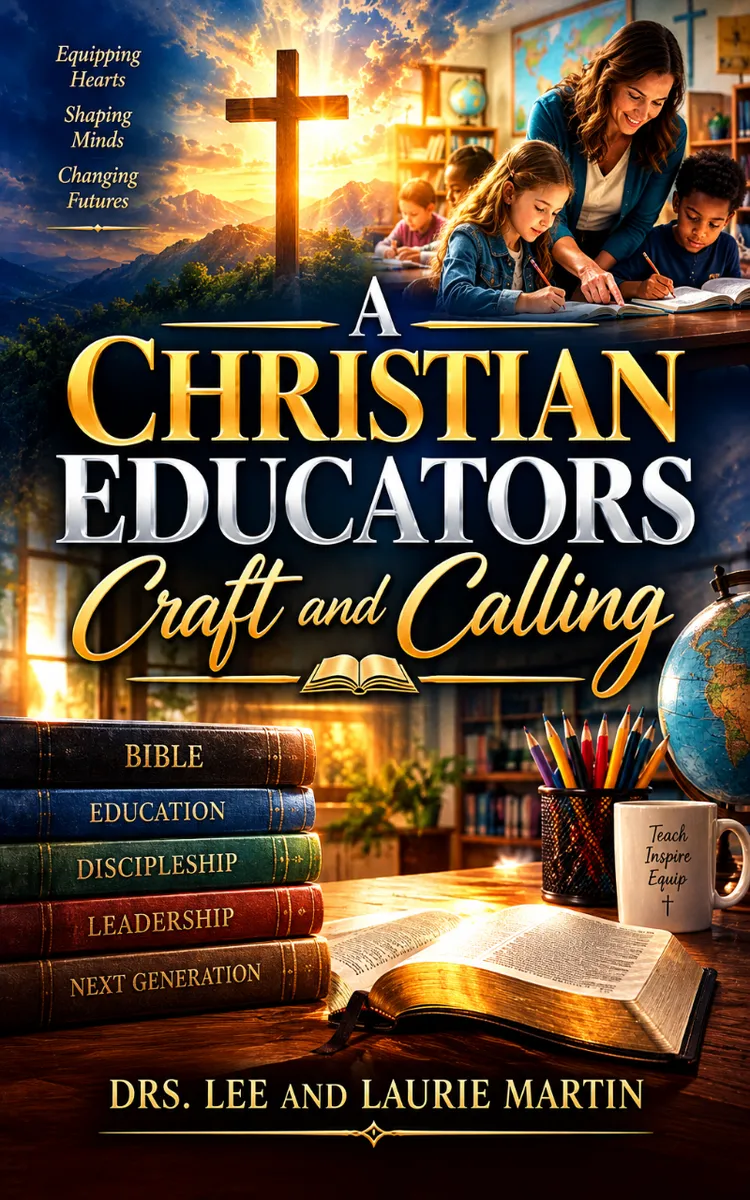
"The Christian Educator’s Craft" is a education book by Drs. Lee & Laurie Martin with 8 chapters and approximately 16,226 words. Biblical K–12 classroom management and curriculum planning for Christian educators.
This book was created using Inkfluence AI, an AI-powered book generation platform that helps authors write, design, and publish complete books. It was made with the AI Lesson Plan Generator.
Frequently Asked Questions
What is "The Christian Educator’s Craft" about?
Biblical K–12 classroom management and curriculum planning for Christian educators
How many chapters are in "The Christian Educator’s Craft"?
The book contains 8 chapters and approximately 16,226 words. Topics covered include Biblical Foundations of Christian Teaching, Scripture, Interpretation, and Educational Purpose, Child Development and Christian Psychology, Christian Schooling and Educational Rights, and more.
Who wrote "The Christian Educator’s Craft"?
This book was written by Drs. Lee & Laurie Martin and created using Inkfluence AI, an AI book generation platform that helps authors write, design, and publish books.
How can I create a similar education book?
You can create your own education book using Inkfluence AI. Describe your idea, choose your style, and the AI writes the full book for you. It's free to start.
Write your own education book with AI
Describe your idea and Inkfluence writes the whole thing. Free to start.
Start writingCreated with Inkfluence AI


