

Read the first chapter
The whole of chapter one, free. About 6 min. Turn the pages with the arrows, your keyboard, or a swipe.
Chapter 1
The Museum That Shouldn’t Exist
Overview
At midnight, the Future Museum’s entrance clock begins ticking backward. Inside, a map has lost a continent, a fossil rests in the wrong rock layer, and an alarm flashes without making a sound. Mysteries #1 through #10 ask you to test clues from science, history, geography, logic, and culture instead of trusting your first guess.
Use this simple detective habit for every exhibit: observe, compare, explain, and check. The strangest answer is not always the correct one - but every answer must fit the evidence.
The Breakdown
#1: The Clock That Runs Backward
Problem: The museum clock shows 8:00, then 7:59, then 7:58. A backward-running clock could mean broken gears, reversed hands, or a trick of viewing. If visitors use it to find their way through the museum, they may miss an exhibit by nearly an hour.
Solution: First, watch the second hand for two minutes and record its direction. Next, compare the clock with a working phone timer. If the hands move normally but the numbers are printed in reverse order, the clock is not running backward; it is being read from behind a glass panel or mirror.
Result: The clock’s behavior becomes a testable clue rather than a supernatural event. The key lesson is to compare motion with a trusted measure of time.
#2: The Map With a Missing Continent
Problem: A world map shows Africa, Asia, Europe, and the Americas, but the Pacific Ocean stretches across an empty space where another landmass should be. The map may be incomplete, distorted, or showing Earth from an unusual angle.
Solution: Look for coastlines that seem to match around the empty space. Then check the map’s date and projection, which is the method used to flatten a round Earth onto paper. The missing shape is likely Antarctica, hidden at the bottom edge, or a piece cut away to show how continents once fitted together.
Result: The “missing” continent is explained by the map’s design, not by a vanished landmass. A map is a model, so it always leaves out or changes something.
#3: The Fossil in the Wrong Layer
Problem: A fish fossil lies in a rock layer labeled “desert sand,” above a layer containing much older sea creatures. If the labels are correct, the fossil seems to have lived before the desert existed, which makes the exhibit appear impossible.
Solution: Examine the fossil’s edges and the surrounding rock. A broken fossil can be carried by wind, water, or a landslide into younger sediment. Compare the fossil’s age with the layer’s age; the fossil may be older than the rock holding it.
Result: The fossil is not necessarily in its original resting place. This teaches an important science rule: the location of an object and the age of the object are not always the same.
#4: The Silent Alarm
Problem: A red alarm lamp flashes every ten seconds, yet no bell or buzzer can be heard. The museum label says the alarm works, so visitors must decide whether the silence is a failure or part of the design.
Solution: Check whether the alarm is meant for people who cannot hear sound. Look for a vibration pad, a flashing pattern, or a connection to a security panel. Ten flashes per minute may be a coded signal rather than a warning meant to be heard.
Result: The silent alarm shows that communication does not require sound. A useful clue can arrive through light, movement, or a repeated pattern.
#5: The Shadow That Points the Wrong Way
Problem: A statue in the courtyard casts a shadow toward the north, although the label says the sun is in the south. The statue appears to break the rules of sunlight and direction.
Solution: Check the time, season, and position of the statue. Near sunrise or sunset, shadows become long, and a statue may stand on a raised platform that changes the shadow’s apparent direction. Also inspect whether the shadow is painted or projected from a hidden lamp.
Result: Direction becomes a measurement problem. Before declaring a mystery impossible, check the light source and the time of day.
#6: The River That Flows Uphill
Problem: A model river carries blue water from a low basin toward a hill. Water should flow downhill, so the display seems to show a river breaking gravity.
Solution: Find the pump, pipes, and return channel beneath the model. A pump can lift water to a higher point, after which gravity sends it downhill again. Trace the full loop instead of judging only the visible section.
Result: The river is a machine-powered cycle, not an uphill natural river. Following a system from beginning to end often reveals what one small view hides.
#7: The Photograph With Two Suns
Problem: An old photograph shows two bright suns above a mountain range. If both are real stars close to Earth, the landscape should have unusual shadows, heat, and seasons.
Solution: Compare the shadows beneath trees and rocks. If both bright spots have the same shape and position in the sky, one may be a reflection inside the camera lens. Dust, scratches, or a double exposure - two pictures placed on one piece of film - can create a second sun.
Result: The photograph becomes evidence about the camera, not proof of a two-sun world. Images must be checked against the conditions they claim to show.
#8: The Statue With a Future Date
Problem: A stone statue bears the date 2140, even though its style and worn surface look hundreds of years old. The date seems to prove that the statue came from the future.
Solution: Inspect the date’s material and placement. It may be a modern museum label carved onto an older statue, or the digits may be a catalog number rather than a year. Compare the carving with the statue’s tools, clothing, and artistic style.
Result: Several clues point to the statue’s history, but they do not all describe the same thing. A number needs a label before it can become evidence.
#9: The Language No One Can Read
Problem: A wall is covered with neat symbols, but no visitor can translate them. The marks could be a lost language, secret writing, or decoration.
Solution: Count repeated symbols and look for groups that appear again. Compare the spacing with known writing systems: words often have gaps, while decorative patterns repeat evenly. Check whether the symbols match a musical score, a number system, or a modern invented code.
Result: The writing can be studied even before it is understood. Patterns, repetition, and spacing provide clues about a message’s purpose.
#10: The Door That Opens Before It Is Touched
Problem: A glass door slides open three seconds before a visitor reaches it. There is no visible handle, button, or guard, making the timing seem impossible.
Solution: Search for a motion sensor near the floor or above the doorway. Such sensors detect changes in infrared light or movement and can activate the door before a person arrives. Test the system by approaching slowly, standing still, and approaching from the side.
Result: The door’s timing reveals a hidden tool rather than a prediction. Careful testing turns a spooky effect into a machine that can be understood.
After ten exhibits, the same method keeps returning: a surprising clue is only the beginning. Ask yourself which explanation fits every observation, not just the most exciting one.
What Comes Next
The next chapter leaves the museum building and follows clues across time zones, ancient roads, and changing borders. Prepare to solve mysteries where geography and history redraw the world beneath your feet.
End of chapter one. 9 more chapters and about 11,017 words in the full book.
Swipe or use the arrows to turn the page


What's inside: 10 chapters
- 1. The Museum That Shouldn’t Exist
- 2. Ancient Worlds, Unfinished Clues
- 3. The Planet’s Hidden Patterns
- 4. The Science of Strange Signals
- 5. The Human Body’s Secret Messages
- 6. Codes, Clocks, and Clever Machines
- 7. World Cultures: Clues in Everyday Things
- 8. Nature’s Masterpieces and Near-Misses
- 9. Tomorrow’s World: Mysteries We’re Still Solving
- 10. The Grand Mystery: Who Built the Future Museum?
About this book
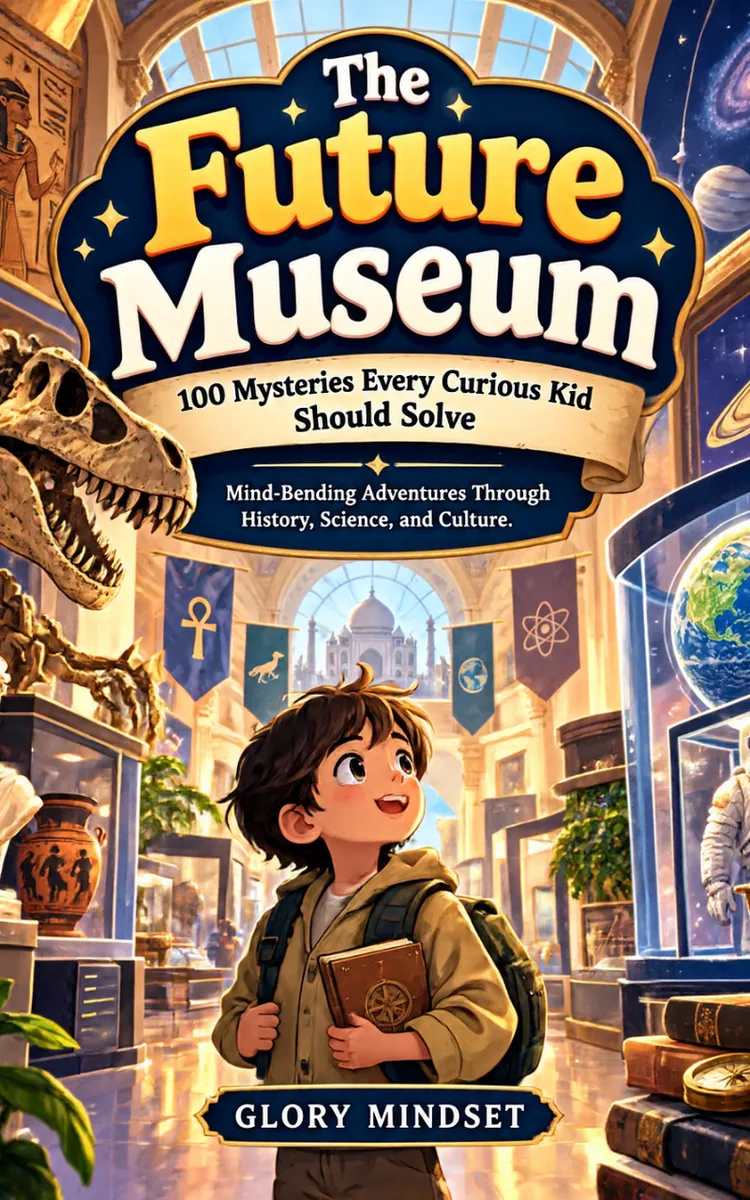
"The Future Museum: 100 Mysteries Every Curious Kid Should Solve" is a list book by Glory Mindset with 10 chapters and approximately 11,017 words. One hundred cross-disciplinary mysteries combining science, history, geography, logic, and culture.
This book was created using Inkfluence AI, an AI-powered book generation platform that helps authors write, design, and publish complete books.
Frequently Asked Questions
What is "The Future Museum: 100 Mysteries Every Curious Kid Should Solve" about?
One hundred cross-disciplinary mysteries combining science, history, geography, logic, and culture
How many chapters are in "The Future Museum: 100 Mysteries Every Curious Kid Should Solve"?
The book contains 10 chapters and approximately 11,017 words. Topics covered include The Museum That Shouldn’t Exist, Ancient Worlds, Unfinished Clues, The Planet’s Hidden Patterns, The Science of Strange Signals, and more.
Who wrote "The Future Museum: 100 Mysteries Every Curious Kid Should Solve"?
This book was written by Glory Mindset and created using Inkfluence AI, an AI book generation platform that helps authors write, design, and publish books.
Write your own list book with AI
Describe your idea and Inkfluence writes the whole thing. Free to start.
Start writingCreated with Inkfluence AI


