

Read the first chapter
The whole of chapter one, free. About 8 min. Turn the pages with the arrows, your keyboard, or a swipe.
Chapter 1
The Flooded Workshop
Rain drummed on the roof of the community workshop, fast and bright, like hundreds of tiny fingers tapping a table.
Maya Chen looked up from her workbench. A thin line of water slipped under the back door. Then another. Soon, a silver puddle spread across the floor, curling around boxes of screws and rolls of wire.
“Dad said the storm would pass,” Maya whispered.
The lights blinked once. The room stayed warm and bright, but Maya hurried to the wall switch and turned on the battery lamps. Their soft yellow glow shone across the workshop. Nothing felt frightening. Still, the water was moving, and the tools were sitting right in its path.
A plastic box bumped gently against a table leg.
Maya stepped around the puddle and read the label on its lid: EMERGENCY TOOL KIT. It was the kit the workshop kept for quick repairs - pliers, tape, a small wrench, and a hand pump. The box had floated away from its shelf and drifted toward the center of the room.
“I need that,” Maya said.
The back door was jammed by a fallen garden cart. The front door opened onto a deep puddle, and several heavy toolboxes blocked the clear path. Maya could wade across, but the water already covered the floor of the workshop. It was cold around her sneakers, and bits of cardboard floated past her ankles.
She reached for a long broom and nudged the emergency kit.
The box moved two inches, then bumped into a stool.
Maya tried again. The broom slid off the smooth plastic lid and splashed into the water.
“Come on,” she said. “Just float this way.”
The kit drifted in a slow circle. A coil of blue hose caught on its handle and pulled it toward a shelf.
Maya watched the box turn. She could not reach it safely from where she stood. She needed something that could travel across the water without making her carry heavy tools through the clutter.
Her eyes moved to the small robot on her workbench.
It was made from a shallow storage tub, two bottle-shaped floats, four wide wheels, and a little motor. Maya had built it the week before as a floating supply robot. She had named it Puddle Pal. The name was not on any official label. It was Maya’s own imaginary invention, a cheerful helper meant to carry small objects over wet ground.
Puddle Pal sat beside a basket of parts. Its two blue floats rested under the tub like tiny boats. A small propeller turned at the back, ready to push it through water.
Maya lifted the robot and checked the battery pack.
“Please work,” she said.
She carried Puddle Pal to the edge of the puddle. The plastic tub bobbed when she set it down. The robot stayed upright.
Maya smiled. “Buoyancy.”
She had learned that buoyancy was the upward push from water that helped floating objects stay above the surface. The floats held Puddle Pal up just as a life jacket helped a person stay afloat. The robot did not sink.
Maya placed a soft cloth inside the tub, then added a roll of tape. She wanted to test the robot before sending it after the emergency kit.
She pressed the button.
The motor buzzed. Puddle Pal moved forward with a gentle whirr, its wheels turning in the water. It bumped into a cardboard box, wiggled, and turned sideways.
Maya reached down and guided it back.
“Good start,” she said. “You can float. Now you need to steer.”
She tied a piece of string to the robot’s front. With one hand on the string and the other on the controller, she guided Puddle Pal around a stool. The robot bumped the stool again, but this time it slid free.
Maya’s friend Leo appeared at the workshop doorway, holding a yellow raincoat over his head.
“Maya! Are you all right?” he called.
“I’m fine,” she said. “The water is coming in, but the lamps are on.”
Leo stepped inside carefully. “What are you doing?”
“Getting the emergency kit. The robot can reach it.”
Leo crouched beside the puddle. “Can I help?”
“Hold the string. If Puddle Pal turns too far, pull it back.”
Leo took the string. Maya placed the controller on a dry table and pointed toward the floating box.
“Slowly,” she said.
Puddle Pal buzzed across the room. Its wide wheels pushed water to both sides. The blue floats kept it level as it passed a shelf of paint jars and a pile of folded fabric.
Maya guided it around a wooden crate. Leo pulled the string a little too soon, and Puddle Pal spun in place.
“Oops,” Leo said.
“That is okay,” Maya replied. “The string needs to stay loose. If it is tight, the robot cannot choose its direction.”
She pressed the left button for a short tap, then the right button. Puddle Pal straightened.
Together, they moved it toward the emergency kit.
The box had lodged against the low shelf. Maya steered Puddle Pal beside it. The robot’s front edge touched the plastic box.
“Push,” Maya said.
The motor buzzed louder. Puddle Pal pushed, but the emergency kit did not move. The blue hose was still caught around its handle.
Leo leaned over the dry part of the floor. “The hose is holding it.”
Maya looked around. A wooden ruler lay on the workbench. She picked it up and used it to lift the hose away from the handle. The hose slipped free and floated toward a corner.
“Try again.”
Puddle Pal pressed against the box. This time, the kit slid forward.
Maya laughed softly. “It worked!”
The robot pushed the kit into open water. Leo pulled the string, and Maya guided Puddle Pal back toward them. The emergency kit floated behind it like a small boat in tow.
Then a drop of water landed on the motor.
Puddle Pal made a sharp buzzing sound.
Maya stopped pressing the controller. “Wait.”
The robot moved once more, but its left wheel slowed. Another splash touched the motor housing. The buzzing became a faint click.
Puddle Pal turned in a circle.
“No, no,” Maya said.
She pulled the string gently, but the robot drifted toward the tall shelf. The emergency kit bumped against a table leg and stopped. Maya could reach the kit now, but Puddle Pal kept sliding away.
Leo grabbed the ruler and held it across the water. “I can stop it.”
He placed the ruler in front of the robot. Puddle Pal bumped against it and rested there.
Maya stepped carefully through the shallow water, picked up the emergency kit, and carried it to the dry workbench. Inside were the tools they needed to move the garden cart and check the door.
The kit was safe.
Puddle Pal was not.
Maya turned back. The robot had floated to the tall shelf. Its blue floats kept it above the water, but one wheel hung over the edge of a lower shelf. The motor made no sound at all.
Maya felt a small pinch in her chest. She had built Puddle Pal to help, and it had helped. It had carried the emergency kit through the flooded room. But now it was stranded.
“I’m sorry,” Maya said.
“You got the kit,” Leo reminded her.
Maya nodded. “But I forgot the motor.”
She picked up the small wrench from the kit and began loosening the garden cart’s wheel. Leo held the lamp closer. Together, they moved the cart away from the back door. The door opened with a soft scrape, and rainwater flowed into the outside drain instead of the workshop.
The water inside stopped rising.
Maya used the hand pump to clear the last puddle near the tool shelves. Leo carried boxes to higher tables. They worked slowly, speaking in calm voices while rain tapped the roof.
When the floor was nearly dry, Maya climbed onto a sturdy step stool. She reached for Puddle Pal and lifted it from the shelf. Water dripped from the motor housing onto the floor.
She pressed the controller once.
Click.
Nothing else happened.
Leo looked at the robot. “Can it be fixed?”
“I think so,” Maya said. She turned the robot over and studied the wet motor. “The floats did their job. They kept the robot up. But buoyancy cannot protect a motor if the motor is exposed to splashes.”
She found a dry cloth and wrapped it around the motor. Then she placed Puddle Pal beside the battery lamp.
Maya looked across the workshop. The emergency kit sat safely on the workbench. The tools were ready. The boxes were stacked high. The room smelled of wet wood, rubber, and the warm dust from the lamps.
A robot had helped them reach what they needed. It had also shown them what needed to change.
“What if one robot is not enough?” Maya asked.
Leo tilted his head. “You mean more Puddle Pals?”
“More useful robots,” Maya said. “One that carries supplies. One that checks high shelves. One that helps when the floor is wet. The neighborhood workshop needs practical rescue robots.”
She picked up a pencil and a clean sheet of paper. At the top, she wrote: ROBOT TEAM.
Below it, she drew Puddle Pal with a cover over its motor. Then she added a second sketch with a tall handle and a third with a basket that could lift above the water.
Leo smiled. “That is a lot of robots.”
Maya looked at Puddle Pal, resting quietly beside the lamp.
“Then I will need a lot of good ideas.”
Outside, the storm softened to a gentle patter. Inside, the workshop was warm again. The emergency kit was safe, the doors were clear, and Maya had a new plan.
Puddle Pal had floated, pushed, and delivered what the workshop needed, but its wet motor taught Maya the most important lesson of the day: a helpful robot must be designed for every part of the job, not just the part that works first.
End of chapter one. 14 more chapters and about 26,898 words in the full book.
Swipe or use the arrows to turn the page

The Truth Detectives

The Future Museum: 100 Mysteries Every Curious Kid Should Solve

School In The Year 2050: The Great Learning Mystery
What's inside: 15 chapters
- 1. The Flooded Workshop
- 2. The Library Book Rover
- 3. Who Moved the Garden Markers?
- 4. The Museum’s Narrow Ramp
- 5. A Robot That Waits
- 6. The Picnic That Blew Away
- 7. Across the Wobbly Footbridge
- 8. The Greenhouse’s Hidden Leak
- 9. Maya’s Almost-Perfect Map
- 10. The Power Outage Parade
- 11. The Silent Sorting Robot
- 12. The Clue in the Click
- 13. The Neighborhood Robot Relay
- 14. The Open Workshop Day
- 15. Tomorrow’s Robot Garden
About this book
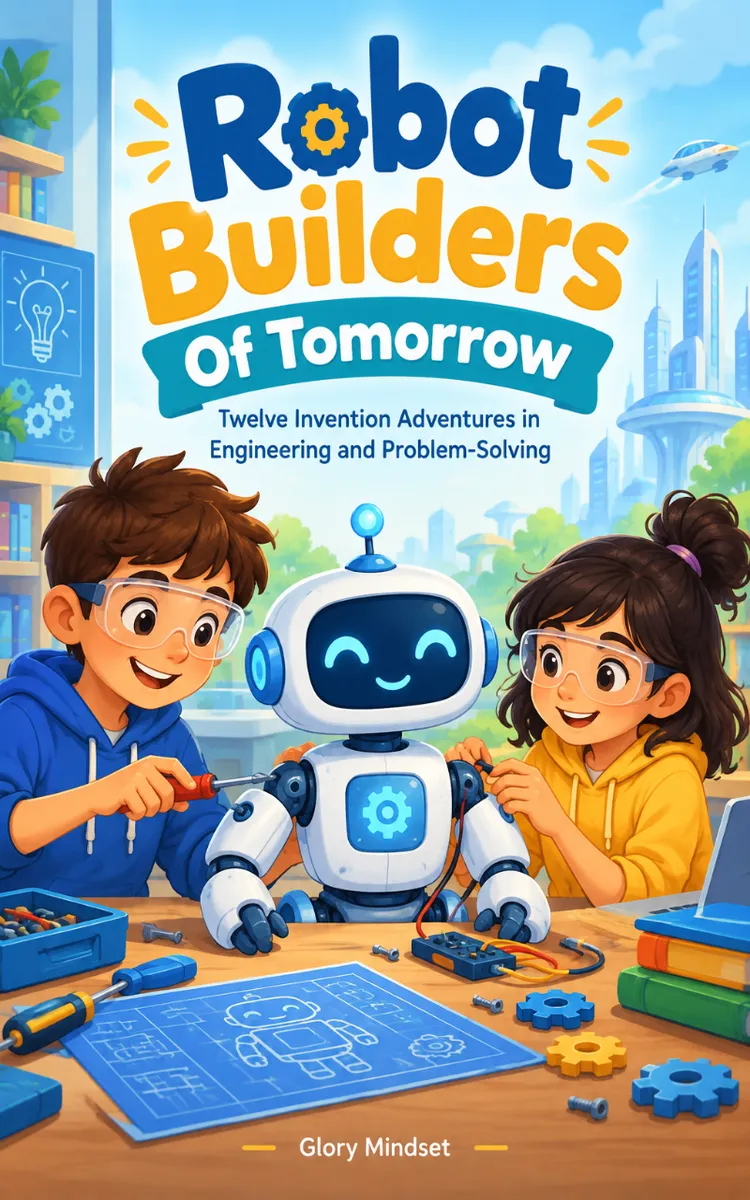
"Robot Builders Of Tomorrow" is a children's book by Glory Mindset with 15 chapters and approximately 26,898 words. Children solve real-world problems through robot design, testing, and engineering.
This book was created using Inkfluence AI, an AI-powered book generation platform that helps authors write, design, and publish complete books. It was made with the AI Children's Book Creator.
Frequently Asked Questions
What is "Robot Builders Of Tomorrow" about?
Children solve real-world problems through robot design, testing, and engineering
How many chapters are in "Robot Builders Of Tomorrow"?
The book contains 15 chapters and approximately 26,898 words. Topics covered include The Flooded Workshop, The Library Book Rover, Who Moved the Garden Markers?, The Museum’s Narrow Ramp, and more.
Who wrote "Robot Builders Of Tomorrow"?
This book was written by Glory Mindset and created using Inkfluence AI, an AI book generation platform that helps authors write, design, and publish books.
How can I create a similar children's book?
You can create your own children's book using Inkfluence AI. Describe your idea, choose your style, and the AI writes the full book for you. It's free to start.
Write your own children's book with AI
Describe your idea and Inkfluence writes the whole thing. Free to start.
Start writingCreated with Inkfluence AI


