
Read the first chapter
The whole of chapter one, free. About 5 min. Turn the pages with the arrows, your keyboard, or a swipe.
Chapter 1
Study Smarter: Prompts for Learning and Retention
Overview
A two-hour study session can disappear into rereading, highlighting, and searching for explanations that never quite make sense. Prompts 1-10 turn that time into a clear process: plan the session, simplify difficult ideas, create practice material, summarize readings, and learn from mistakes.
You can paste these prompts into an AI assistant and replace the bracketed details with your own subject, level, and notes. Do not share private exam data or personal information. Always check important facts against your textbook, teacher, or trusted source.
The Breakdown
#1: Build a Focused Study Plan
Problem: Many study sessions begin without a clear target. After 90 minutes, you may have read several pages but still be unsure what you learned or what to do next.
Solution: Use this prompt: “Create a [60]-minute study plan for [subject and topic]. Include a learning goal, three study blocks, a five-minute break, and a final self-test. Put the hardest task first.” Tell the AI what you already know and when your exam or deadline is.
Result: You finish with a realistic plan and a clear measure of progress, rather than a vague promise to “study more.”
#2: Turn a Large Topic into Small Tasks
Problem: A subject such as “human biology” or “business accounting” is too broad for one sitting. A large topic can create stress and make it difficult to choose where to begin.
Solution: Ask: “Break [topic] into eight study tasks for a beginner. Arrange them from basic to advanced, and estimate how many minutes each task needs.” Choose only two or three tasks for today and save the rest for later.
Result: A confusing subject becomes a short checklist. You can start with one manageable task instead of trying to learn everything at once.
#3: Explain a Difficult Concept in Plain English
Problem: Textbooks often use dense language and assume background knowledge. If you cannot explain an idea simply, you may recognize the words without understanding the concept.
Solution: Paste a short section or name the concept: “Explain [concept] in plain English for a beginner. Use one everyday example, define any technical terms, and then ask me two questions to check my understanding.” Read the explanation, then answer the questions without looking back.
Result: Difficult material becomes easier to remember because it is connected to a clear example and your own explanation.
#4: Compare Two Easily Confused Ideas
Problem: Learners often mix up related ideas, such as correlation and causation or mitosis and meiosis. Reviewing both definitions separately may not show what makes them different.
Solution: Use: “Compare [idea A] and [idea B] in a table. Include the definition, purpose, one example, one common mistake, and a simple memory clue.” Then ask the AI for three short questions that require you to choose between the two.
Result: The key difference is visible at a glance, making recall faster during homework, discussion, or an exam.
#5: Create Practice Questions Without Answers First
Problem: Rereading feels comfortable but does not show whether you can recall information. Students may discover gaps only when the test begins.
Solution: Ask: “Create 10 practice questions about [topic] for a beginner. Mix five short-answer, three multiple-choice, and two application questions. Show the questions first, then place the answer key under a separate heading.” Complete the questions before checking the answers.
Result: You test active recall - the act of bringing information to mind - and identify weak areas while there is still time to improve them.
#6: Make Flashcards That Test One Fact
Problem: Poor flashcards contain whole paragraphs or several facts on one side. They take too long to review and make it unclear which part you remembered incorrectly.
Solution: Prompt the AI: “Create 15 flashcards from these notes. Put one question on the front and one short answer on the back. Use simple wording, avoid duplicate cards, and include a practical example when useful.” Review difficult cards more often, but remove cards you can answer confidently for several sessions.
Result: Your review becomes quicker and more precise. Each card checks one useful piece of knowledge instead of testing an entire page.
#7: Summarize a Reading at Three Levels
Problem: A long article or chapter can take hours to reduce into useful notes. A summary that is too short may lose important details, while one that is too long simply repeats the reading.
Solution: Paste the reading or your notes and ask: “Summarize this in three versions: one sentence, five bullet points, and a 100-word explanation. Keep the main argument, key evidence, and important terms. Do not add information not found in the text.” Compare the versions and mark anything you still do not understand.
Result: You get a quick review tool and a fuller study note without rewriting the entire reading.
#8: Turn Notes into a Memory Map
Problem: Notes written in page order may hide how ideas connect. This makes it harder to remember causes, steps, and examples.
Solution: Ask: “Organize these notes into a text-based memory map. Put [main topic] at the center, then group related ideas under headings. Show cause-and-effect links, sequences, and examples using arrows or indentation.” Check the map against your original notes to catch missing points.
Result: You see the structure of the topic, not just a list of sentences. This is especially useful for processes such as photosynthesis, project planning, or historical events.
#9: Review Mistakes and Find the Pattern
Problem: Correcting an answer without studying the reason for the error allows the same mistake to return. Five wrong answers may come from one repeated problem, such as confusing units or skipping a step.
Solution: Give the AI three to five incorrect questions and ask: “For each mistake, identify the likely cause, explain the correct method step by step, and create one similar practice question. Group mistakes that have the same cause.” Check its explanation against your teacher’s method or answer key.
Result: Mistakes become a targeted study list. You spend time fixing the cause instead of repeatedly correcting the same symptom.
#10: Create a Final Self-Test and Review Plan
Problem: Finishing notes can feel like finishing the subject, even when important information has not been tested. Without a review date, knowledge can fade before the exam.
Solution: Use: “Create a 20-minute self-test on [topic] with 10 questions, including two application questions. Provide a scoring guide and a review plan for scores below 60%, 60-79%, and 80% or higher. Schedule reviews for tomorrow, three days from now, and one week from now.” Complete the test without notes and record your score.
Result: You leave the session knowing what you can actually do and when to review it. A score of 80% is useful evidence, while a lower score points to specific material that needs another pass.
What Comes Next
These ten prompts build a strong learning routine from planning through error review. Next, the guide moves from studying and retention to practical prompts for finding and preparing for job opportunities, including applications, resumes, and interviews.
End of chapter one. 4 more chapters and about 6,524 words in the full book.
Swipe or use the arrows to turn the page
What's inside: 5 chapters
- 1. Study Smarter: Prompts for Learning and Retention
- 2. Get Hired: Prompts for Job Search and Career Growth
- 3. Create with Confidence: Prompts for Content and Communication
- 4. Plan Your Day: Prompts for Focus and Follow-Through
- 5. Build Better Routines: Prompts for Everyday Decisions and a 7-Day Challenge
About this book
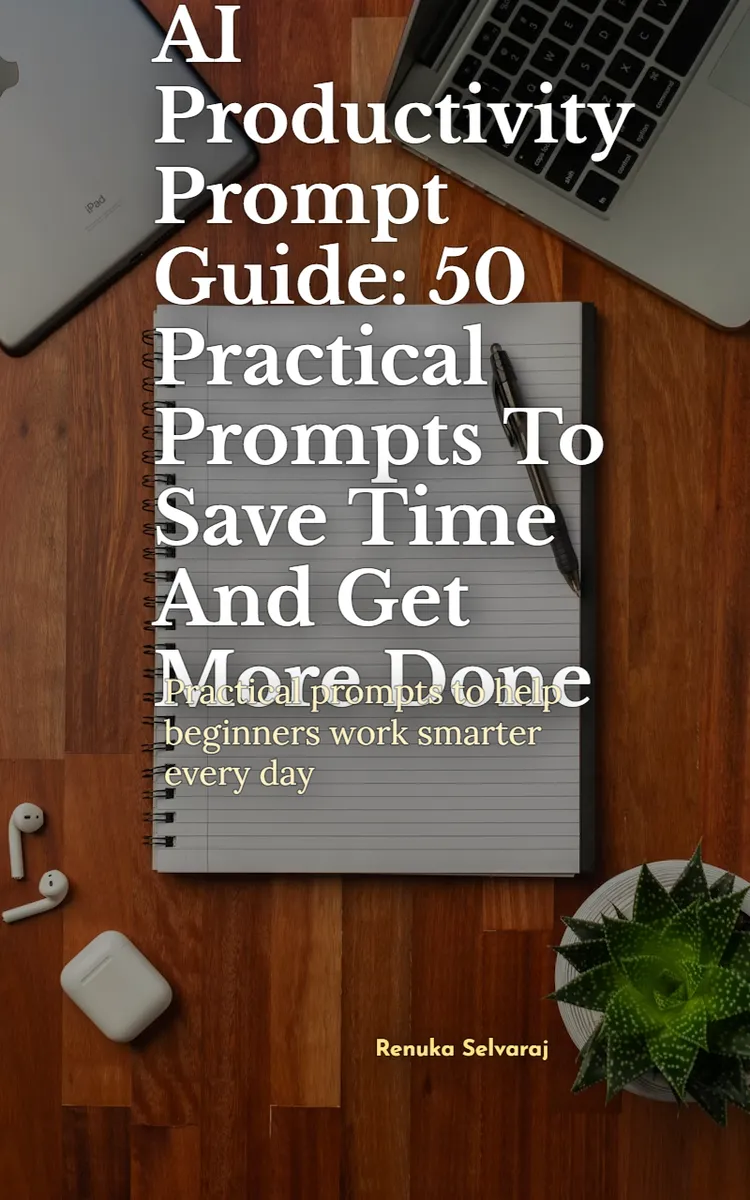
"AI Productivity Prompt Guide: 50 Practical Prompts To Save Time And Get More Done" is a list book by Renuka Selvaraj with 5 chapters and approximately 6,524 words. AI prompts for studying, job searching, content creation, and daily planning.
This book was created using Inkfluence AI, an AI-powered book generation platform that helps authors write, design, and publish complete books.
Frequently Asked Questions
What is "AI Productivity Prompt Guide: 50 Practical Prompts To Save Time And Get More Done" about?
AI prompts for studying, job searching, content creation, and daily planning
How many chapters are in "AI Productivity Prompt Guide: 50 Practical Prompts To Save Time And Get More Done"?
The book contains 5 chapters and approximately 6,524 words. Topics covered include Study Smarter: Prompts for Learning and Retention, Get Hired: Prompts for Job Search and Career Growth, Create with Confidence: Prompts for Content and Communication, Plan Your Day: Prompts for Focus and Follow-Through, and more.
Who wrote "AI Productivity Prompt Guide: 50 Practical Prompts To Save Time And Get More Done"?
This book was written by Renuka Selvaraj and created using Inkfluence AI, an AI book generation platform that helps authors write, design, and publish books.
Write your own list book with AI
Describe your idea and Inkfluence writes the whole thing. Free to start.
Start writingCreated with Inkfluence AI


