

Read the first chapter
The whole of chapter one, free. About 7 min. Turn the pages with the arrows, your keyboard, or a swipe.
Chapter 1
Choose a Health Identity Mantra
When Your Inner Voice Sets the Tone
What do you say to yourself when the alarm rings, your body feels heavy, and yesterday’s healthy plan already seems out of reach? Maybe the first thought is, “I’m so inconsistent.” Maybe it’s, “I always mess this up.” Before you’ve even left the bed, self-doubt has entered the room and started making decisions for you.
Later, you might skip the walk because you’re “not disciplined enough,” eat quickly because the day feels chaotic, or snap at someone because your patience is running thin. None of these moments proves that you’re failing. They show how strongly your inner identity can shape your next choice.
Will you keep letting self-doubt describe you, or will you choose the phrase that guides you?
From Self-Doubt to a Health Identity
Old Belief: I have to feel confident and motivated before I can make healthy choices.
New Reality: I can choose a health identity phrase first, then let small actions build confidence.
Self-doubt often sounds believable because it uses familiar evidence. You missed the workout, so it says, “See? You never follow through.” You reached for comfort food after a stressful day, so it declares, “You have no control.” The mind loves a quick label, especially when you’re tired. But a label isn’t a life sentence. It’s a repeated description - and repeated descriptions can be changed.
A daily identity phrase gives you a steadier description to return to. It might be, “I am someone who cares for my body with patience,” or, “I make choices that help me feel steady.” The phrase doesn’t need to claim that you’re perfect. In fact, believable language usually works better. You’re not pretending that every day is easy. You’re reminding yourself who you’re practicing becoming.
Picture a busy morning when you planned to prepare breakfast but slept through your alarm. The old identity says, “I’ve ruined the day, so I may as well give up.” A health identity phrase says, “I’m someone who can make the next caring choice.” That could mean drinking water, choosing a filling option on the way to work, or taking three calm breaths before rushing into the day. The phrase doesn’t fix everything. It interrupts the all-or-nothing story long enough for you to choose again.
This is the heart of the Identity Mantra Loop: choose a phrase, repeat it at a meaningful moment, take one action that matches it, and notice the evidence you created. Each small action makes the phrase feel less like a wish and more like a truth in progress.
Notice the Pattern Before You Replace It
Your identity mantra works best when it meets self-doubt in the exact places where self-doubt usually appears. Pay attention to the moments that trigger the old story. Is it when you step on the scale? When you see an unfinished workout plan? When you’re emotional and standing in front of the refrigerator?
The goal isn’t to criticize yourself for having these thoughts. That would simply add another layer of pressure. Instead, notice the pattern with curiosity. A thought can be loud without being accurate. You can hear it and still choose a different sentence.
Signs This Pattern Is Running Your Life
1. You treat one choice as proof of your entire identity. Missing one walk becomes “I’m lazy,” rather than “Today got crowded.”
2. You wait for the perfect mood to begin. If you don’t feel motivated, you assume the action won’t count. This keeps your health dependent on feelings that naturally change.
3. You use harsh language after a setback. Words like “always,” “never,” and “hopeless” turn a single moment into a permanent verdict.
4. You overlook small successes. You may notice the snack you ate while stressed but ignore the water you drank, the earlier bedtime, or the pause you took before reacting.
A health identity mantra changes the question from “Did I do everything right?” to “What would someone who cares for themselves choose next?”
That question matters because it brings you back to the present. You don’t need to repair your entire lifestyle in one afternoon. You need one choice that supports the identity you’re building. Then another. The brain begins to collect new evidence: “I said I would care for myself, and I did - even in a small way.”
Choose a phrase that feels strong but honest. “I am perfectly healthy” may feel disconnected from your current experience. “I am learning to support my health every day” leaves room for growth. It doesn’t demand flawless behavior. It gives you somewhere to stand when the day feels wobbly.
Questions That Make the Mantra Personal
1. What exact situation brings out your harshest health-related self-talk? Be specific. It might be Sunday evening, after a missed workout, or when you’re eating in the car. Naming the moment helps you place your mantra where it can actually help.
2. What would you like your phrase to remind you of when you feel discouraged? Perhaps you need patience, consistency, calm, or self-respect. Your phrase should answer the need beneath the doubt, not merely sound impressive.
3. Which identity feels believable enough to practice today? Try finishing this sentence: “I am someone who…” You might write, “I am someone who returns to caring choices,” or, “I am someone who listens to my body without judging it.”
4. What small action would prove that phrase today? If your mantra is “I protect my energy,” the action might be turning off your phone fifteen minutes earlier. If it’s “I nourish myself with care,” you might add something satisfying and nourishing to your next meal.
5. What evidence have you already created, even if you dismissed it? Look for moments when you did follow through, recovered, paused, or tried again. A mantra becomes more convincing when you connect it to real memories instead of waiting for future perfection.
Write your answers in a notebook or in the notes app on your phone. Keep the wording close to your everyday voice. A phrase you’d actually say will serve you better than one that sounds like it belongs on a poster you’d never hang up.
The Seven-Day Identity Mantra Loop
Challenge: Practice One Phrase for Seven Days
Choose one identity phrase and use it as a daily cue. Keep the challenge small enough that a busy day can’t easily talk you out of it.
• Write your phrase in three places: your phone lock screen, a note beside your bed, and somewhere you’ll see it before a meal or health choice. - Say the phrase once in the morning, slowly enough to hear the words. - Attach it to one predictable moment, such as pouring your first drink, putting on your shoes, or opening your lunch. - Take one action that matches the phrase. Keep it concrete: walk for ten minutes, add a nourishing food, stretch before bed, or pause for three breaths. - At night, record one sentence of evidence: “Today I was someone who cared for myself when I…” - If you miss a day, restart at the next opportunity. Don’t turn a missed repetition into proof that the phrase failed.
Expected difficulty: Easy to Medium
You’ll know it’s working when…
• You catch self-doubt sooner instead of automatically obeying it. - The phrase feels familiar during a stressful moment. - You make one helpful choice before waiting to feel motivated. - A setback feels like information, not an identity. - You begin noticing more evidence that you can return to yourself.
For this challenge, try the phrase, “I am someone who makes the next caring choice.” It’s useful because it doesn’t require a perfect schedule, a certain mood, or a flawless meal. It gives you a direction. When the day changes, the direction remains.
Let Your Chosen Words Lead
A health identity mantra isn’t a magic sentence that erases difficult feelings. It’s a steady hand on the wheel when your thoughts start pulling you toward old habits. You may still feel tired, doubtful, impatient, or overwhelmed. The difference is that those feelings no longer get the final word.
• You learned that self-doubt often turns one choice into a judgment about your whole identity. - You learned to replace that judgment with a believable phrase about the person you’re practicing becoming. - You learned how the Identity Mantra Loop connects words, small actions, and real evidence. - You created a seven-day practice for making your phrase part of everyday health decisions.
The phrase you repeat becomes a path back to the person you’re choosing to be.
Keep your mantra close today. Say it before the next decision that usually brings doubt, then make one small choice that supports it. That simple pairing - positive words followed by caring action - can become the foundation for using images and phrases to strengthen your lifestyle, one steady moment at a time.
End of chapter one. 4 more chapters in the full book.
Swipe or use the arrows to turn the page


What's inside: 5 chapters
- 1. Choose a Health Identity Mantra
- 2. Reframe Beliefs That Sabotage Wellness
- 3. Build Habit Prompts with Positive Pictures
- 4. Speak to Your Body Without Shame
- 5. Bounce Back with Purposeful Resilience Phrases
About this book
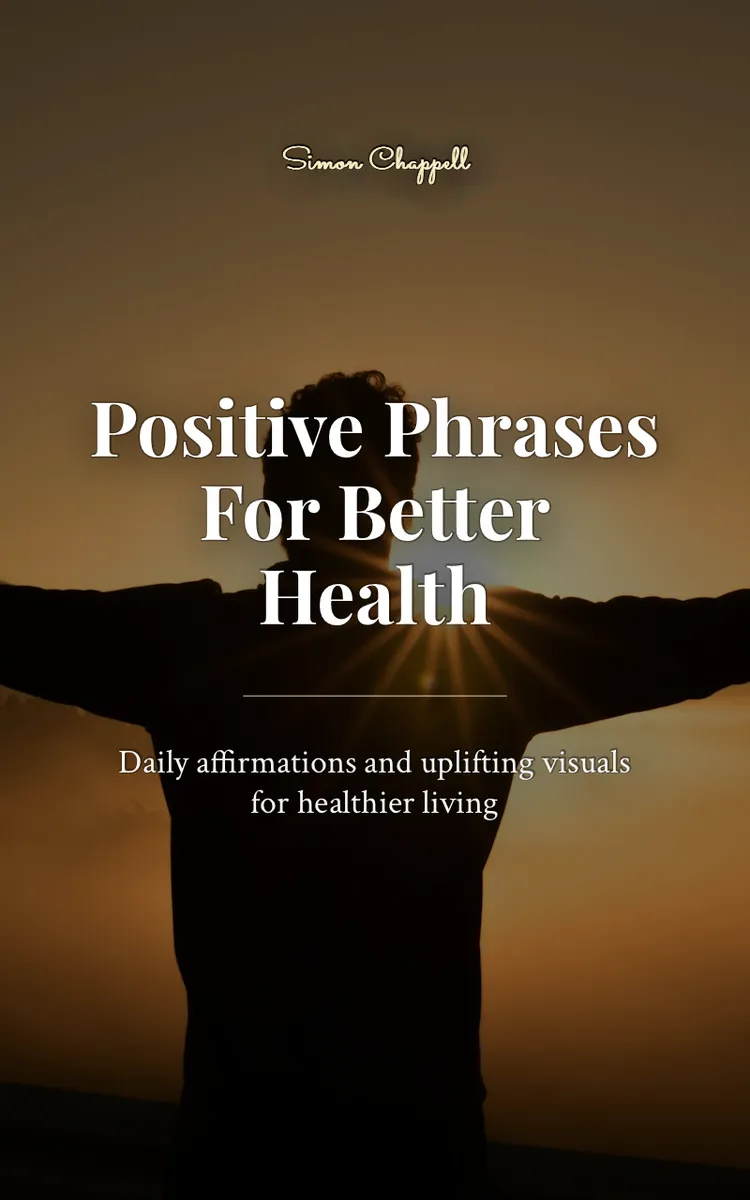
"Positive Phrases For Better Health" is a self-help book by Simon Chappell with 5 chapters and approximately 7,458 words. Using positive phrases and images to support lifestyle and health.
This book was created using Inkfluence AI, an AI-powered book generation platform that helps authors write, design, and publish complete books. It was made with the AI Self-Help Book Writer.
Frequently Asked Questions
What is "Positive Phrases For Better Health" about?
Using positive phrases and images to support lifestyle and health
How many chapters are in "Positive Phrases For Better Health"?
The book contains 5 chapters and approximately 7,458 words. Topics covered include Choose a Health Identity Mantra, Reframe Beliefs That Sabotage Wellness, Build Habit Prompts with Positive Pictures, Speak to Your Body Without Shame, and more.
Who wrote "Positive Phrases For Better Health"?
This book was written by Simon Chappell and created using Inkfluence AI, an AI book generation platform that helps authors write, design, and publish books.
How can I create a similar self-help book?
You can create your own self-help book using Inkfluence AI. Describe your idea, choose your style, and the AI writes the full book for you. It's free to start.
Write your own self-help book with AI
Describe your idea and Inkfluence writes the whole thing. Free to start.
Start writingCreated with Inkfluence AI


