
Read the first chapter
The whole of chapter one, free. About 5 min. Turn the pages with the arrows, your keyboard, or a swipe.
Chapter 1
Customer Email Replies (Delays, Complaints, and “Difficult” Messages)
Overview
A customer’s “Why haven’t you started?” email can take longer to answer than the actual update. These four copy-paste prompts help you draft replies that acknowledge the concern, explain what is known, give a clear next step, and avoid promising a date, price, refund, or warranty outcome you have not confirmed.
Each prompt uses the same working structure: identify your role, provide the real message and facts, then define the tone and limits. AI can draft the wording, but you must check every detail before sending - especially dates, costs, material availability, and warranty language.
The Breakdown
#1: Calm Reply to a Delayed Project
Problem: A delayed material shipment or inspection can leave a customer feeling ignored, even when the delay is outside your control. A rushed reply may sound defensive or accidentally promise that work will begin on a date you cannot guarantee.
Solution: Paste this prompt into ChatGPT, Claude, or another AI assistant:
You are responding on behalf of [business name], a residential [trade] contractor. A customer wrote: “[paste the customer’s email].”
Here are the confirmed facts: [material, inspection, crew, or other cause of delay]. The current status is: [status]. The next action we will take is: [action]. The earliest date or timeframe I can responsibly mention is: [date or timeframe, or “not confirmed”].
Write a professional, warm, direct reply under 150 words. Acknowledge the customer’s concern first. Explain the delay in plain English without blaming another company. Give the next step and a confirmed timeline only. Do not invent facts, offer a discount, promise a completion date, or state that work is scheduled unless I have confirmed it.
Read the draft against your job calendar and supplier information. If the delivery date is still uncertain, say “I will update you by Thursday” rather than turning an estimate into a commitment.
Result: The customer receives a clear update and knows when to expect the next communication. You remain accountable without committing the company to an unverified schedule.
#2: Reply to an Angry Complaint
Problem: An upset customer may include several complaints in one email: missed calls, dust, a late crew, unfinished work, or damage. Responding point by point while irritated can make the disagreement worse and bury the action that needs to happen next.
Solution: Use this prompt:
You are the owner of [business name], a residential [trade] contractor. Draft a reply to this customer complaint: “[paste the full email].”
Known facts from our records: [list dates, visits, completed work, open issues, and relevant communication]. Facts I have not confirmed: [list unknowns].
Write a calm, accountable reply between 120 and 180 words. Start by acknowledging the customer’s main concern without admitting fault for facts that are not confirmed. Separate confirmed facts from items that need inspection or discussion. Propose this next step: [phone call, site visit, photos, repair review]. Offer this timeframe: [confirmed timeframe only]. Do not argue, blame the customer or a vendor, offer money, or promise a repair until I approve it.
Before sending, remove anything that is technically true but unnecessary. A customer who reports a leaking window usually needs to know who will inspect it and when - not a long defense of every crew decision.
Result: The reply lowers the temperature and moves the complaint toward a documented next step. It also keeps unverified statements out of the customer record.
#3: Answer a Warranty or Repair Request
Problem: Warranty questions are risky because the customer may treat a casual email as a coverage decision. Saying “we’ll fix it” before reviewing the contract, installation history, or cause of the problem can create a commitment you did not intend.
Solution: Give the AI the exact information it needs:
You are responding on behalf of [business name], a residential [trade] contractor. The customer wrote: “[paste the customer’s email].”
Relevant warranty or agreement language: “[paste the applicable section, or write ‘not yet reviewed’].” Work completed: [date and brief description]. The reported issue is: [description]. What we have confirmed: [facts]. What still needs inspection: [unknowns].
Write a professional reply under 160 words. Thank the customer for reporting the issue, acknowledge the concern, and explain the next step for reviewing it. If coverage is not yet confirmed, say that clearly. Provide only this confirmed timeframe: [timeframe]. Do not decide whether the issue is covered, admit installation fault, promise a repair, or quote a cost unless those decisions are stated in the information above.
Check that the draft does not use words such as “definitely covered,” “our mistake,” or “free repair” unless you have made that decision. If the agreement is unclear, have the appropriate person review it before you send a final answer.
Result: The customer gets a useful response without receiving an accidental warranty ruling. You preserve room to inspect the issue and apply the actual agreement.
#4: Respond to a Refund or Price Complaint
Problem: A customer who asks for a refund may be reacting to a missed expectation, incomplete work, a change order, or a disputed charge. An AI draft can easily offer a credit or refund amount that you never approved, especially if the customer’s email uses urgent or emotional language.
Solution: Use a firm boundary in the prompt:
You are responding on behalf of [business name], a residential [trade] contractor. The customer is asking about this price, charge, credit, or refund: “[paste the customer’s email].”
Confirmed account facts: [invoice amount, payment status, approved change order, completed work, or other facts]. My current decision is: [no refund approved / reviewing the request / approved amount]. The next step is: [review invoice, inspect work, call customer, send documentation]. I can commit to this response date: [date].
Write a professional, respectful reply under 150 words. Acknowledge the customer’s concern. Explain what is being reviewed or what has been decided. Give the next step and response date. Do not offer a refund, discount, credit, revised price, payment plan, or admission of overcharging unless it is explicitly included in my current decision. Do not make legal claims or threaten collection.
Compare every dollar amount and date with your accounting records before sending. If you are still reviewing the request, the email should say when the customer will receive an answer - not suggest what that answer will be.
Result: You can respond quickly without negotiating against yourself. The customer gets a clear process and deadline while pricing decisions stay with you.
What Comes Next
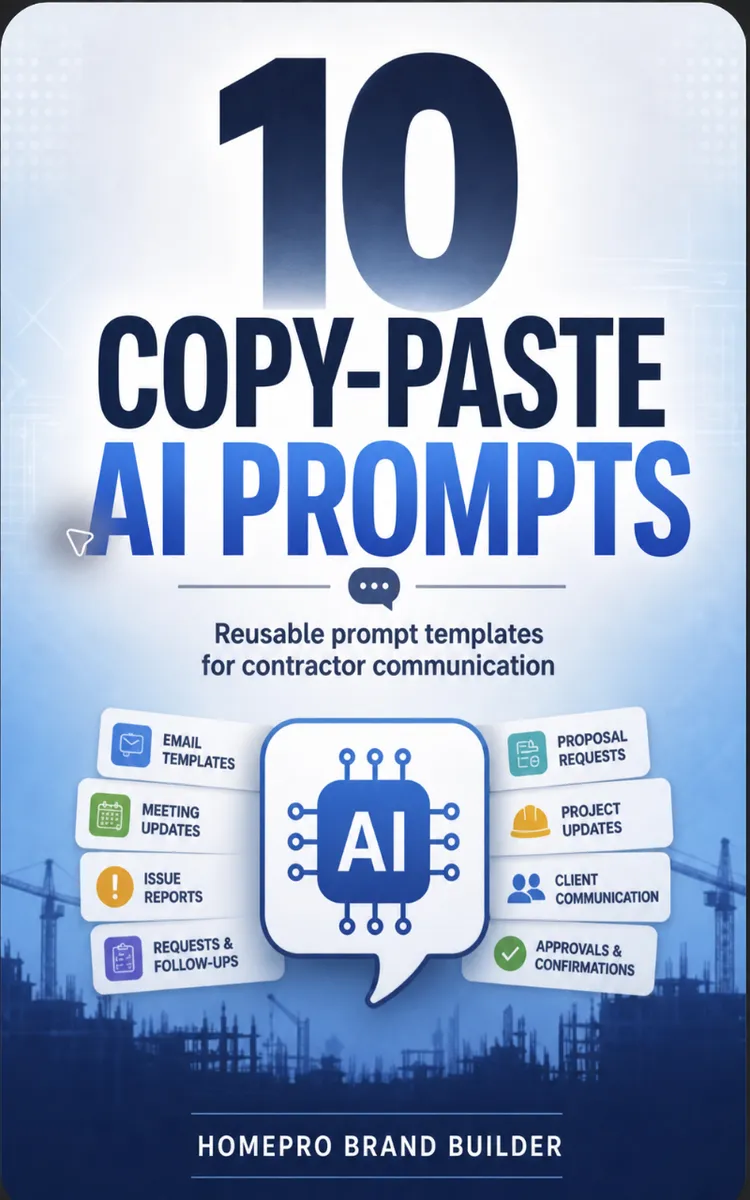
Clean professional contractor communication guide cover. Bright white and blue palette, large readable title area, subtle blue grid, construction cranes and a central AI chat icon. Preserve the existing business-book feel. Include exactly the author name HomePro Brand Builder at the bottom.
These four prompts handle customer delays, complaints, warranty questions, and refund requests without accidental commitments. Next, the focus shifts to using AI as a sparring partner before negotiations with suppliers, subcontractors, and customers.
End of chapter one. 2 more chapters in the full book.
Swipe or use the arrows to turn the page

Meta Ads For Residential Contractors

Contract Dispute Playbook For Contractors

Construction Contract Defensibility Playbook
What's inside: 3 chapters
- 1. Customer Email Replies (Delays, Complaints, and “Difficult” Messages)
- 2. Change Orders, Scope Clarifications, and Warranty Responses (Accuracy + Boundaries)
- 3. Negotiation Sparring + Follow-Up Emails (Suppliers, Subcontractors, and Pushback)
About this book
"10 Copy-Paste AI Prompts" is a list book by HomePro Brand Builder with 3 chapters and approximately 3,039 words. Ten copy-paste prompts for AI drafting and negotiation emails.
This book was created using Inkfluence AI, an AI-powered book generation platform that helps authors write, design, and publish complete books.
Frequently Asked Questions
What is "10 Copy-Paste AI Prompts" about?
Ten copy-paste prompts for AI drafting and negotiation emails
How many chapters are in "10 Copy-Paste AI Prompts"?
The book contains 3 chapters and approximately 3,039 words. Topics covered include Customer Email Replies (Delays, Complaints, and “Difficult” Messages), Change Orders, Scope Clarifications, and Warranty Responses (Accuracy + Boundaries), Negotiation Sparring + Follow-Up Emails (Suppliers, Subcontractors, and Pushback).
Who wrote "10 Copy-Paste AI Prompts"?
This book was written by HomePro Brand Builder and created using Inkfluence AI, an AI book generation platform that helps authors write, design, and publish books.
Write your own list book with AI
Describe your idea and Inkfluence writes the whole thing. Free to start.
Start writingCreated with Inkfluence AI


