
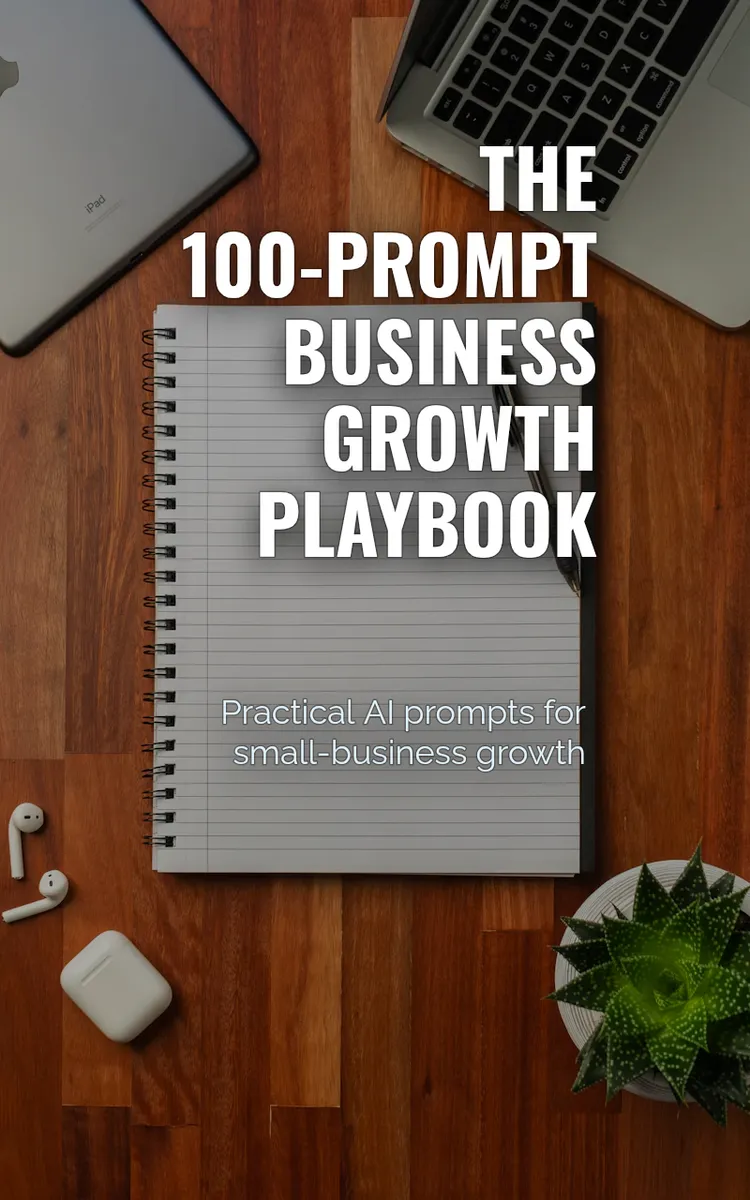
Read the first chapter
The whole of chapter one, free. About 11 min. Turn the pages with the arrows, your keyboard, or a swipe.
Chapter 1
Build Your Business Foundation
Overview
A business idea becomes easier to sell when you can explain exactly what you offer, who needs it, and why they should choose you. Prompts #1 - #20 help you turn a rough idea into a clear business foundation: a defined customer, a useful competitor view, a strong value proposition, and measurable growth goals.
Use the prompts with real details rather than broad answers. Replace placeholders with your product, service, location, prices, customer questions, and current numbers. The clearer your input, the more useful the output.
The Breakdown
#1: Turn a Rough Idea into a Clear Business Concept
Problem: Many business ideas stay vague, such as “I want to sell beauty products” or “I want to offer online coaching.” Without a clear offer, customers cannot quickly understand what they are buying, and you may waste weeks creating products nobody asked for.
Solution: Ask AI to turn your idea into a one-sentence business concept using this structure: “I help [specific customer] achieve [specific result] through [product or service].” Include your skills, product type, location, price range, and any customer problem you have noticed. Ask for three versions and choose the one a stranger could understand in five seconds.
Result: You will have a simple description for your bio, website, sales messages, and future planning. It also exposes gaps that need research before you spend money.
#2: Identify the Customer Problem
Problem: Sellers often describe what they make instead of the problem it solves. A handmade planner, for example, may be useful because busy parents need a simple way to manage school, work, and appointments - not because the planner has attractive paper.
Solution: Give AI your product or service and ask it to list the practical problems, frustrations, costs, and emotional concerns it may address. Ask it to separate problems customers actively try to solve from problems that are merely nice to improve. Check the list against real customer messages, reviews, and questions.
Result: Your marketing can focus on outcomes customers care about. You will also know which product features deserve attention.
#3: Separate the Customer from the User
Problem: The person using an offer is not always the person paying for it. A parent may buy tutoring for a child, an office manager may hire a cleaner, and a company owner may approve a freelancer’s invoice.
Solution: Ask AI to identify the user, buyer, decision-maker, and anyone who influences the purchase. For each person, request their main concern, preferred information, and likely objection. Use the answers to create separate messages when different people are involved.
Result: Your sales page and conversations will speak to the person who must say yes. This reduces confusion in higher-value or business-to-business sales.
#4: Build a First Customer Profile
Problem: “Everyone who needs this” is not a usable target market. Broad targeting makes your content, product features, and advertising more expensive because the message has no clear focus.
Solution: Ask AI to create a first customer profile using details such as age range, location, job, budget, habits, buying triggers, and common frustrations. Add evidence from your existing customers or followers. Keep the profile practical - for example, “local salon owners with one to three staff” is more useful than “small-business owners.”
Result: You will know whom to address in posts, emails, and sales calls. A focused starting audience does not prevent future expansion; it gives your business a sensible first step.
#5: Find the Customer’s Buying Trigger
Problem: Customers may like an offer but delay buying until something changes. A wedding photographer’s clients may act after setting a date, while a tax adviser’s clients may act when a filing deadline approaches.
Solution: Ask AI to list the events, deadlines, frustrations, and changes that make your target customer search for help. Rank them by urgency and frequency. Create content that connects your offer to those moments, such as “Book your spring garden cleanup before the April rush.”
Result: Your marketing will appear closer to the moment customers are ready to act. This can improve responses without requiring constant discounts.
#6: Map the Customer’s Buying Journey
Problem: A customer who has never heard of you needs different information from someone comparing prices. Using the same sales message at every stage can make beginners feel pressured and ready buyers feel under-informed.
Solution: Ask AI to map five stages: problem awareness, solution research, option comparison, purchase, and repeat purchase. For each stage, request one useful post, one customer question to answer, and one call to action. A call to action is the next step you ask people to take, such as sending a message or booking a call.
Result: You will have a simple content plan that guides people from curiosity to purchase. It also shows where customers may be dropping out.
#7: Turn Customer Language into Marketing Copy
Problem: Business owners often use internal terms customers do not use. A fitness coach might say “progressive overload,” while a beginner may search for “how to get stronger without hurting my back.”
Solution: Paste customer reviews, direct messages, survey answers, or comments into AI and ask it to extract repeated phrases, concerns, desired results, and objections. Tell it not to invent wording and to preserve the customer’s plain language. Organize the findings into a table with columns for “customer says,” “what they mean,” and “message to test.”
Result: Your captions, product descriptions, and website headings will sound more familiar to buyers. Customer language is often more persuasive than polished business language.
#8: Research Competitors Fairly
Problem: Competitor research often becomes either a quick glance at prices or an overwhelming spreadsheet. Both approaches can miss what customers actually experience when choosing between businesses.
Solution: Give AI links or notes from five to ten relevant competitors and ask it to compare their offers, prices, delivery times, reviews, guarantees, content themes, and customer complaints. Do not copy their wording or claim access to private information. Use public websites, social profiles, review platforms, and your own test inquiries.
Result: You will see common standards in your market and areas where customers are underserved. This gives you facts for improving your offer rather than relying on guesswork.
#9: Analyse Competitor Reviews
Problem: Positive reviews show what competitors do well, but negative reviews often reveal the clearest opportunities. If several customers mention slow replies or unclear delivery dates, that weakness may be costing the competitor sales.
Solution: Collect at least 20 public reviews across three competitors and ask AI to group them into praise, complaints, unmet expectations, and repeated requests. Ask for the number of mentions in each group, then verify the important findings yourself. Turn one repeated complaint into a service standard you can meet.
Result: You may discover a useful advantage that does not require a lower price, such as faster replies, clearer instructions, or better follow-up.
#10: Compare Offers, Not Just Prices
Problem: Comparing only prices can push you into a race to the bottom. A £40 service with delivery, revisions, and support is not the same as a £25 service with no follow-up.
Solution: Ask AI to create a competitor comparison table covering price, quantity, turnaround, included extras, payment terms, support, and guarantees. Add your own offer and mark what is included in plain language. Identify whether your offer is basic, standard, or premium for the customer you want.
Result: You can explain your price using clear differences instead of apologising for it. Customers can judge the full value, not just the headline number.
#11: Find an Underserved Customer Segment
Problem: A crowded market does not mean every customer is well served. Some groups may need different hours, payment options, sizes, languages, delivery areas, or levels of support.
Solution: Ask AI to review your customer and competitor research and suggest five specific segments that appear overlooked. For each segment, request evidence to look for, a tailored offer, and a low-cost test. Validate one idea through a poll, ten conversations, or a small pre-order before building a full product.
Result: You may find a narrower group with a stronger reason to buy. A small, well-served segment can be easier to reach than a large general audience.
#12: Write a Distinctive Value Proposition
Problem: A value proposition is a clear statement of who you help, what result you provide, and why your approach is useful. Statements such as “high-quality service at great prices” are too common to help customers choose.
Solution: Ask AI to write five value propositions using this formula: “For [customer] who need [problem solved], [business] provides [specific result] through [distinctive method or proof].” Include a real strength, such as same-day local delivery, fixed pricing, custom sizing, or a 48-hour turnaround. Remove any claim you cannot prove.
Result: You will have a stronger foundation for your homepage, Instagram bio, pitch, and product listings. The best version should make the right customer think, “That is exactly what I need.”
#13: Choose Your Strongest Differentiator
Problem: Businesses often list ten small differences instead of one reason customers should remember them. Too many claims make the offer sound unfocused and difficult to believe.
Solution: Ask AI to score your possible differentiators on customer importance, competitor weakness, proof, and ease of delivery, using a scale from 1 to 5. Examples include speed, convenience, specialist knowledge, personalisation, reliability, or a clear guarantee. Choose one primary differentiator and two supporting benefits.
Result: Your marketing will become easier to recognise and repeat. You will also avoid promising features that your business cannot consistently deliver.
#14: Test Your Business Idea Before Investing
Problem: Buying stock, renting space, or building a full website before testing demand can tie up cash. A product can receive compliments online and still produce no paid orders.
Solution: Ask AI to design a seven-day validation test using a landing page, sample, pre-order, paid trial, or ten direct sales conversations. Set a pass mark, such as five paid orders, three deposits, or ten qualified enquiries. Record actual actions rather than likes or polite feedback.
Result: You will gain evidence before making a larger commitment. A weak test is useful because it tells you what to change while the cost is still low.
#15: Create a Minimum Viable Offer
Problem: New owners often try to launch every service, size, colour, or package at once. This creates extra work and makes it harder to learn which offer customers actually want.
Solution: Ask AI to reduce your idea to the smallest version that delivers a clear result. Request one target customer, one problem, one package, one price, and one delivery method. For example, a freelance designer might test one fixed logo package instead of offering unlimited branding services.
Result: You can launch faster, serve customers consistently, and gather useful feedback. Expansion becomes based on demand rather than assumptions.
#16: Set a Simple Pricing Starting Point
Problem: Underpricing can leave you busy but unable to cover materials, fees, taxes, delivery, and your own time. Overpricing without clear value can reduce enquiries before customers understand the offer.
Solution: Give AI your direct costs, time required, payment fees, delivery costs, desired hourly return, and competitor price range. Ask for three pricing options - basic, standard, and premium - and the assumptions behind each. Check the figures yourself and include a buffer for unexpected work.
Result: You will have a defensible starting price and clearer package choices. Track sales and objections for 30 days before making a major change.
#17: Turn Goals into Measurable Targets
Problem: “Grow my business” does not tell you what to do this week. Without a number and deadline, owners may spend time on low-impact tasks while sales remain unchanged.
Solution: Ask AI to convert your goal into a 90-day target with a number, deadline, and measurement method. Break it into monthly and weekly actions. For example, “increase monthly revenue” can become “reach £3,000 in monthly sales by 30 June through 20 qualified enquiries and a 25% conversion rate.”
Result: Your goal becomes something you can review and manage. You will know whether the problem is reach, enquiries, conversion, price, or repeat sales.
#18: Build a Basic Business Scorecard
Problem: Revenue alone does not explain business performance. Sales may rise while profit falls, or follower numbers may increase while enquiries stay at zero.
Solution: Ask AI to create a weekly scorecard with five to seven measures suited to your business. Useful measures include enquiries, conversion rate, average order value, gross profit, repeat purchases, response time, and cash collected. Ask for a simple spreadsheet layout and definitions for each measure.
Result: You can spot problems earlier and choose actions based on evidence. Keep the scorecard small enough to update every week in under 15 minutes.
#19: Plan a 30-Day Foundation Sprint
Problem: Research can become a substitute for action. Owners may keep refining their idea without speaking to customers, testing an offer, or asking for payment.
Solution: Ask AI to turn your answers from Prompts #1 - #18 into a 30-day plan. Assign one task per day across four stages: clarify the offer, interview customers, test the market, and review results. Include a daily time limit, a completed-by definition, and one number to record.
Result: Your foundation work turns into visible progress. By day 30, you should have clearer customer evidence, a tested offer, and a short list of next decisions.
#20: Create a One-Page Business Foundation
Problem: Important decisions often remain scattered across notes, messages, and spreadsheets. When the offer, customer, price, and goal are not on one page, your content and daily tasks can pull in different directions.
Solution: Ask AI to summarise your work into a one-page document containing: business concept, target customer, customer problem, value proposition, differentiator, starter offer, price, competitor insight, 90-day goal, and three weekly measures. Read it aloud and remove any sentence that sounds unclear or unsupported. Review the page every Monday and update it when customer evidence changes.
Result: You will have a practical decision sheet for content, sales, and product choices. It keeps the business focused while you learn what the market truly wants.
What Comes Next
Once your offer and target customer are clear, the next step is turning that foundation into a visible brand and a practical marketing message. The next chapter focuses on content ideas, brand voice, and promotional prompts that help the right people notice and remember your business.
End of chapter one. 4 more chapters and about 11,031 words in the full book.
Swipe or use the arrows to turn the page
What's inside: 5 chapters
- 1. Build Your Business Foundation
- 2. Create Offers and Price for Profit
- 3. Market Your Business and Grow Your Audience
- 4. Turn Leads into Sales
- 5. Keep Customers and Build Sustainable Growth
About this book
"The 100-Prompt Business Growth Playbook" is a list book by Anonymous with 5 chapters and approximately 11,031 words. AI prompts and practical strategies for building, marketing, and growing small businesses.
This book was created using Inkfluence AI, an AI-powered book generation platform that helps authors write, design, and publish complete books.
Frequently Asked Questions
What is "The 100-Prompt Business Growth Playbook" about?
AI prompts and practical strategies for building, marketing, and growing small businesses
How many chapters are in "The 100-Prompt Business Growth Playbook"?
The book contains 5 chapters and approximately 11,031 words. Topics covered include Build Your Business Foundation, Create Offers and Price for Profit, Market Your Business and Grow Your Audience, Turn Leads into Sales, and more.
Who wrote "The 100-Prompt Business Growth Playbook"?
This book was written by Anonymous and created using Inkfluence AI, an AI book generation platform that helps authors write, design, and publish books.
Write your own list book with AI
Describe your idea and Inkfluence writes the whole thing. Free to start.
Start writingCreated with Inkfluence AI


