
Read the first chapter
The whole of chapter one, free. About 7 min. Turn the pages with the arrows, your keyboard, or a swipe.
Chapter 1
The ROI Filter for Every Purchase
The Question That Stops Bad Spending
What would happen if you had to explain every business purchase in one sentence: “This expense directly makes money, saves meaningful time, protects the business, or materially improves the customer experience”?
That question separates a useful expense from an expensive distraction. Service owners make payroll, replace tools, repair trucks, answer customers at night, and still get pitched another subscription, lead package, software upgrade, or advertising campaign. The sales pitch usually sounds urgent. The bill becomes permanent. The return stays unclear.
I learned this the hard way across residential and commercial construction, government contracting, automotive repair, food-truck operations, and rental property. I have paid for advertising that created recognition but no trackable calls. I have carried extra phones because someone convinced me separate numbers made the business look more professional. I have tested software that duplicated tools I already owned. Those mistakes cost real money, not theoretical money.
The M-S-P-C Test gives you a simple filter before you spend. M means Money: does the expense directly make money? S means Save: does it save meaningful time? P means Protect: does it protect the business from loss, damage, or avoidable risk? C means Customer: does it materially improve the customer experience? After applying this test, you will know what to approve, what to measure, what to renegotiate, and what to cancel. You will also stop confusing a polished appearance with a measurable return.
How the M-S-P-C Test Works
Run every purchase through these four questions:
1. Money - Does this expense directly make money? Look for a clear path from the purchase to a paying customer or completed sale. A lead source qualifies only when you can track inquiries, booked jobs, revenue, and profit. A vague promise about “exposure” does not qualify.
2. Save - Does this expense save meaningful time? Count owner and employee hours. A scheduling tool may earn its cost if it removes repeated phone calls and prevents missed appointments. Another software subscription that adds one more login probably does not.
3. Protect - Does this expense protect the business? Insurance, secure payment processing, backup systems, and proper safety equipment can prevent a single expensive problem. Protection needs a practical reason. Do not buy fear packaged as a product.
4. Customer - Does this expense materially improve the customer experience? Faster replies, accurate arrival windows, cleaner invoices, and dependable follow-up can improve trust and repeat business. A flashy office upgrade that customers never see does not automatically pass.
The test requires a specific answer, not a hopeful one. “This marketing package will help people find us” fails the Money question until you can identify the source, track the calls, and connect those calls to paid work. Yelp leads, Angi leads, and HomeAdvisor leads often get sold as an easy answer to an empty schedule. Do not buy them simply because a salesperson promises more opportunities. If you cannot control the lead quality, measure the booked jobs, and calculate the profit after the lead fee, you are buying activity, not a return.
You also need to separate branding expenses from lead-generation expenses. A billboard may help people recognize your company, but recognition is not the same as a measurable lead. I have spent money on branding that looked impressive and did not produce trackable jobs. A work vehicle usually makes more sense for a small service company because you already need it. A white vehicle with large, clean vinyl lettering on several sides can put your name in front of local customers every day. Spend roughly $500 on clear lettering instead of $4,000 or more on a full wrap when your goal is simple name recognition. Track it honestly as branding, not direct-response lead generation.
The M-S-P-C Test does not mean every purchase must produce a customer immediately. Accounting software may protect your records and save hours. A reliable customer relationship management system, or CRM, may save office time and improve follow-up. QuickBooks handles accounting for many businesses perfectly well. For construction contractors, JobTread is my preferred CRM and project-management option after trying many platforms; Jobber also works well for service-oriented companies. The point is not to collect tools. The point is to choose one tool for a real problem and remove overlap.
Derrick Applies the Test Before Spending
Derrick is 41 and runs a residential remodeling company. His work stays steady, but his cash gets tight because small expenses keep stacking up. He receives a proposal for a $1,200 monthly marketing package, a $300 scheduling application, and a $4,500 vehicle wrap. He also carries two cell phones and pays for separate business calling service.
Here is how Derrick applies the M-S-P-C Test:
1. He writes down the claimed result for each purchase. The marketing package promises “more visibility.” The scheduling application promises easier booking. The vehicle wrap promises a more professional appearance. The second phone supposedly keeps business separate.
2. He tests the marketing package against Money. Derrick asks how many leads the package should generate, how the company will identify those leads, and whether he can see booked jobs and revenue. The answers stay vague. He declines the package rather than pay $1,200 for unclear exposure.
3. He tests the scheduling application against Save and Customer. Derrick currently spends about eight hours each week coordinating appointments through calls and text messages. The application costs $300 monthly and should reduce that work by four hours. He starts a 30-day trial, records missed appointments, and checks whether customers receive clearer arrival windows. If the tool saves four hours and reduces scheduling mistakes, it earns a second review.
4. He tests the vehicle wrap against the correct category. Derrick needs branding, not a claim of direct leads. He chooses clean lettering on multiple sides for about $500 and records every call that mentions seeing the truck. He does not expect the lettering to replace a lead-generation system.
5. He tests the second phone against Save. Two phones create extra cost and inconvenience, especially when Derrick moves between jobsites. He keeps one good smartphone and uses a reliable calling and texting application for the business number. The change reduces equipment and makes communication easier.
6. He reviews the results after 30 days. Derrick compares marketing inquiries, booked work, office hours, missed appointments, customer complaints, and monthly software costs. He keeps purchases that show a clear result and cancels those that do not.
Quick checklist
• Write the promised result beside every proposed expense. - Label the expense Money, Save, Protect, or Customer. - Separate branding from lead generation. - Reject lead packages that cannot show booked jobs and revenue. - Test software against hours saved and customer problems reduced. - Remove overlapping subscriptions and extra phone costs. - Set a review date before approving the purchase. - Keep receipts, call sources, booked jobs, and revenue in one simple record.
The expected outcome is not perfection. Derrick wants fewer blind expenses and better decisions. If the scheduling tool saves four hours but creates no customer improvement, he may still keep it if those hours produce more estimates or completed work. If it saves no time and customers notice no difference, he cancels it. The test forces the decision back to evidence.
Mistakes That Make the Test Useless
Calling branding lead generation
A company name on a truck can build recognition. A billboard can make the name familiar. Neither proves that a customer will call, book, or produce profit. Treating branding as direct-response marketing makes owners believe an expense works when they have no way to verify it.
Do this: Record branding separately and ask callers how they found you.
Not this: Claim every truck sighting or billboard impression produced a job.
Buying leads because the schedule looks empty
An empty week creates pressure, and lead companies know it. Yelp, Angi, and HomeAdvisor may present leads as a shortcut, but the fee comes before you know whether the customer fits your work, budget, location, or schedule. A bad lead can cost more than its price when it pulls you away from profitable jobs.
Do this: Require a clear tracking method from inquiry to booked job, collected revenue, and profit.
Not this: Keep buying leads because the provider reports clicks, impressions, or “opportunities.”
Keeping tools that duplicate each other
“All-in-one” software often sounds cheaper until you discover that your accounting system, CRM, payment tool, scheduler, and phone platform repeat the same functions. More subscriptions create more passwords, more training, and more places for information to get lost.
Do this: List every tool, its monthly cost, its main job, and the hours it saves. Keep the simplest stack that handles accounting, customer communication, job management, and marketing.
Not this: Add another platform because a salesperson says your current system is outdated.
Before the next purchase, write the M-S-P-C question at the top of the quote: does this expense directly make money, save meaningful time, protect the business, or materially improve the customer experience? If you cannot answer clearly, keep your money until the seller or your own records provide a real reason. That habit becomes the foundation for every marketing and operating decision that follows.
End of chapter one. 7 more chapters in the full book.
Swipe or use the arrows to turn the page

Meta Ads For Residential Contractors

Contract Dispute Playbook For Contractors

10 Copy-Paste AI Prompts
What's inside: 8 chapters
- 1. The ROI Filter for Every Purchase
- 2. Branding vs Lead-Generation Budget
- 3. Vehicle Branding That Actually Gets Remembered
- 4. Brochures, Hats, and Printed Proof
- 5. Stop Buying Yelp and Marketplace Leads
- 6. The Marketing System You Can Control
- 7. Hiring vs Paying a Key Person
- 8. Your Simple Operating Stack
About this book
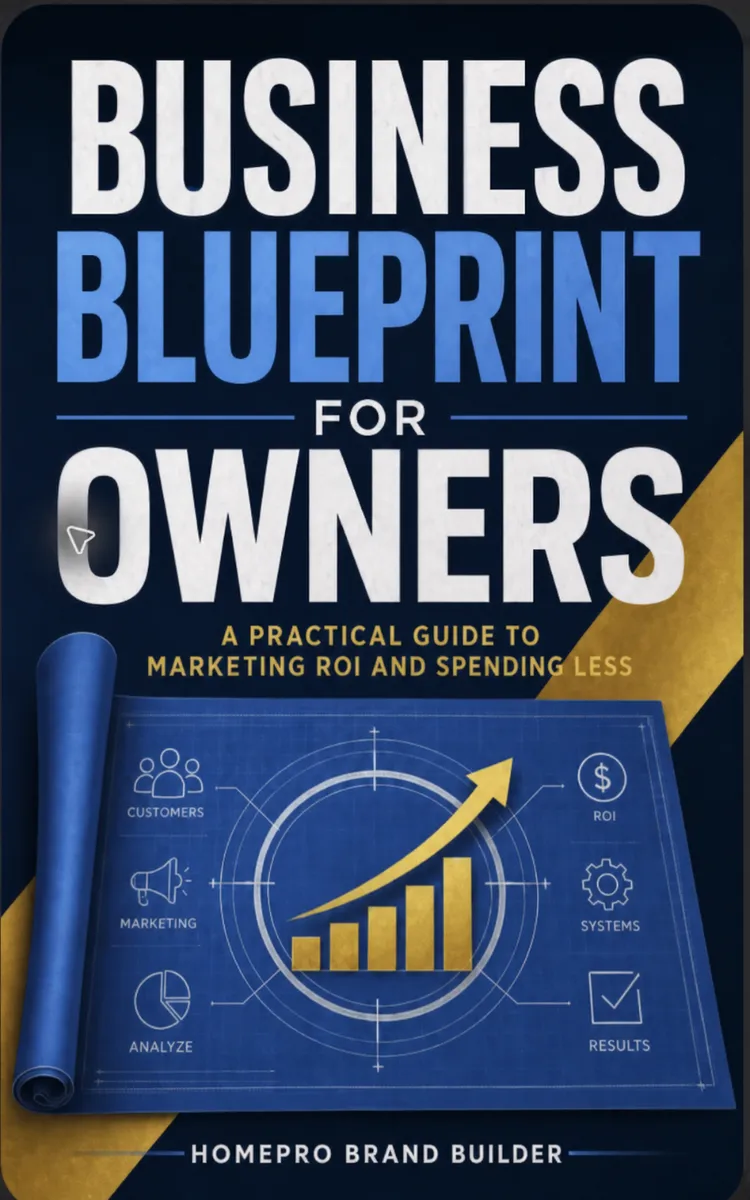
"Business Blueprint For Owners" is a business book by HomePro Brand Builder with 8 chapters and approximately 14,177 words. Service business marketing, lead generation, and cost control.
This book was created using Inkfluence AI, an AI-powered book generation platform that helps authors write, design, and publish complete books. It was made with the AI Business Book Writer.
Frequently Asked Questions
What is "Business Blueprint For Owners" about?
Service business marketing, lead generation, and cost control
How many chapters are in "Business Blueprint For Owners"?
The book contains 8 chapters and approximately 14,177 words. Topics covered include The ROI Filter for Every Purchase, Branding vs Lead-Generation Budget, Vehicle Branding That Actually Gets Remembered, Brochures, Hats, and Printed Proof, and more.
Who wrote "Business Blueprint For Owners"?
This book was written by HomePro Brand Builder and created using Inkfluence AI, an AI book generation platform that helps authors write, design, and publish books.
How can I create a similar business book?
You can create your own business book using Inkfluence AI. Describe your idea, choose your style, and the AI writes the full book for you. It's free to start.
Write your own business book with AI
Describe your idea and Inkfluence writes the whole thing. Free to start.
Start writingCreated with Inkfluence AI


