
Read the first chapter
The whole of chapter one, free. About 9 min. Turn the pages with the arrows, your keyboard, or a swipe.
Chapter 1
FTC Cooling-Off Cancellation Mechanics
Why the Three-Day Clock Matters at the Kitchen Table
Dina, 41, owns a storm-repair company. She visits a homeowner’s house, measures roof damage, explains the proposed work, and signs a $18,000 contract at the kitchen table. The homeowner invited her to inspect the property. That invitation does not remove the federal cancellation right. Because Dina signed the contract away from her permanent place of business, the Federal Trade Commission’s Cooling-Off Rule may give the homeowner until midnight of the third business day after signing to cancel.
The rule appears simple, but contractors often lose protection through small execution failures. A salesperson may mention cancellation but forget the required forms. An office may print a blank form and expect the homeowner to complete it later. A crew may start work before the cancellation period ends. Each mistake creates a record problem and may allow the homeowner to unwind the transaction long after signing.
The governing rule, 16 C.F.R. Part 429, covers contracts for $25 or more made at a location other than the seller’s permanent place of business, subject to the rule’s specific exclusions. Residential estimates and contracts commonly occur at the customer’s home, so a contractor should treat the rule as a standard closing procedure unless counsel confirms an exclusion. After applying the Three-Day Clock Checklist, you should know when the clock starts, what the contractor must say, what documents the homeowner must receive, and how to preserve proof that the process occurred.
The practical takeaway: treat cancellation compliance as part of contract formation, not as paperwork added after the sale.
The Three-Day Clock Checklist
The Three-Day Clock Checklist separates the legal requirement from the office habit. Complete each item at signing, because the contractor needs a reliable record of what happened and when.
1. Confirm the signing location. Ask whether the parties signed at the contractor’s permanent place of business or somewhere else. A customer’s home, temporary storm office, hotel, or other location away from the permanent business location can trigger the rule. Dina’s kitchen-table signing qualifies as an off-premises transaction even though the homeowner requested the inspection.
2. Confirm the contract amount. The federal threshold is $25 or more. Record the contract price on the agreement and compare it with the threshold before using the cancellation packet.
3. Give the oral notice. The contractor or salesperson must orally tell the buyer about the right to cancel. Use clear language: “You may cancel this transaction until midnight of the third business day after you sign. The attached notice explains how to cancel.” The oral statement matters because the rule requires more than a silent form packet.
4. Provide two copies of a completed cancellation form. Give the homeowner two copies at the time of signing. Complete the forms with the transaction information, including the contractor’s name and address, the contract date, and the deadline. Do not hand over blank forms and ask the homeowner to fill them out later. Two copies give the homeowner one copy to send and one copy to keep.
5. Record the deadline. Count the applicable business days after signing and identify the deadline as midnight on the third business day. The form should state the exact date and time rather than forcing the homeowner to calculate it.
6. Hold the work during the period. Do not begin performance when the contract or financing arrangement requires the contractor to wait. A contractor should also avoid collecting or using project funds in a way that conflicts with the rule or applicable state law during the cancellation period. Confirm the timing with construction counsel when the project involves custom materials, emergency conditions, deposits, or immediate services.
7. Preserve delivery proof. Keep a copy of the signed contract, the completed cancellation forms, the salesperson’s acknowledgment, the signing location, and the date and time of delivery. A file note that says “forms provided” gives less protection than a signed receipt identifying the two forms and the deadline.
The homeowner can cancel even after signing and even after inviting the contractor to the property. The contractor cannot make the right disappear by labeling the visit a “requested inspection.” Ask yourself: if a reviewer saw only the file, could that reviewer identify the signing location, the oral notice, both forms, and the precise deadline?
A separate financing rule may apply. The Truth in Lending Act, 15 U.S.C. § 1635, and Regulation Z provide a separate three-business-day rescission right for certain credit transactions secured by the homeowner’s principal residence. That issue arises when the contractor arranges or refers in-house financing, a home equity loan, or a second mortgage to fund the project. Do not treat that rescission right as the same right under the Cooling-Off Rule. When secured financing applies, the contract and financing documents must not require or permit work to begin during the applicable rescission window. Have counsel review the financing workflow, because the disclosure package and timing can differ from the construction contract.
The practical takeaway: one oral statement, two completed forms, an exact deadline, and a documented hold on performance create the core compliance record.
Applying the Checklist to Dina’s Storm-Repair Sale
Dina meets the homeowner on Monday, June 8, at 6:00 p.m. The homeowner signs an $18,000 roof-repair contract at the residence. Dina’s company does not use the home as its permanent place of business. Dina must handle the transaction as an off-premises sale unless a documented legal exclusion applies.
1. At signing, Dina identifies the transaction. Her file records the address, the $18,000 price, the Monday signing date, and the fact that the contract was signed at the homeowner’s residence. Expected outcome: the company can explain why the Cooling-Off Rule applies.
2. Dina gives the oral notice. She says that the homeowner may cancel until midnight of the third business day after signing and points to the cancellation instructions. Expected outcome: the file reflects compliance with the oral-notice requirement rather than relying only on printed language.
3. Dina delivers two completed forms. Each form names Dina’s company, states the contract date, identifies the transaction, and states the cancellation deadline. The homeowner receives both copies at 6:00 p.m. on June 8. Expected outcome: the homeowner has the documents needed to cancel, and Dina can prove delivery.
4. The office calculates the deadline. The company checks the applicable business-day calendar and prints the exact deadline on both forms. If the third business day falls on Thursday, June 11, the forms state “midnight on June 11,” subject to the rule’s applicable business-day calculation. Expected outcome: the homeowner and office use the same deadline.
5. Dina delays ordinary work. She schedules no tear-off, material delivery, or non-reversible ordering that would conflict with the cancellation right before the deadline. If an emergency condition requires immediate action, Dina obtains state-specific legal advice before changing the normal process. Expected outcome: the company avoids creating an argument that it ignored the cancellation period.
6. The office closes the record. After the deadline, the office keeps the signed contract, the homeowner’s acknowledgment of receiving two forms, the salesperson’s checklist, and any cancellation correspondence. Expected outcome: the file shows a complete process rather than a disputed memory.
If the homeowner sends a timely cancellation, Dina should stop the transaction, follow the rule’s refund and property-return requirements, and consult counsel about any materials already delivered. If no cancellation arrives, Dina still should not treat silence as permission to skip the required forms. The right exists because the transaction occurred off-premises, not because the homeowner later complains.
Quick checklist
• Confirm that the contract is for $25 or more. - Record whether signing occurred at the permanent place of business. - State the oral cancellation notice clearly. - Provide two completed cancellation forms at signing. - Print the exact midnight deadline. - Delay work when the cancellation or financing rules require a hold. - Obtain a signed receipt or electronic acknowledgment of the two forms. - Store the contract, forms, deadline calculation, and delivery record together. - Review exclusions and state requirements with a licensed construction attorney.
The practical takeaway: Dina’s strongest defense comes from a contemporaneous file that proves each step without relying on the salesperson’s recollection.
Mistakes That Keep the Clock From Running Cleanly
Mistake: Giving one form or giving blank forms
The rule requires two copies of a completed cancellation form at the time of signing. A blank template creates uncertainty about whether the homeowner received usable notice and whether the deadline appeared on the form.
Do this: Complete both forms before the homeowner signs, state the contractor’s identifying information and exact deadline, and obtain a receipt for both copies. Not this: Leave two blank forms in the packet and tell the homeowner to complete them if needed.
Mistake: Assuming the homeowner’s invitation removes the right
A homeowner may call Dina, request an inspection, and invite her inside. That fact does not by itself remove the Cooling-Off Rule. The relevant question remains whether the parties signed at the contractor’s permanent place of business or elsewhere.
Do this: Apply the location test every time and document the signing location. Not this: Mark the transaction “customer requested” and skip the forms.
Mistake: Starting work or arranging secured financing too early
Beginning tear-off, ordering custom materials, or allowing a financing arrangement to fund the job before the applicable period ends can create avoidable disputes. The financing rescission right under the Truth in Lending Act and Regulation Z may apply separately when a loan is secured by the principal residence.
Do this: Use a written hold instruction, identify the responsible employee, and obtain counsel’s review when secured financing or emergency work affects timing. Not this: Put a clause in the contract stating that the homeowner waives the federal cancellation or rescission right.
State law adds another layer. State unfair or deceptive acts and practices statutes, often called UDAP statutes, frequently follow the Federal Trade Commission Act’s Section 5 model and may treat a misleading cancellation process, missing disclosure, or deceptive sales statement as an independent violation. A contractor should not assume that federal compliance cures a state-law defect. Confirm state deadlines, form language, delivery rules, refund procedures, and remedies before using a nationwide template.
The same caution applies to insurance claims. Many states restrict a contractor from acting as a public insurance adjuster. A contractor may perform repairs, but the contractor should not negotiate, adjust, or promise a specific insurance settlement outcome while also performing the work unless state law clearly permits that conduct and the contractor holds every required license. Use conservative language such as: “Contractor performs construction and repair services only. Contractor is not acting as the homeowner’s public insurance adjuster, will not negotiate or adjust the insurance claim, and does not promise any insurance payment or settlement.”
Lien language also requires localization. Mechanic’s lien rights generally allow a contractor or subcontractor to claim an interest in property when the owner fails to pay, but most states impose advance notices, contract disclosures, deadlines, homestead rules, or recording requirements. Texas Property Code Chapter 53, including Sections 53.254 and 53.255, illustrates how detailed residential lien disclosures can become. Do not copy Texas language into another state or assume a generic clause preserves a lien. Insert a reviewed section marked: “Insert your state’s required language here,” then verify the current state statute before use.
The two drafting deliverables are therefore clear. First, prepare a plain-English explainer that covers the federal cancellation rule, secured-financing rescission, state UDAP exposure, insurance-adjusting limits, and general lien-rights issues. Second, attach a homeowner-readable clause set containing the cancellation notice, the conservative insurance disclaimer, and the placeholder lien-rights disclosure. These materials provide drafting structure, not a substitute for review by a licensed construction attorney in the contractor’s own state. Verify every state-specific statute citation, dollar threshold, deadline, homestead protection, and required disclosure against the current code before presenting the contract to customers.
A defensible cancellation process does not depend on a clever clause. It depends on a correct location test, a clear oral notice, two completed forms, an exact deadline, and a file that proves delivery. Those details turn the three-day clock from a hidden liability into a controlled contract step.
End of chapter one. 7 more chapters in the full book.
Swipe or use the arrows to turn the page

Meta Ads For Residential Contractors

Contract Dispute Playbook For Contractors

10 Copy-Paste AI Prompts
What's inside: 8 chapters
- 1. FTC Cooling-Off Cancellation Mechanics
- 2. TILA Rescission When Financing Appears
- 3. Contingency Clause for Insurance Claims
- 4. State Public Adjuster Licensing Variance Map
- 5. UDAP-Proof Contract Language Standards
- 6. Mechanic’s Lien Rights Overview
- 7. Texas Mechanic’s Lien Disclosure Example
- 8. Assemble the Defensible Clause Set
About this book
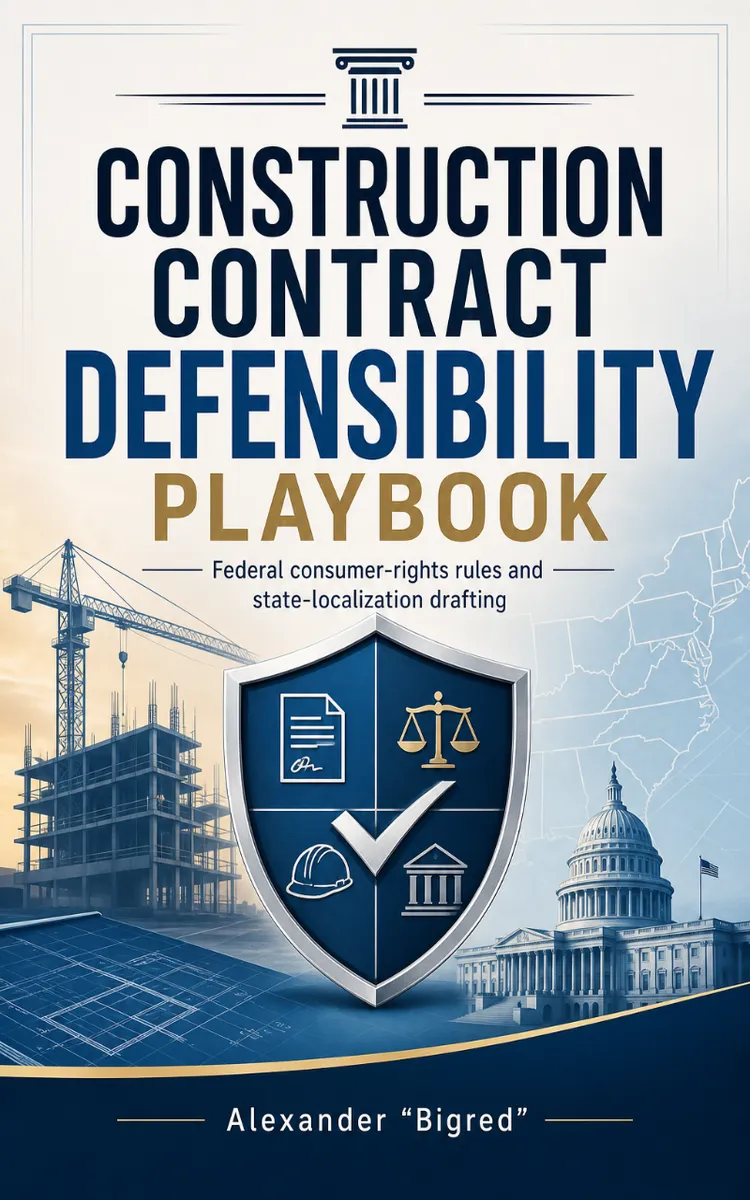
"Construction Contract Defensibility Playbook" is a how-to guide book by HomePro Brand Builder with 8 chapters and approximately 15,770 words. Drafting residential construction contracts with federal and state legal compliance.
This book was created using Inkfluence AI, an AI-powered book generation platform that helps authors write, design, and publish complete books. It was made with the AI Ebook Generator.
Frequently Asked Questions
What is "Construction Contract Defensibility Playbook" about?
Drafting residential construction contracts with federal and state legal compliance
How many chapters are in "Construction Contract Defensibility Playbook"?
The book contains 8 chapters and approximately 15,770 words. Topics covered include FTC Cooling-Off Cancellation Mechanics, TILA Rescission When Financing Appears, Contingency Clause for Insurance Claims, State Public Adjuster Licensing Variance Map, and more.
Who wrote "Construction Contract Defensibility Playbook"?
This book was written by HomePro Brand Builder and created using Inkfluence AI, an AI book generation platform that helps authors write, design, and publish books.
How can I create a similar how-to guide book?
You can create your own how-to guide book using Inkfluence AI. Describe your idea, choose your style, and the AI writes the full book for you. It's free to start.
Write your own how-to guide book with AI
Describe your idea and Inkfluence writes the whole thing. Free to start.
Start writingCreated with Inkfluence AI


