

Read the first chapter
The whole of chapter one, free. About 4 min. Turn the pages with the arrows, your keyboard, or a swipe.
Chapter 1
Day One: Begin Where David Began-With God
Scripture Focus
Psalm 16:8 (KJV)
> I have set the LORD always before me: because he is at my right hand, I shall not be moved.
David’s starting point was not confidence in himself, but the steady presence of God beside him.
Before David faced Goliath, ruled a kingdom, ran from Saul, or sang through sorrow, he learned to look toward the Lord. Psalm 16 gives us a glimpse of that settled choice: “I have set the LORD always before me.” David didn’t treat God as a distant idea reserved for worship gatherings or emergencies. He placed the Lord before his eyes in ordinary life.
That changes the way we begin a day. God isn’t merely a subject to study or a name to mention when trouble arrives. He is the living God who walks with His people. David’s faith grew through conversation, obedience, worship, and honest dependence. He brought his fear to God. He brought his questions. He brought his failures, too.
The phrase “always before me” doesn’t mean David never became distracted. Scripture shows that he did. It means he kept returning his attention to the Lord. That’s good news for us. A distracted mind isn’t a disqualified heart. We can turn back to God in the kitchen, in the truck, at the desk, or while waiting in a doctor’s office. A simple inward prayer can become a doorway: “Lord, help me remember that You are here.”
David’s relationship with God also had a rhythm. He listened to God’s word, reflected on what it meant, prayed honestly, and responded with trust. We can follow that same rhythm today: read, reflect, pray, respond. Reading gives us truth. Reflection helps us notice how that truth meets our lives. Prayer brings our hearts before God. Response turns faith into a step of obedience.
Perhaps you’re beginning this devotional with a busy mind. Maybe your schedule is already crowded, and adding one more thing sounds difficult. The goal isn’t to create a polished religious routine. It’s to make room for a real relationship. Five attentive minutes with God are better than twenty distracted minutes performed out of guilt.
David’s example invites us to begin with a simple decision: God will not be pushed to the edges of my day. You may not know what tomorrow holds, but you can choose where to look today. Set the Lord before you, not as a burden, but as your companion and sure foundation.
Practice for Today
1. Read Psalm 16:1-11 slowly. Read it once without stopping. Then read it a second time, paying attention to every phrase that describes God’s nearness, guidance, or goodness. Underline one phrase in your Bible or write it on a note in your phone. Let that phrase stay with you during the day. “I have set the LORD always before me” is a good one to carry into a difficult conversation or a demanding workday.
2. Use the four-part rhythm: read, reflect, pray, respond. Set a timer for ten minutes. Spend the first three minutes reading Psalm 16. Use the next two minutes to reflect on this question: Where have I been treating God like a distant idea instead of the Person who is with me? Spend three minutes praying in plain words. You might mention your schedule, a decision, a worry, or a relationship. Use the final two minutes to choose one response. Write a sentence such as, “Today I will pause before answering in anger,” or, “Today I will ask God for wisdom before making this decision.”
3. Keep a one-page “Walking With God” journal. At the top, write today’s date. Then complete these three sentences:
• I noticed God’s presence when… - I need to trust Him with… - My next faithful response is…
Be specific. Instead of writing, “I need to trust God more,” write, “I need to trust God with the conversation I’m avoiding.” Instead of “God was good,” write, “God gave me patience when the delivery was late and I wanted to complain.” These details train your heart to recognize that walking with God happens in real places and ordinary moments.
As you move through the day, use a small physical reminder. Place your Bible beside your coffee cup, set Psalm 16:8 as a phone note, or keep the verse on a card in your wallet. Each time you see it, pause for one breath and say, “Lord, You are with me.” This isn’t a magic formula. It’s a practical way to turn your attention back toward the Person you’ve chosen to walk with.
Don’t measure today by how perfectly you kept your focus. Measure it by how often you returned. If you forget God for three hours, return when you remember. If you become impatient, return. If you receive good news, return with thanks. David’s life was not a picture of flawless attention. It was a life repeatedly brought back to God.
Closing Prayer
Lord, I set You before me today. Help me know You as near, personal, and faithful - not merely as an idea I think about. Teach me to read Your Word with an open heart, reflect honestly, pray simply, and respond with trust. When I become distracted, draw my attention back to You without fear or shame. Walk with me through every ordinary task and every difficult moment. Because You are at my right hand, steady my heart. In Jesus’ name, amen.
End of chapter one. 14 more chapters in the full book.
Swipe or use the arrows to turn the page


What's inside: 15 chapters
- 1. Day One: Begin Where David Began-With God
- 2. Day Three to Four: The Call to Trust
- 3. Day Five to Six: Prayer That Breathes
- 4. Day Seven to Eight: Courage in the Waiting
- 5. Day Nine to Ten: Failing Without Hiding
- 6. Day Eleven: The Turning Point-Surrender Your Heart
- 7. Day Twelve to Thirteen: Godly Fear and Real Repentance
- 8. Day Fourteen to Fifteen: Forgiveness That Restores
- 9. Day Sixteen: When Enemies Press In
- 10. Day Seventeen to Eighteen: Hope in the Dark
- 11. Day Nineteen: Worship as Warfare
- 12. Day Twenty to Twenty-One: Integrity When It Costs
- 13. Day Twenty-Two to Twenty-Three: God’s Grace in Consequences
- 14. Day Twenty-Four to Twenty-Six: Forgiving Others as You’ve Been Forgiven
- 15. Day Twenty-Seven to Thirty: A New Walk-Steadfast to the End
About this book
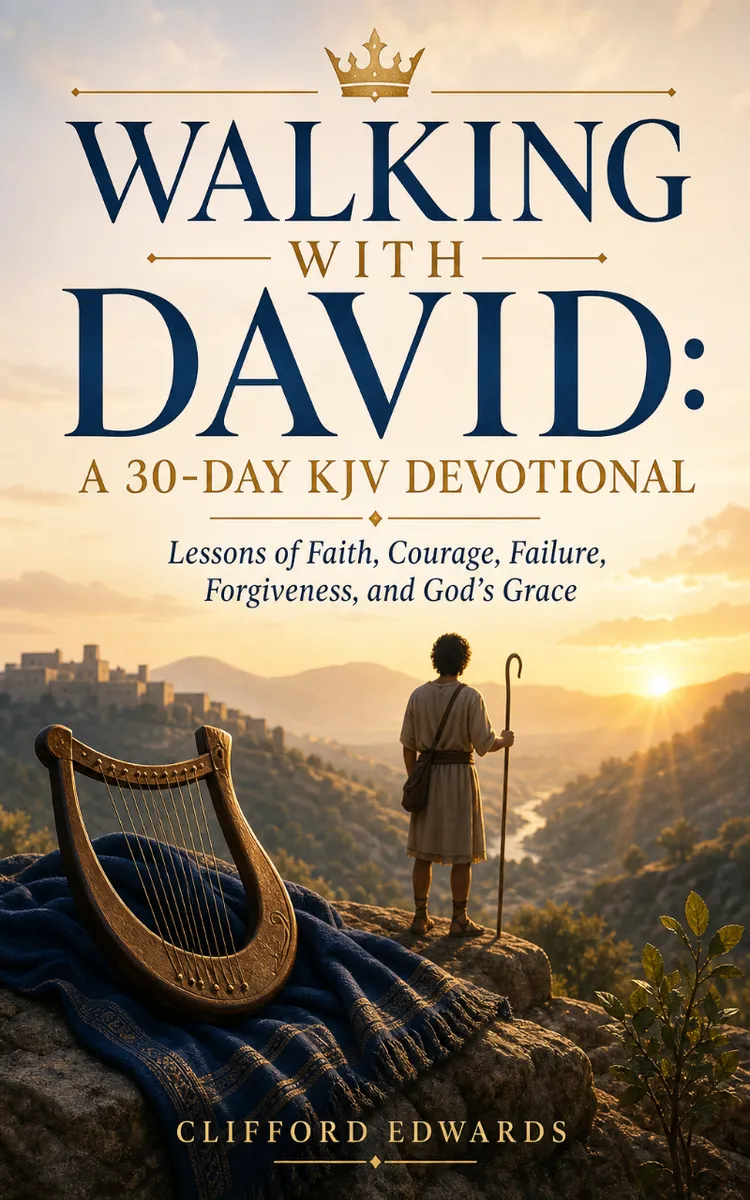
"Walking With David" is a religious devotional book by Clifford Edwards with 15 chapters and approximately 15,314 words. 30-day KJV devotional lessons from David’s life.
This book was created using Inkfluence AI, an AI-powered book generation platform that helps authors write, design, and publish complete books.
Frequently Asked Questions
What is "Walking With David" about?
30-day KJV devotional lessons from David’s life
How many chapters are in "Walking With David"?
The book contains 15 chapters and approximately 15,314 words. Topics covered include Day One: Begin Where David Began-With God, Day Three to Four: The Call to Trust, Day Five to Six: Prayer That Breathes, Day Seven to Eight: Courage in the Waiting, and more.
Who wrote "Walking With David"?
This book was written by Clifford Edwards and created using Inkfluence AI, an AI book generation platform that helps authors write, design, and publish books.
Write your own religious devotional book with AI
Describe your idea and Inkfluence writes the whole thing. Free to start.
Start writingCreated with Inkfluence AI


