
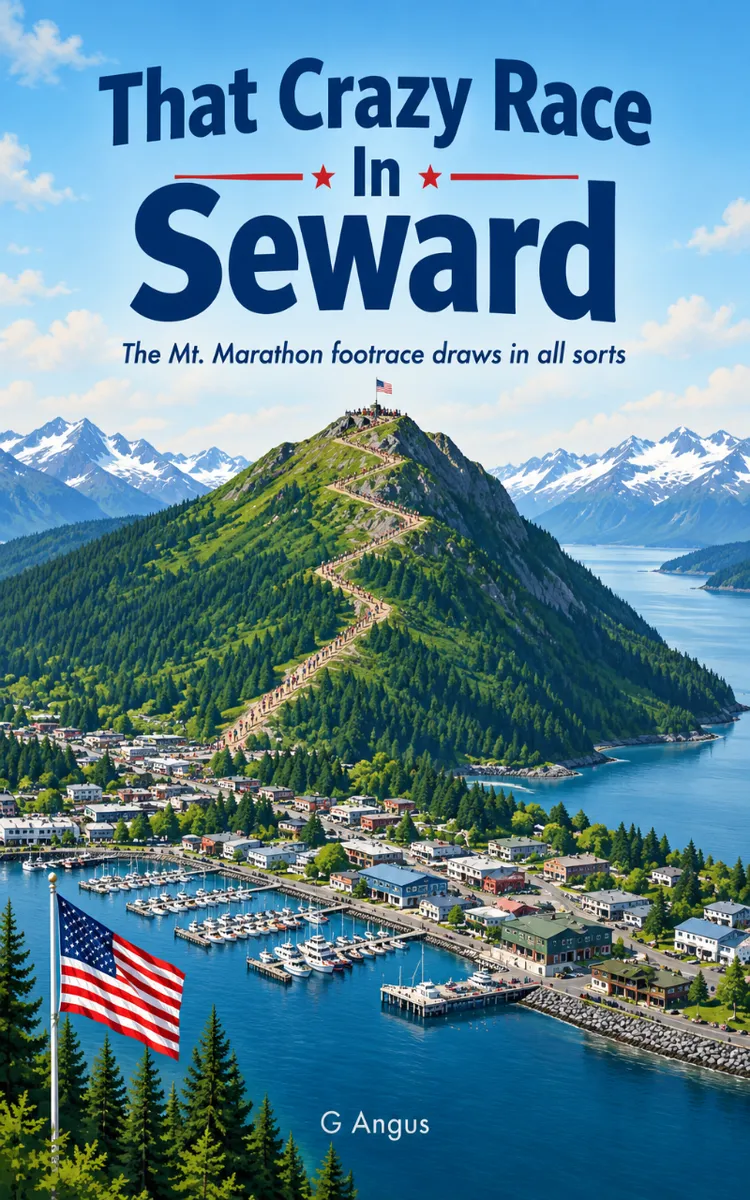

Read the first chapter
The whole of chapter one, free. About 10 min. Turn the pages with the arrows, your keyboard, or a swipe.
Chapter 1
The Trailhead Mudslide
June Calder arrived in Seward with one ambition, two sensible shoes, and a race map already softening in the drizzle.
The map had been folded into a square no larger than a sandwich and tucked beneath her jacket, where it was supposed to remain dry. Seward, however, had other plans. Rain ticked against the hood of her coat. Salt wind came off Resurrection Bay smelling of kelp, diesel, and somebody’s cinnamon roll. Ahead, the Mt. Marathon trailhead rose above the July Fourth crowds, a dark, muddy notch between spruce trees and impatient runners.
June wanted to see the course before the famous footrace began. She wanted to understand where runners started, where they climbed, where they turned around, and where they came down looking as if the mountain had personally objected to their entry form.
A volunteer in a yellow vest waved her toward the trail.
“Start area’s up there,” he called. “Mind the bottleneck.”
June looked at the narrow path, the slick stones, and the line of spectators packed behind a rope.
“How bad is the bottleneck?”
The volunteer glanced at the sky. “Depends whether you ask before or after somebody falls.”
That seemed less like information than a prophecy.
June stepped through the opening.
The first few yards were manageable. Her left foot found gravel. Her right foot found a flat rock. Then her right foot found the exact patch of mud that had been waiting all morning for a newcomer with confidence.
Her boot sank to the ankle.
June’s arms flew out. The map under her jacket crinkled like a startled bird. She tried to pull free, but the mud held her with the quiet determination of a landlord collecting rent.
“Don’t lean back!” someone shouted.
June leaned back.
Her other boot slid forward. For one graceful second, she stood in a pose usually seen on ice skaters and people who had just discovered a banana peel. Then she dropped onto one knee.
Cold mud splashed up her coat, across her chin, and into the open collar of a man behind her.
“Sorry,” she said.
The man wiped his neck. “I’ve had worse.”
“Here?”
“Only once.”
A cluster of runners pressed around them, each carrying the tense, narrow expression of someone who had spent months training for speed and had now been reduced to watching a stranger lose an argument with the ground.
June tried to stand. The mud made a wet popping sound.
“Give me your hand,” said a woman in a red cap.
June grabbed it. The woman pulled. June rose six inches, the mud released her boot, and the red-capped woman sat down hard in the puddle.
Her cap floated away.
“Excellent,” the woman said, staring at it. “I was worried my hair might stay dry.”
The crowd shifted, and the bottleneck tightened. A stroller backed into a rope post. A teenager carrying three paper cups turned sideways and lost one cup to a spruce branch. Somewhere above them, a loudspeaker crackled and announced that the junior runners should remain in their staging lane.
Nobody in the bottleneck was in a staging lane.
June finally freed both feet and scrambled toward a fir tree. She caught a branch for balance. The branch bent, shook rainwater into her hood, and sprang back with enough force to slap a man’s sunglasses off his face.
“Trail’s lively today,” he said.
June wiped her eyes and looked uphill.
The course began just beyond the trailhead, marked by orange flags and wooden arrows nailed to posts. She could see the route climbing toward the mountain, disappearing among wet rocks and low brush. The sight of it thrilled her. It was steeper than the photographs suggested, rougher too. Mt. Marathon did not appear to invite anyone upward. It appeared to tolerate runners briefly.
June reached beneath her jacket for the map.
The paper was damp but readable. The start area was marked in blue. The first turn was marked in red. A dotted line showed the lower trail, bending around the very bottleneck currently swallowing boots, caps, cups, and dignity.
She took one step toward the course marker.
A runner in a black jacket moved between her and the post.
Then another runner joined him.
June stopped.
They were not stretching. They were not admiring the mountain. One of them had a small wrench in his hand. The other held the wooden arrow at the base while a third man, taller and broad-shouldered, looked back toward the crowd.
The arrow pointed uphill and slightly left.
The tall man shook his head.
“Too obvious,” he said.
The runner with the wrench crouched. “It only has to look official.”
“It looks official now.”
“It looks like a sign.”
“That’s generally the goal.”
June glanced around. The crowd noise rolled over the trailhead: boots scraping, children calling, vendors shouting about coffee. No one seemed to notice the three men near the marker. The broad-shouldered runner pulled a folded strip of orange tape from his pocket.
June’s damp map crackled in her hand.
The runner with the wrench loosened the bolt.
The arrow shifted.
Not much. Just enough to point toward a narrower path disappearing behind the spruce.
June stepped forward. Her boot sank again.
This time she caught herself against the marker post.
The post wobbled.
All three runners turned.
The man with the wrench stared at her muddy knee. “You all right?”
“I’m fine,” June said.
The marker leaned against her shoulder.
“Your sign isn’t,” she added.
The broad-shouldered man reached for it. “Wind.”
“There isn’t any.”
“There was wind earlier.”
“It’s July Fourth,” said the man with the wrench. “Wind gets patriotic.”
June looked from him to the wrench, then to the arrow. “Is the route supposed to go that way?”
“Which way?”
“The way you’re moving it.”
Nobody answered.
Behind June, the bottleneck gave a tremendous sucking noise. The red-capped woman had attempted to retrieve her hat and lost one shoe instead. A spectator shouted that somebody’s thermos was rolling downhill. The thermos struck a post, bounced off a boot, and came to rest against June’s ankle.
She bent to pick it up.
The paper map slipped from her hand.
It landed face-down in the mud.
June froze.
The thermos owner called, “That’s mine!”
The three runners looked at the map. The map looked back from beneath a glossy layer of brown sludge.
June snatched it up. The course lines blurred together. The first turn became a blue smear. The dotted trail vanished entirely.
“Perfect,” she muttered.
The broad-shouldered runner stepped closer. “You should get out of here.”
June held the map by one corner. Mud dripped from it onto her boot.
“Why?”
“Because this section is dangerous.”
“That’s what the volunteer said.”
“And he was right.”
The runner with the wrench tucked it into his jacket. “Nobody wants a tourist blocking the route.”
June stared at him. “I’m not blocking the route.”
At that moment, a child in a yellow raincoat ran between them chasing a balloon. The balloon snagged on the orange tape. The tape pulled loose from the runner’s hand, wrapped around the child’s waist, and dragged the entire marker post sideways.
The arrow swung.
For one impossible moment, it pointed directly at the broad-shouldered runner.
The child looked up at him. “Is that the way to the bathroom?”
“No,” he said.
The marker tipped.
June grabbed it. The wrench runner grabbed it too. The third man seized the arrow. All four of them held the post while the child’s balloon squeaked overhead and the crowd squeezed closer to see what was happening.
“Let go,” June said.
“You let go,” said the wrench runner.
“I’m not the one tampering with it.”
“We’re repairing it.”
“With a wrench?”
“It’s a very specialized repair.”
The post slid another inch. Mud burped around its base.
The red-capped woman, now wearing one boot and carrying the other, arrived at the edge of the group. “Is this the line for something?”
“It’s the course marker,” June said.
“Oh.” She studied the arrow. “Then it’s pointing wrong.”
The three runners went still.
The broad-shouldered man smiled with the careful politeness of someone trying to convince a dog not to bark. “It’s being adjusted.”
“Why?”
“Better visibility.”
“From where?”
He pointed uphill. “From there.”
“That’s not where the runners come from.”
“It could be.”
The loudspeaker crackled again.
“Runners in the lower staging area, please move toward the start chute.”
The crowd began to shift. The rope sagged. Someone bumped June from behind. Her muddy map tore down the middle with a soft, final rip.
She stared at the two halves.
The red-capped woman leaned over. “That seems bad.”
“It was a map.”
“It was also a map before.”
June tucked the ruined pieces into her jacket. “I know.”
The marker post lurched. The wrench runner lost his grip. The arrow swung free and struck the broad-shouldered man in the shoulder with a hollow wooden thunk.
He grunted.
The child’s balloon escaped, rose three feet, and lodged in the branches.
The man who had lost his sunglasses shouted, “My glasses!”
The thermos owner shouted, “My thermos!”
The red-capped woman shouted, “My shoe!”
June shouted, “Stop moving the marker!”
Her voice carried farther than she expected. The three runners released the post at once.
It sprang upright.
Then it fell in the opposite direction, directly across the narrow trail.
Runners approaching from below stopped short. One skidded, collided with another, and sat down in the mud with both legs straight out. A third runner vaulted over him, landed on the fallen arrow, and windmilled into a stack of empty coffee cups.
The cups scattered like tiny white helmets.
The broad-shouldered man bent to lift the marker. The wrench runner grabbed the arrow. The third man pulled orange tape from his pocket again.
June saw the movement clearly now. They were not repairing anything. They were setting the marker to point away from the proper course, toward the narrow path behind the spruce.
“Hey!” she said.
The wrench runner looked at her.
June pointed. “That’s not an adjustment.”
His face changed. The joking disappeared first. Then the polite expression. What remained was a quick calculation.
He glanced toward the mountain, toward the crowd, and toward the other two men.
“Move,” he said.
June did not.
The broad-shouldered man stepped around the post. “You don’t understand what you’re seeing.”
“I understand arrows.”
“And mud,” said the red-capped woman, who had just recovered her shoe. “She understands mud extremely well.”
The third runner yanked the marker upright. Orange tape snapped around the post. The arrow pointed toward the wrong trail.
For a heartbeat, the whole noisy trailhead seemed to arrange itself around that crooked sign. The rain tapped the leaves. The loudspeaker hissed. The mountain rose beyond the trees, patient and gray.
Then a volunteer spotted the marker.
“Hey!” he called from below. “Who moved that?”
The runners moved.
Not together. That would have looked suspicious. The broad-shouldered man headed toward the staging lane. The wrench runner slipped behind the spruce. The third man jogged uphill with the loose tape trailing from his pocket like a bright orange tail.
June lunged after them.
Her boot caught the fallen arrow.
She went down onto both hands.
Mud spread beneath her palms. Her ruined map slid from her jacket, skated across the trail, and disappeared beneath a passing boot.
By the time June stood, the three runners had joined the crowd. One was adjusting his bib. Another was stretching beside a trash barrel. The broad-shouldered man had found a volunteer vest and was pointing toward the proper course with great authority.
June looked at the marker.
It stood straight now.
It pointed the right way.
The volunteer reached her, breathing hard. “What happened?”
June opened her mouth.
The red-capped woman raised her one-shoed foot. “Several things.”
June looked toward the spruce. The narrow path was empty. The orange tape had vanished. Around her, runners gathered for the start, faces bright with rain and nervous excitement. The mountain waited above them, and somewhere in the crowd three men were preparing to run a race whose route they had just tried to change.
“I saw them move it,” June said.
“Who?”
June searched the crowd.
The broad-shouldered runner looked back at her. His expression was calm now, almost bored. He lifted two fingers in a casual wave.
June pointed.
But a parade marshal stepped between them carrying a flag, and when the crowd shifted again, the runner was gone.
The volunteer steadied the marker. “Are you certain?”
June looked down at her hands, her coat, her single intact bootlace, and the two muddy halves of her map. She had reached the trailhead. She had learned the course layout. She had also learned that the layout could apparently be edited by anyone carrying a wrench and enough confidence.
“Yes,” she said. “I’m certain something is wrong.”
Behind them, the loudspeaker announced the runners’ staging call.
From farther up the trail came the faint clatter of wood against stone.
June turned toward the sound.
The marker beside her was still pointing the right way.
For the moment.
End of chapter one. 32 more chapters in the full book.
Swipe or use the arrows to turn the page


What's inside: 33 chapters
- 1. The Trailhead Mudslide
- 2. The Volunteer Whistle Mix-Up
- 3. The Missing Course Map
- 4. The Dockside Boot Snag
- 5. The Bib Number Temptation
- 6. The Inflatable Arch Escape
- 7. Who Took the Timing Box?
- 8. The Rental-Kiosk Kayak Tangle
- 9. The Girlfriend’s Quiet Doubt
- 10. The Parade Float Detour
- 11. The Crate Label Clue
- 12. The Fish-Gut Alley Shortcut
- 13. The Easy Lie
- 14. The Bib Table Avalanche
- 15. The Duplicate Number Trail
- 16. The Mountain Path Wrong Turn
- 17. The Plan in the Radio Static
- 18. The Unsaid Apology
- 19. The Stolen Megaphone Parade
- 20. The False Volunteer Roster
- 21. The Fish Cannery Maze
- 22. The Girlfriend’s Hard Choice
- 23. The Starting-Gun Confetti Burst
- 24. The Missing Marshal’s Flag
- 25. The Empty Evidence Pocket
- 26. The Ridge-Path Dead End
- 27. The Borrowed Shoe Decision
- 28. The Radio Call That Vanished
- 29. The Wrong-Turn Flag Parade
- 30. Owen’s Public Confession
- 31. The Muddy Finish-Chute Shuffle
- 32. The Medal on the Wrong Neck
- 33. The Confetti, Kayaks, and Bibs
About this book
"That Crazy Race In Seward" is a comedy book by G Angus with 33 chapters and approximately 76,654 words. A plot to steal and win Seward’s famed July Fourth footrace.
This book was created using Inkfluence AI, an AI-powered book generation platform that helps authors write, design, and publish complete books. It was made with the AI Novel Writer.
Frequently Asked Questions
What is "That Crazy Race In Seward" about?
A plot to steal and win Seward’s famed July Fourth footrace
How many chapters are in "That Crazy Race In Seward"?
The book contains 33 chapters and approximately 76,654 words. Topics covered include The Trailhead Mudslide, The Volunteer Whistle Mix-Up, The Missing Course Map, The Dockside Boot Snag, and more.
Who wrote "That Crazy Race In Seward"?
This book was written by G Angus and created using Inkfluence AI, an AI book generation platform that helps authors write, design, and publish books.
How can I create a similar general book?
You can create your own general book using Inkfluence AI. Describe your idea, choose your style, and the AI writes the full book for you. It's free to start.
Write your own comedy book with AI
Describe your idea and Inkfluence writes the whole thing. Free to start.
Start writingCreated with Inkfluence AI


