

Read the first chapter
The whole of chapter one, free. About 7 min. Turn the pages with the arrows, your keyboard, or a swipe.
Chapter 1
The Quiet Before the Dead Zone
The departure board above Union Station froze at 8:17, every destination replaced by a clean white rectangle.
Claire Bennett noticed because the board had never frozen before. It had stuttered during storms, flashed wrong platforms during maintenance, once displayed an apology in three languages when a squirrel shorted a line near Baltimore. But now the letters vanished across the entire panel at once.
Around her, Washington continued moving.
Shoes struck the marble. A train announcement dissolved into static. Someone laughed near the coffee kiosk, unaware that the woman beside him had lifted her phone and was staring at a screen that showed no bars, no carrier name, nothing but the time.
Claire checked hers.
No service.
She opened the secure work application. The login wheel spun, stopped, and returned her to the password field.
“Come on,” she whispered.
Her first thought was her family. Her mother in Arlington. Her younger brother at work near Bethesda. Claire tapped her mother’s number, pressed call, and listened.
Not ringing. Not voicemail.
A flat electronic tone repeated twice, then died.
She tried again. The same tone.
A man in a navy suit pushed past her, phone raised. “Is anybody getting through?”
“No,” Claire said.
He turned toward the crowd. “The whole station?”
A dozen people answered at once. Some cursed. Others moved toward the exits, as if the doors themselves might offer a stronger signal.
Claire slipped her laptop from its case and headed for the security office beneath the station concourse. She had come to Washington for a routine morning review of federal communications anomalies, the kind of work that usually ended with a flagged router, a software patch, and a bland email no one read. Her objective had changed in less than a minute. She needed to determine whether the failure belonged to Union Station or to every network around it, then reach her family before the city understood what had happened.
At the security desk, a guard blocked the corridor.
“Staff only,” he said.
“I’m federal communications analysis.”
“Badge?”
Claire held it out. He looked at the photograph, then at her face. His radio crackled against his shoulder, emitting a burst of noise.
“Your radio working?” she asked.
He pressed the transmit button. “Control, this is station security. Do you copy?”
Static.
He tried again, harder, as though force could travel through dead circuitry. Nothing answered.
Claire felt the first cold line of fear move beneath her ribs.
“Let me through,” she said.
The guard hesitated. Behind them, the crowd thickened. A woman was crying into a phone. A child tugged at his father’s coat, asking why nobody could call the police. The station’s air-conditioning hummed overhead, steady and indifferent.
“Miss, I can’t - ”
“Your emergency systems are failing.” Claire lowered her badge. “If this is local, I can help isolate it. If it isn’t, you need to know before someone panics and turns this place into a crush.”
That reached him. He unlocked the door.
The security office smelled of dust, hot plastic, and old coffee. Three monitors showed camera feeds. Two had gone black. The third displayed the main hall from above, where commuters now clustered beneath the dead departure board.
Claire took the nearest terminal and connected her laptop through an access port. The station network accepted the physical handshake, but every outside route timed out.
She opened a diagnostic window and ran the carrier checks manually. One network failed. Then another. Then the government priority channel. The results appeared in sequence, each one marked unavailable.
She stared at the screen.
“Can you tell what’s wrong?” the guard asked.
“Not yet.”
“Is it an attack?”
“I said I don’t know.”
A sharp bang sounded beyond the door. The guard reached for his sidearm. Claire flinched, then saw the camera feed jump. A crowd had surged against the ticket gates. Metal rails bent with a shriek. Transit officers shouted for people to step back, but their commands vanished beneath the rising noise.
Claire pulled a headset from the console and fitted it over one ear. The local radio channel was alive with fragments.
“ - repeat, no cellular service - ”
“ - ambulance dispatch unable to - ”
“ - all carriers, not just - ”
Then the channel cut.
She opened a second diagnostic window. The network map filled with red points across the District. She widened the range to Northern Virginia. Red. Maryland. Red.
That should have been enough to establish a regional failure. It wasn’t enough for her.
Claire reached into her case for a compact spectrum receiver, a tool she carried for field verification. The device was cold and heavy in her hand. She connected it to the laptop and began scanning the bands used by commercial cellular networks.
Nothing.
The screen showed empty channels, clean and silent.
Then, beneath the noise floor, a thin green line appeared.
Claire leaned closer.
The signal lasted less than a second, a narrow pulse buried between dead bands. It returned three seconds later, then vanished again.
“Did you see that?” she asked.
The guard was watching the hall camera. “See what?”
She adjusted the scan range and waited.
Another pulse.
Not a carrier beacon. Not the broad, chaotic spill of a damaged tower. It was too precise, too narrow, as if something were speaking from underneath the outage and taking care not to be heard.
Claire started a capture.
The guard looked over. “What are you doing?”
“Recording the signal.”
“Why?”
“Because nothing is supposed to be transmitting.”
The station lights flickered.
For one second, the monitors went black. When they returned, the camera feed showed the main hall from a different angle, one Claire had never seen listed in the system. The image was grainy and pointed toward a maintenance corridor behind the ticket gates.
A figure stood at the far end.
Claire froze.
The figure wore a dark jacket and faced the camera. No face was visible, only a pale rectangle where the image had blown out. Then the feed snapped back to the normal overhead view.
“Did your system just switch cameras?” she asked.
The guard turned from the monitor. “What?”
She replayed the last five seconds. The corridor appeared, the figure motionless in the center, then the hall returned.
He swore and reached for the radio again.
Before he could speak, the station’s public-address system came alive.
“Attention,” a voice said, distorted by static. “Remain calm. Service interruption is temporary.”
The message repeated.
Claire looked at the spectrum receiver. The green pulse had returned, stronger now. It climbed through the laptop’s capture window in a pattern of short bursts, each separated by the same interval.
A message inside a failure.
Her phone remained dead in her palm. She pictured her mother standing in the kitchen, trying to call her. She pictured her brother leaving work into streets where no one could summon help. The thought tightened into something more useful than fear.
She opened the packet capture and began stripping away the carrier noise. The signal resisted, then resolved into a string of raw data. Not enough to interpret, but enough to prove that the outage was not an accident confined to one station.
She selected the emergency federal gateway and attempted a direct transmission.
The first attempt failed.
The second failed.
On the third, a single line appeared.
ROUTE UNAVAILABLE.
Claire stared at it, then reached for the landline mounted beside the console. She lifted the receiver.
No dial tone.
The guard watched her. “What now?”
“Now I leave.”
“Outside is worse.”
“I need a hardline.”
“There isn’t one.”
“Then I find one.”
She copied the signal capture to an encrypted drive, shut the laptop, and slid it into her case. The guard stepped in front of the door.
“You can’t walk into that crowd.”
Claire looked through the narrow window. The hall had become a moving mass of coats, bags, and raised phones. A man was pounding on a locked gate. Somewhere near the entrance, glass shattered. The sound rolled through the station like a starting gun.
“If I stay here,” she said, “I’m blind. If I get to the federal building, I might find out what happened.”
“And your family?”
She tightened her grip on the case. “I find them after I know whether this is happening everywhere.”
The words sounded cruel. They were also the only decision left.
The guard opened the door.
Cold morning light cut across the concourse as Claire stepped into the surge. People pressed around her, carrying the dead weight of devices that had become useless in their hands. Outside, traffic had stalled along Massachusetts Avenue. Drivers leaned on horns that answered one another in angry waves. A bus sat crooked across an intersection, its electronic sign blank.
Claire climbed the station steps and stopped.
Washington had lost its invisible voice.
No ringing phones. No bursts of conversation from earbuds. No digital chimes from crosswalks or delivery scanners. Only engines, shouting, and the hard slap of shoes moving in every direction.
She opened the receiver on her spectrum device.
The signal was still there.
It pulsed beneath the city’s silence, faint but deliberate.
Claire turned toward the federal district, then glanced once at the useless phone in her hand. Somewhere beyond the dead network, her family was waiting for an answer she could not send.
The receiver pulsed again.
She started walking.
By the time she reached the next block, the scan had expanded beyond Washington. A remote node answered from Chicago. Another surfaced near Los Angeles. Then one in Seattle.
The failure was nationwide.
And beneath it, something was still transmitting.
End of chapter one. 32 more chapters and about 68,346 words in the full book.
Swipe or use the arrows to turn the page


What's inside: 33 chapters
- 1. The Quiet Before the Dead Zone
- 2. The Signal Beneath Silence
- 3. The Packet That Shouldn't Exist
- 4. The Relay Station
- 5. A Promise Without Signal
- 6. The Sky Goes Blind
- 7. Accounts Under Lock
- 8. The Terminal Without Exits
- 9. The Cost of Staying
- 10. The First Street Fire
- 11. The Federal Fingerprint
- 12. The Checkpoint Line
- 13. The Line She Won't Cross
- 14. The Curfew Broadcast
- 15. The Country in the Trace
- 16. The Borderless Safehouse
- 17. The Undercover Mandate
- 18. The Name on the List
- 19. The Quiet Departure
- 20. The Passenger Who Knew
- 21. The Port of False Papers
- 22. The Face in the Mirror
- 23. The Military Warning
- 24. The Empty Server Room
- 25. The Last Safe Channel
- 26. Across the Dry Wadi
- 27. The Choice at the Gate
- 28. The Handler's Real Name
- 29. The Barrier Breaks
- 30. The First Answer Home
- 31. The City Behind Barricades
- 32. The Account Reopens
- 33. The Signal That Remains
About this book
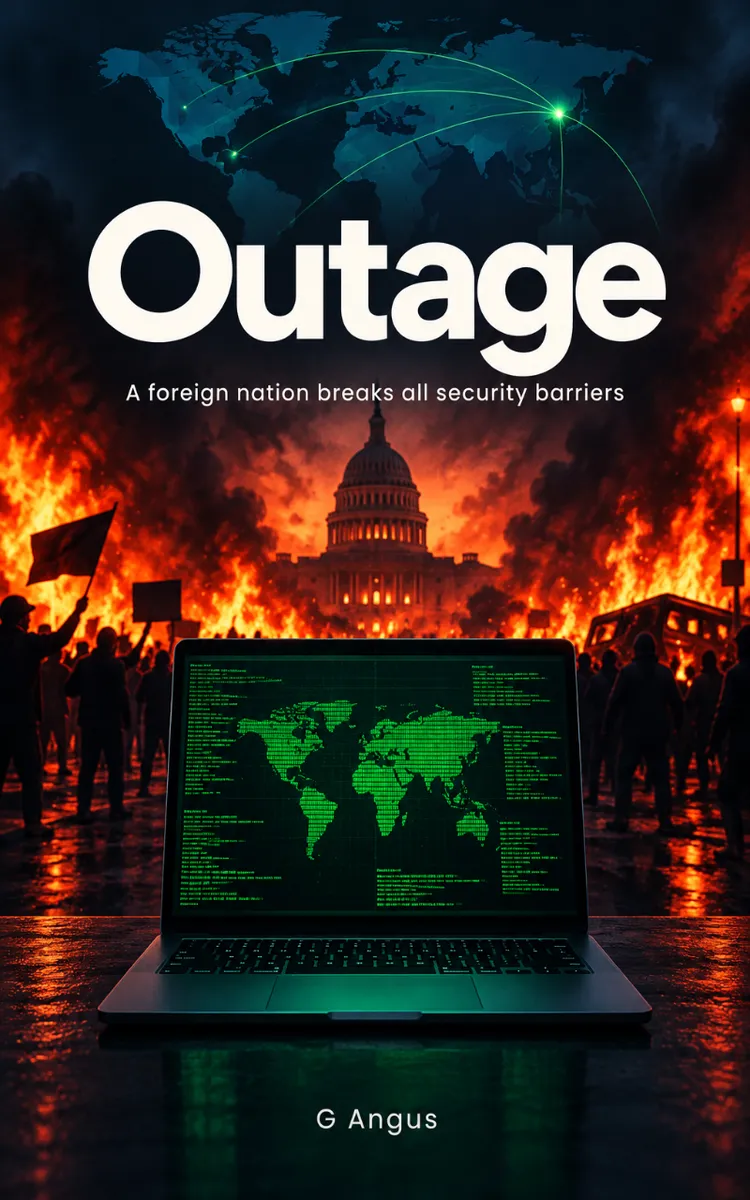
"Outage" is a fiction book by G Angus with 33 chapters and approximately 68,346 words. A covert security team races to stop cyberattacks destabilizing the United States.
This book was created using Inkfluence AI, an AI-powered book generation platform that helps authors write, design, and publish complete books. It was made with the AI Novel Writer.
Frequently Asked Questions
What is "Outage" about?
A covert security team races to stop cyberattacks destabilizing the United States
How many chapters are in "Outage"?
The book contains 33 chapters and approximately 68,346 words. Topics covered include The Quiet Before the Dead Zone, The Signal Beneath Silence, The Packet That Shouldn't Exist, The Relay Station, and more.
Who wrote "Outage"?
This book was written by G Angus and created using Inkfluence AI, an AI book generation platform that helps authors write, design, and publish books.
How can I create a similar fiction book?
You can create your own fiction book using Inkfluence AI. Describe your idea, choose your style, and the AI writes the full book for you. It's free to start.
Write your own fiction book with AI
Describe your idea and Inkfluence writes the whole thing. Free to start.
Start writingCreated with Inkfluence AI


