

Read the first chapter
The whole of chapter one, free. About 11 min. Turn the pages with the arrows, your keyboard, or a swipe.
Chapter 1
The Bakery Flour Detour
The flour list had been folded into Mildred McGravy’s coat pocket so many times that it had acquired the texture of a small, anxious hand.
“Twenty sacks,” she said, steering The Slightly Concerned between two shelves of coral. “No more than twenty-two. A dozen jars of molasses. Yeast, if they have any that hasn’t been stored beside something adventurous. And one tin of cinnamon.”
“Two tins,” said Gertrude.
“One.”
“The bakery budget allows two.”
“The bakery budget is imaginary.”
“So is the bakery.”
Mildred glanced at her. “That is not the supportive tone I was hoping for.”
Gertrude adjusted the spectacles balanced on the end of her nose and made a mark in her ledger. She had divided the page into columns for flour, spices, projected profit, and unlikely disasters. The last column was already full.
The Caribbean sun pressed warmly against the deck. Salt dried white along the ropes. Somewhere below, a loose plank knocked at regular intervals, like a polite person waiting to be let into a room where nobody wanted them. The ship’s cat sat on the capstan, orange and broad, watching the horizon with the grim concentration of a harbourmaster.
Mildred looked towards the low strip of coast ahead. The flour market lay beyond the reef passage, tucked behind a headland where sensible vessels went in daylight and sensible captains went with a pilot. Unfortunately, the market closed at noon on Thursdays, and Mildred had spent the morning repairing a cupboard that had not been broken when she began.
A quiet flour stop. That was all she wanted.
No cannon fire. No cursed treasure. No being thanked by strangers in a manner that suggested she had done something heroic.
She had even worn her least pirate-like coat.
Barnaby emerged from the companionway carrying a length of rope and the expression of a man who had just discovered an opportunity for theatre.
“Captain,” he said, “the reef passage is narrow.”
“Yes, Barnaby.”
“Potentially perilous.”
“Yes.”
“Rich in dramatic possibility.”
“No.”
He paused. “I haven’t even proposed the music.”
“Good. Keep it that way.”
At the wheel, Maps gave a small, damp cough. He had been studying the chart upside down for several minutes, presumably because the correct orientation made him feel worse.
“We’re nearly there,” he said.
“Nearly where?”
“Somewhere less nauseating than here.”
“That is not a navigational position.”
“It is the one I have.”
Mildred took the chart from him and turned it around. The reef was marked by a series of jagged ink teeth. The channel between them was no wider than The Slightly Concerned at her most optimistic.
“Can we fit through?” she asked.
Maps considered the question, then leaned over the rail and was sick with impressive accuracy.
Gertrude checked her ledger. “The vessel’s beam is eighteen feet. The channel is listed as nineteen feet at high tide.”
“It is high tide,” Mildred said.
“It was high tide nine minutes ago.”
“Is that a problem?”
Gertrude looked over the side. “The tide appears to have developed an independent schedule.”
Mildred tightened her hands on the wheel. The ship creaked beneath her, an old wooden complaint with sails. Her uncle’s final gift had been a vessel that regarded every journey as a personal insult. The Slightly Concerned leaned towards the reef.
“Slowly,” Mildred said.
The ship entered the channel.
For three seconds, everything went well.
Then the hull scraped the coral with a noise like a giant dragging a fork across a dinner plate.
The cat leapt from the capstan onto Barnaby’s shoulder. Barnaby staggered into Gertrude. Gertrude dropped her ledger. Maps clutched the mast and announced, “I knew we should have gone the other way,” despite having spent the last hour insisting there was no other way.
Mildred turned the wheel.
The ship scraped again.
“Perhaps less slowly,” Barnaby suggested.
“Perhaps less speaking,” Mildred replied.
A second scrape ran along the hull. A crockery cup fell from somewhere below and shattered. Polly flapped down from the rigging, landed on the wheel, and said, in Mildred’s mother’s exact voice, “Your uncle would be so proud, if he were still alive and hadn’t died of embarrassment.”
Mildred closed her eyes for half a second.
When she opened them, a fishing boat was visible beyond the reef.
It sat at an angle, bow caught on a pale shelf of coral. Three fishermen stood on its deck, waving. One of them was holding a red cloth. Another was holding a frying pan. The third appeared to be holding his trousers up.
“They’re signalling,” said Barnaby.
“They’re distressed,” said Mildred.
“They may be both.”
The fishing boat gave a long, mournful creak. A coil of rope slid across its deck and dropped into the sea.
Mildred looked at the narrow channel behind and the stranded boat ahead. The market was beyond it. The flour was beyond that. The quiet retirement plan, for the moment, remained a distant and poorly funded concept.
“Can we get through to them?” she asked.
Maps peered at the chart. “We can get near them.”
“That wasn’t the question.”
“It is the answer I’m comfortable with.”
Mildred ordered the sail lowered. Barnaby ran to help and immediately became entangled in it. Gertrude threw him a line, which caught around his ankle. The cat stepped neatly over both of them and walked to the bow.
The Slightly Concerned drifted forward, nudged by the tide. Mildred kept the wheel steady while coral rasped along the hull. Water slapped against the planks. The smell of salt and sun-warmed rope thickened the air.
“Boarding scene!” Barnaby called, finally freeing himself. “Positions, everyone. We need urgency, but not panic. Panic is difficult to project.”
“We are not boarding anyone,” Mildred said.
“We are assisting.”
“That is not a pirate word.”
“Exactly. It needs a stronger entrance.”
The fishing boat was close now. One fisherman waved the frying pan. It struck the mast with a loud clang.
Gertrude pointed. “They have a signal.”
“They have a frying pan,” Mildred said.
“It may be both.”
The cat jumped onto the rail, balanced there for a moment, and then sprang across the gap to the fishing boat. The fishermen stared as the orange animal landed among their baskets, knocked over a bucket, and sat down.
The boat’s occupants began shouting.
“They’ve been attacked,” said Barnaby.
“By the cat?” Mildred asked.
“Possibly. It has a history of decisive action.”
Mildred brought The Slightly Concerned alongside. The hull bumped the fishing boat with a heavy wooden thud. One of the fishermen grabbed a rope and tied the vessels together.
“Are you pirates?” he called.
“No,” Mildred said.
A pause.
“Are you sure?”
Mildred looked at the black flag drooping above her, the cutlasses hanging unused beside the mast, and Barnaby’s coat, which had somehow acquired a dramatic tear across the shoulder.
“We are trying very hard not to be.”
The fisherman seemed to find this unsatisfactory. “Our boat is stuck!”
“Yes,” Mildred said. “We noticed.”
“We need to get off.”
“That is more reasonable.”
Barnaby stepped forward. “Good people, remain calm. We are here to facilitate a controlled transfer of personnel.”
“Just say rescue,” Gertrude muttered.
“I am avoiding premature genre commitment.”
Mildred ignored them. “Gertrude, take the line. Barnaby, get the gangplank.”
“The gangplank is cracked.”
“Then get the least cracked one.”
“There is only one.”
“Excellent. We’re already saving time.”
The gangplank was brought out. It was a narrow plank with a suspicious bend in the middle. Barnaby placed one end on The Slightly Concerned and the other on the fishing boat.
The first fisherman stepped onto it.
The plank bowed.
The second fisherman stepped onto it.
The plank made a sound usually associated with old furniture giving up.
“Perhaps one at a time,” Mildred said.
The third fisherman, still holding his trousers, hurried across. Halfway over, the cat darted beneath his feet. He leapt, shouted, and landed on the deck beside Gertrude’s ledger.
Gertrude looked down at him. “You’ve smudged the disaster column.”
“I’m sorry.”
“It was already quite crowded.”
A wave lifted both boats. The gangplank rose between them like a badly designed drawbridge. Barnaby grabbed the third fisherman by the collar. Mildred caught Barnaby’s belt. Gertrude caught Mildred’s coat. Maps caught the mast and shouted that the sea was moving.
For one long moment, they formed a chain of people, rope, coat, and increasingly offended dignity.
Then the wave dropped.
The fisherman landed safely on deck. Barnaby landed on top of him. Mildred’s coat tore at the seam. Gertrude remained upright, partly because she had excellent balance and partly because the cat had wrapped its tail around her ankle.
Polly fluttered down onto the rail.
“Very graceful,” she said.
“Thank you,” Mildred replied through her teeth.
The stranded boat gave another groan. Its stern shifted against the reef.
“We need to cut it loose,” said the fisherman.
“No,” Mildred said at once.
The fisherman blinked. “No?”
“If we cut it loose, it will drift into the channel.”
“If we leave it, it will break apart.”
Mildred looked towards the flour market, invisible beyond the headland. Then she looked at the reef, the boat, and the three men now standing on her deck with the cat sitting on one of their hats.
“Gertrude,” she said, “how much rope do we have?”
“Enough for the boat, but not enough for Barnaby’s proposed human safety net.”
“I hadn’t proposed that.”
“You wrote ‘human safety net’ on the supply request.”
Barnaby glanced at her. “It was a metaphor.”
“It was itemised.”
Mildred gave the order. Gertrude organised the rope. Barnaby attempted to direct the fishermen in a formation called “The Wounded Gull,” which nobody followed. Maps was sent to the stern and told to watch the current, a task he performed while facing away from the sea.
Mildred eased The Slightly Concerned ahead.
The first attempt pulled the fishing boat sideways and brought it neatly against the reef. The second attempt freed the bow but spun the stern towards the channel. The third attempt caught the rope around the ship’s bell.
The bell rang.
Once.
Twice.
Then continuously, as the rope tightened and the ship swung.
Mildred pulled the wheel hard. The Slightly Concerned lurched. The cat slid across the deck, landed on the bell rope, and caused the bell to ring faster.
From beyond the headland came a distant answering call.
Everyone stopped.
“What was that?” Mildred asked.
The fisherman pointed. “That’s the harbour signal.”
“It sounds like a bell.”
“It is a bell.”
“Why are they answering?”
The fisherman looked at the black flag. Then at the three rescued men. Then at the fishing boat being dragged through the reef behind them.
“Perhaps they think you’re calling the pirates.”
“I am not calling the pirates.”
Polly flapped onto the mast and shouted, “All hands, prepare to make a spectacle of yourselves!”
Another bell answered from the coast.
Then another.
Small boats began appearing beyond the headland. They came out in twos and threes, sails snapping open in the sun. From this distance they looked like a fleet.
Mildred stared.
The fishermen, who had been quiet until then, began waving their arms enthusiastically.
“Stop that,” she said.
“They’re signalling thanks.”
“They’re making it worse.”
One of them raised the frying pan and struck it against the rail. The clang carried across the water.
The bells on shore rang again.
Barnaby climbed onto a crate. His face had taken on the solemn expression he used when directing amateur productions.
“Captain,” he said, “the moment requires a gesture.”
“It requires everyone to sit down.”
“A gesture of leadership.”
“Sit down and look less interesting.”
Barnaby lifted one hand.
The fishermen lifted theirs.
Gertrude, believing this was an agreed signal, lifted hers.
Maps lifted his, then immediately needed it to steady himself and grabbed the sail.
Polly spread her wings.
The cat, from the bow, raised one paw.
Mildred watched the entire deck become a tableau of accidental authority.
Beyond the reef, the approaching boats changed course towards them.
The fishing boat was now floating freely. The rope held. The Slightly Concerned had made it through the passage, though her hull complained with every wave and one of her lamps had fallen into a bucket.
Mildred could see the flour market’s white roofs beyond the headland.
She could also see at least seven boats heading towards her, their occupants waving.
“Gertrude,” she said quietly, “how much flour can we carry if we also have to accommodate an unexpected crowd?”
Gertrude opened her ledger. “That depends on whether the crowd is grateful, hostile, or carrying baked goods.”
“I’m hoping for grateful.”
“That is not a category in the cargo plan.”
The rescued fishermen gathered around Mildred. Their faces were sunburned, their clothes damp, and their gratitude extremely inconvenient.
The oldest shook her hand with both of his.
“You saved us,” he said.
“We moved you a short distance.”
“You saved us.”
“We also damaged our ship.”
“Heroically.”
“No. Mechanically.”
He turned towards the approaching boats and waved the frying pan again.
The boats answered with cheers.
Mildred felt the quiet bakery plan slip another inch away from her. She had wanted flour. She had got through the reef. She had rescued three fishermen, possibly. More importantly, she had become visible.
The cat leapt onto the rail and stared towards the growing flotilla.
Polly settled beside it.
“Your mother will hear about this,” Polly said.
“She always does.”
A bell rang from the shore, bright and official.
The nearest boat raised a fresh flag. It was not the harbour flag. It was black.
Mildred looked at Barnaby.
Barnaby looked at the flag, then at the cheering boats.
“Captain,” he said, “I believe we have been mistaken for a pirate rally.”
Mildred glanced at the flour market, the damaged hull, and the fishermen now telling everyone how magnificently she had saved them.
“Fine,” she said. “But we’re still going for the flour.”
The Slightly Concerned creaked onwards, towing the rescued boat behind her while a small armada gathered in her wake.
End of chapter one. 39 more chapters and about 104,971 words in the full book.
Swipe or use the arrows to turn the page


What's inside: 40 chapters
- 1. The Bakery Flour Detour
- 2. The Biscuit Barrel Mutiny
- 3. The Missing Flour Ledger
- 4. The Lighthouse Staircase Jam
- 5. The Retirement Notice Blunder
- 6. The Cannonball Color Mix-Up
- 7. Who Stole the Cat's Key?
- 8. The Fogbank Ferry Trap
- 9. The Bakery Dream Inventory
- 10. The Ferry Bell Stampede
- 11. The Rival's Flour Invoice
- 12. The Mangrove Channel Snag
- 13. Mildred's Flour-Only Bargain
- 14. The Complaint Letter Broadside
- 15. The Treasure Map's Missing Corner
- 16. The Singing Shoal Passage
- 17. The Captain's Quiet Resignation
- 18. The Repair Dock Flood
- 19. The Seagull's Island Decree
- 20. The Cursed Treasure's Fine Print
- 21. The Custodian's Bakery Dilemma
- 22. The Harbor Repair Parade
- 23. Rook's Hidden Race Clause
- 24. The Cliffside Audit Route
- 25. The Bakery Fund Temptation
- 26. The Missing Ledger Page
- 27. The Cat's Secret Cargo Route
- 28. The Flour Hold Escape
- 29. The Cat's Mutiny Manifesto
- 30. The Bakery Plan Goes Under
- 31. The Ledger's Final Destination
- 32. The Hurricane Pass Shortcut
- 33. The Captain's Last Bakery Choice
- 34. The Signal Flag Misread
- 35. The Harbor-Wide Biscuit Summit
- 36. Mildred's Retirement Terms
- 37. The Bakery Doorway Jam
- 38. The Motherly Parrot Review
- 39. The Trial Oven Biscuit Shortage
- 40. The Armada's Opening-Day Audit
About this book
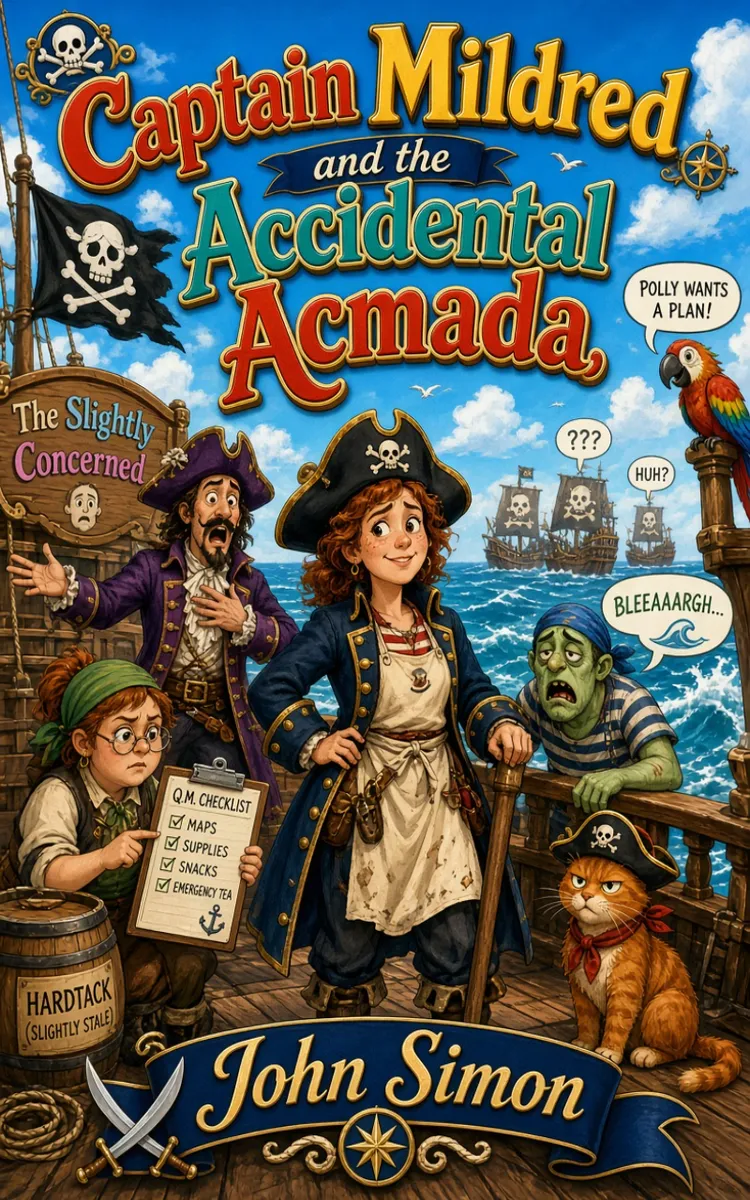
"Captain Mildred And The Accidental Armada" is a comedy book by John Simon with 40 chapters and approximately 104,971 words. A reluctant pirate captain and her hapless crew stumble into legendary Caribbean adventures.
This book was created using Inkfluence AI, an AI-powered book generation platform that helps authors write, design, and publish complete books. It was made with the AI Novel Writer.
Frequently Asked Questions
What is "Captain Mildred And The Accidental Armada" about?
A reluctant pirate captain and her hapless crew stumble into legendary Caribbean adventures
How many chapters are in "Captain Mildred And The Accidental Armada"?
The book contains 40 chapters and approximately 104,971 words. Topics covered include The Bakery Flour Detour, The Biscuit Barrel Mutiny, The Missing Flour Ledger, The Lighthouse Staircase Jam, and more.
Who wrote "Captain Mildred And The Accidental Armada"?
This book was written by John Simon and created using Inkfluence AI, an AI book generation platform that helps authors write, design, and publish books.
How can I create a similar general book?
You can create your own general book using Inkfluence AI. Describe your idea, choose your style, and the AI writes the full book for you. It's free to start.
Write your own comedy book with AI
Describe your idea and Inkfluence writes the whole thing. Free to start.
Start writingCreated with Inkfluence AI


