
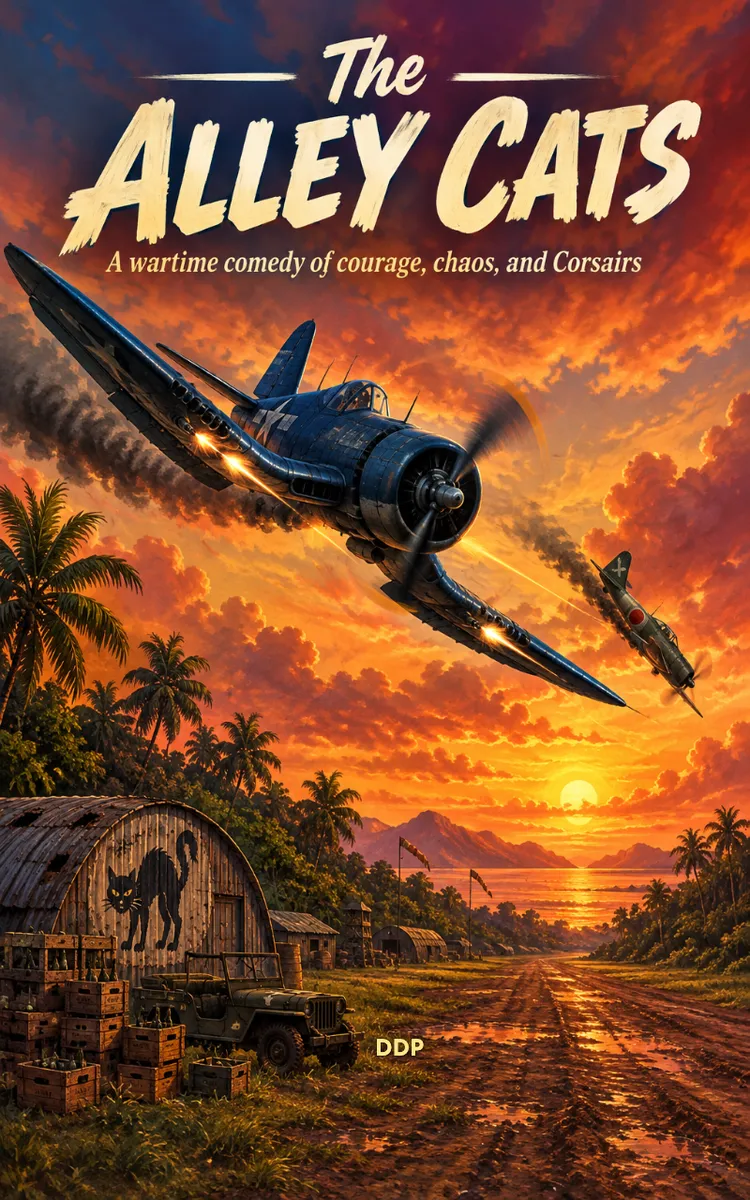
Read the first 2 chapters
The opening of the book, free: 2 chapters. About 19 min. Turn the pages with the arrows, your keyboard, or a swipe.
Chapter 1
The Officers’ Club Avalanche
The officers’ club had been built for twelve men, three chairs, and one discreet argument about promotion. By sunset, it contained forty-seven Marines, six Navy staff officers, a piano with one surviving key, and enough spilled whiskey to make the floor shine like an oil slick.
Maj. Jack “Hangover” Dalton stood in the doorway with his cap tucked beneath one arm and watched Lt. Tommy Vance attempt to pour champagne into a coffee mug.
“Not that mug,” Dalton said.
Vance froze. “Why not, sir?”
“That mug belongs to the colonel.”
Vance glanced at the coffee mug, then at the crowded room. “How can you tell?”
“Because it says ‘World’s Best Colonel.’”
“Could be ironic.”
Dalton took the bottle from him. The champagne had been liberated from a rear-base storeroom and tasted faintly of varnish. The Alley Cats had been transferred north, which meant they were leaving this comfortable patch of jungle, its dry beds, and its staff officers who had learned to lock their liquor cabinets. The squadron’s farewell had begun with Dalton’s explicit order that it remain orderly.
That order had lasted eleven minutes.
Rusty Kowalski leaned against the piano, wearing a dress jacket over a shirt stained with gravy. He was holding court with a Navy lieutenant whose left eyebrow had begun to swell.
“Rusty,” Dalton called.
“I’m not fighting,” Kowalski said.
“I didn’t ask if you were fighting.”
“Good, because I’m not.”
The Navy lieutenant pointed at him. “He called my ship a floating apartment building.”
“It is a floating apartment building,” Kowalski said. “Only the tenants can’t get out.”
Dalton shut his eyes for half a second. Behind him, the night pressed hot and wet against the club’s screened windows. Mosquitoes whined in the rafters. Somewhere beyond the palms, a generator coughed like a dying mule.
He wanted the Alley Cats out before anyone lost a tooth, a stripe, or an entire career.
“Rusty,” he said, “take the pilots outside.”
“Gladly.”
“And don’t let anybody touch the boats.”
“We don’t have boats.”
“Then you’re already ahead.”
Kowalski pushed away from the piano and began herding men toward the door. Eddie Pruitt, known to everyone as Deacon, was trying to conceal a bottle under his tunic. Lou Moretti, the squadron’s card shark and former sergeant, had three staff officers’ paybooks spread across the piano lid. Hank Billings stood beside the punch bowl, enormous and mild, holding a ham sandwich in both hands as if it required official inspection.
Ray Tibbs, the ground chief, had arrived in oil-stained dungarees and was asleep beneath a side table. Dalton considered leaving him there. Tibbs could sleep through artillery, but not through the sound of somebody misplacing a carburetor.
The first chair broke.
It did not break during a fight. It broke when Moretti sat on it while collecting a bet. The chair folded neatly beneath him, and he vanished with the solemnity of a man descending through a trapdoor.
The staff officers turned.
Moretti rose from the wreckage with a playing card stuck to his forehead.
“That,” he announced, “was sabotage.”
A lieutenant colonel in a clean white jacket stepped forward. He had the narrow face and polished shoes of a man who had never been required to sleep in mud. Dalton recognized him from headquarters: Col. Ambrose Thorne, staff officer, regulation enthusiast, and the only man in the Pacific who could make a clipboard look vindictive.
“Major Dalton,” Thorne said.
“Colonel.”
“Is this your command?”
Dalton looked over his shoulder. Deacon had now produced a second bottle. Tommy Vance was standing on a chair to reach the ceiling fan. Hank had given his sandwich to a Navy ensign who appeared too frightened to eat it.
“Technically,” Dalton said.
“Then control it.”
“I’m trying.”
“Try harder.”
Dalton smiled without warmth. “I’ll put that in the squadron newsletter.”
Thorne’s eyes moved to Moretti, who was dusting chair splinters from his trousers. “Your men have been drinking for three hours.”
“Two and a half.”
“That is not a defense.”
“No, sir. It’s an estimate.”
Thorne’s mouth tightened. Dalton had seen that expression on enemy pilots just before they made a mistake. Unfortunately, Thorne did not fly.
Dalton stepped into the room. “All right, Cats. Party’s over. Outside.”
Nobody moved.
The piano gave a sad, single note.
Dalton turned toward it. “Who touched that?”
Tommy Vance raised one hand from atop the chair.
The ceiling fan struck him in the forehead.
It was not a hard strike. It was a bureaucratic strike, slow and repeated, each blade arriving with the patient certainty of a clerk stamping forms. Vance ducked, the chair rocked, and Hank reached for him. Hank caught Vance by the belt, but the belt came loose. Vance dropped onto the piano.
The piano answered with a chord.
The coffee table collapsed under the punch bowl.
Red liquid rolled across the floor.
For one clean second, everyone watched it travel toward Col. Thorne’s shoes.
Dalton lunged with a tablecloth. He caught the punch, the bottle, and one ashtray. He also caught the tablecloth’s corner around a Navy captain’s wrist.
The captain jerked backward. Dalton went forward. The bottle flew.
It struck Kowalski in the chest and burst.
Kowalski looked down at the spreading stain. “That was champagne.”
“Congratulations,” Dalton said.
The Navy lieutenant with the swelling eyebrow shoved Kowalski.
Kowalski shoved him back.
Moretti, assuming the shove had been part of the card game, slapped the lieutenant’s hand away. Deacon tried to separate them and lost his bottle. Tommy Vance dropped off the piano and landed on a staff officer’s foot. Hank set down his sandwich and stepped between two men, which would have ended the matter if one of those men had not been standing behind him.
The room became a narrow wooden box full of elbows.
Dalton caught a fist meant for Kowalski and drove its owner into the wall. The wall shook. A framed map of the Solomon Islands fell sideways, leaving the western edge of Guadalcanal pointing toward the floor.
“Outside!” Dalton shouted.
His voice vanished beneath the crash of the piano.
Someone had knocked it over.
The instrument tipped slowly, almost thoughtfully, and came down across the doorway. Its legs split. Its one surviving key played a final, accusing note.
Now nobody could get outside.
“Excellent,” Dalton said.
Thorne stood behind the bar, untouched except for a red splash on one shoe. He had acquired a clipboard. Dalton had no idea where it came from.
“Major,” Thorne said, “this is precisely the conduct I have been documenting.”
“Then document that we’re trapped.”
“I am documenting that too.”
Kowalski appeared beside Dalton with a Navy captain’s collar in one hand. “Jack, I think we’ve made a poor impression.”
“You think?”
“I’m open to correction.”
The side window shattered.
Ray Tibbs came through it feet first, followed by a shower of screen wire and mosquitoes. He landed on the punch table, which had already surrendered to gravity, and stared at the room.
“Everybody out,” Dalton said.
Tibbs looked at the fallen piano. “Through there?”
“Use the window.”
“That’s a window?”
“It was.”
Tibbs climbed back through, then returned carrying a metal toolbox.
Dalton stared at him. “Why did you go out and come back with that?”
“Somebody stole my wrench.”
“During the fight?”
“Especially during the fight.”
Behind them, Deacon had cornered the Navy lieutenant against the bar. “Brother,” he said, with the calm voice of a preacher’s son who had just broken a bottle, “there is still time to accept peace.”
The lieutenant swung.
Deacon ducked. The fist struck the liquor shelf.
Bottles toppled in a glittering row. Whiskey, gin, and something medicinal poured down the wall. The club filled with the sharp stink of alcohol and splintered glass.
Hank Billings blinked at the mess. “That seems bad.”
“It is,” Dalton said.
Hank nodded. “Should I move the ham?”
“No.”
The ham slid off the counter by itself.
Thorne raised his clipboard. “Enough!”
The word carried. Even the piano seemed to listen.
Every man in the room paused in a different position of disgrace. Kowalski held a torn sleeve. Moretti had one shoe. Vance crouched beneath the ceiling fan. Deacon had a bottle neck in his hand. Hank stood beside the fallen ham. Tibbs was halfway through the ruined window with his toolbox.
Dalton saw the moment before Thorne spoke. The colonel looked not angry but satisfied. He had come to the party hoping for a crime and found a banquet.
“Marine Fighting Squadron 299,” Thorne said, “will be removed from this installation.”
Kowalski leaned toward Dalton. “Removed how?”
“Quietly, I hope.”
Thorne continued. “You will report to Mudbottom Island by dawn.”
A silence settled over the club. Outside, the jungle hissed with rain beginning on the leaves.
Dalton looked at the wreckage: the piano blocking the door, the liquor running between the floorboards, the map hanging crooked, and his pilots wearing the stunned expressions of men who had just discovered that consequences came with paperwork.
“Mudbottom,” Dalton said.
“It is an operational airfield,” Thorne replied. “Barely.”
“Does it have a club?”
“It has a strip.”
“Beds?”
“A tent camp.”
“Liquor?”
Thorne looked at the broken shelves. “Not if I can help it.”
Dalton glanced at Kowalski. “We’re going to need a bigger apology.”
“You think an apology will cover this?”
“No. But it’s lighter than a piano.”
Thorne stepped closer. “Understand me, Major. I intend to recommend that this squadron be broken up. Your conduct tonight has made the decision simple.”
Dalton felt the familiar pressure behind his eyes, the old headache that had earned him his nickname and outlasted his marriage. He could have argued. He could have saluted. Instead he looked at Thorne’s red-stained shoe.
“Colonel,” he said, “before we leave, may I ask one question?”
“What?”
“Was that your best pair?”
Thorne stared at him.
Behind Dalton, Moretti whispered, “Wrong question.”
Thorne turned on his heel and marched toward the blocked doorway. He stopped at the piano, placed both hands on it, and shoved.
The piano did not move.
Tibbs climbed fully through the window and joined him. Hank joined Tibbs. Kowalski joined Hank. Dalton watched his squadron and the staff officer push together against the wrecked instrument while Deacon held the broken bottle and Tommy Vance rubbed his forehead.
On the third attempt, the piano shifted six inches.
The surviving key struck the floor.
It played one bright note.
By midnight, the Alley Cats stood outside in the rain while the officers’ club sagged behind them, leaking whiskey through its walls. Thorne’s written order had been delivered with the finality of a death notice, though Dalton suspected the club itself had received the more merciful sentence.
Peggy Hale waited near the motor pool in a rain cape, having come from the hospital across the bay. She took in Dalton’s torn sleeve, the punch on his boots, and the blood on his knuckles.
“Celebration?” she asked.
“Farewell.”
“To what?”
Dalton glanced back at the ruin. “Civilization.”
Peggy’s eyes moved to Thorne, then to the pilots. “Where are you going?”
“Mudbottom.”
“That sounds unpleasant.”
“It has a runway.”
“Then you’ll be right at home.”
She walked away before he could charm her, which was becoming a habit.
Kowalski came up beside him. “Jack.”
“What?”
“Deacon says the still can be packed by dawn.”
Dalton looked toward the dark airfield, where the Corsairs waited beneath their tarps, noses pointed into the rain.
“Tell him to pack it.”
“And Tommy?”
“Pack Tommy too.”
“Thorne says we report by dawn.”
Dalton watched the rain wash punch and whiskey into the mud.
“Then we’d better leave before the club falls on us.”
Behind them, the officers’ club gave a long wooden groan.
Tibbs looked up. “That sound mean anything?”
Dalton pulled on his cap.
“It means,” he said, “we’ve been transferred.”
Chapter 2
Corsairs on Mudbottom
The first Corsair hit Mudbottom’s runway and vanished to the hubs.
Dalton watched from the edge of the jungle as brown water climbed over the fighter’s tires and the propeller flung mud across the palms. The aircraft slewed left, straightened, and stopped with its nose buried in a bank of fern.
Rusty Kowalski climbed down from the cockpit.
“Good strip,” he called.
Dalton wiped rain from his eyes. “How good?”
“Better than the officers’ club.”
“That isn’t a standard.”
“It is now.”
Behind them, the rest of the squadron waited in a ragged line of trucks, jeeps, and one trailer whose left wheel had been replaced with a steel ammunition drum. The Corsairs had made the journey under tarps, engines coughing, tires sinking, and ground crews hanging off the trucks like shipwreck survivors. Dawn had arrived gray and steaming. Mudbottom Island lived up to its name with the confidence of a man wearing a medal.
Dalton wanted one thing before the first patrol: every aircraft in the air and every pilot alive enough to complain about it.
At present, one Corsair was nose-down in the jungle, three were stuck along the runway, and the remaining machines were covered in mud so thick they looked armored.
Ray Tibbs stood beside the stranded fighter with his hands on his hips. He was already soaked through, which saved time.
“Get it out,” Dalton said.
Tibbs looked at the aircraft, then at the runway. “With what?”
“A tractor.”
“The tractor is in the ditch.”
“Use another tractor.”
“That one’s in the ditch too.”
Dalton glanced toward the strip. A Marine tractor sat tilted against a palm, its rear wheels spinning lazily in the mud. The second had disappeared behind a mound of earth except for its exhaust pipe, which puffed like a cigar.
“Use the winch.”
“The winch is on the first tractor.”
Dalton looked at Kowalski. “Why is everything in a ditch?”
“Because this is Mudbottom,” Rusty said. “They named it honestly.”
A truck tried to pass the stranded Corsair. Its wheels spun. Mud sprayed over Deacon Pruitt, who had just climbed out carrying a crate of ammunition. He stood dripping brown from cap to boots.
“Looks like the island’s baptized me,” Deacon said.
“God works in mysterious ways,” Moretti said from the truck bed.
“God didn’t build this runway,” Tibbs answered. “A drunk with a shovel did.”
Dalton turned toward the operations tent. It was a canvas rectangle sagging between two trees, with a map pinned to one wall and a mosquito net hanging from the roof like a surrender flag. Somewhere inside, a telephone rang with the lonely persistence of a man who had not yet learned where he was.
A Navy lieutenant emerged, holding a clipboard.
“Major Dalton?”
Dalton recognized the tone. It was the same tone Thorne used when announcing that a building had been destroyed by Marines.
“Who wants to know?”
“Airfield control. Your orders say the squadron is to establish immediately.”
“We’re establishing.”
“You have aircraft blocking the runway.”
“We’re establishing a blockage.”
The lieutenant glanced at the Corsair buried in the ferns. “That machine is not serviceable.”
“That’s why it’s blocking the runway instead of flying over it.”
The lieutenant’s mouth tightened. “I’ll report the delay.”
“Report the weather too. It’s doing most of the work.”
The officer disappeared into the tent.
Dalton heard a familiar cough behind him. Kowalski had found a tin cup and was attempting to drink coffee the color of axle grease.
“Where did you get that?” Dalton asked.
“From the operations tent.”
“Did you ask?”
“I asked whether it was coffee.”
“And?”
“They said no.”
Rain hammered the tarps. Water ran through the ruts in the runway and pooled beneath the Corsairs. The aircraft had been designed for carriers, but Mudbottom offered no deck, no arresting gear, and no forgiveness. Its jungle strip was a brown ribbon cut between palms, with coral showing through in places like broken teeth.
Dalton walked to the nearest fighter. The tarp had blown loose, exposing the bent propeller and a wing streaked with mud. The Corsair’s broad nose and gull wings looked magnificent even while sinking.
“Get the tarps off,” he said. “We need to inspect every engine.”
Tibbs pointed at the sky. “Rain’s coming sideways.”
“It’s already coming sideways.”
“Then it’ll come harder.”
“Ray.”
Tibbs sighed and began pulling canvas from the aircraft. The others followed. Hank Billings lifted an entire tarp by himself, revealing a Corsair beneath it with a wheel half buried and a frog sitting on the cowling.
Tommy Vance approached, still wearing the forehead bruise earned from the ceiling fan. “Is that standard equipment?”
“Only on Navy aircraft,” Moretti said.
Vance looked toward the jungle. “Where’s the nearest dry ground?”
“Across the bay,” Rusty said. “The hospital.”
Vance brightened. “How do we get there?”
“Fall into the water and keep walking.”
Dalton ignored them. He moved from aircraft to aircraft, counting the problems. One had a damaged starter. Another had a fuel leak. A third had a control cable that felt wrong beneath the stick. The fourth had lost a panel somewhere between the old base and Mudbottom. The fifth would not turn over at all.
Tibbs crawled beneath it, vanished into the mud, and returned with a wrench clenched between his teeth.
“Missing part,” he said.
“What part?”
“The part that makes it work.”
Dalton crouched beside him. “Can you fix it?”
“Sure.”
“With what?”
Tibbs looked at the jungle, the runway, the wrecked tractors, and the pile of crates that had arrived without labels.
“With something that doesn’t know it’s the wrong part.”
That was Tibbs’s method. He did not repair machines so much as intimidate them into cooperation.
By midmorning, the runway had become a contest between the squadron and gravity. The men laid planks beneath the wheels. The planks sank. They laid ammunition boxes beneath the planks. The boxes split. Hank Billings dragged a length of timber from the jungle, and a snake fell out of it into Moretti’s shirt.
Moretti removed his shirt, the snake, and most of his dignity in one movement.
“I had that shirt tailored,” he said.
“By whom?” Kowalski asked.
“A man in Brisbane.”
“He did a poor job.”
“He was working under fire.”
“So were you.”
The snake slid into a puddle and disappeared. Moretti watched the water.
“I’m putting that in the squadron expense account.”
The first tractor finally came free when Tibbs tied its winch cable to a palm. The palm came free first.
It rose from the mud with a wet sucking sound, roots dangling, and collapsed across the edge of the runway. The tractor rolled backward into a stack of fuel drums.
Dalton moved before the drums could tumble. He seized the nearest one and shoved. Rusty grabbed another. Hank caught two under his arms.
The stack held.
A small metal cup rolled out from beneath the drums and stopped against Dalton’s boot.
He picked it up. It was stamped with a Navy supply mark.
Rusty saw it and grinned. “A souvenir.”
“Put it back.”
“Why?”
“Because if we steal from the Navy before noon, they’ll think we’re predictable.”
Rusty tucked the cup into his pocket. “Then I’ll steal something else.”
From beneath the fifth Corsair came a sharp metallic clatter.
Tibbs backed out holding a part no larger than Dalton’s fist.
“This is the missing piece,” he said.
Dalton looked at it. “What is it?”
“The thing that was missing.”
“Can you identify it?”
“I can identify where it isn’t.”
Tibbs carried the part toward the aircraft. A Navy mechanic intercepted him.
“That belongs to a fuel pump,” the mechanic said.
Tibbs stopped. “Which fuel pump?”
“An aircraft fuel pump.”
“That narrows it down to the entire island.”
The mechanic reached for the part. Tibbs held it behind his back.
“That part came from our stores,” the mechanic said.
“Then your stores are very generous.”
“You can’t just take it.”
Tibbs pointed toward the nose-down Corsair. “Your stores can come explain that to the pilot.”
Dalton stepped between them. “What do you need?”
Tibbs held up the part. “A fitting.”
“Find one.”
“I found this.”
“Find a fitting for it.”
Tibbs looked offended by the distinction. “Major, if I had a fitting, I’d have found the airplane attached to it.”
The Navy mechanic folded his arms. “No parts leave my stores.”
Dalton glanced at the runway. Another Corsair had begun sliding sideways, its wheels turning slowly while the aircraft drifted toward the trees.
“Hank,” Dalton called.
Billings ran over and caught the wingtip. The fighter stopped. Hank stood there holding the aircraft while Vance climbed into the cockpit and shut off the engine.
Dalton turned back to the mechanic. “Your stores have just left the runway.”
The mechanic stared at the aircraft, at Hank, and then at Tibbs.
“Five minutes,” he said.
Tibbs took twenty.
He returned carrying a fitting, two bolts, a length of wire, and a wrench that belonged to someone else. The aircraft’s fuel pump received the fitting. The wire became a clamp. One bolt was shortened with a file. The other was installed backward because Tibbs said it had “better manners that way.”
When he finished, he wiped his hands on his trousers and slapped the cowling.
“Start it.”
Dalton climbed into the cockpit. The seat smelled of wet canvas and old oil. He checked the instruments, primed the engine, and hit the starter.
The Pratt & Whitney coughed.
Mud trembled beneath the tires.
The engine coughed again, then exploded into a deep, furious roar that rolled across the jungle. Birds burst from the palms. The frog fled the cowling. Every man on the strip turned toward the sound.
Dalton eased the throttle forward.
The Corsair moved six inches and stopped.
Tibbs shouted, “More power!”
Dalton gave it more.
The fighter lurched free of the mud, shot down the strip, and began sliding toward the jungle.
“Less power!” Rusty yelled.
Dalton pulled back. The tail swung. The right wheel struck a rut and threw a wall of mud over the canopy. For three seconds Dalton saw nothing but brown water.
He kept the stick steady.
The Corsair clawed forward. The runway narrowed between palms. Dalton lifted the tail, felt the aircraft lighten, and hauled back.
The fighter left the ground with all the grace of a refrigerator being thrown off a roof.
It cleared the palms by ten feet.
Then it dropped.
Dalton’s stomach rose into his throat. He held the nose level, added power, and watched the strip fall away beneath him. The Corsair shuddered, settled, and climbed into the wet gray air.
Below, the Alley Cats erupted into motion.
Kowalski waved both arms. Vance leaped onto a crate. Deacon raised a wrench like a holy relic. Moretti appeared to be counting money. Tibbs stood in the middle of the runway, covered from helmet to boots in mud, and looked up with the grim satisfaction of a man whose argument had just become airborne.
Dalton circled once.
The strip looked even worse from above. Three Corsairs sat nose-deep in mud. One tractor leaned against a palm. The uprooted tree blocked half the runway. Men and equipment sprawled around the wreckage like pieces from a child’s broken toy.
But the aircraft flew.
Dalton brought her around and landed with the engine snarling. The wheels struck, skidded, and held. He stopped beside Tibbs, opened the canopy, and climbed out.
Tibbs approached.
“Well?” he asked.
“She flies.”
Tibbs nodded. “I told you.”
“You told me nothing.”
“That’s because you were busy doubting.”
Across the strip, another engine started.
Then another.
Rusty’s Corsair rolled forward, throwing mud. Hank’s followed. Deacon’s coughed twice and joined them. Moretti’s engine roared so violently that a crate slid off the back of a truck.
Tommy Vance climbed into his cockpit.
Dalton caught his arm. “You stay on the ground until Tibbs clears you.”
Vance looked toward the other aircraft. “I can fly.”
“I didn’t say you couldn’t.”
“Then why am I staying?”
“Because I enjoy having one rookie left.”
Vance’s jaw tightened, but he nodded. The bruise on his forehead had turned purple beneath the rain.
Dalton turned toward the operations tent. The Navy lieutenant stood there with his clipboard, watching the Corsairs taxi through the muck.
“Major,” he called, “the runway is still officially unserviceable.”
Dalton looked at the four fighters lining up beneath the palms.
“Then officially,” he said, “we’ll be flying from somewhere else.”
The lieutenant glanced at the jungle. “There is nowhere else.”
“Tell headquarters that.”
“And if they ask where you are?”
Dalton climbed back onto the wing of his Corsair and settled into the cockpit.
“Tell them Mudbottom has accepted delivery.”
Tibbs wandered past carrying the last salvaged part. He tossed it into a toolbox.
Dalton looked down. “What was that?”
“Extra.”
“Extra what?”
Tibbs shut the box. “We’ll find out when something breaks.”
The four Corsairs lifted one after another, climbing over the palms in a ragged formation that somehow tightened before they reached the clouds. Mudbottom’s runway remained a swamp, its tractors remained useless, and the operations officer remained offended.
But the Alley Cats were airborne.
Behind Dalton, on the ground, the fifth Corsair coughed once.
Tibbs looked at it.
The engine caught.
He smiled.
Then the aircraft’s propeller flung an entire puddle through the operations tent.
End of the sample. 22 more chapters and about 55,541 words in the full book.
Swipe or use the arrows to turn the page
What's inside: 24 chapters
- 1. The Officers’ Club Avalanche
- 2. Corsairs on Mudbottom
- 3. The Crane on the Tail
- 4. A Note in the Propwash
- 5. The Generator Poker Pot
- 6. The Nurses’ Dance Landing
- 7. The Escort’s Missing Wingman
- 8. The Pig in Thorne’s Office
- 9. Billings in the Green
- 10. The Hospital Ward Poker Game
- 11. The Engine Exchange
- 12. The Engine Crate Parade
- 13. The Replacement Squadron’s Welcome
- 14. The Patched Corsair Launch
- 15. The Crane’s Second Pass
- 16. The Ward’s Narrow Passage
- 17. The Map with No Safe Harbor
- 18. Dalton’s Unapproved Strike
- 19. The Missing Radio Log
- 20. The Anchorage Runway Fire
- 21. The Jungle Canopy Duel
- 22. The Crane’s Broken Wing
- 23. Thorne’s Medal Mishap
- 24. The Pig’s Last Inspection
About this book
"The Alley Cats" is a comedy book by DDP with 24 chapters and approximately 55,541 words. Misfit Marine fighter pilots battle Japanese aces and military bureaucracy in 1943.
This book was created using Inkfluence AI, an AI-powered book generation platform that helps authors write, design, and publish complete books. It was made with the AI Novel Writer.
Frequently Asked Questions
What is "The Alley Cats" about?
Misfit Marine fighter pilots battle Japanese aces and military bureaucracy in 1943
How many chapters are in "The Alley Cats"?
The book contains 24 chapters and approximately 55,541 words. Topics covered include The Officers’ Club Avalanche, Corsairs on Mudbottom, The Crane on the Tail, A Note in the Propwash, and more.
Who wrote "The Alley Cats"?
This book was written by DDP and created using Inkfluence AI, an AI book generation platform that helps authors write, design, and publish books.
How can I create a similar general book?
You can create your own general book using Inkfluence AI. Describe your idea, choose your style, and the AI writes the full book for you. It's free to start.
Write your own comedy book with AI
Describe your idea and Inkfluence writes the whole thing. Free to start.
Start writingCreated with Inkfluence AI


