

Read the first chapter
The whole of chapter one, free. About 8 min. Turn the pages with the arrows, your keyboard, or a swipe.
Chapter 1
The Bus in the Story
Rainwater trembled in the cracked backboard above Liam’s head, each drop striking the metal rim with a sharp ping. The neighborhood court was empty except for him and the young man sitting beneath the bleachers, where the concrete stayed mostly dry.
Liam caught the basketball against his hip and looked over. “So you really stayed there all winter?”
The young man rubbed his hands together. His boots were still muddy from the walk across the park, and a frayed green jacket hung from his shoulders. He had returned from Alaska only days ago, but the place seemed to cling to him - the dark under his eyes, the roughness in his voice, the way he kept glancing beyond the houses as if the trees might open.
“All winter,” he said.
Liam bounced the ball once. It struck a puddle and splashed his jeans.
“Where?”
“Alaska.”
“That’s not a place.”
“It is when you’re standing in it.”
The young man smiled, but Liam did not. He had spent the afternoon listening to his mother move around the apartment, opening and slamming drawers, muttering at nobody. When he left, she had been asleep in the chair with the television flashing across her face. He had not said goodbye. She would not notice.
Now the wet court stretched beneath a low gray sky, and the young man was telling him about a country so far away that even its cold sounded different.
Liam sat on the lowest bleacher. The metal was cold through his pants.
“Start at the beginning,” he said.
The young man leaned back against the support pole. “There isn’t much of a beginning. You go in. You find the place. You try not to die.”
“You had a house?”
“No.”
“A cabin?”
“No.”
“Then where did you sleep?”
The young man looked toward the far end of the court, where weeds pushed through a split in the asphalt. “An old school bus.”
Liam saw it immediately. Not as a joke or a wreck, but as a shelter waiting beyond the trees. Its windows would be dusty. Its seats would be torn out. The yellow paint would have faded almost white beneath snow.
“You lived in a bus?”
“Most nights.”
“Why?”
“Because it was there.”
The answer lodged in Liam more deeply than any grand explanation could have. Because it was there. Because there was nowhere else.
At home, there was always somewhere else, but none of it belonged to him. His mother’s apartment smelled of old grease and damp laundry. Her moods filled every room. If Liam spoke, she called him ungrateful. If he stayed quiet, she accused him of sulking. Sometimes she shoved him hard enough to make his shoulder strike the doorframe, then sat down and forgot he was there.
In Alaska, a bus could be enough.
“What did you eat?” Liam asked.
“Whatever I had. Rice. Oatmeal. Some canned food. I trapped a little.”
“You hunted?”
“Not like in the movies.” The young man’s expression tightened. “Mostly I tried to make what I had last.”
“And the cold?”
The young man looked at him then. “The cold was the part that didn’t care what I wanted.”
A gust pushed rain beneath the bleachers. Liam tucked his hands into the sleeves of his sweatshirt.
“How cold?”
“Cold enough that you wake up and your blanket is stiff. Cold enough that your boots have to stay inside with you or they freeze solid. Cold enough that you stop thinking about comfort and start thinking about the next hour.”
Liam pictured himself inside the bus, listening to wind rake the metal roof. He pictured the dark outside, endless and clean. No television shouting from the living room. No cupboard slamming. No mother’s voice rising from sleep.
“What did you do when you were scared?” he asked.
The young man gave a short laugh. “I was scared most of the time.”
“That isn’t an answer.”
“It is the answer.”
The basketball rolled from Liam’s foot and tapped against the fence. He let it go.
The young man bent forward, elbows on his knees. “The bus kept the snow off. That was about all it promised. The windows leaked cold. The floor stayed damp. Smoke got trapped inside when the stove acted up. Once, I woke up and couldn’t feel two fingers.”
“What happened?”
“I put them under my armpit until they hurt.”
“Did you think you were going to die?”
The young man’s silence lasted long enough for the rain to fill it.
“Yes,” he said. “More than once.”
Liam waited for the story to become a warning. He expected the young man to tell him that Alaska had been a mistake, that the wilderness had stripped away every romantic idea he carried into it. Instead, the young man looked almost relieved when he spoke of the place.
“Out there,” he said, “nobody knew me.”
Liam’s stomach tightened.
The young man continued, quieter now. “Nobody had a history with me. Nobody could drag old things out and use them against me. If I messed up, the land punished me. That was different.”
“Different how?”
“At least the land was honest.”
A car passed beyond the court, tires hissing over wet pavement. Liam watched its red lights disappear behind the row of houses. He thought of his mother asleep beneath the television’s blue flicker, her mouth open, one hand hanging over the chair. If he went home, she might wake and ask where he had been. She might slap him for tracking mud across the floor. She might not look up at all.
He wanted to know every detail of the bus.
“Was it yours?”
“No. It sat on a piece of land someone had left alone.”
“Whose land?”
“Does it matter?”
“It does if I’m going there.”
The young man’s face changed. “You’re not going there.”
“I didn’t say I was.”
“You’re asking like you already decided.”
Liam stood and retrieved the basketball. The pavement had darkened beneath his shoes. “How far was it from town?”
“Far enough.”
“That’s not a distance.”
“Then call it a day by foot. Maybe more.”
“With a road?”
“Some road. Then a trail. Then no trail.”
Liam gripped the ball until his fingers hurt. “How did you find it?”
The young man stared at him. “You’re not listening.”
“I am.”
“No. You’re hearing the parts you want.”
Liam stepped closer. “Tell me how.”
The young man rose. He was taller than Liam, though not by much, and the tiredness in him made him seem older. “You think the bus means you’ll be safe. It doesn’t. It means you might have walls around you while you freeze.”
The words should have ended the conversation. Instead, they sharpened the picture. Walls. A roof. A place where Liam could close a door and keep the world out.
“What was around it?” he asked.
“Trees. A river somewhere nearby. No neighbors.”
“Animals?”
“Yes.”
“What kind?”
“Whatever was hungry.”
The young man picked up his jacket from the bench. “Go home, Liam.”
Liam flinched at his name. He hated the way it sounded when his mother said it, clipped and accusing. From the young man, it carried something else - recognition, maybe. A warning offered without pity.
“You don’t get to tell me where to go.”
“No,” the young man said. “I’m telling you what the place is.”
The rain stopped. Water dripped from the hoop and struck the blacktop in steady intervals.
Liam looked past him toward the road leading out of the neighborhood. Beyond the last houses, the land rose into wooded hills. Alaska was not visible there, but for a moment he felt its distance as a physical pressure, pulling against his chest.
“Would you go back?” he asked.
The young man did not answer immediately.
“Yes,” he said at last.
That was all Liam needed.
The young man reached into his jacket and pulled out a folded piece of paper. It had been creased and opened so many times that the edges had gone soft.
“Don’t lose this,” he said.
Liam took it. A rough map filled the page in pencil: a road, a bend, a line that might have been a river, and a square marked with a single word.
BUS.
“Is this the land?” Liam asked.
“It’s a way to find the land.”
“Can I stay there?”
“If you ever get there, nobody’s stopping you.”
“That sounds like permission.”
“It isn’t.”
Liam folded the paper and slipped it into his pocket. The map was damp from the young man’s hand. He could feel its shape against his thigh as though it were a small, living thing.
The young man watched him. “You need more than a map.”
“I know.”
“You don’t.”
Liam wanted to argue, but the words failed him. He had no answer for the cold, the food, the distance, or the animals. He had only the bus, bright in his mind against the white wilderness.
At home, a window on the second floor glowed yellow. His mother had woken. Her silhouette crossed the curtain, paused, and disappeared.
Liam began walking.
“Where are you going?” the young man called.
Liam kept the map pressed beneath his palm.
“Somewhere else,” he said.
Behind him, the young man swore softly. “Liam.”
He stopped at the edge of the court but did not turn around.
“Alaska doesn’t care why you’re running.”
The words followed him through the wet streets. He walked faster, past the darkened shops and the overflowing trash bins, toward the apartment where his mother waited without waiting for him.
By the time he reached the building, the bus had become more than a shelter. It was a door. Beyond it lay a remote Alaska wilderness site, undisclosed and empty, where fall turned quickly into winter and the only shelter was an old school bus.
Liam was still a teenager then. He did not know that, years later, at twenty-three, he would arrive there in late fall with few clothes, minimal tools, and minimal food. He did not know the bus would protect him from little, or that after about three weeks he would succumb to the elements.
He knew only that the map was in his pocket and that the wilderness, for the first time, seemed capable of taking him in.
End of chapter one. 32 more chapters and about 62,628 words in the full book.
Swipe or use the arrows to turn the page


What's inside: 33 chapters
- 1. The Bus in the Story
- 2. A Home to Outlast
- 3. The Winter He Left Out
- 4. Years of Almost Leaving
- 5. The Map on the Table
- 6. Advice Against the Cold
- 7. The Fare North
- 8. A Bag Too Light
- 9. The Last Familiar Mile
- 10. Late-Fall Arrival
- 11. The Route Goes Quiet
- 12. The Trailhead Mistake
- 13. The Bus at Dusk
- 14. A Door That Will Not Seal
- 15. The Friend’s Warning
- 16. The First Frozen Morning
- 17. The Bus Was Never Enough
- 18. The Road Back
- 19. The Wind Breaks Loose
- 20. The Missing Landmark
- 21. Snow at the Door
- 22. The Meal He Cannot Spare
- 23. The Fire That Fails
- 24. No Signal Beyond the Trees
- 25. The Last Full Ration
- 26. The Trail Under Snow
- 27. The Choice to Stay
- 28. The Route He Misremembered
- 29. The Night the Cold Wins
- 30. The Unanswered Check-In
- 31. The Search Reaches the Property
- 32. What the Bus Kept
- 33. The Warning Left Behind
About this book
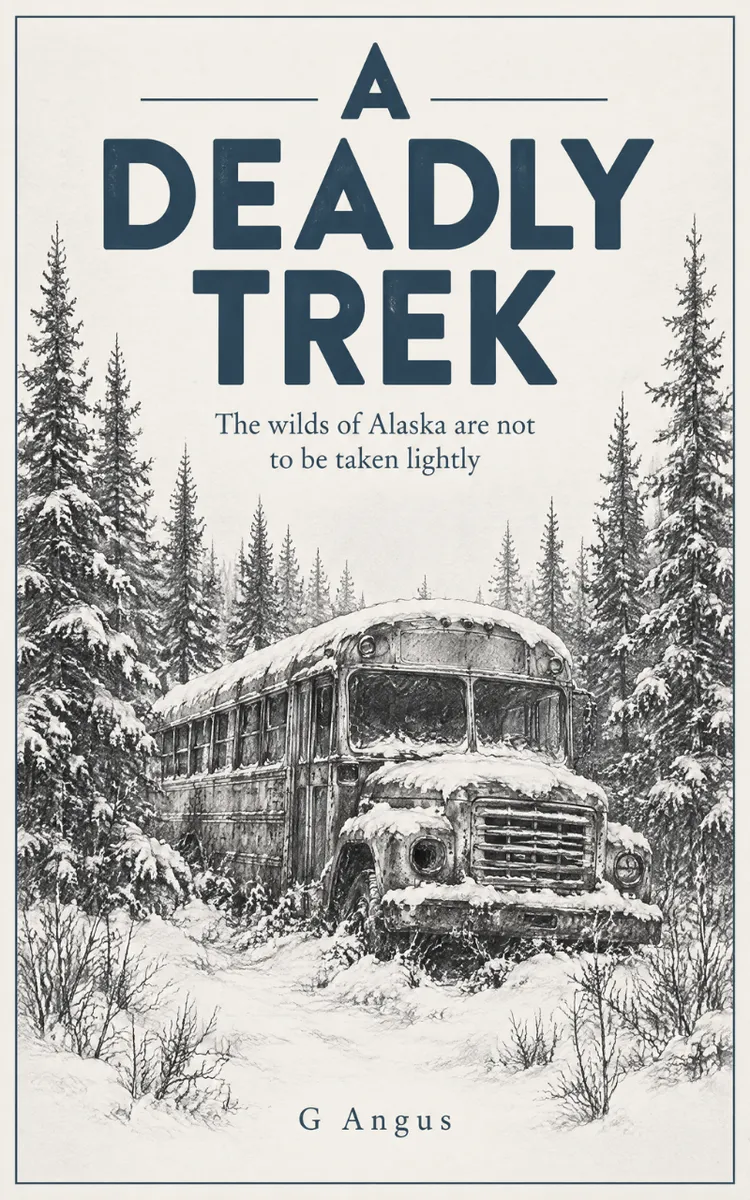
"A Deadly Trek" is a fiction book by G Angus with 33 chapters and approximately 62,628 words. An unprepared young man’s fatal attempt to survive an Alaska wilderness winter.
This book was created using Inkfluence AI, an AI-powered book generation platform that helps authors write, design, and publish complete books. It was made with the AI Novel Writer.
Frequently Asked Questions
What is "A Deadly Trek" about?
An unprepared young man’s fatal attempt to survive an Alaska wilderness winter
How many chapters are in "A Deadly Trek"?
The book contains 33 chapters and approximately 62,628 words. Topics covered include The Bus in the Story, A Home to Outlast, The Winter He Left Out, Years of Almost Leaving, and more.
Who wrote "A Deadly Trek"?
This book was written by G Angus and created using Inkfluence AI, an AI book generation platform that helps authors write, design, and publish books.
How can I create a similar fiction book?
You can create your own fiction book using Inkfluence AI. Describe your idea, choose your style, and the AI writes the full book for you. It's free to start.
Write your own fiction book with AI
Describe your idea and Inkfluence writes the whole thing. Free to start.
Start writingCreated with Inkfluence AI


