

Read the first chapter
The whole of chapter one, free. About 8 min. Turn the pages with the arrows, your keyboard, or a swipe.
Chapter 1
A Bargain for Aleut Hands
The seal-hide door snapped in the wind before Alen could fasten it.
“Alen!” his wife called from the hearth. “They have come again.”
He pushed through the doorway. Sand stung his cheeks, and the cold drove tears from his eyes. Beyond the low sod houses, three Russian boats rocked in the cove, their oars lifted like black ribs. A Company flag hung from the tallest mast, stiff in the wind.
His youngest son, Nuka, stood beside the fish rack with a strip of dried salmon in his hand. He was saving it for his sister. Alen saw the boy close his fingers around it.
A Russian agent waited near the shore with two armed men. His coat was too fine for the island, dark wool buttoned to the throat. In one hand he held a paper. In the other, a stick.
“Alen Koliak,” he called. “You are wanted.”
Alen glanced toward the houses. His wife, Sula, had come outside. Their daughter Aniq crouched behind her skirt, thin shoulders raised against the cold. The winter stores had fallen low. Three seal skins hung empty by the door. Their last basket of dried fish held more bones than meat.
“I am here,” Alen said.
The agent looked him over. “The Russian-American Company requires hunters.”
“The sea requires hunters.”
The agent smiled without warmth. “Then the sea will serve the Company.”
His name was Pavel Orlov. He had come before, counting men and kayaks, asking who could paddle, who could dive, who had sons old enough to carry a spear. Each time Alen had sent him away with the same answer: his family needed him on their own waters.
Now Pavel unfolded the paper.
“General Manager Baranov has ordered a new arrangement,” he said. “Every able hunter will give service. In return, the Company provides flour, powder, tools, and protection.”
“Protection from whom?” Alen asked.
Pavel’s smile disappeared. “From hunger, perhaps.”
Behind him, one of the armed men laughed.
Alen felt the weight of the salmon in Nuka’s hand, though the boy stood several paces away. Flour sounded like warmth. Powder sounded like food. The Company storehouse had full barrels while Aleut families scraped fat from old lamps and boiled kelp to quiet their bellies.
Sula stepped closer. “How long?”
Pavel turned to her. “The men will be taken to the hunting grounds when the boats leave. The term is not yet fixed.”
“Then it is not an agreement,” Alen said.
“It is an order.”
The wind drove a rope against the nearest boat. Crack. Crack. Crack.
Alen looked at the water. The cove was narrow, and the Company boats blocked the safest passage. Even if he refused, Pavel could take his kayak, his weapons, perhaps one of the boys. The Russians had done such things on other islands. Men were gathered for the sea-otter hunt and carried far from home. Some returned coughing blood. Some did not return at all.
Sula’s hand found his sleeve.
“Alen,” she whispered, “we have two days of food.”
He knew. He had counted it himself before dawn: one small seal, a handful of dried fish, and the last of the berries gathered in autumn. Their daughter had stopped asking when they would eat. That frightened him more than her crying.
Pavel held out the paper. “Mark it.”
“I cannot read your words.”
“You do not need to read them. You need to obey them.”
Alen stared at the lines. The marks looked like gull tracks crossing a frozen shore. His people had agreements too, spoken before witnesses, sealed with shared food and a hand laid over the other’s hand. This paper had no place for Sula, no place for Nuka or Aniq, no place for the dead who had taught them these waters.
“What happens if I refuse?” he asked.
Pavel nodded toward the boats. “Your family receives no Company goods. Your hunting gear may be held until the debt is paid.”
“What debt?”
“The Company has fed this island.”
“You brought trade,” Alen said. “You did not feed us.”
The armed man nearest Pavel lifted his musket.
Sula’s fingers tightened on Alen’s sleeve. “Do not.”
The word struck him harder than the wind. She was not begging him to protect their freedom. She was begging him to keep the musket silent.
Alen walked to the fish rack. Nuka watched him, still clutching the salmon.
“Give that to Aniq,” Alen said.
“It is for you.”
“I am not hungry.”
The boy knew the lie. He handed the strip to his sister anyway. Aniq broke it in half, keeping one piece for him.
Pavel’s boots scraped over the gravel. “You see? The Company can change this.”
Alen turned. “By taking us?”
“By employing you.”
“My sons are not yours.”
“I did not ask for your sons.”
“Not today.”
For the first time, Pavel’s face hardened. “Baranov has no patience for men who mistake kindness for weakness.”
Alen had heard the name in distant reports, carried from island to island by frightened hunters. Aleksandr Baranov, General Manager of the Russian-American Company, ruled from Sitka through orders, debts, and guns. He wanted skins, and he wanted them quickly. If a village failed to supply enough, the Company tightened its grip. Men were sent farther, kept longer, and returned with less strength than when they left.
The Russians called it commerce. Alen had seen the cost in empty houses.
Sula drew him aside while Pavel spoke with the other men.
“If you go,” she said, “who will hunt here?”
“I will return before the spring storms.”
“You do not know that.”
“No.”
She looked toward Nuka and Aniq. “If you refuse, they may take the kayak. Then we cannot hunt at all.”
“I know.”
“Then choose what keeps them alive.”
The words left no room for courage. Only a narrow path between two kinds of loss.
Near the shore, Pavel struck the paper with his stick. “Mark it, Koliak.”
Alen walked back.
“What will you give us?” he asked.
“Flour for your household. Powder for Company hunts. A portion of the catch.”
“A portion?”
“The Company owns the boats, the ammunition, and the trade.”
“The sea does not belong to Baranov.”
Pavel leaned close. His breath smelled of spirits. “He does not need to own the sea. He only needs to own the men who cross it.”
Alen looked at the paper again. He imagined Sula boiling flour into a thick paste. He imagined Aniq sleeping without hunger twisting her small body. He imagined Nuka growing tall enough to paddle, then vanishing into a Russian boat before he understood what service meant.
His hand shook as he took the charcoal Pavel offered.
“Alen,” Sula said.
He pressed the charcoal to the paper.
The mark was crooked. It looked like a wound.
Pavel folded the document and tucked it inside his coat. “You leave at first light.”
“First light?” Sula said. “You said the boats would leave in two days.”
“The order changed.”
“You promised flour tonight.”
Pavel pointed toward the storehouse. “One measure. The rest is issued after departure.”
Alen stepped in front of him. “My family needs more than one measure.”
“Then hunt well.”
“That was not our agreement.”
Pavel’s eyes dropped to the charcoal mark. “You have agreed to Company terms.”
Behind him, the armed men began moving toward the storehouse. One carried a sack. It was smaller than Alen had hoped. The other held a ledger and called out names from the island.
When he reached Nuka’s name, the boy stiffened.
Alen moved between them. “He is a child.”
“He can carry supplies.”
“He stays here.”
Pavel consulted the ledger. “The first shipment requires workers and dependents to be registered.”
“Dependents?”
“Children may be assigned to storehouse work or taken to Sitka if the Company requires labor.”
Sula made a sound low in her throat.
Alen seized Pavel’s wrist. The agent’s skin was cold beneath the wool cuff. At once, both muskets rose.
“Touch me again,” Pavel said, “and your family will receive nothing.”
Alen let go.
Nuka had gone pale. Aniq stood behind Sula, the half-piece of salmon still in her hand.
A boat horn sounded from the cove. The men on the shore called to one another. Somewhere beyond the ridge, a dog began barking and would not stop.
Alen bent toward his son. “Stay beside your mother.”
“Are you going away?”
“For a time.”
“Will I go too?”
Alen could not answer quickly enough.
Pavel did it for him. “If the Company lists you.”
Sula pulled both children close. Her eyes met Alen’s across their heads. He saw accusation there, but not against him. Against the paper. Against the boats. Against the man whose authority reached across the water from Sitka.
The Company agent handed the storehouse keeper a token. “One measure for the Koliak household.”
The sack was carried past them. It was opened inside the house, and white flour poured into a wooden bowl. The sight of it nearly broke Alen. Sula touched the flour with two fingers, then drew her hand back as if it burned.
That evening, they made a thin stew. The children ate slowly, afraid the food would disappear if they swallowed too fast. Alen watched them until the bowl was empty.
After dark, while the wind shook the roof, Sula sat beside him.
“You saved them tonight,” she said.
Alen looked at the folded copy Pavel had left behind. His mark showed through the thin paper.
“Tonight,” he said.
Outside, men shouted as they loaded the boats. The sound traveled through the walls: crates dragged over gravel, oars knocked against gunwales, a Russian voice calling names.
Then Pavel called from the shore.
“Koliak! Bring your sons for registration!”
Sula’s hand closed around Nuka’s shoulder.
Alen stood. For one breath he considered taking the children inland, hiding them among the rocks until the boats left. But the Company had guns, and the island had nowhere beyond the sea. If he ran, the storehouse would close. Their food would end. The Russians would search every house.
He lifted the seal-hide door flap.
The night beyond it was black water and flying snow.
“Stay here,” he told Sula.
She caught his hand. “Come back.”
He looked at the children, at the flour dust still clinging to Aniq’s cheek, at Nuka’s frightened face.
“I will.”
But the promise felt like another mark pressed onto paper, made under a hand that was not his own.
Alen stepped into the wind and walked toward the Company boats while, behind him, the Russians opened their ledger to write down what his agreement had cost.
End of chapter one. 32 more chapters in the full book.
Swipe or use the arrows to turn the page


What's inside: 33 chapters
- 1. A Bargain for Aleut Hands
- 2. Baranov’s Orders Reach Sitka
- 3. The Missing Children’s Names
- 4. The Storm That Breaks the Schedule
- 5. A Father’s Choice to Bargain
- 6. The Ledger Spells Out Forced Work
- 7. A Trail to the Aleut Children
- 8. Saint Herman’s Candle in the Dark
- 9. German Alaskinsky Counts the Sick
- 10. A Whip Crack for a Slow Step
- 11. The Question of Who Ordered It
- 12. A Boatload of Furs, No Mercy
- 13. The Name on the Grave Marker
- 14. Baranov’s Representative Refuses Help
- 15. A Hidden Letter to the Company
- 16. The Aleutian Night Raid for Labor
- 17. A Question of Escape Routes
- 18. The Child Taken from German’s Shelter
- 19. Baranov’s Policy Tightens the Leashes
- 20. The Ledger Shows No Place for Grief
- 21. Winter Hunger on the Aleut Islands
- 22. A Promise Broken by a Captain
- 23. The Fire That Consumes Evidence
- 24. Following the Smoke to Baranov
- 25. When the Last Strength Fails
- 26. A Narrow Escape Through Fog
- 27. German’s Lesson, Aleut Survival
- 28. The Search Party Finds the Trail
- 29. Baranov’s Men Corner the Family
- 30. A New Life Built on Witness
- 31. The Chapel Remembers the Taken
- 32. Baranov’s Shadow Lingers After Departure
- 33. Baranov’s Cruel Exploitation Endures in Memory
About this book
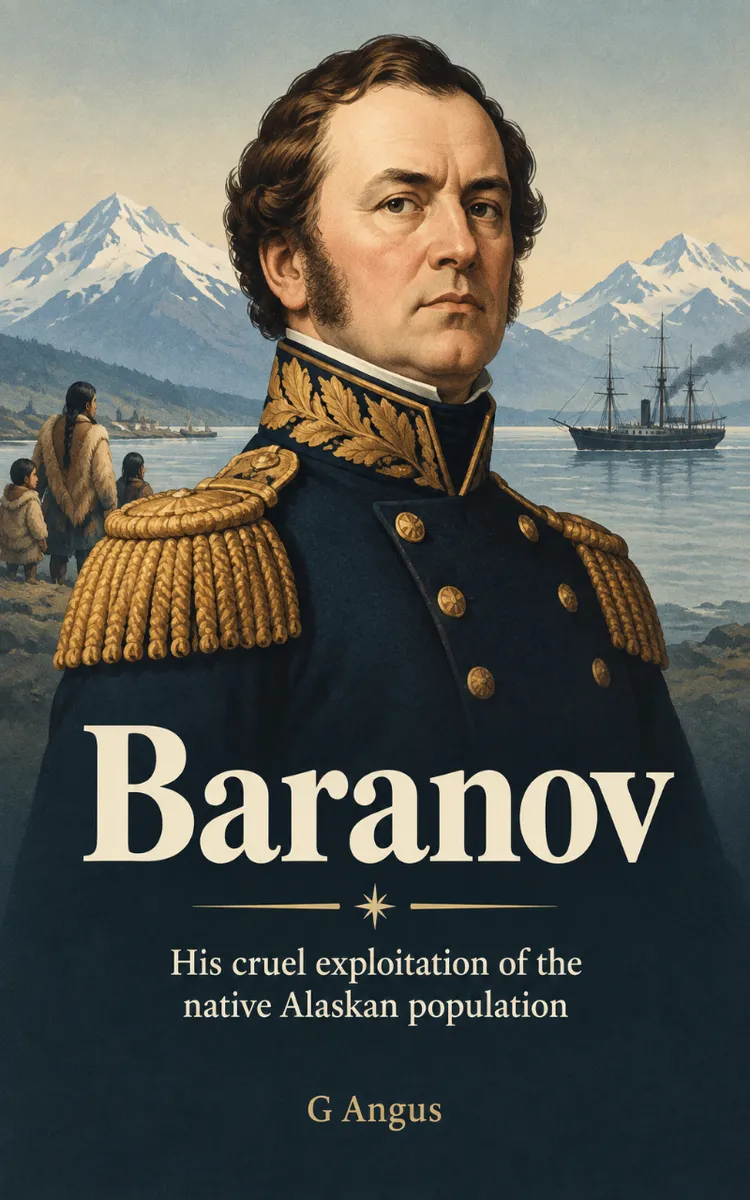
"Baranov" is a fiction book by G Angus with 33 chapters and approximately 68,148 words. Historical fiction about Aleksandr Baranov’s policies in Alaska, 1799–1818.
This book was created using Inkfluence AI, an AI-powered book generation platform that helps authors write, design, and publish complete books. It was made with the AI Novel Writer.
Frequently Asked Questions
What is "Baranov" about?
Historical fiction about Aleksandr Baranov’s policies in Alaska, 1799–1818
How many chapters are in "Baranov"?
The book contains 33 chapters and approximately 68,148 words. Topics covered include A Bargain for Aleut Hands, Baranov’s Orders Reach Sitka, The Missing Children’s Names, The Storm That Breaks the Schedule, and more.
Who wrote "Baranov"?
This book was written by G Angus and created using Inkfluence AI, an AI book generation platform that helps authors write, design, and publish books.
How can I create a similar fiction book?
You can create your own fiction book using Inkfluence AI. Describe your idea, choose your style, and the AI writes the full book for you. It's free to start.
Write your own fiction book with AI
Describe your idea and Inkfluence writes the whole thing. Free to start.
Start writingCreated with Inkfluence AI


