
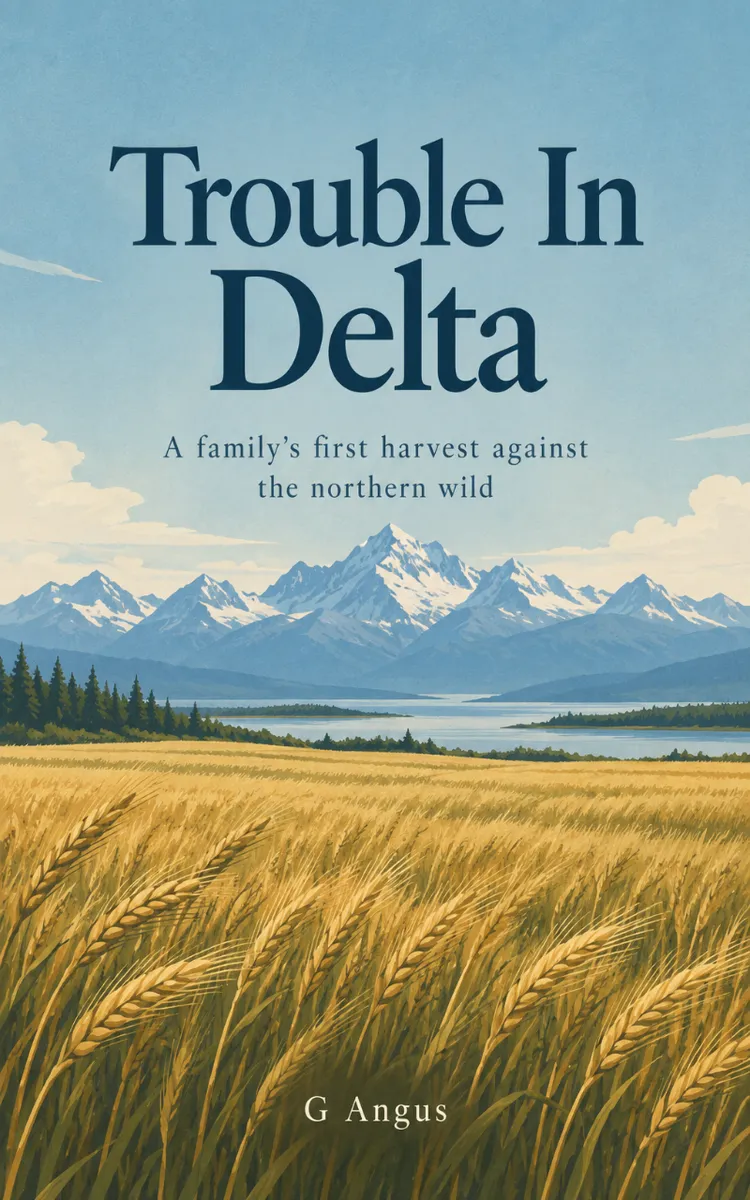

Read the first chapter
The whole of chapter one, free. About 9 min. Turn the pages with the arrows, your keyboard, or a swipe.
Chapter 1
The Field That Wouldn't Lie Flat
The drill coughed, lurched, and stopped with its rear wheels buried to the hubs.
Eli Mercer climbed down into the wind. It struck him sideways, cold enough to sting his cheeks through his beard. Behind him, the barley field stretched in rough brown rows toward the spruce line, and beyond that lay Delta Junction under a sky the color of old tin.
“Dad!” Finn shouted from the tractor seat. “It’s stuck again!”
“I heard it.”
Eli bent beside the drill and pressed one hand against the packed earth. The soil felt loose on top and hard beneath, a thin skin over ground that had not forgotten winter. He dug his fingers into it and found barley seed caught in the dust.
The wind lifted the dust before he could close his hand.
He watched the seed skitter across the field.
“Eli!”
Mara’s voice came from the pickup near the field gate. She stood with one hand gripping her coat and the other raised against the blowing grit. Her dark hair had come loose from its tie. She had been loading seed bags since dawn, and the wind had found every inch of her.
Eli straightened. “We’re all right.”
She gave him a look that said she could see the lie from the gate.
Their savings sat in that field. Not in a bank account. Not beneath a mattress. In bags of barley seed, diesel, repairs, and the used drill Eli had bought from a farmer outside Fairbanks. The machine had cost more than he had wanted to pay and less than he had needed to spend. The difference had gone into the field.
He climbed onto the tractor and pulled the lever. The engine growled. Finn jumped down to help him clear the wheel, and together they shoveled at the dirt with their boots and a short-handled spade.
“Get back,” Eli said.
Finn stepped away.
Eli eased the tractor forward. The wheel spun, throwing mud against the side of the drill. Then it caught. The machine rolled free, leaving a deep hollow in the first row.
Finn looked into it. “That’s not going to help.”
“No.”
“Should we fill it?”
“We finish the pass first.”
Finn glanced toward the west. “The wind’s getting worse.”
Eli looked too. A pale smear had formed along the horizon. It was not a cloud. It was dust, lifting from the open ground and moving toward them in a low, ragged sheet.
“Climb up,” Eli said.
Finn obeyed, though his mouth tightened. At fifteen, he had grown nearly as tall as Eli and had the long, restless arms of someone who wanted to be somewhere else. He disliked the tractor, the drill, the mud, and nearly every conversation that began with Eli saying, “When I was your age.”
Eli climbed in after him. “Keep your hand on the clutch.”
“I know.”
“I’m telling you to keep it there.”
“I know.”
The tractor moved again, dragging the drill through the uneven ground. Seed rattled inside the metal hopper. The sound was small beneath the engine and the wind.
Eli watched the rows form behind them. Each line was meant to be straight and shallow, the seed covered by enough soil to protect it but not enough to bury it. That was what the county agent had told him. That was what the old farming books said.
The field did not care what the books said.
The drill rose over a hard ridge and dropped into a hollow. The left wheel bounced. A stream of seed spilled from one opening, scattering in a bright arc before the wind caught it.
“Stop!” Finn yelled.
Eli pulled the lever. The tractor groaned to a halt.
Finn jumped down and ran back. He crouched in the row, searching the dirt. Seed lay on top in clusters, pale against the dark ground.
Eli climbed down more slowly.
“Is it bad?” Finn asked.
“It’s not good.”
Finn rubbed his sleeve across his face. “You said this was the best day for it.”
“It was.”
“That doesn’t look like the best day.”
Eli looked across the field. The first pass had taken most of the morning. They still had the far side to seed, and the wind was turning the loose ground into a moving thing.
“We keep going,” he said.
Finn stood. “Why?”
“Because stopping doesn’t put the seed in.”
“Neither does this.”
The words landed harder than Finn meant them to. Eli saw it in the boy’s face a second later, but the hurt did not make the words untrue.
Mara had reached them. She came across the field with her boots sinking at the edges of the tractor tracks.
“Finn,” she said, “go check the hopper.”
“I’m checking the rows.”
“Go check the hopper.”
Finn looked at Eli. Eli nodded.
The boy walked away.
Mara crouched beside the scattered seed. She picked up a handful of dirt and let it fall through her fingers. “How much have we lost?”
“I don’t know.”
“That’s not an answer.”
“It’s the one I have.”
She turned toward the far end of the field. “We can wait until evening.”
“The weather report says the front may come tonight.”
“It may.”
“And if we wait, the ground could be wet tomorrow.”
“If we push through this, we may be planting dust.”
Eli looked at her. Her face was tired, but her eyes were steady. She had not wanted this field at first. She had wanted the old house repaired, the boys’ winter clothes paid for, and a little money left for the truck. But she had stood beside him when he signed the loan papers. She had helped measure the field with a length of orange rope. She had not complained when the drill needed a belt two days before planting.
Now the wind snapped her coat against her legs.
“We have to finish,” Eli said.
Mara’s mouth tightened. “You keep saying that as though finishing makes it work.”
“It gives it a chance.”
“It gives us a bill.”
He looked away.
The tractor engine ticked as it cooled. Dust whispered across the field. Somewhere near the spruce, a raven called once and flew low, black wings beating against the wind.
Mara rose. “At least cover what’s showing.”
“With what?”
She pointed toward the tractor. “The drag.”
Eli glanced at the old chain drag tied behind the drill. It was meant to smooth the surface after seeding, but the wind had already lifted parts of the ground. Pulling it now might cover some seed and uncover more.
“It’ll tear the rows.”
“Then slow down.”
He wanted to tell her the machine was already moving as slowly as it could. He wanted to tell her that every dollar they had spent was sitting beneath his boots, waiting for weather, birds, frost, and luck to decide its value.
Instead he said, “All right.”
They worked through the afternoon.
Finn checked the hopper and called out when the seed level dropped. Mara walked beside the drill for a time, watching the openings and clearing dirt from a clogged tube with a piece of wire. Eli kept one hand on the wheel and the other near the clutch. The tractor crawled over the field, bumping hard enough to jar his teeth.
The wind did not ease.
It came across the open land with nothing to slow it. Dust streamed from the ridges. The spruce bent and straightened. The loose soil moved in thin sheets, sliding across the fresh rows and piling against the grass at the field’s edge.
At the far boundary, Eli stopped to turn.
The turn was too tight. The drill swung wide and struck a buried stone with a sharp metal crack.
Finn swore.
Eli shut off the tractor.
“Don’t use that word,” Mara called from behind them.
Finn’s face reddened. “The machine hit a rock.”
“The machine doesn’t use words.”
Eli climbed down and examined the drill. One of the metal teeth had bent backward. He took the wrench from the toolbox and worked at the bolt while the wind pushed at his shoulders.
“Can you fix it?” Finn asked.
“I can straighten it.”
“That’s not what I asked.”
Eli looked up. “It’ll hold.”
Finn stared at him. “Everything has to hold, doesn’t it?”
Eli tightened the bolt. “That’s the idea.”
“No. The idea was that this would be a farm.”
Mara stepped closer. “Finn.”
“What?” He pointed toward the field. “We’re spending every day fixing things that were supposed to work.”
Eli stood. “You think I don’t know that?”
“I think you keep pretending.”
The wind filled the space between them.
Eli felt the old anger rise, the one that came whenever Finn spoke as if the farm were a foolishness Eli had chosen alone. He had chosen it. That part was true. But he had chosen it for all of them, or believed he had.
“Get back in the tractor,” Eli said.
Finn’s jaw worked. “I’m not the one pretending.”
“Get in.”
Finn climbed up without another word.
Mara waited until Eli had started the engine again. “You could have let that go.”
“He needs to learn what work costs.”
“He knows what it costs. He watches you count every dollar at the kitchen table.”
Eli guided the tractor into the next row. “Then he should know better than to waste his breath.”
Mara walked beside him for several yards. “Owen is inside with the old laptop.”
Eli kept his eyes ahead. “Of course he is.”
“He’s checking the forecast.”
“He can check it from the tractor.”
“He can’t see the forecast from the tractor.”
“He can see the sky.”
Mara stopped. The drill rolled on, and Eli had to look back to be sure she was clear. She raised both hands, angry now.
“Don’t make this about Owen.”
“It is always about Owen when he finds a reason not to be here.”
“He is fifteen.”
“So is Finn.”
“Finn is fifteen and wants to work beside you. Owen is fifteen and does not.”
Eli felt the words settle into the cab with him. Finn sat stiffly at his side, looking straight ahead.
The next row ran crooked. Eli corrected the wheel, but the drill had already crossed a shallow ridge. Behind them, the seed line broke and vanished beneath a wash of dust.
By late afternoon, the hopper was nearly empty.
The wind had not stopped, but the dust had thinned. A gray light spread over the field. Eli made one last pass along the near edge, where the ground was roughest and the tractor sank deep in places.
Mara stood at the gate with the empty seed bags stacked behind her. Finn had climbed down and was carrying tools back to the shed.
Eli kept the tractor moving until the last seed rattled through the drill.
Then there was only the engine.
He pulled the lever and stopped.
For a moment, nobody spoke. The field lay behind them in long, uneven lines. Some rows were dark and clean. Others showed pale seed on the surface. Narrow strips had been scoured bare, while along the ridges the wind had gathered soil in low ripples.
Eli climbed down.
Mara came toward him. “Did it all go in?”
“Most of it.”
“Most?”
He looked across the field. “Enough, maybe.”
She followed his gaze. “Maybe.”
Finn joined them, carrying the wrench. “The hopper’s empty.”
Eli nodded.
The boy looked at the exposed strips. “Will it grow?”
Eli wanted to say yes. He wanted to give Finn something solid. But the wind moved through the field, lifting a veil of dirt over the nearest row.
“I don’t know,” Eli said.
Finn looked surprised by the answer.
Mara took Eli’s hand. Her fingers were cold and rough from the work. “We’ll see what morning brings.”
Eli closed his hand around hers.
Behind them, the tractor clicked as it cooled. Ahead, the newly seeded field stretched beneath the hard northern sky, its promise showing in places and gone in others. They had finished the first pass. The barley was in the ground.
But the ground had not agreed to keep it.
End of chapter one. 32 more chapters in the full book.
Swipe or use the arrows to turn the page


What's inside: 33 chapters
- 1. The Field That Wouldn't Lie Flat
- 2. A Family Takes the Rows
- 3. Where the Seed Went
- 4. The Low Ground Floods
- 5. Mara Counts the Cost
- 6. The First Green Is Thin
- 7. Tracks Across the Barley
- 8. The Creek Crossing Gives Way
- 9. Owen's Other Harvest
- 10. ATV Ruts Through the Rows
- 11. Who Rode Through Here?
- 12. The Wind Takes the Fence
- 13. Mara Draws a Line
- 14. A Frost at Noon
- 15. The Old North Notes
- 16. The Silt Road Closes
- 17. The Buried Method
- 18. Owen Refuses the Tractor
- 19. Mara Saves the Trial
- 20. The Numbers Don't Match
- 21. Snow Holds in the Cut
- 22. Mara's Last Reserve
- 23. Finn Finds the Old Sled
- 24. The Missing Page
- 25. Eli Calls It Finished
- 26. The North Cut in Darkness
- 27. Owen Sets His Own Terms
- 28. The Last Forecast Fails
- 29. The Snowline Saves the Seed
- 30. A Father Learns to Listen
- 31. The Fence Holds This Time
- 32. Mara Joins the Ledger
- 33. The First Barley Comes In
About this book
"Trouble In Delta" is a fiction book by G Angus with 33 chapters and approximately 78,089 words. A farming family struggles to grow barley in Delta Junction.
This book was created using Inkfluence AI, an AI-powered book generation platform that helps authors write, design, and publish complete books. It was made with the AI Novel Writer.
Frequently Asked Questions
What is "Trouble In Delta" about?
A farming family struggles to grow barley in Delta Junction
How many chapters are in "Trouble In Delta"?
The book contains 33 chapters and approximately 78,089 words. Topics covered include The Field That Wouldn't Lie Flat, A Family Takes the Rows, Where the Seed Went, The Low Ground Floods, and more.
Who wrote "Trouble In Delta"?
This book was written by G Angus and created using Inkfluence AI, an AI book generation platform that helps authors write, design, and publish books.
How can I create a similar fiction book?
You can create your own fiction book using Inkfluence AI. Describe your idea, choose your style, and the AI writes the full book for you. It's free to start.
Write your own fiction book with AI
Describe your idea and Inkfluence writes the whole thing. Free to start.
Start writingCreated with Inkfluence AI


